Tesla’s Cybercab Plan: No Wheel, No FSD Until 2027 [2026]

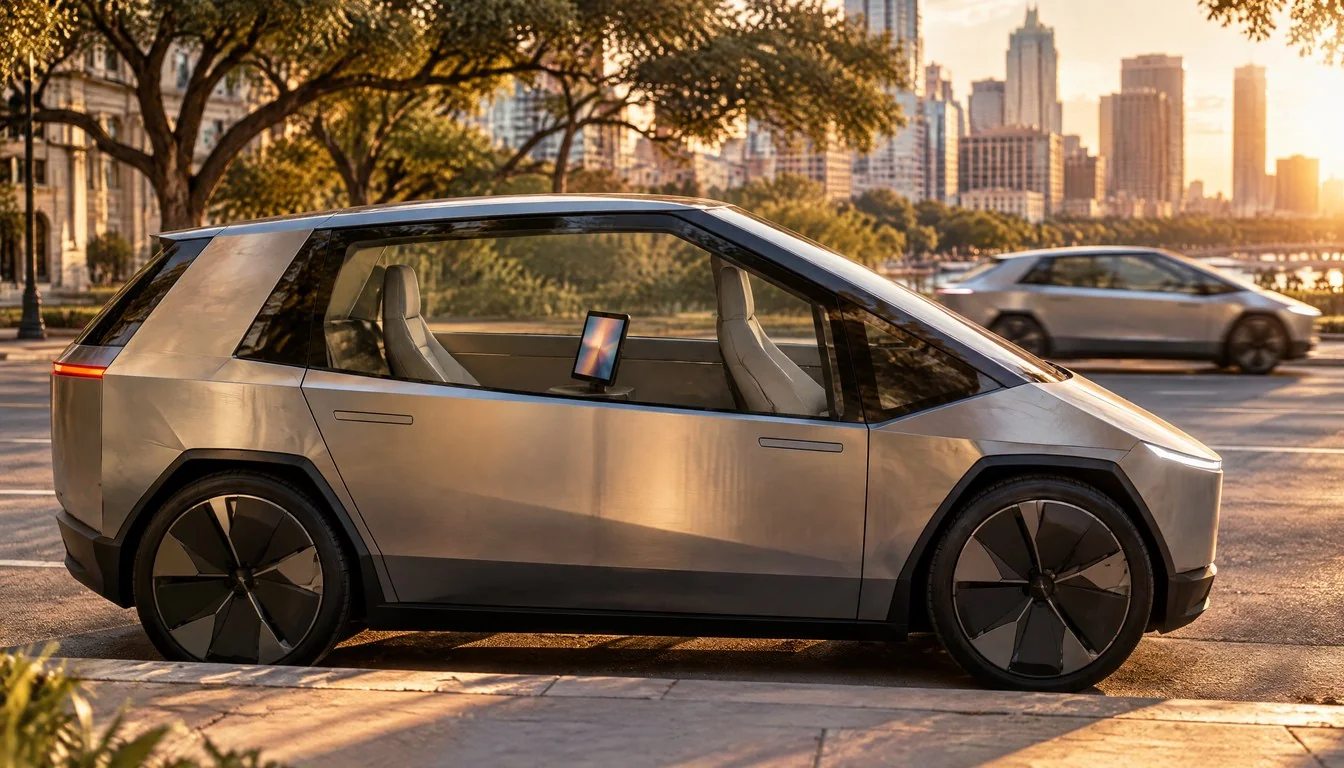
Tesla used its October 21, 2026 earnings call to confirm something investors and shoppers alike had been waiting to hear: the company is aiming to put its steering wheel free Cybercab into private customers’ hands before the end of the year. Lars Moravy, Tesla’s vice president of engineering, told analysts the company was “trying” to get Cybercabs to customers by the end of 2026, according to InsideEVs. The statement landed the same week Electrek’s Fred Lambert published a pointed question in a headline: what is a buyer supposed to do with a two seat car that has no steering wheel, no pedals, and, by Tesla’s own account, no unsupervised self driving software ready for personal use until 2027.
The tension at the center of the story is not whether Tesla can build the Cybercab. It is already building it, and running it, in Austin, Texas. The tension is what happens when Tesla tries to sell that same car to someone who expects to drive it home.
Don't miss new tech stories on Google
Add TrendinTech once in the Google app and our stories appear in your news suggestions.
What Tesla Actually Said on the Q3 2026 Earnings Call
Tesla’s October 21 earnings call covered a lot of ground, but the Cybercab update was the line that traveled fastest. Moravy told analysts that Cybercabs currently rolling off the line in Austin are going almost entirely into Tesla’s own Robotaxi fleet, not into private hands, and that the company is targeting a shift toward customer deliveries by year end, as InsideEVs reported. That is a target, not a confirmed delivery date, and Tesla has not published an order page, a configuration tool, or a retail price for the vehicle as of October 22, 2026.
The same call also revealed that Cybercab service is expanding beyond Austin. Tesla said it plans to bring the Robotaxi network, including Cybercabs, to Dallas in November 2026, making it the first city outside Austin to get the two seat vehicle. Executives also addressed the software side of the business, which Tesla has leaned on heavily in its most recent quarterly results covered in its $28 billion quarter driven partly by FSD software revenue, and in the cash flow picture detailed in coverage of Tesla’s $1.53 billion free cash flow report.
No Steering Wheel, No Pedals, No Confirmed Price
Cybercab is a purpose built, two passenger autonomous vehicle. It was designed from the start without a steering wheel or conventional pedals, a decision Tesla has defended publicly since the car’s 2024 unveiling. The New York Times reported that Tesla began offering paid rides in the vehicle in September 2026, describing it as a car designed to transport passengers without direct human intervention.
Pricing remains the most conspicuous blank in Tesla’s pitch. Elon Musk previously floated a target of less than $30,000 for a customer version of the car, a figure that dates back to earlier Tesla commentary and has never been attached to an official order page. As of October 22, 2026, Tesla has not published a retail price, a lease price, or even a confirmed ride fare structure tied specifically to Cybercab ownership. Search interest in “tesla cybercab price” has climbed through 2026, a sign that shoppers are actively looking for a number Tesla has not yet given them.
Why Electrek Called the Plan “Useless”
Electrek’s framing was blunt: Tesla wants to sell a car that cannot be driven by the person who owns it, at a time when the software that would allow the car to drive itself without supervision is not expected in customer vehicles until Q2 2027. That is an opinion, not a settled fact, and Tesla has not confirmed that Cybercab buyers would receive no usable autonomy at all. But the underlying math is hard to dispute. If a customer receives a Cybercab before Tesla’s unsupervised Full Self Driving software clears for personal use, that owner is left with a vehicle that has no manual controls and, at least for a stretch of time, no confirmed way to drive itself unsupervised either.
Tesla has not addressed this gap directly in public remarks. The company’s position, consistent across its Q3 call and its own product pages, is that Cybercab is built for Tesla’s managed Robotaxi network first, with broader customer ownership as a secondary, longer term goal. Whether early private buyers would be folded into that network, rent out their vehicles, or simply wait for software to catch up is not something Tesla has spelled out.
The Self Driving Problem: Unsupervised FSD Slips to Q2 2027
The detail that gives the “useless car” framing its teeth is timing. During the same Q3 call, Tesla executives, including Ashok Elluswamy, pointed to Q2 2027 as the target for unsupervised Full Self Driving reaching customer vehicles, according to reporting cited around the call. That is a future target, not a current release, and it sits on top of a vehicle that already has no manual fallback.
Tesla’s current consumer facing product remains Full Self Driving (Supervised), which the company markets through demo drives and subscription plans in existing Model 3 and Model Y vehicles. It is explicitly a driver assistance product. Tesla says the driver must stay attentive and ready to take over, which is the opposite of what a Cybercab buyer would need, since the car gives them no way to take over at all. Until unsupervised FSD actually ships to customer vehicles, which Tesla itself now says will not happen before Q2 2027, a private Cybercab owner is dependent entirely on Tesla’s own driving stack with no physical backup.
From 40 to Over 300 Cybercabs in 30 Days
Whatever doubts surround the customer version of Cybercab, the fleet version is scaling fast. Tesla had more than 40 purpose built Cybercabs running limited Robotaxi service in Austin by mid September 2026. By October 10, that number had passed 300, an eightfold increase in roughly 30 days, a jump covered in detail when the fleet first crossed that mark. Texas vehicle registration data tracked separately put the count closer to 319 Cybercabs alongside 420 Model Y vehicles running Robotaxi service in the same period.
Operating hours have expanded alongside the fleet. Austin service, originally limited to a narrow window, grew first to 11 p.m. closing, then to midnight, and by mid October ran from 6 a.m. to midnight. None of that growth, notably, is customer ownership. It is Tesla scaling its own taxi business using cars it still owns and operates.
NHTSA’s Open Questions About a Car With No Manual Controls
Federal regulators have not signed off on the idea that a car without a steering wheel or pedals is automatically legal to sell to the public. Yahoo Finance reported that the National Highway Traffic Safety Administration has told Tesla it needs to demonstrate that Cybercab complies with federal vehicle safety standards despite lacking the manual controls those standards were originally written around. That scrutiny sits alongside the separate 21 question review of Cybercab’s software that regulators opened earlier this year, and the broader NHTSA review of Tesla’s Robotaxi operations near school zones.
None of this means Tesla cannot eventually sell the car. It means that, as of October 22, 2026, there is still a live regulatory question mark sitting on top of a commercial plan Tesla has already started talking about in investor calls. Selling to retail customers, as opposed to running a company owned taxi fleet, raises the stakes on that question considerably, since individual owners rather than Tesla’s own legal team would be the ones relying on the vehicle’s safety certification.
Dallas Is Next on Tesla’s Expansion Map
Austin will not stay the only Cybercab city for long. Tesla told investors on the October 21 call that Dallas is the next market for Robotaxi and Cybercab service, with a planned November 2026 start. That is a notably fast follow up to Austin, where the fleet only crossed 300 vehicles in the preceding weeks, and it suggests Tesla wants to keep the operational momentum going even while the private ownership question remains unresolved.
Tesla has also floated a longer term idea: letting customers who do eventually own a Cybercab add it to the company managed Robotaxi network, generating income from the vehicle rather than driving it themselves. Executives pointed to roughly Q2 2027 for that option, the same window attached to unsupervised FSD. The timing is not a coincidence. Both milestones depend on the same underlying software clearing Tesla’s own bar for unsupervised operation.
Tesla’s Q3 2026 Numbers, in Context
The Cybercab headlines landed inside a broader earnings report that was, on balance, close to expectations. Tesla reported total revenue of $28.046 billion against a Street estimate near $28.34 billion, alongside non GAAP earnings per share of $0.48, ahead of the $0.45 expected. Operating margin came in at 2.6 percent versus an expected 2.5 percent, and operating income landed at $718 million against a $721 million estimate. Free cash flow reached $1.531 billion, a sharp reversal from the roughly negative $4.51 billion that had been expected, a swing explored further in the earlier look at Tesla’s cash flow performance against AI capital spending.
Production and delivery figures, reported separately on October 2, showed 464,391 vehicles produced and 486,532 delivered for the quarter, split between 478,237 Model 3 and Model Y units and 8,295 other models. Energy storage deployments reached 13.7 gigawatt hours for the quarter. None of those disclosures broke out Cybercab customer deliveries as a separate line, because, as of October 22, 2026, there are not yet any to report.
| Q3 2026 Metric | Reported | Expected |
|---|---|---|
| Total revenue | $28.046 billion | $28.34 billion |
| Non GAAP EPS | $0.48 | $0.45 |
| Operating margin | 2.6% | 2.5% |
| Operating income | $718 million | $721 million |
| Free cash flow | $1.531 billion | approximately negative $4.51 billion |
| Vehicles produced | 464,391 | N/A |
| Vehicles delivered | 486,532 | N/A |
| Energy storage deployed | 13.7 GWh | N/A |
Market Impact: What Investors Are Actually Watching
Wall Street’s reaction to the Cybercab commentary was muted compared with the headline earnings numbers, but the underlying question matters for how Tesla’s stock gets valued going forward. Tesla has spent years asking investors to price in a future where autonomy and ride hailing revenue, not just car sales, drive the bulk of its value. A customer facing Cybercab that cannot legally or practically function as a normal car complicates that story, because it suggests the near term revenue opportunity is still the Robotaxi network Tesla owns and operates itself, not a new retail product line.
That distinction also touches the compensation package tied to Musk’s performance targets, since Tesla’s board has repeatedly linked Musk’s pay to progress on autonomous vehicle software, a connection examined in the earlier report on how Musk’s pay award depends on Robotaxi software milestones. A slip in unsupervised FSD timing to Q2 2027 is exactly the kind of delay that package was designed to track.
Historical Context: From “We, Robot” to a Real Sales Target
Cybercab’s no steering wheel design was never a secret. Tesla unveiled the concept at its “We, Robot” event in October 2024, where Musk told the crowd plainly that the car has no steering wheels or pedals. A design patent covering the vehicle’s two door fastback body, credited to a team led by Franz von Holzhausen, was filed the day before that event and granted on October 6, 2026, nearly two years later, highlighting how long the design has been locked in while the software and regulatory pieces caught up.
Production of the physical car began earlier this year. The first production Cybercab reportedly rolled off the Giga Texas line on February 17, 2026, and Tesla confirmed during its Q1 2026 earnings call, in April, that production was underway. From there, the car moved through limited Austin deployment in September, international showcase tours in Australia, Hong Kong, and Japan, and now, as of the October 21 call, a stated intention to reach private customers before year end.
| Date | Milestone |
|---|---|
| October 2024 | Cybercab unveiled at Tesla’s “We, Robot” event |
| February 17, 2026 | First production Cybercab reportedly rolls off the Giga Texas line |
| April 22, 2026 | Tesla confirms Cybercab production underway on Q1 2026 call |
| September 3, 2026 | Austin launch event; invite only Cybercab rides begin |
| September 4, 2026 | Public Austin Robotaxi rides open in limited areas |
| October 10, 2026 | Austin fleet passes 300 Cybercabs, up from roughly 40 |
| October 21, 2026 | Tesla targets year end customer deliveries; Dallas expansion for November 2026 announced |
| Q2 2027 | Tesla’s internal target for unsupervised FSD reaching customer vehicles |
How Cybercab’s Approach Compares to Other Robotaxi Bets
Tesla’s strategy stands apart from most of its robotaxi competitors in one specific way: it wants ordinary people to eventually own the vehicle, not just ride in one owned by a company. Alphabet’s Waymo and Amazon’s Zoox have both built their businesses around company owned and operated fleets, where the rider never has to think about purchase price, maintenance, or software updates. Tesla’s long term pitch is different. It wants a Cybercab owner to be able to use the car personally, rent it out through the Robotaxi network, or do both, a model closer to how some owners already treat Tesla’s Model 3 and Model Y vehicles when they are not in use.
The catch, as the current rollout shows, is that Tesla is trying to run both models at once, and the ownership model is arriving well behind the fleet model. Every Cybercab in service today is a Tesla owned taxi. The private ownership version Tesla described on its October 21 call is still a plan, dependent on manufacturing capacity, regulatory sign off from NHTSA, and software that will not reach the unsupervised stage Tesla says customers need until at least Q2 2027.
What Industry Voices Are Saying
Tesla executives have been consistent, if not always precise, about why the car looks the way it does. In October 2025, Musk defended the no controls design directly, saying that the vehicle “must be designed as a clean robotaxi,” adding, “we’re going to take that risk” rather than build what he called “some sort of amphibian frog that’s a halfway car,” according to Electrek’s reporting from that period. The comment came even as Tesla was publicly weighing whether regulatory pressure might eventually force design changes.
At the car’s 2024 unveiling, Musk put the design choice as simply as possible, telling the audience that “Cybercab has no steering wheels or pedals,” a line reported at the time by the Times of India. Not everyone at Tesla has treated that as an absolute. Tesla chairwoman Robyn Denholm has left the door open to a different outcome if regulators require it, saying plainly, “if we have to have a steering wheel, it can have a steering wheel and pedals,” according to The Verge. That is a notable hedge from inside Tesla’s own boardroom, suggesting the company is not treating the no controls design as untouchable if NHTSA ultimately insists otherwise.
Musk has also framed the scale up in characteristically promotional terms, telling followers to expect what he called “a storm of Cybercabs” as the Austin fleet expanded. The phrase fits the fleet data: a jump from roughly 40 to more than 300 vehicles in about a month is, by any measure, a fast ramp for a brand new vehicle platform.
Predictions: Where the Cybercab Sales Plan Goes From Here
- Tesla will likely begin small, invitation style private deliveries before December 31, 2026, but in numbers small enough that they function more as a proof of concept than a mass market launch.
- NHTSA’s review of Cybercab’s compliance with manual control safety standards will stretch well past the end of 2026, keeping any broad retail sale on hold even if a handful of early units reach customers.
- Dallas will go live on a similar invite first, ride hailing basis to Austin’s September rollout, rather than as a retail sales launch, when it starts in November 2026.
- Tesla will continue avoiding a published retail price for Cybercab through the rest of 2026, keeping the $30,000 figure as an unconfirmed talking point rather than an order page number.
- The Q2 2027 unsupervised FSD target will face real pressure to slip further, given Tesla’s pattern of moving autonomy deadlines, which would push true private Cybercab ownership closer to the second half of 2027.
What This Means for Everyday Tesla Shoppers
For most people currently shopping for a Tesla, the practical advice has not changed much because of this announcement. Cybercab is not for sale, there is no order page, and the only way to experience one today is as a passenger in Tesla’s own Robotaxi app in Austin, with Dallas joining soon. Shoppers who want a Tesla they can actually drive themselves still have Model 3 and Model Y, both of which continue to ship with a steering wheel, continue to receive Full Self Driving (Supervised) as a subscription product, and continue to be sold through a normal, published pricing page.
Anyone specifically interested in being an early Cybercab owner should treat Tesla’s year end target the way Moravy himself framed it, as something the company is “trying” to hit, not something it has promised. Given the open NHTSA questions, the unpublished price, and a software timeline that Tesla’s own executives now place in Q2 2027, the realistic expectation is a narrow, early access style rollout rather than a car anyone can simply walk in and buy before the end of 2026.
Frequently Asked Questions
Does the Tesla Cybercab have a steering wheel?
No. Cybercab is a purpose built, two seat autonomous vehicle designed without a steering wheel or pedals. Tesla has confirmed this design repeatedly since the car’s 2024 unveiling and through its 2026 Austin Robotaxi rollout.
How much does the Tesla Cybercab cost?
Tesla has not published an official retail price as of October 22, 2026. Musk previously floated a target of less than $30,000, but that figure has never appeared on an official Tesla order page or pricing tool.
When will Tesla start delivering Cybercabs to private customers?
Tesla said on its October 21, 2026 earnings call that it is targeting the end of 2026 for the first customer deliveries. Vice president of engineering Lars Moravy described this as something the company is “trying” to achieve, not a confirmed delivery date.
Can I ride in a Tesla Cybercab today?
Yes, as a passenger. Tesla has been offering paid Cybercab rides through its Robotaxi app in limited areas of Austin, Texas since September 2026, with a fleet that passed 300 vehicles by October 10, 2026. Dallas is expected to join the service in November 2026.
Does the Cybercab have unsupervised self driving software?
Not yet for personal customer use. Tesla executives said during the October 21, 2026 earnings call that unsupervised Full Self Driving for customer vehicles is targeted for Q2 2027. Tesla’s current consumer product, Full Self Driving (Supervised), still requires an attentive driver ready to intervene, which is not possible in a car with no manual controls.
Is the Tesla Cybercab legal to sell to the public?
That question is still open. The National Highway Traffic Safety Administration has told Tesla it needs to demonstrate that Cybercab meets federal vehicle safety standards despite lacking a steering wheel and pedals, a review that was ongoing as of October 22, 2026.
Why is Tesla’s Cybercab plan controversial?
Critics, including Electrek, have questioned the value of selling a car to private customers that has no steering wheel and, for a stretch of time, no confirmed unsupervised self driving software either. Tesla has not directly addressed what early private owners would be able to do with the vehicle before unsupervised FSD becomes available.
Where is the Tesla Cybercab currently available?
As of October 22, 2026, Cybercab operates only as part of Tesla’s company owned Robotaxi fleet in limited areas of Austin, Texas, with Dallas expected to become the second market in November 2026. No region has a confirmed private retail launch.
Related Coverage
Helena Marsh
Helena Marsh is the Editor-in-Chief at TrendinTech, where she leads editorial strategy and oversees coverage across artificial intelligence, cybersecurity and enterprise technology. She believes technology reporting should be rigorous and plainly written, so readers understand what actually changes for them rather than what a company's announcement promises.
All stories by Helena Marsh (285)