18 Tesla Solar Panels Idle for Months in Pittsburgh [2026]

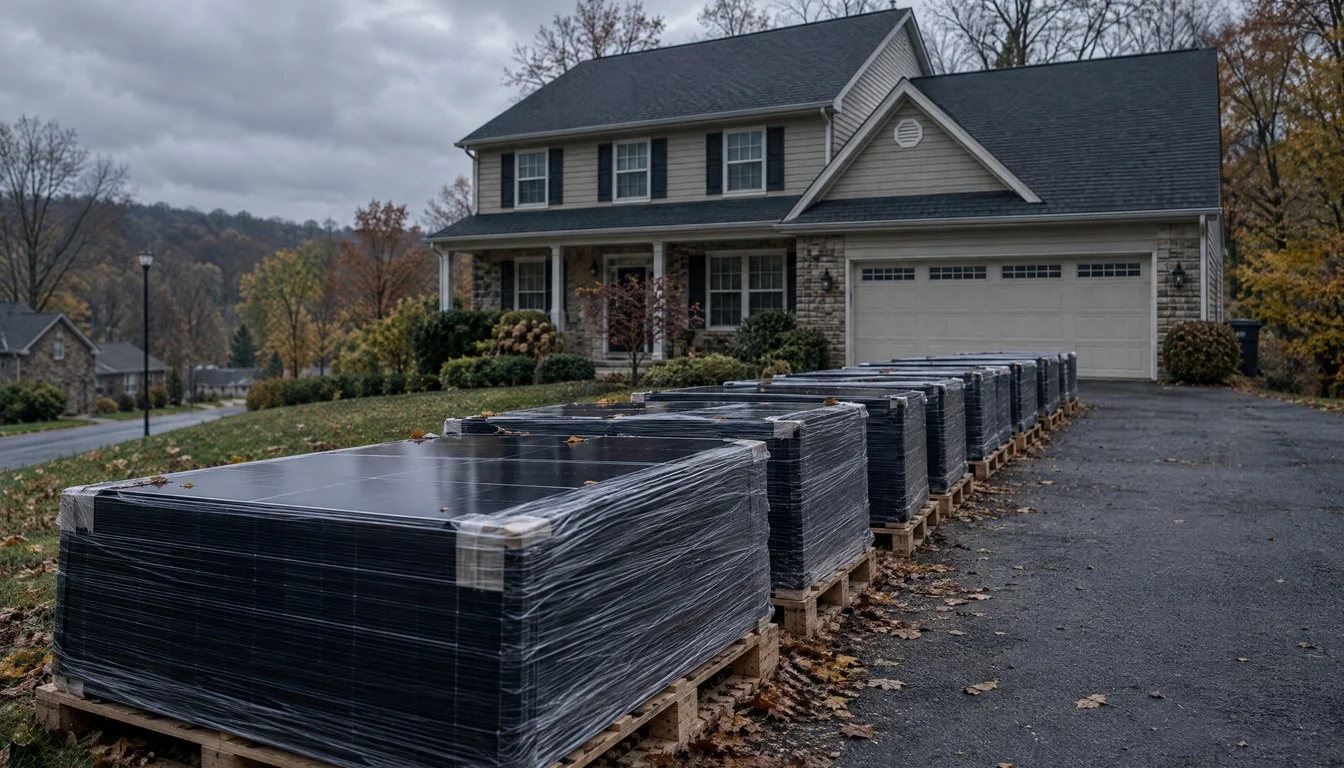
A Pittsburgh homeowner says a routine roof replacement turned into a months-long standoff with Tesla after workers removed 18 solar panels in July and never put them back, even as the company’s invoices kept arriving. The case, first detailed by Ground News, has become a flashpoint for a pattern that other Tesla solar panels owners describe in online forums: panels come off the roof fast, but getting them back on can take months of phone calls, subcontractor hand-offs, and bills for power the system was never generating.
The homeowner, whose system dated back to the SolarCity era of Tesla’s energy business, told the story in enough detail to show how the removal-and-reinstallation process can go sideways. The roof itself was finished in a single day. The panels, which the homeowner says they paid Tesla directly to remove and later reinstall, are a different story entirely.
Don't miss new tech stories on Google
Add TrendinTech once in the Google app and our stories appear in your news suggestions.
What Happened at This Pittsburgh Home
According to the account, the 18 SolarCity-era panels came off the roof in July so a new roof could go on. The reroofing crew finished in a single day, which is a normal turnaround for a residential job of that size. What was not normal, the homeowner said, was what happened next: the panels stayed off the roof, stacked and waiting, while Tesla’s side of the project stalled.
The homeowner said they had paid Tesla directly for both the removal and the promised reinstallation, treating it as a single service order. Instead, the job reportedly got routed to a subcontractor without clear communication, and the homeowner was left to chase down basic information: who had the job, when it would start, and why the panels kept sitting idle on tesla solar panels equipment that was supposed to be back on the roof in weeks, not months.
The Timeline, From a One-Day Reroof to an Open-Ended Wait
The available reporting does not pin down exact calendar dates for every step, but the sequence of events is clear enough to lay out as a timeline. A separate account describing a similar situation, shared alongside the Pittsburgh story, put numbers to a comparable case: “New roof in April, got inspected by Tesla in May. Didn’t get installed until August.” That is roughly four months from the start of the roofing project to reinstallation, and it illustrates the kind of gap homeowners say they are running into nationwide.
| Stage | What Happened | Reported Detail |
|---|---|---|
| Pre-removal | Homeowner pays Tesla for removal and reinstallation | Treated as one combined service order |
| July | 18 SolarCity-era panels removed | Panels taken down ahead of reroofing work |
| Same month | Roof replacement completed | Homeowner says the roof job itself took one day |
| Weeks later | No reinstallation scheduled | Panels remain off the roof; no clear timeline given |
| Follow-up call 1 | Homeowner learns job was reassigned | Reinstallation had been sent to a subcontractor |
| Follow-up call 2 | Homeowner presses for details | Has to “pry the name of the contractor” out of a Tesla rep |
| Ongoing | Billing continues | Invoices kept arriving while the system sat offline |
| Latest update | Tesla says it will notify the homeowner | Once the subcontractor accepts the job |
The Two Phone Calls It Took to Learn Who Had the Job
The most pointed detail in the homeowner’s account is how little information Tesla volunteered. In the homeowner’s own words, it took “2 calls to find out the reinstallation has been sent to a subcontractors,” and then “another call after that to pry the name of the contractor out of the Tesla rep.” That is three separate calls just to learn basic facts: that the work had been handed off, and to whom.
For a company that sells itself on a connected, app-driven ownership experience, the gap between what the Tesla app shows and what is actually happening on a subcontractor’s schedule is the part that frustrates owners most. The homeowner had to escalate manually, call center visit by call center visit, rather than track progress through any dashboard or notification system. Tesla’s most recent update to the homeowner, according to the account, was that the company would let them know once the subcontractor formally accepted the job, which leaves the actual reinstallation date open-ended.
Why the Invoices Kept Coming While the Roof Sat Empty
Billing during an outage is the detail that turns a scheduling delay into a consumer complaint. The homeowner said Tesla invoices kept arriving even though the panels were sitting in the yard, producing no electricity at all. Whether that reflects a loan payment, a lease payment, or a service charge was not specified in the account, but the effect is the same either way: a customer paying for power generation that physically cannot happen.
This is not a one-off complaint. A separate case, reported by The Cool Down, described a different Tesla solar owner whose panels were off a roof for about a year after a reroofing job, while lease bills kept arriving the whole time. In that account, the homeowner said the panels had “been stacked up in my yard for months now waiting to get reinstalled.” The dollar amounts and exact dates differ between cases, but the shape of the complaint, panels down, meter dark, invoices still landing, repeats itself.
What Tesla’s Own Support Policy Says About Removal and Reinstallation
Tesla maintains an official support page for what it calls Removal and Reinstallation, or R&R, describing the process for temporarily taking down solar panels or an entire system for reroofing, remodeling, or a home move. On Tesla’s own support page, the company says it will follow up on an R&R request within approximately seven to ten business days of submission, a window meant to cover scheduling and logistics before any crew shows up.
That seven-to-ten-business-day figure describes the initial response window, not a guaranteed reinstallation date, and the Pittsburgh case shows how much daylight can open up between the two. A quick acknowledgment from Tesla does not necessarily translate into a quick subcontractor dispatch, and once a job is handed off to a third party, the homeowner’s point of contact and the pace of communication both appear to change.
This Isn’t an Isolated Complaint
Pittsburgh is the case making headlines this week, but it sits inside a broader pattern of reported delays tied to Tesla’s reliance on third-party installers for removal and reinstallation work. Tesla itself has described a shift away from performing its own solar installations, moving instead toward a network of certified third-party installers, a change the company says has been underway since 2024. That shift explains why a subcontractor, rather than a Tesla crew, ends up holding the reinstallation job in cases like this one. It does not, on its own, explain why communication about that handoff was so hard for the homeowner to get.
| Reported Case | Panel Count | Time Reported Offline | What the Owner Said |
|---|---|---|---|
| Pittsburgh, PA | 18 panels | Months, not yet reinstalled | Billed through calls and a subcontractor hand-off |
| Unspecified (reported alongside Pittsburgh case) | Not specified | Roughly 4 months (April to August) | “Didn’t get installed until August” |
| Separate case reported by The Cool Down | Not specified | About a year | Panels “stacked up in my yard” while lease bills continued |
| Separate Reddit account (unverified, general reports) | Up to several dozen panels in similar accounts | Multiple months in some reports | Described rescheduling delays after removal |
None of these accounts come from Tesla directly, and Tesla had not publicly addressed the Pittsburgh case as of October 20, 2026, according to published reports. The company also has not confirmed a specific billing policy for systems that remain offline during R&R delays, which leaves owners to compare notes informally rather than point to a published service standard.
What Other Tesla Solar Customers Are Reporting
Beyond the Pittsburgh case itself, similar complaints have surfaced in owner forums over the past several weeks. One Tesla Solar customer described the removal process alone as a drawn-out ordeal, writing that “it took me a whole year to coordinate with Tesla to have my solar panels removed so I could repair a roof that needed urgent attention.” The same owner said the panels “managed to take the panels off in April, but rescheduling the reinstall for September has turned into a hassle,” highlighting that the delay problem can show up on both ends of the job, not just reinstallation.
Another reported case, out of Texas, described a far longer wait tied to a larger system. That homeowner wrote about needing “to wait 7+ months for Tesla to have a crew available,” adding that “this delay is causing significant financial strain as we continue to pay both my Tesla Solar Loan and a high utility bill, which exceeds $600.00 per month due to the extreme temperatures in Texas.” That account involved 34 panels removed after hail damage, roughly double the Pittsburgh count, and a loan payment stacked on top of a summer utility bill with no solar offset to soften it.
Taken together, these accounts point to the same structural issue: once panels come off a roof, getting Tesla to prioritize putting them back on competes against new installation sales, and owners say they are the ones absorbing the cost of that queue.
Tesla Is Also Restructuring Its Solar Hardware Lineup
The Pittsburgh dispute lands at a moment when Tesla’s broader solar hardware business is already in flux. Trade reporting indicates Tesla stopped accepting new orders for its Solar Roof tile product around August 20, 2026, telling certified installers that future shipments would be conventional solar panels instead. The dedicated Solar Roof page on Tesla’s site has reportedly been redirected to the standard Solar Panels page, and Solar Roof no longer appears in Tesla’s Energy navigation, though Tesla has not issued a formal discontinuation announcement.
At the same time, Tesla has reportedly been building out a more conventional panel of its own. Industry reporting points to a panel referred to as the TSP-420, a 420-watt, all-black unit built on Tesla’s cascading-cell design and manufactured at Gigafactory New York in Buffalo, with an early 2026 rollout. If that timeline holds, it marks a pivot toward in-house conventional panels for new customers, even as owners with older SolarCity-era hardware, like the Pittsburgh homeowner, wait in line for service on equipment that predates the newer product line entirely.
A Reported Leadership Change Inside Tesla’s Energy Division
Reporting from mid-October adds another wrinkle. Mike Snyder, who had held the title of vice president of energy and charging since October 2024, was reported to have stepped down around October 15, 2026, according to a Wall Street Journal report cited by multiple outlets. AJ Booth, previously described as Tesla’s senior director of energy products engineering, was reported as his successor. Reuters said it could not independently verify the leadership change, and Tesla had not immediately commented as of that mid-October reporting, so the change should be treated as reported rather than officially confirmed.
If accurate, the timing is notable: a reported changeover atop Tesla’s energy and charging organization lands in the same stretch of weeks as the Pittsburgh complaint and the Solar Roof pullback, all pointing to a business unit that is shifting shape even as individual service tickets like this one sit unresolved.
How Tesla’s Energy Business Is Performing Heading Into Earnings
None of this is happening in a business that is shrinking. Tesla’s own investor relations release for the third quarter of 2026, dated October 2, 2026, reported that the company produced more than 464,000 vehicles, delivered more than 486,000 vehicles, and deployed 13.7 gigawatt-hours of energy storage products in the quarter, up roughly 9.6 percent year over year. Tesla’s Q3 2026 financial results and Q&A webcast was scheduled for Wednesday, October 21, 2026, one day after this story became national news, putting fresh pressure on the company to address how its energy and solar service operations are being run.
| Metric | Q3 2026 Figure | Source |
|---|---|---|
| Vehicles produced | More than 464,000 (464,391 reported) | Tesla Q3 2026 investor release, Oct. 2, 2026 |
| Vehicles delivered | More than 486,000 (486,532 reported) | Tesla Q3 2026 investor release, Oct. 2, 2026 |
| Energy storage deployed | 13.7 GWh | Tesla Q3 2026 investor release, Oct. 2, 2026 |
| Energy storage, year over year | Up about 9.6% | Tesla Q3 2026 investor release, Oct. 2, 2026 |
| Q3 earnings call date | Wednesday, October 21, 2026 | Tesla investor relations |
The energy-storage number covers large-scale products like Powerwall and Megapack rather than rooftop solar panels specifically, and Tesla’s quarterly release does not break out solar panel installation or reinstallation volume. That gap in disclosure is part of why individual owner accounts, like the one out of Pittsburgh, end up carrying so much weight in the public conversation: there is no published company metric for how long a typical R&R job actually takes. The same quarter in which these solar complaints surfaced is one where the Model Y outsold the next 24 best-selling EVs in the US combined, a reminder of how much weight the vehicle business still carries relative to the energy segment’s smaller, service-heavy solar business.
How Tesla’s Solar Service Model Compares With the Rest of the Industry
Tesla is not the only major residential solar brand that leans on third-party crews for post-installation work. Across the industry, including large installers like SunPower and Sunrun, removal and reinstallation around roofing jobs is typically treated as a secondary service line rather than a core sales activity, which means it often gets staffed and scheduled behind new installations. What sets this case apart is less the existence of a subcontractor model and more the communication gap the homeowner described: a company-run call center that reportedly could not immediately tell its own customer who was doing the work or when it would happen.
For a company built on direct-to-consumer software integration, from the Tesla app to over-the-air updates for products like Powerwall, the contrast with a slow, phone-call-driven service experience for solar hardware is sharp. Tesla’s energy division also includes products such as Powerwall batteries, which recently helped set a 601 MW virtual power plant record across tens of thousands of homes, a reminder that the software and grid-services side of Tesla Energy is scaling even as the hands-on service side draws complaints.
Historical Context: SolarCity’s Legacy Still Weighs on Tesla
The Pittsburgh system traces back to the SolarCity era, the rooftop solar company Tesla acquired roughly a decade ago. That lineage matters because SolarCity-era contracts, leases, and hardware have long been a source of friction for Tesla’s energy business, from older warranty terms to legacy billing structures that predate Tesla’s current product lineup. Tesla has also faced solar pricing disputes before: the company agreed to a settlement in a class-action lawsuit over Solar Roof price increases in past years, a reminder that billing and pricing complaints are not new territory for Tesla’s solar business, even if the specifics of each case differ.
Tesla unveiled Solar Roof in October 2016, around the time of the SolarCity acquisition, with production starting in Buffalo in late 2017 and several product revisions following to simplify manufacturing and installation. Nearly a decade later, that product line is reportedly being wound down just as some of the earliest SolarCity-era panel owners, like the Pittsburgh homeowner, are running into service bottlenecks on the older hardware that started it all. Tesla’s pattern of hardware timelines slipping well past their original promise is not new either: the production Roadster itself finally had its reveal event on October 15, 2026, roughly nine years after it was first unveiled, showing that long waits on Tesla hardware are not unique to the solar business.
Market and Reputational Impact
For Tesla, the immediate financial exposure from any single reinstallation dispute is small next to a business that produced and delivered close to a million vehicles combined last quarter. The reputational exposure is a different matter. Solar and home-energy purchases are high-trust, long-horizon decisions, and stories about panels sitting in a yard for months while bills keep arriving tend to travel further than the underlying dollar amounts would suggest, especially when they surface the same week as reports of a leadership change atop the energy division and a quiet retreat from the Solar Roof product.
That reputational risk sits alongside a company that has drawn scrutiny on other fronts this year, including a $162,000 court judgment tied to a Model X fire dispute and continued attention on the $158 billion Musk pay package tied to robotaxi software milestones. Investors weighing Tesla’s energy segment against its automotive and robotics ambitions now have one more data point suggesting that service quality on existing hardware has not kept pace with the company’s sales and software ambitions. The scrutiny comes as Tesla shareholders are separately due to vote on re-electing Elon Musk and two other board members on December 3, 2026, a vote that will likely draw questions about operational execution across every division, energy included.
What Comes Next: Five Predictions
- More SolarCity-era owners are likely to come forward with similar reinstallation complaints as the Pittsburgh story gets wider pickup, simply because the underlying subcontractor-handoff process has not changed.
- Tesla will probably face renewed calls from consumer advocates to publish a clear service-level standard for removal-and-reinstallation jobs, rather than the general seven-to-ten-business-day response window currently listed on its support page.
- Questions about solar service backlogs are likely to come up on Tesla’s October 21, 2026 earnings call, even if the company does not break out R&R metrics in its prepared remarks.
- Tesla’s shift toward in-house conventional panels and away from Solar Roof may streamline new installations over time, but it does little to resolve the backlog facing existing SolarCity-era and early Tesla Solar customers.
- If the reported leadership change inside Tesla’s energy and charging division is confirmed, expect scrutiny of whether new management makes any visible change to how removal-and-reinstallation requests are staffed and tracked.
What Affected Homeowners Can Do Right Now
Owners facing a similar situation have a few concrete options while waiting on Tesla. Submitting a removal-and-reinstallation request in writing, rather than only by phone, creates a timestamped record that can be referenced if the seven-to-ten-business-day response window on Tesla’s support page is missed. Asking directly, and in writing, for the subcontractor’s name and contact information, rather than relying on a Tesla rep to volunteer it, appears to be the step that took the Pittsburgh homeowner multiple calls to get. And flagging any invoice that covers a period when the system was confirmed offline gives Tesla’s billing team a specific date range to investigate, rather than leaving the dispute as a general complaint about “being billed while the panels were down.”
Homeowners planning a roof replacement with Tesla solar panels already installed may also want to confirm removal and reinstallation scheduling before the roofing crew starts, rather than after, given how often the two jobs appear to be handled by separate teams on separate timelines. Tesla’s own Powerwall and Wall Connector businesses, by contrast, have recently rolled out features like expanded vehicle-to-home charging and smart-charging coordination, a sign that the software side of Tesla Energy is still moving quickly even where the hands-on service side is not.
Frequently Asked Questions
What exactly happened with the Tesla solar panels in Pittsburgh?
A homeowner says Tesla removed 18 SolarCity-era solar panels in July 2026 ahead of a roof replacement that itself took one day to complete, but the panels had not been reinstalled months later, and Tesla invoices reportedly kept arriving the whole time.
Did Tesla confirm the Pittsburgh homeowner’s account?
As of October 20, 2026, Tesla had not publicly confirmed the specific Pittsburgh billing dispute, the promised reinstallation date, or whether charges would be paused, according to published reports.
Why did the reinstallation get sent to a subcontractor?
Tesla has described a shift, underway since 2024, away from performing its own solar installations and toward a network of certified third-party installers, which is consistent with the homeowner’s account of the reinstallation being handed to a subcontractor.
How long does Tesla say removal and reinstallation should take?
Tesla’s support page for Removal and Reinstallation says the company will follow up on a request within approximately seven to ten business days, though that covers the initial response rather than a guaranteed completion date.
Is this the only reported case of a Tesla solar reinstallation delay?
No. Separate accounts describe similar delays, including one case where panels reportedly stayed off a roof for close to a year while lease bills continued, and another involving a reported seven-month-plus wait on a larger, 34-panel system.
Is Tesla still selling the same type of solar panels involved in this case?
The Pittsburgh system used older SolarCity-era panels. Tesla has reportedly been shifting toward newer in-house conventional panels and away from its tile-based Solar Roof product, which industry reporting says stopped accepting new orders around August 20, 2026.
Does this affect Tesla’s broader energy business?
Tesla’s Q3 2026 results reported 13.7 gigawatt-hours of energy storage deployed, up about 9.6% year over year, alongside more than 464,000 vehicles produced and more than 486,000 delivered, so the company’s energy segment overall is still reporting growth even as individual service complaints surface.
What should a homeowner do if their Tesla solar reinstallation is delayed?
Submit removal-and-reinstallation requests in writing, ask directly for the subcontractor’s name and contact details, and flag any invoice covering a period when the system was confirmed offline so Tesla’s billing team has a specific date range to review.
Related Coverage
Helena Marsh
Helena Marsh is the Editor-in-Chief at TrendinTech, where she leads editorial strategy and oversees coverage across artificial intelligence, cybersecurity and enterprise technology. She believes technology reporting should be rigorous and plainly written, so readers understand what actually changes for them rather than what a company's announcement promises.
All stories by Helena Marsh (271)