AMD FSR 4.1 Hits RX 6000 as DLSS 4.5 Leads on 6X Gen [2026]

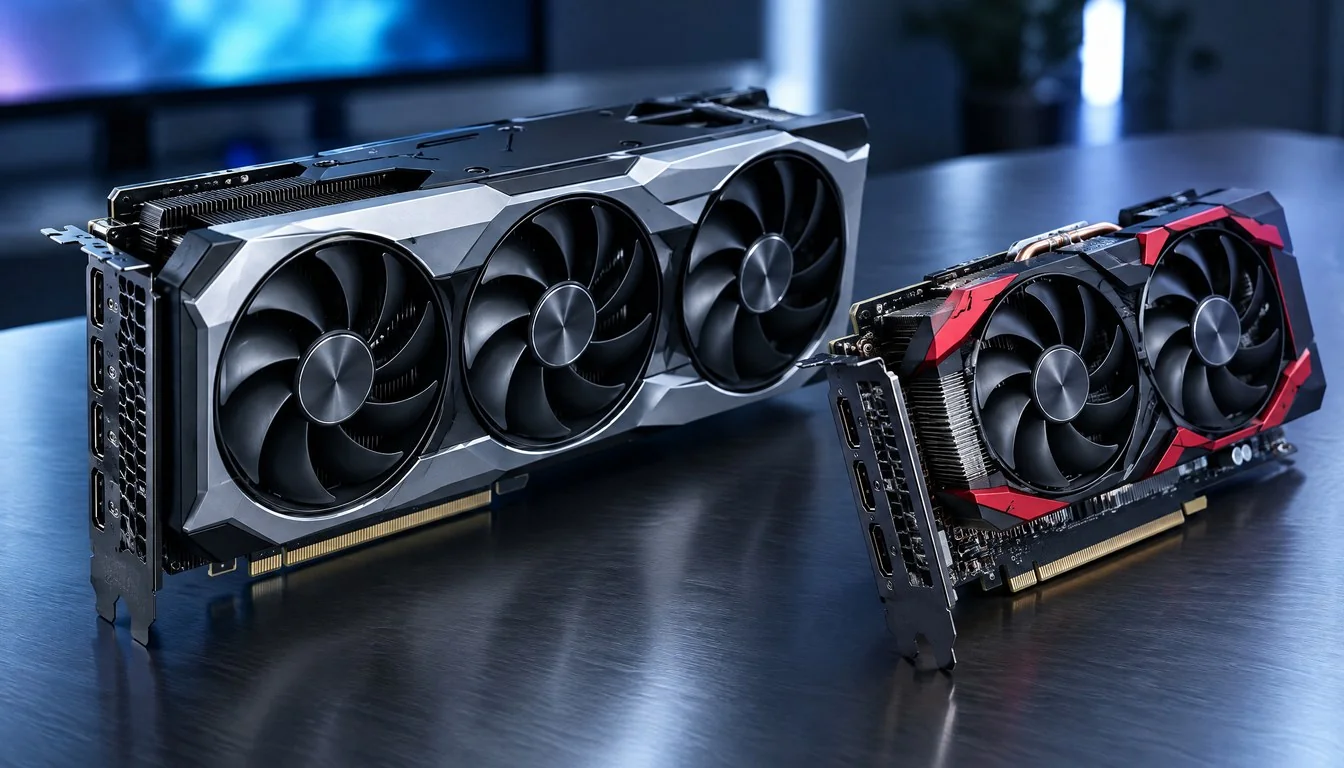
A graphics card comparison went viral this week claiming Nvidia leads and AMD wins by 40 percent in the long-running DLSS versus FSR fight. The headline, published by shattered.io on October 19, 2026, spread fast across hardware forums and social feeds. There is a problem with it: neither Nvidia nor AMD has published technical material confirming a 40 percent AMD win, and both companies have already moved past the exact technologies the headline names.
While that debate circulated online, AMD made a real announcement of its own. On October 20, 2026, the company’s newsroom confirmed that FSR Upscaling 4.1, the rebranded successor to FidelityFX Super Resolution 4, is now available on Radeon RX 6000 graphics cards, several Ryzen AI laptop and handheld chips, and is coming soon to Xbox Series X|S. Nvidia, meanwhile, has spent 2026 shipping DLSS 4.5, a version with Dynamic Multi Frame Generation that AMD’s upscaling update does not directly match feature for feature. The actual story is less a 40 percent blowout and more a case of two companies racing to put AI-driven frame generation on as much hardware as possible, as fast as possible, similar to how the RTX 5080 and RX 9070 XT have been trading blows on price and performance all year.
Don't miss new tech stories on Google
Add TrendinTech once in the Google app and our stories appear in your news suggestions.
What actually happened on October 20, 2026
AMD’s newsroom post, titled “AMD FSR Upscaling 4.1 Boosts Frames and Image Quality,” lays out a staged rollout that has been building since the middle of 2026. FSR 4 launched exclusively on Radeon RX 9000 series cards in 2025. In July 2026, AMD extended FSR Upscaling 4.1 to the older Radeon RX 7000 series. The October 20 update goes further: AMD optimized the INT8 model originally built for RX 7000 so it now runs on Radeon RX 6000 series GPUs, a lineup first released back in 2020.
The same announcement extends FSR Upscaling 4.1 to Ryzen AI Max 300 and 400 series processors, Ryzen AI 9 300 and 400 series laptop chips, and selected Ryzen AI Z2 Extreme, Ryzen Z2 Extreme, and Ryzen Z2 A handheld processors. In the announcement video, Xbox CTO Scott Van Vliet confirmed FSR Upscaling 4.1 is coming to Xbox Series X|S consoles, though AMD did not give a release date, describing console support only as “coming soon.” The rollout is delivered through AMD Software: Adrenalin Edition 26.10.1, a driver package AMD also published on October 20.
That driver release carries some fine print. AMD’s own release notes flag intermittent hangs when playing Death Stranding 2: On the Beach with FSR enabled on RX 9000 cards, plus intermittent crashes or hangs when switching applications or toggling overlays while FSR frame generation runs. A separate known issue describes crashes or driver timeouts in Cyberpunk 2077 when FSR upscaling, AMD Anti-Lag, and in-game frame generation are all active together on some RX 9000 cards. None of that is unusual for a driver update spanning this many device families at once, but it is the kind of detail that gets lost in a viral “winner declared” headline.
Why “DLSS 4 vs FSR 4” is already the wrong comparison
The framing driving search traffic this week, DLSS 4 versus FSR 4, describes technology that both companies have since iterated past. Nvidia’s current shipping generation is DLSS 4.5, which the company has been expanding through 2026 with Dynamic Multi Frame Generation, an upgraded second-generation Transformer model for Super Resolution, and Ray Reconstruction updates. AMD’s current shipping generation, as of today, is officially called FSR Upscaling, formerly branded FidelityFX Super Resolution 4, now at version 4.1. Comparing the original DLSS 4 and the original FSR 4 ignores a year of updates on both sides.
Nvidia’s developer page still describes the broader umbrella technology as “DLSS 4 with Multi Frame Generation,” and that branding persists in marketing even as DLSS 4.5 features roll out underneath it. Nvidia says DLSS 4.5 Super Resolution is now available through the NVIDIA app across all GeForce RTX GPUs and works with more than 400 games and applications, up from the more than 250 games and applications Nvidia cited for DLSS 4 Multi Frame Generation when it announced that milestone on January 14, 2026. The naming is genuinely confusing for shoppers, which is part of why a simplified “DLSS 4 vs FSR 4” headline is so easy to click, even when it describes last year’s technology.
AMD has the same branding drift. The company’s official FSR product page now calls the technology simply “FSR Upscaling,” distinguishing it from other features that now sit under the broader FSR umbrella. AMD describes FSR Upscaling as its most advanced solution for reconstructing crisp, high-quality visuals from lower-resolution frames, and the company says more than 60 games can be upgraded from FSR 3.1 to FSR 4 for image quality improvements on Radeon RX 9000 graphics cards specifically.
The frame generation gap that actually exists
Where Nvidia holds a documented, company-confirmed advantage is frame generation headroom on its newest cards. Nvidia’s RTX Blackwell architecture materials state that DLSS 4 Multi Frame Generation can boost frame rates by up to 2X over DLSS 3 and 3.5. DLSS 4.5 pushes further: Nvidia’s own game-support pages describe Dynamic Multi Frame Generation scaling output by up to 6X on GeForce RTX 50 series hardware specifically, a capability tied to that generation of cards rather than available across the whole RTX lineup. RTX 40 series systems get DLSS 4.5 Frame Generation but not the RTX 50-exclusive Dynamic Multi Frame Generation mode.
Nvidia’s research division has published a case study using Avowed to illustrate the gap: enabling DLSS 4 technology took the game from 35 FPS to 215 FPS in the tested configuration, while input latency dropped from 114 milliseconds to 43 milliseconds, a reduction Nvidia’s own research page describes as 62 percent. Nvidia has also pointed to Cyberpunk 2077 running at 4K with full ray tracing at 290 FPS on a GeForce RTX 5090 with DLSS 4 Multi Frame Generation enabled, a figure the company’s own materials describe as 8X faster than brute-force rendering without any of Nvidia’s AI frame technology turned on.
AMD’s October 20 announcement is framed differently. It is primarily an upscaling and hardware-compatibility story, not a frame-generation performance claim. AMD’s own newsroom post describes FSR Upscaling 4.1 as an improvement in image quality over FSR 3.1, delivered through machine learning, but the company’s materials reviewed for this story do not publish an equivalent multiplier figure for FSR frame generation the way Nvidia does for DLSS Multi Frame Generation. That gap in AMD’s own public claims is itself notable: it means the specific “40 percent AMD win” figure circulating this week cannot be traced back to anything AMD has officially published.
Hardware support: AMD’s real advantage this week
If there is a category where AMD’s October 20 news genuinely outpaces Nvidia, it is breadth of hardware support for older and lower-cost silicon. Nvidia lists DLSS as supported across GeForce RTX 50, 40, 30, and 20 series GPUs, but the newest Dynamic Multi Frame Generation features remain tied to RTX 50 series cards. AMD, by contrast, just pushed its newest upscaling model down to Radeon RX 6000 cards that are six years old, plus a wide range of Ryzen AI laptop and handheld silicon that never had RX 9000-class graphics hardware to begin with.
That strategy fits AMD’s stated direction. AMD senior vice president and general manager of the Computing and Graphics Group Jack Huynh said on October 7, 2026, that AMD intended to extend FSR 4 to APUs, laptops, and handheld devices by the end of 2026. The October 20 rollout to Ryzen AI Max, Ryzen AI 9, and selected Ryzen Z2 handheld processors looks like AMD following through on that commitment roughly two weeks later, ahead of the holiday shopping season when devices like AMD’s newer Ryzen AI chips are expected to show up in a wave of handheld gaming PCs.
For buyers comparing current-generation desktop cards rather than legacy hardware, the picture looks different. The Radeon RX 9070 XT launched with a suggested retail price of $599, positioning it well under Nvidia’s RTX 50 series pricing, while carrying AMD’s full FSR Upscaling 4.1 feature set from day one. Shoppers weighing that value equation against Nvidia’s lineup have more options now than they did even a few months ago, a dynamic also visible in how AMD and Nvidia have been pricing memory and components differently across their respective 2026 GPU stacks.
Image quality: the part neither company will settle itself
Neither Nvidia nor AMD publishes a side-by-side image quality scorecard against the other company’s product, for obvious competitive reasons. Independent comparison site nvidiareview.com, in an October 10, 2026 writeup explicitly titled around the DLSS 4.5 versus FSR 4.1 framing, is one of the few outlets that has attempted a structured side-by-side using both companies’ current shipping technology rather than last year’s versions. That a competing publication already retitled its own comparison away from “DLSS 4 vs FSR 4” and toward the current version numbers is itself a signal that the viral shattered.io headline is behind the curve on naming, whatever its performance claims turn out to be.
There is also a wrinkle that neither company asked for. A fan-made modification project reported on October 17, 2026, claims to bring DLSS-style Super Resolution, Ray Reconstruction, and up to 4X frame generation to AMD graphics cards, running as an unofficial alpha version 0.8.0. That project is not an Nvidia or AMD release, and it does not represent an official cross-compatibility feature from either company, but its existence highlights how much enthusiast energy is pouring into closing the gap between the two ecosystems by whatever means are available, official or not.
DLSS 4.5 vs FSR Upscaling 4.1: current specs side by side
| Attribute | Nvidia DLSS 4.5 | AMD FSR Upscaling 4.1 |
|---|---|---|
| Current branding | DLSS 4 with Multi Frame Generation / DLSS 4.5 Super Resolution | FSR Upscaling (formerly FidelityFX Super Resolution 4) |
| Game and app support | 400+ games and applications (Super Resolution) | 60+ games upgradable from FSR 3.1 on RX 9000 |
| Supported GPU families | GeForce RTX 50, 40, 30, and 20 series | Radeon RX 9000, RX 7000 (since July 2026), RX 6000 (since Oct. 20, 2026) |
| Max frame generation multiplier claimed | Up to 8X over brute-force rendering (DLSS 4 MFG); up to 6X Dynamic MFG on RTX 50 | No official multiplier figure published for FSR frame generation |
| Laptop or handheld chip support | Tied to GeForce RTX GPU presence in the device | Ryzen AI Max 300/400, Ryzen AI 9 300/400, select Ryzen Z2 chips |
| Console support | Not applicable to this comparison | Xbox Series X|S, announced “coming soon” |
| Latest driver or app update | NVIDIA app rolling updates through October 2026 | AMD Software: Adrenalin Edition 26.10.1 (Oct. 20, 2026) |
A quick history of the DLSS and FSR rivalry
Nvidia introduced DLSS 4 with Multi Frame Generation and a new transformer model for super resolution as its headline feature for the RTX 50 series launch, pitching it as the biggest upgrade to its AI upscaling models since DLSS 2.0 arrived in 2020. AMD’s answer, FSR 4, launched in 2025 as an exclusive feature of the Radeon RX 9000 series, a deliberate narrowing of hardware support that let AMD lean more heavily on machine learning for the first time in the FSR line after several generations of non-ML upscaling. The gap between a GPU-exclusive AMD launch and Nvidia’s broader initial rollout across four GPU generations was the original version of the hardware-access argument that has now resurfaced with the RX 6000 expansion.
Through 2026, both companies widened their initial launches in opposite directions. Nvidia pushed feature depth, adding Dynamic Multi Frame Generation and a second-generation transformer model under the DLSS 4.5 name while keeping support within the RTX GPU lineup. AMD pushed hardware breadth, extending FSR Upscaling 4.1 first to RX 7000 in July 2026 and now to RX 6000, non-gaming-focused Ryzen AI chips, and console hardware. Both are reasonable strategies for the install bases each company is defending: Nvidia’s RTX ecosystem skews toward newer cards among enthusiasts, while AMD has a much larger population of older Radeon and integrated-graphics hardware that benefits more from compatibility than from exclusive features.
What the viral comparison gets right and wrong
Viral hardware comparisons tend to compress a genuinely complicated technical field into a single scoreboard number, and this week’s “Nvidia leads, AMD wins by 40 percent” framing is a textbook example. The broad claim that Nvidia leads overall is not something either company’s own technical materials establish as a universal, measured result across every scenario; Nvidia’s documentation covers specific features and specific games, not a thorough ranked comparison. The narrower claim that AMD wins by 40 percent, without specifying whether that is a price-per-frame calculation, a specific game benchmark, or something else entirely, is similarly impossible to verify against anything AMD or Nvidia has published.
What is verifiable is more mundane and, in its own way, more useful to an actual buyer. Nvidia’s RTX 50 series has a documented, company-confirmed frame generation ceiling that AMD has not matched with an equivalent public figure. AMD has a documented, company-confirmed hardware compatibility expansion that reaches further down the price ladder and into non-gaming-focused silicon than anything Nvidia announced this week. Both of those facts can be true, and a buyer’s actual choice between the two ecosystems should depend on which one matters more for the hardware they already own or are about to buy, not on a single unverified percentage.
Market and competitive context
The timing of AMD’s RX 6000 expansion matters competitively. Nvidia’s current desktop lineup spans GeForce RTX 50, 40, 30, and 20 series cards, giving the company a much longer supported-hardware tail for DLSS than AMD historically offered for FSR 4. By pushing FSR Upscaling 4.1 down to RX 6000, a family that first shipped in 2020, AMD is closing that compatibility gap rather than trying to out-spec Nvidia’s newest silicon directly. It is a strategy that plays to AMD’s installed base rather than to headline frame-rate numbers, similar to how AMD has approached pricing on cards like the RTX 5090 and RTX 4090 generation comparisons that have shaped buyer expectations this year.
Nvidia, for its part, has been using its scale advantage to push DLSS 4.5 into as many high-profile game releases as possible. Recent integrations include Call of Duty: Modern Warfare 4, which began campaign early access on October 16, 2026 with DLSS 4.5 Dynamic Multi Frame Generation and Super Resolution, STAR WARS: Galactic Racer, Microsoft Flight Simulator 2024’s Sim Update 7, and Dragon’s Dogma 2: Dark Arisen. That cadence of day-one or near-day-one DLSS 4.5 support in marquee titles is a different kind of competitive pressure than AMD’s compatibility push, and it is one AMD’s FSR Upscaling 4.1 announcement this week does not directly answer with an equivalent list of exclusive game integrations.
Buyer scenarios: who actually benefits from each update
| Buyer situation | What matters most | Which update helps |
|---|---|---|
| Owns a Radeon RX 6000 card, not upgrading soon | Getting ML upscaling on existing hardware | AMD’s Oct. 20 FSR Upscaling 4.1 expansion |
| Owns a GeForce RTX 50 series card | Maximum frame generation multiplier | Nvidia’s DLSS 4.5 Dynamic Multi Frame Generation (up to 6X) |
| Shopping for a handheld gaming PC | Upscaling support on APU-class graphics | AMD’s Ryzen AI Max/AI 9/Z2 FSR Upscaling 4.1 rollout |
| Owns an older GeForce RTX 20 or 30 series card | Continued Super Resolution support | Nvidia’s DLSS 4.5 Super Resolution (all RTX GPUs) |
| Console gamer on Xbox Series X|S | Future upscaling support, not yet live | AMD’s announced but undated FSR Upscaling 4.1 console support |
What this means for the GPU market heading into 2027
The upscaling and frame-generation fight has become one of the main battlegrounds for GPU buying decisions, arguably more influential on day-to-day gaming experience than raw rasterization performance for many mid-range buyers. That shift explains why a single viral headline with an unverified percentage could generate the kind of search interest it did this week. Readers are genuinely trying to figure out which ecosystem’s AI-driven features will matter more for the hardware they are about to buy, and a single catchy number is an easy, if unreliable, shortcut.
Looking at where both companies are actually investing, a few predictions follow reasonably from the facts on record rather than from speculation. First, expect AMD to keep pushing FSR Upscaling 4.1 compatibility downward and outward rather than chasing Nvidia’s top-end multiplier claims directly, continuing the RX 6000 and Ryzen AI pattern into more device categories before the end of 2026, consistent with Jack Huynh’s stated timeline. Second, expect Nvidia to keep tying its newest Dynamic Multi Frame Generation features to RTX 50 series exclusivity rather than extending the 6X mode backward to RTX 40 or 30 series cards, since that exclusivity is part of what makes newer GeForce purchases attractive. Third, expect Xbox Series X|S FSR Upscaling 4.1 support to actually ship before the console’s next major software update cycle, given that AMD had Xbox’s own CTO on camera confirming the plan. Fourth, expect more unofficial compatibility projects like the October 17 fan modification to keep appearing as enthusiasts try to blur the line between the two ecosystems, even though neither Nvidia nor AMD has any incentive to officially support that kind of cross-platform compatibility. Fifth, expect future viral comparisons to keep using outdated version numbers like “DLSS 4 vs FSR 4” simply because those phrases already have search volume behind them, even as the underlying technology moves to DLSS 4.5, FSR Upscaling 4.1, and whatever comes next.
How to check which version your hardware actually supports
For readers trying to sort through their own setup rather than the marketing noise, the practical check is straightforward. Nvidia GPU owners can confirm DLSS 4.5 availability through the NVIDIA app, which Nvidia has used as the primary distribution channel for Super Resolution updates across all GeForce RTX GPUs. AMD GPU and APU owners should check whether they have installed AMD Software: Adrenalin Edition 26.10.1 or later, since that is the driver package carrying FSR Upscaling 4.1 support for Radeon RX 6000, Ryzen AI Max, Ryzen AI 9, and the listed Ryzen Z2 handheld chips. Readers who are also evaluating raw GPU performance rather than just upscaling features may find it useful to look at how cards compare without any upscaling turned on at all, which is the angle covered in recent native-performance benchmark testing between Nvidia’s current and previous generation hardware.
The bottom line on this week’s viral claim
The honest summary of October 20, 2026 is less dramatic than a 40 percent win headline but arguably more useful. AMD shipped a real, dated, company-confirmed expansion of FSR Upscaling 4.1 to older and cheaper hardware than it had ever supported before. Nvidia continued a yearlong rollout of DLSS 4.5 features that already outpace the original DLSS 4 specs the viral comparison was built around. Neither company has published anything that supports a specific 40 percent performance gap in either direction, and readers chasing that number will not find it in AMD’s newsroom, Nvidia’s developer documentation, or either company’s architecture materials.
What readers will find, if they look past the headline, is two companies pursuing genuinely different strategies with their AI upscaling technology: Nvidia maximizing frame-generation headroom on its newest cards, AMD maximizing the range of hardware that gets any upscaling boost at all. That is a more interesting story than a scoreboard number, even if it is a harder one to compress into a single viral headline.
Frequently Asked Questions
Is DLSS 4 vs FSR 4 still the right comparison to search for in 2026?
Not technically. Nvidia’s current shipping technology is DLSS 4.5, and AMD’s current shipping technology is officially called FSR Upscaling 4.1 (formerly FidelityFX Super Resolution 4). The older version numbers still get used in casual conversation and search queries, but neither company is marketing those exact versions as current anymore.
Is the claim that AMD wins by 40 percent over Nvidia DLSS true?
It is unconfirmed. The claim originated in a viral comparison from shattered.io and has not been verified against official technical material published by Nvidia or AMD. Neither company’s architecture documents, newsroom posts, or developer pages state a 40 percent performance gap in either direction.
Does FSR Upscaling 4.1 now work on Radeon RX 6000 cards?
Yes. AMD confirmed on October 20, 2026 that it optimized the INT8 model originally built for Radeon RX 7000 cards so it now runs on Radeon RX 6000 series GPUs, delivered through AMD Software: Adrenalin Edition 26.10.1.
What is the maximum frame generation multiplier for DLSS 4.5?
Nvidia states that DLSS Multi Frame Generation can multiply frame rates by up to 8X over traditional brute-force rendering, and that Dynamic Multi Frame Generation on GeForce RTX 50 series hardware specifically can scale output by up to 6X. Nvidia’s RTX Blackwell architecture materials separately describe up to a 2X boost over DLSS 3 and 3.5.
Does AMD publish an equivalent frame generation multiplier for FSR?
Not in the materials reviewed for this story. AMD’s October 20, 2026 announcement focuses on upscaling image quality and expanded hardware compatibility rather than publishing a frame-generation multiplier figure comparable to Nvidia’s stated numbers.
When is FSR Upscaling 4.1 coming to Xbox Series X|S?
AMD confirmed the feature is coming to Xbox Series X|S consoles, with Xbox CTO Scott Van Vliet appearing in AMD’s announcement video to confirm the plan, but no release date has been given as of October 20, 2026.
Which graphics cards currently support DLSS?
Nvidia lists GeForce RTX 50 series, RTX 40 series, RTX 30 series, and RTX 20 series under DLSS-supported hardware, though the newest Dynamic Multi Frame Generation features in DLSS 4.5 are specific to RTX 50 series cards.
What is the Radeon RX 9070 XT’s launch price?
AMD’s suggested retail price for the Radeon RX 9070 XT at launch was $549, positioning it as a value alternative to Nvidia’s RTX 50 series lineup while supporting AMD’s full FSR Upscaling feature set.
Related Coverage
Owen Castellanos
Owen Castellanos is the Hardware & Gaming Reporter at TrendinTech, where he tests graphics cards, processors, consoles and peripherals and follows the games industry, from the major publishers to independent studios. He writes for readers who want to know whether a product is worth the money, and he is not shy about saying when it is not.
All stories by Owen Castellanos (405)