Ryzen 9850X3D vs Core Ultra 9 285K: $100 Price Gap [2026]

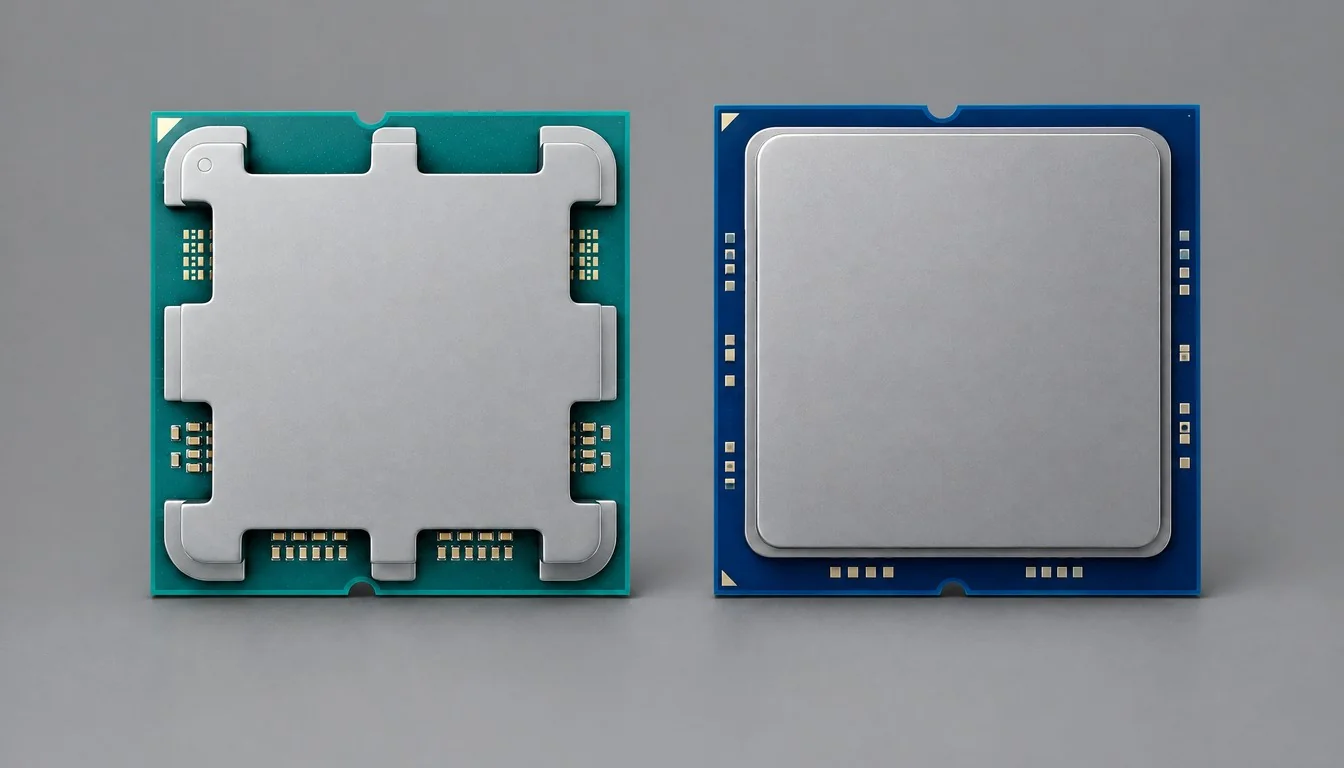
AMD and Intel have spent most of 2026 fighting over AI chips, data center supply, and eye watering price increases, but the fight that actually matters to most PC builders is quieter: which company makes the better gaming processor right now. The answer has shifted since AMD quietly refreshed its flagship X3D gaming chip in January. The AMD Ryzen 7 9850X3D and the Intel Core Ultra 9 285K sit at the top of each company’s current desktop lineup for gamers, and they could not approach the job more differently. One chip has eight cores wrapped around a huge slab of 3D stacked cache built purely for frame rates. The other has 24 cores and a much broader job description that includes video editing, compiling code, and crunching through creative workloads.
This hardware comparison breaks down specs, current October 2026 pricing, independently reported gaming benchmarks, and the platform costs tied to each socket. The goal is a straight answer to the AMD vs Intel for gaming question as it stands today, not as it stood when the 285K launched back in October 2024.
Don't miss new tech stories on Google
Add TrendinTech once in the Google app and our stories appear in your news suggestions.
Why This AMD vs Intel for Gaming Matchup Matters Right Now
Component prices across the PC market have been climbing all year because of AI driven memory and GPU demand, and CPUs have not been immune. Intel supplier level pricing reportedly rose between 5 and 20 percent across several processor families in recent months, according to supply chain reporting, while AMD’s own leadership has been candid about the pressure. AMD chair and CEO Lisa Su told partners in October that computing demand would stay very high for years and that AMD plans to substantially increase chip supply only in 2027, a comment she made mostly in the context of AI hardware rather than gaming chips, but one that signals tight supply across the board. Analysts have named AMD alongside Nvidia, Intel, and Micron as buy picks heading into Q3 2026 earnings, and Micron’s own HBM4 memory roadmap is part of why memory pricing keeps climbing for everyday PC builders too.
Against that backdrop, buyers comparing AMD vs Intel for gaming are not just picking a chip. They are picking a socket, a motherboard generation, and a memory kit, often for the next three to five years. AMD has already said it intends to keep supporting the AM5 socket for a long run, while Intel’s desktop roadmap has grown more complicated with the Core Ultra 200S Plus refresh sitting below the 285K and a laptop focused Core Ultra Series 3 (code named Panther Lake) now shipping in select markets since October 5, 2026. Neither of those newer Intel releases replaces the 285K as Intel’s top desktop gaming chip today, which is exactly why this comparison centers on the 9850X3D and the 285K specifically.
Meet the AMD Ryzen 7 9850X3D
The Ryzen 7 9850X3D is AMD’s newest gaming focused desktop chip, built on the Zen 5 architecture under the Granite Ridge codename. AMD launched it on January 29, 2026, as part of a broader Ryzen 9000X3D refresh announced at CES, and it slots in as the fastest member of AMD’s 3D V-Cache gaming family, ahead of the Ryzen 7 9800X3D it effectively replaces at the top of the lineup. That desktop push sits alongside AMD’s mobile roadmap too, including the recently leaked Ryzen AI 7 HX 455, a sign that AMD is refreshing its Ryzen branding across both laptops and desktops at the same time.
It carries 8 cores and 16 threads through simultaneous multithreading, a 4.7 GHz base clock, and a boost clock AMD rates up to 5.6 GHz, according to spec comparisons run by The FPS Review. The signature feature is still the 3D V-Cache itself: 96 MB of L3 cache stacked on the compute die, for roughly 104 MB of total cache once L2 is counted. AMD ships it with a 120 W default TDP, the same power envelope as the 9800X3D before it, which keeps cooling requirements familiar for anyone already running an AM5 build.
AMD’s own US store listed the chip at $499 on October 17, 2026, including tax, with no bundled cooler. AMD’s store currently shows the older 9800X3D chip at $479, $20 under its newer sibling. AMD has publicly framed the 9850X3D as the fastest Ryzen 9000X3D gaming processor it has ever shipped, and the company’s own announcement claimed up to 27 percent better gaming performance than the Intel Core Ultra 9 285K, a figure worth noting but treating as a vendor claim rather than an independently confirmed result.
Meet the Intel Core Ultra 9 285K
The Core Ultra 9 285K is Intel’s flagship Arrow Lake desktop chip, part of the Core Ultra Processors Series 2 family, and it has been on the market since October 24, 2024. Two years is a long time in CPU terms, but Intel has not released a higher tier desktop gaming chip since. The Core Ultra 200S Plus refresh that arrived in March 2026 brought the Core Ultra 7 270K Plus and Core Ultra 5 250K Plus, both positioned below the 285K, and a planned Core Ultra 9 290K Plus was reportedly cancelled around October 15, 2026. That leaves the 285K as Intel’s current top desktop option for gaming, even as the company’s newest consumer silicon attention shifts toward laptops.
Specs wise, the 285K is a 24 core, 24 thread chip that does not support Hyper-Threading, running on the FCLGA1851 socket with Intel’s 800 series chipsets. Intel’s performance documentation lists a 250 W PL1/PL2 power configuration, more than double the Ryzen chip’s 120 W rating. Pricing has stayed remarkably steady: Intel’s launch tray price sat around $589 to $599 per 1,000 units, and supply chain reporting from July 2026 said the recommended customer price remained unchanged at $599, nearly two years after launch. Early retail pricing landed closer to $600 to $630.
The core count difference is the single biggest spec gap in this entire comparison, and it explains almost everything about how these two chips trade blows depending on the workload.
Full Specs Comparison: Ryzen 7 9850X3D vs Core Ultra 9 285K
Here is how the two chips stack up spec for spec, pulled directly from AMD and Intel’s own published material.
| Specification | AMD Ryzen 7 9850X3D | Intel Core Ultra 9 285K |
|---|---|---|
| Architecture / codename | Zen 5 (Granite Ridge) | Arrow Lake |
| Product family | Ryzen 9000X3D | Core Ultra Processors Series 2 |
| Socket / platform | AM5 | FCLGA1851, Intel 800-series chipsets |
| Cores | 8 | 24 |
| Threads | 16 (SMT enabled) | 24 (no Hyper-Threading) |
| Base clock | 4.7 GHz | Not published in the material reviewed |
| Max boost clock | Up to 5.6 GHz | Not published in the material reviewed |
| Cache | 96 MB L3, about 104 MB total | Not published as a comparable total in Intel’s performance index |
| TDP / power | 120 W | 250 W (PL1/PL2) |
| Launch date | January 29, 2026 | October 24, 2024 |
| Launch price | $499 MSRP | $589 to $599 tray price |
| Current flagship status | Top of the Ryzen 9000X3D gaming lineup | Top of Intel’s conventional Core Ultra 200S desktop lineup |
Two things jump out immediately. AMD is chasing gaming frame rates with a small core count and a mountain of cache sitting close to the compute die, cutting down the memory latency that games are sensitive to. Intel is chasing raw parallel throughput with three times the core count, at more than double the power draw. Neither approach is wrong, but they point toward very different buyers, which is the whole reason this AMD vs Intel for gaming debate keeps resurfacing every product cycle.
October 2026 Pricing: Launch MSRP vs Street Price
Launch pricing rarely survives contact with the real market, and that is especially true in a year when component costs have been climbing across the board. Here is what both chips, plus their closest siblings, were actually selling for in October 2026.
| Processor | Launch price | Reported October 2026 street price | Notes |
|---|---|---|---|
| AMD Ryzen 7 9850X3D | $499 | Roughly $454.96 to $484 across retailers. AMD’s own store still listed $499 on October 17 | Current AMD gaming flagship |
| AMD Ryzen 7 9800X3D | $479 | Around $417.58 in one October 20 listing. Newegg cut it to $429 with a free cooler and game bundle on October 5 | Previous generation flagship |
| AMD Ryzen 7 7800X3D | Not specified in the material reviewed | About $326.99 in one October 20 comparison listing | Budget AM5 X3D option |
| Intel Core Ultra 9 285K | $589 to $599 tray price | Recommended customer price reportedly unchanged at $599 as of July 2026 | Current Intel desktop flagship |
| Intel Core Ultra 7 270K Plus | $299 initial MSRP (March 2026) | Reported ceiling raised to as much as $349 by July 2026 | Mid-tier Core Ultra 200S Plus refresh |
| Intel Core Ultra 5 250K Plus | $199 initial MSRP (March 2026) | Reported ceiling raised to as much as $229 by July 2026 | Budget Core Ultra 200S Plus refresh |
The headline number is simple. AMD’s own store price for the 9850X3D and Intel’s reported recommended customer price for the 285K sit $100 apart, with AMD on the cheaper side. That gap has barely moved since the Intel chip launched in late 2024, even as both companies raised prices elsewhere in their lineups. If you are shopping on price alone, AMD vs Intel for gaming is not close at the very top of each roster, though Intel’s cheaper Core Ultra 7 270K Plus and Core Ultra 5 250K Plus exist specifically to compete with AMD’s non-X3D and older X3D chips rather than the 9850X3D itself.
Gaming Benchmarks: What Independent Reviewers Found
Specs and prices only tell part of the story. What actually happens in games is where this comparison gets decided, and three separate outlets have weighed in on the 9850X3D since its January launch.
Ars Technica senior technology reporter Andrew Cunningham summed up the chip’s real world gain plainly: “The Ryzen 7 9850X3D mostly does what it says it does: It’s a mild speed bump to AMD’s best gaming processor that, in most cases, very slightly extends the company’s performance lead over Intel chips like the Core Ultra 9 285K.” That is a useful reality check against AMD’s own 27 percent marketing claim. Cunningham’s framing suggests the gap over Intel was already wide before the 9850X3D arrived, and the new chip stretches it further rather than creating it from scratch.
PC Gamer reached a similar conclusion in its review, writing that the Ryzen 7 9850X3D is still as great a gaming processor as its 9800X3D forebear, a verdict that treats the chip as a refinement rather than a reinvention. The improvements over the 9800X3D reported elsewhere support that reading: one comparison measured the newer chip about 3 percent faster overall, another put the gap closer to 4 percent depending on the game, and a Cyberpunk 2077 test at 1440p recorded 71.19 frames per second on the 9850X3D against 69.61 on the 9800X3D, roughly a 2.3 percent edge.
The gap against Intel looks much larger. A 14-game comparison attributed to TechSpot and cited in an October 6, 2026 Core Ultra 9 285K review placed the Ryzen 7 9850X3D about 40 percent ahead of the Intel chip in medium quality, CPU focused testing, a setting designed to remove GPU bottlenecks and isolate processor performance. A separate four-way X3D benchmark roundup covering the 7700X3D, 7800X3D, 9800X3D, and 9850X3D reached similar conclusions about where AMD’s current gaming lineup stands. That figure is considerably higher than AMD’s own 27 percent claim, and both numbers should be read as directional rather than exact given they come from different test suites and settings.
Club386 reviewer Ryan Jones landed on an unambiguous gaming verdict: “There’s no denying that the Ryzen 7 9850X3D is an excellent processor, particularly for gaming.” Across every independent review referenced here, nobody disputes that AMD’s chip wins the frame rate fight. The disagreement, where it exists, is only about the size of the margin.
Where the Core Ultra 9 285K Fights Back
Gaming is not the only workload that matters to a lot of buyers, and this is where the 285K’s extra 16 cores change the calculus. Patrick Moorhead, founder and CEO of Moor Insights & Strategy, put it in stark terms: the 285K “wins in every multi-core benchmark by a healthy margin, but loses to both the 9800X3D and 9850X3D in single-core benchmarks like GeekBench 6 and 3Dmark Steel Nomad Light.” Moorhead also noted that the 9850X3D “is a great fit for someone looking to build the fastest possible gaming CPU or upgrade from any other AM5 chip,” which lines up with how most reviewers have framed the two chips: AMD for frame rates, Intel for throughput.
That split matters more than it might seem. Video encoding, 3D rendering, large compile jobs, and heavily threaded creative software scale with core count in a way most games simply do not. A streamer encoding video while gaming, or a hobbyist rendering Blender scenes between matches, may genuinely come out ahead with the 285K’s 24 cores even while losing the pure gaming benchmark race.
Why AMD’s Claim and the Independent Number Do Not Match
A reasonable question after reading the benchmark section above is why AMD’s own 27 percent figure and the TechSpot-sourced 40 percent figure sit so far apart when they are supposedly measuring the same two chips. The honest answer is that neither number comes from an identical test. AMD’s 27 percent claim, published in its January 5 CES announcement, almost certainly reflects AMD’s own internal test suite, game selection, graphics card pairing, and settings, none of which were disclosed alongside the headline figure in the material reviewed here. Company-run benchmarks tend to favor configurations that flatter the product being announced, which is not an accusation of dishonesty so much as an acknowledgment of how marketing benchmarks are built industry-wide, by both AMD and Intel.
The 40 percent figure cited in the Core Ultra 9 285K review comes from a 14-game test run at medium graphics settings, specifically chosen to keep the graphics card from becoming the bottleneck so the comparison isolates CPU performance alone. That is a deliberately CPU-stressing scenario, and it tends to widen the gap between chips compared with a test run at native 4K or with ray tracing maxed out, where the GPU becomes the limiting factor and CPU differences shrink. Buyers running a high-end GPU at 4K with every visual setting cranked up, such as an RTX 5090 or an RTX 5080, should expect the real-world gap between these two chips to land somewhere between AMD’s claim and the wider independent figure, not necessarily at either extreme. The practical lesson is to treat any single benchmark percentage as a directional signal rather than a guarantee, and to weigh it against your own resolution, GPU pairing, and the specific games you play most.
A Short History of AMD’s X3D Chips and Intel’s Arrow Lake
Context helps explain why these two chips approach gaming so differently. AMD’s 3D V-Cache strategy has been running for several product generations now, stacking extra cache directly onto the compute die to shrink the round trips a game’s CPU thread has to make to main memory. The Ryzen 7 9850X3D sits alongside a lineage that includes the Ryzen 7 7700X3D, the Ryzen 7 7800X3D, and the Ryzen 7 9800X3D, all of which remain on sale today at lower prices and still deliver strong gaming performance, according to the pricing data gathered for this comparison. AMD has stuck with the same basic formula release after release: keep the core count modest, maximize cache, and let games reward the latency savings. The 9850X3D’s modest gains over the 9800X3D, reported in the low single digits by most reviewers, suggest AMD is nearing the point of diminishing returns on that particular approach without a bigger architectural jump.
Intel’s Arrow Lake architecture, which the Core Ultra 9 285K is built on, took a different direction when it launched in October 2024, moving to a tile-based design and dropping Hyper-Threading entirely in favor of more physical cores. That decision still defines the 285K’s identity two years later: it is built to win at raw parallel throughput, not to chase the single-threaded, latency-sensitive performance that most games reward. Intel’s subsequent Core Ultra 200S Plus refresh, which added the Core Ultra 7 270K Plus and Core Ultra 5 250K Plus in March 2026, kept the same FCLGA1851 socket and the same basic architectural philosophy rather than introducing a fundamentally new approach to gaming performance. Until Intel ships a gaming-focused desktop chip built around a different philosophy, the core count versus cache tradeoff described throughout this comparison is likely to keep repeating itself with each new generation from both companies.
Power Consumption and Cooling Requirements
The 120 W versus 250 W gap between these two chips is not a minor footnote, it shapes the entire build around each one. AMD’s 9850X3D inherits the same thermal envelope as the 9800X3D, meaning the mid-range air coolers and 240mm liquid coolers that already work for AM5 X3D builds will continue to work here without any real surprises. Case airflow requirements stay modest, and the chip is a realistic fit for smaller cases and quieter builds.
Intel’s 250 W PL1/PL2 configuration on the 285K asks for considerably more from a cooling loop, typically a 280mm or larger all-in-one liquid cooler or a high-end air tower to keep the chip running at its rated clocks under sustained multi-core load. That is the tradeoff for 24 cores: more heat to move, more case airflow needed, and a louder build under heavy load. For anyone building a small form factor PC specifically for gaming, the power gap alone tilts the AMD vs Intel for gaming decision toward the 9850X3D before a single benchmark even enters the conversation.
Platform and Upgrade Path: AM5 vs FCLGA1851
Buying a CPU also means buying into a platform, and the two companies are headed in different directions here. AMD has publicly signaled long term AM5 support, with reporting pointing to continued socket compatibility well beyond 2026, a point AMD itself has emphasized at recent trade events even if this specific comparison does not confirm an exact end date. That matters for anyone who wants to drop a faster Ryzen chip into an existing AM5 board two or three years from now without replacing the motherboard.
Intel’s FCLGA1851 socket, introduced with Arrow Lake in 2024, already has company: the Core Ultra 200S Plus refresh uses the same socket, so existing 800-series motherboard owners can upgrade within the Intel ecosystem without a new board. What is less clear is how long FCLGA1851 continues as Intel’s current socket once the laptop focused Core Ultra Series 3 generation eventually reaches desktops, something that has not happened as of October 2026.
What a Full Platform Actually Costs
Neither chip exists in a vacuum. An AM5 motherboard plus DDR5 memory kit is a mature, broadly available market at this point, since the platform has been around since 2022, which tends to keep board prices competitive across budget, mid-range, and premium tiers. Intel’s 800-series boards are newer and the selection, while solid, still skews toward mid-range and premium pricing rather than the rock-bottom budget boards AM5 now offers. Builders doing a full platform swap, not just a CPU swap, should price out the motherboard and memory alongside the processor itself rather than comparing CPU prices in isolation.
Five Real-World Buying Scenarios
Specs and benchmarks matter less than how they apply to an actual build. Here are five scenarios that cover most of the people actually weighing AMD vs Intel for gaming this fall.
- The competitive esports player: Someone chasing the highest possible frame rates in Counter-Strike 2 or Valorant at 1080p on a 240Hz or faster monitor should lean toward the Ryzen 7 9850X3D. Every reviewer cited here agrees AMD’s 3D V-Cache design wins the pure frame rate race, and esports titles are exactly the lightly threaded, latency sensitive workloads that cache benefits most.
- The streamer who also encodes video: A creator running OBS encoding alongside a game, or editing VODs between streams, may actually prefer the Core Ultra 9 285K’s 24 cores for the encoding and editing side of the job, even while accepting a gaming frame rate deficit during the stream itself.
- The budget AM5 upgrader: Someone already on an older Ryzen 5000 or early Ryzen 7000 AM5 build does not need to jump straight to the 9850X3D. The Ryzen 7 7700X3D, carrying a $329 MSRP, or the discounted Ryzen 7 9800X3D at around $429 with a bundle, both deliver the bulk of the gaming benefit at a noticeably lower price.
- The small form factor builder: A compact case with limited airflow favors the 120 W Ryzen 7 9850X3D over the 250 W Core Ultra 9 285K almost by default, since the AMD chip simply generates less heat to dissipate in a cramped enclosure.
- The hybrid gaming and workstation user: Anyone running CAD software, Premiere Pro exports, or large codebases alongside gaming sessions should weigh Moorhead’s multi-core findings carefully. The 285K’s three-times core count advantage shows up directly in those heavily threaded workloads, even though it loses the head-to-head gaming benchmark.
Best Use Cases for Each Processor
Beyond the five scenarios above, here is a direct recommendation breakdown by use case, since the AMD vs Intel for gaming question rarely has one universal answer.
- Pure 1080p and 1440p gaming performance: Ryzen 7 9850X3D, based on every independent review referenced in this comparison.
- Heavily multi-threaded productivity alongside gaming: Core Ultra 9 285K, based on Patrick Moorhead’s multi-core benchmark findings.
- Lowest total platform cost on a new build: Ryzen 7 9850X3D or Ryzen 7 9800X3D, given the mature and competitively priced AM5 motherboard market.
- Quiet, compact, or small form factor systems: Ryzen 7 9850X3D, due to its 120 W TDP versus the Intel chip’s 250 W configuration.
- Staying inside an existing Intel 800-series motherboard: Core Ultra 9 285K, since it drops into the same FCLGA1851 socket already used by Core Ultra 200S and 200S Plus boards.
- Tightest possible budget on the AM5 platform: Ryzen 7 7700X3D at its $329 MSRP, which still delivers strong 3D V-Cache gaming performance for considerably less than the flagship.
Migration Guide: Moving to Either Platform
Whether you are switching brands entirely or simply upgrading within the same socket, the process is worth planning out before parts arrive. Here is a practical path for either direction.
- Confirm your current CPU, motherboard chipset, and BIOS version before ordering anything. On Windows, a quick PowerShell check gives you the installed processor details in seconds.
- If staying on AM5 and upgrading to the Ryzen 7 9850X3D, update your motherboard’s BIOS to the latest version first, since newer AGESA firmware improves compatibility and memory stability with Ryzen 9000X3D chips.
- If moving from an older AM4 Ryzen build, budget for a new AM5 motherboard and DDR5 memory kit, since AM5 does not support AM4 coolers’ mounting hardware in every case and does not support DDR4.
- If staying on Intel’s FCLGA1851 socket and upgrading to the Core Ultra 9 285K, verify your existing 800-series board’s BIOS supports the chip before purchase, since some boards need a firmware update first.
- If switching from AMD to Intel or vice versa, plan for a full platform swap: new motherboard, new cooler mounting hardware, and in most cases new memory, since cooler compatibility and socket dimensions differ between AM5 and FCLGA1851.
- Back up your existing system or clone your drive before swapping platforms entirely, since a cross-brand CPU swap typically requires a fresh Windows installation or at minimum a driver cleanup to avoid boot issues.
- Reapply thermal paste and reseat your cooler properly during installation, particularly important on the 250 W Core Ultra 9 285K where cooling margins are tighter.
- After installation, enable AMD’s Precision Boost Overdrive or confirm Intel’s power limits are set to the chip’s rated PL1/PL2 values in BIOS, since some motherboards ship with conservative defaults that leave performance on the table.
That first step is worth doing properly. Here is the command to check your current processor details on Windows before you commit to either upgrade path.
Get-WmiObject Win32_Processor | Select Name, NumberOfCores, NumberOfLogicalProcessors, MaxClockSpeedPros and Cons of the AMD Ryzen 7 9850X3D
AMD’s chip has a clear identity, and the tradeoffs that come with it are just as clear once you look past the frame rate numbers.
- Pro: Fastest gaming chip in AMD’s current lineup, according to Ars Technica, PC Gamer, and Club386’s independent reviews.
- Pro: $100 cheaper than the Intel Core Ultra 9 285K at AMD’s own listed store price.
- Pro: 120 W TDP keeps cooling and power requirements modest, fitting a wider range of cases.
- Pro: Drops into existing AM5 motherboards, keeping upgrade costs lower for current Ryzen owners.
- Con: Only 8 cores and 16 threads, which limits multi-core productivity performance well behind the 285K.
- Con: The gain over the already strong Ryzen 7 9800X3D is modest, reported in the low single digits to roughly 4 percent in most game-by-game comparisons.
- Con: At least one retailer reportedly had an isolated fulfillment issue shipping the wrong processor, a reminder to verify your order before installation.
Pros and Cons of the Intel Core Ultra 9 285K
Intel’s flagship makes more sense once you stop judging it purely as a gaming chip.
- Pro: 24 cores deliver a healthy margin in every multi-core benchmark, according to Moor Insights & Strategy’s testing.
- Pro: Fits Intel’s established FCLGA1851 socket, shared with the newer Core Ultra 200S Plus refresh.
- Pro: Strong choice for mixed gaming and content creation or compiling workloads where core count matters more than single-thread speed.
- Con: Loses the straight gaming benchmark race to the Ryzen 7 9850X3D by a wide margin in independent testing.
- Con: 250 W PL1/PL2 power configuration demands significantly more cooling than AMD’s chip.
- Con: Recommended customer price has stayed at $599, roughly $100 above AMD’s current flagship, despite being over two years old.
- Con: No Hyper-Threading, unlike many past Intel flagships, which caps per-core thread availability for certain workloads.
What Reviewers Are Saying
Pulling the quoted reactions together paints a consistent picture across outlets that tested the chips independently of either company’s marketing. Ars Technica described the 9850X3D’s gain as a mild speed bump that nonetheless very slightly extends the company’s performance lead over Intel chips like the Core Ultra 9 285K. PC Gamer called it still as great a gaming processor as its 9800X3D forebear, treating consistency as the real selling point rather than a dramatic leap. Club386’s Ryan Jones was the most direct, stating flatly that there’s no denying that the Ryzen 7 9850X3D is an excellent processor, particularly for gaming.
None of the three independent reviewers disputed AMD’s gaming lead over the 285K. Where the conversation gets more balanced is in Patrick Moorhead’s analysis at Moor Insights & Strategy, which is also the only perspective cited here that credits Intel with a clear, measurable win: multi-core throughput. Taken together, the reviews describe two chips doing exactly what their design choices suggest they should do, which is a rare case of marketing claims and independent testing actually lining up.
The Verdict: AMD vs Intel for Gaming in 2026
If the only question is which chip to buy for gaming, the data points in one direction. The Ryzen 7 9850X3D costs $100 less than the Core Ultra 9 285K at each company’s own listed pricing, draws less than half the power at its rated TDP, and wins every independent gaming benchmark referenced From the roughly 27 percent gap AMD itself claims to the steeper 40 percent gap reported in a TechSpot-sourced 14-game test. For anyone building or upgrading a PC primarily to play games, that combination of price, power, and performance is hard for Intel to argue against with the 285K as currently priced.
The Core Ultra 9 285K still earns its place in a narrower set of builds: heavily threaded productivity work, content creation pipelines, or any household PC that needs to split time convincingly between gaming and serious multi-core workloads. Patrick Moorhead’s testing makes a solid case for the 285K on exactly those terms. But for the specific, narrow question of AMD vs Intel for gaming as a head-to-head gaming chip purchase in October 2026, the Ryzen 7 9850X3D is the more convincing buy on price, power, and every independently reported frame rate number available right now.
Frequently Asked Questions
Is the Ryzen 7 9850X3D worth it over the Ryzen 7 9800X3D?
Only marginally for existing 9800X3D owners. Reported gains range from about 3 percent to roughly 4 percent depending on the game, with one Cyberpunk 2077 test at 1440p showing a 2.3 percent edge. Buyers starting fresh may still prefer the 9850X3D since it is AMD’s current flagship, but upgrading purely from a 9800X3D is a tougher case to make.
Does the Intel Core Ultra 9 285K support Hyper-Threading?
No. The 285K has 24 cores and 24 threads with no Hyper-Threading, a change from many earlier Intel flagships that offered simultaneous multithreading on their performance cores.
Which chip is better for 1440p gaming specifically?
The Ryzen 7 9850X3D, based on every independent gaming benchmark cited in this comparison. Its 3D V-Cache design is particularly well suited to the latency sensitive performance that high refresh rate 1440p gaming rewards.
Will AMD keep supporting the AM5 socket?
AMD has signaled long term commitment to AM5, which has already been the standard Ryzen desktop socket since 2022. That history gives AM5 buyers more confidence in future upgrade paths compared with newer sockets still building out their motherboard ecosystem.
Is Intel planning a direct replacement for the Core Ultra 9 285K?
Not as of October 2026. Intel’s Core Ultra 200S Plus refresh added the Core Ultra 7 270K Plus and Core Ultra 5 250K Plus below the 285K, and a reported Core Ultra 9 290K Plus was said to have been cancelled around October 15, 2026. Intel’s newest consumer silicon, Core Ultra Series 3, began shipping in laptops in select markets starting October 5, 2026, but has not reached desktop as of this comparison.
How much does a full platform upgrade cost beyond the CPU?
That depends heavily on your starting point. AM5 motherboards and DDR5 memory are widely available across budget to premium tiers since the platform launched in 2022. Intel’s FCLGA1851 boards are newer and currently skew toward mid-range and premium pricing, so a full Intel platform swap tends to cost more than a comparable AMD one.
Which processor is more power efficient?
The Ryzen 7 9850X3D, by a wide margin on paper. Its 120 W TDP is less than half the Core Ultra 9 285K’s 250 W PL1/PL2 configuration, which also means lower cooling demands and quieter operation under sustained load.
Should I wait for next-generation chips before buying either one?
There is no confirmed desktop successor to either chip shipping yet. Reports point to AMD exploring Zen 6 desktop silicon and Intel’s Core Ultra Series 3 remaining laptop focused for now, but neither has a confirmed desktop gaming release date as of October 2026, so waiting indefinitely means delaying a real upgrade for an unconfirmed one.
Related Coverage
Owen Castellanos
Owen Castellanos is the Hardware & Gaming Reporter at TrendinTech, where he tests graphics cards, processors, consoles and peripherals and follows the games industry, from the major publishers to independent studios. He writes for readers who want to know whether a product is worth the money, and he is not shy about saying when it is not.
All stories by Owen Castellanos (403)