Tesla’s Cybercab Faces 21-Question Software Test [2026]

Tesla walks into its October 21, 2026 earnings call carrying two very different stories at once. The first is a delivery number that beat Wall Street’s math. The second is a federal paper trail that could decide whether Cybercab, the company’s pedal-free, wheel-free robotaxi, is allowed to keep scaling the way Tesla wants. Both stories collide this week, and the software behind Cybercab, not the hardware, is what regulators are actually asking about.
Tesla reported producing 464,391 vehicles and delivering 486,532 vehicles in the third quarter of 2026, alongside 13.7 GWh of deployed energy storage products, according to the company’s own production and delivery release and coverage from CNBC. The full financial results, including revenue, margins and any management commentary on China demand or Cybercab’s software program, are scheduled for release after market close on October 21, with a webcast following at 4:30 p.m. Central time. Nothing about margins, profit or Cybercab’s commercial status is confirmed until that report lands.
Don't miss new tech stories on Google
Add TrendinTech once in the Google app and our stories appear in your news suggestions.
The Headline Numbers: A Delivery Beat With a Production Gap
Tesla’s company-compiled analyst consensus had pointed to 461,974 vehicles for the quarter. The actual delivery figure of 486,532 came in roughly 5.3% above that estimate, a beat that pushed shares higher on the day the numbers posted, based on reporting from Drive Tesla Canada. Of those deliveries, 478,237 were Model 3 and Model Y combined, with the remaining 8,295 spread across other models including Cybertruck and Model S/X. Production told a slightly different story: Tesla built 457,387 Model 3/Y units and 7,004 units of other models, for a combined 464,391, which is 22,141 fewer vehicles than it delivered.
That gap between production and deliveries usually means one thing in a quarterly cadence: Tesla drew down inventory that had built up earlier in the year to hit the delivery number. It is not unusual, and it does not by itself say anything about demand strength. But it does mean the delivery beat should be read with a caveat. A factory that produces fewer cars than it ships is spending down a buffer, not necessarily building more cars faster.
Context matters here. Tesla delivered 480,126 vehicles in the second quarter of 2026 and 497,099 in the third quarter of 2025. Compared with the year-ago quarter, Q3 2026 deliveries were down slightly, even though they beat the current quarter’s Wall Street target. That is the kind of detail that gets lost in a single headline number, and it is why Tesla’s earlier earnings preview flagged a wide range of possible stock reactions heading into this report.
| Metric | Value | Period |
|---|---|---|
| Total deliveries | 486,532 | Q3 2026 |
| Total production | 464,391 | Q3 2026 |
| Model 3/Y deliveries | 478,237 | Q3 2026 |
| Model 3/Y production | 457,387 | Q3 2026 |
| Other models deliveries | 8,295 | Q3 2026 |
| Other models production | 7,004 | Q3 2026 |
| Energy storage deployed | 13.7 GWh | Q3 2026 |
| Analyst consensus (deliveries) | 461,974 | Q3 2026 estimate |
| Prior quarter deliveries | 480,126 | Q2 2026 |
| Year-ago quarter deliveries | 497,099 | Q3 2025 |
China’s Export Pressure Valve Is Doing the Heavy Lifting
The part of Tesla’s story that is genuinely weaker sits inside the China numbers, and it does not show up in the global delivery total. Tesla’s Shanghai plant, which builds Model 3 and Model Y for both domestic Chinese sale and export, recorded 95,366 vehicles sold at wholesale in September 2026, up from 90,812 a year earlier. On its face that looks like modest growth. Underneath it, the mix has shifted hard.
Exports from the Shanghai plant jumped 58% year over year to 30,529 vehicles in September, while domestic retail sales inside China fell roughly 9% to 64,837 vehicles. In other words, almost all of the wholesale growth came from cars leaving China for other markets, not from Chinese buyers choosing Tesla. Domestic demand, measured the way China’s own retail data captures it, went backward.
| Shanghai plant metric | September 2026 | Year-over-year change |
|---|---|---|
| Total wholesale sales (China-made) | 95,366 units | +5% |
| Exports | 30,529 units | +58% |
| Domestic retail sales | 64,837 units | -9% |
| September 2025 baseline wholesale | 90,812 units | n/a |
Tesla does not break out exact quarterly delivery totals by region in its official release, so the September wholesale figures are the clearest available signal of where the business stands in China heading into the earnings call. Read together, they suggest Shanghai has become less of a China growth engine and more of a flexible export base that happens to sit in China, absorbing local softness by shipping cars elsewhere. That dynamic will likely come up when analysts press Tesla executives for color on October 21, since it directly affects how investors should weight the headline delivery beat against the competitive pressure Tesla faces from BYD and other domestic Chinese automakers.
Cybercab: From Austin Showcase to Federal Paperwork
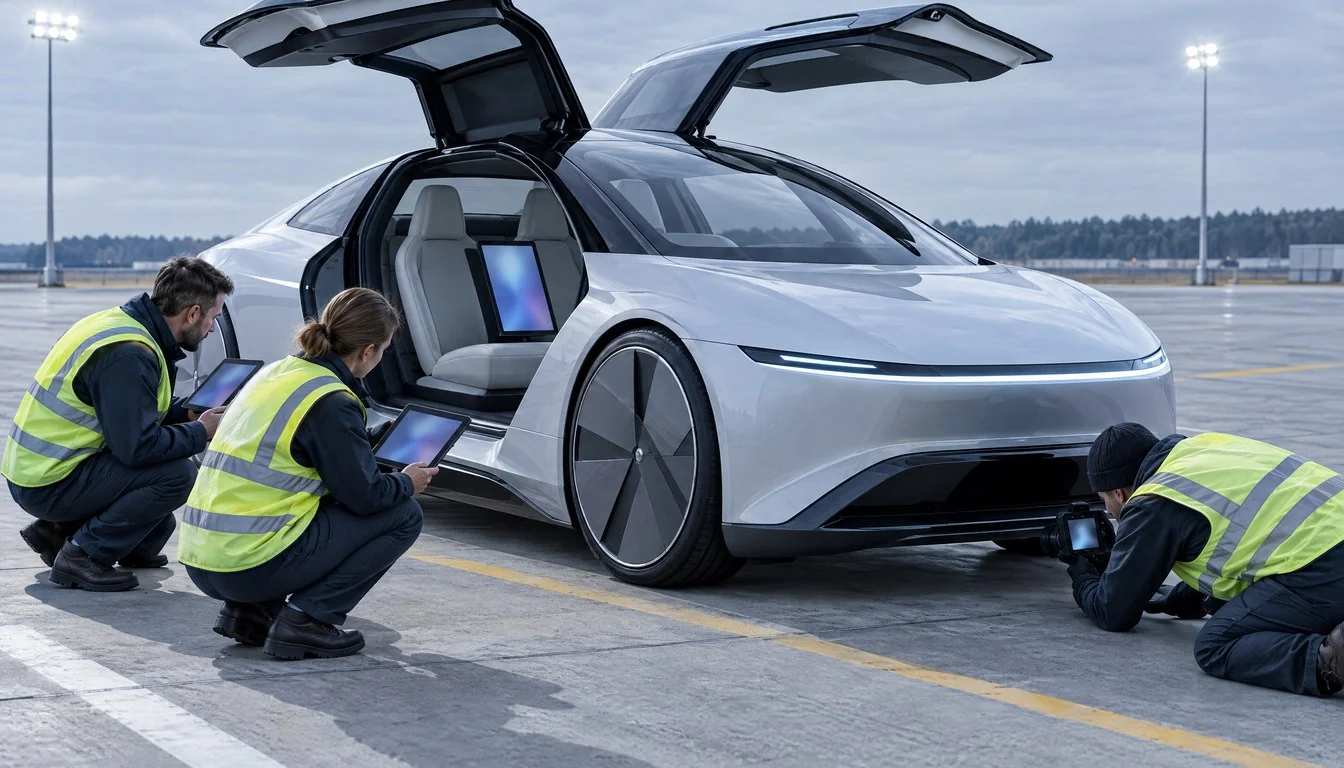
Tesla began producing Cybercab in February 2026. The vehicle is a purpose-built robotaxi with two seats, no steering wheel and no pedals, a design that only makes sense if the software driving it is trusted to handle every situation a human driver would otherwise manage manually. Tesla held an invitation-only Cybercab launch event in Austin on September 3, 2026, and paid public rides reportedly began through Tesla’s existing Robotaxi service the following day.
Since then, the deployment has moved quickly. Reporting from Teslarati indicates Tesla’s Austin Cybercab fleet grew past 300 vehicles by mid-October, an eightfold increase in roughly 30 days, a scaling pace that outstrips how Tesla rolled out its original supervised Robotaxi service in Texas. Trendintech covered that fleet expansion in detail as it happened. What has not drawn nearly as much attention is the regulatory paperwork running in parallel with that growth.
Why a Car With No Pedals Needs a Different Kind of Certification
Every new vehicle sold in the United States has to comply with Federal Motor Vehicle Safety Standards, and automakers are allowed to self-certify that compliance rather than wait for a government pre-approval process. That system works reasonably well for a car with a steering wheel, pedals and mirrors, because the baseline assumptions behind those standards were written with a human driver in mind. Cybercab removes all three of those assumptions, which forces an uncomfortable question: what does it mean to self-certify a vehicle whose safety case rests almost entirely on software rather than mechanical driver controls.
That is the question at the center of the National Highway Traffic Safety Administration’s scrutiny of Cybercab. Reports describe NHTSA requiring Tesla to answer 21 safety-certification questions covering issues including braking performance and the absence of conventional pedals, with a response reportedly due by October 30, 2026. The agency’s interest, as described in coverage of the inquiry, centers on how Tesla concluded the vehicle meets federal standards without the physical controls those standards generally assume will be present, which puts the weight of the certification on the software stack: the perception, planning and braking logic that stands in for a human driver’s hands and feet.
Separately, NHTSA opened an evaluation earlier in October into allegations that Tesla robotaxis, including vehicles in the broader autonomous fleet, exceeded speed limits in active school zones. Trendintech has covered that review on its own, and it is a distinct inquiry from the pedal-and-braking certification questions, even though both point at the same underlying issue: whether Cybercab’s software behaves the way Tesla told regulators it would in every scenario the agency tests for.
The Software Stack Behind the Certification Fight
Tesla’s autonomy software runs on what the company calls Full Self-Driving, now delivered through staged versions rather than a single static build. Reports describe firmware 2026.38.5.1, distributed in mid-October, as including FSD v14.3.12 for Tesla’s AI4 hardware and a reduced FSD v14.3 Lite build for older AI3 hardware that reportedly lacks parking, reverse and Smart Summon capability. That split matters for the certification conversation, because it shows Tesla is not running one monolithic software version across its fleet. It is running a tiered set of builds gated by what the underlying compute hardware can support, which is precisely the kind of staged software architecture that regulators need to understand before they can evaluate a safety claim built on top of it.
Tesla has also been adjusting how it talks about the software itself. A report dated October 15, 2026 said Tesla was dropping the “Full Self-Driving” name in Europe in favor of assisted-driving terminology, a naming change that lines up with European regulators’ more cautious stance on how autonomy claims are marketed. Naming aside, the underlying engineering challenge for any software team shipping safety-critical updates to a live fleet is the same: every release has to move through validation gates before it reaches cars carrying paying passengers.
For a robotaxi fleet, that typically means a staged rollout rather than a single push to every vehicle at once. A simplified version of that pattern, as engineers in the autonomy field commonly describe it, looks roughly like this:
stage_1_shadow_mode:
  deploy_to: internal_fleet
  action: log_only, no_vehicle_control
stage_2_canary:
  deploy_to: small_percentage_of_production_fleet
  action: monitor_disengagements, compare_to_baseline
stage_3_fleet_rollout:
  deploy_to: remaining_fleet
  condition: canary_metrics_within_safety_thresholds
  rollback: automatic_if_regression_detected
That is an illustration of the general pattern, not a disclosed Tesla engineering document. But it is the kind of pipeline NHTSA’s 21 questions are effectively probing: not whether Cybercab can drive, but whether Tesla can prove, on paper and in telemetry, that every software change clears a safety bar before it reaches a fare-paying passenger in a vehicle with no manual override available.
Dallas Is Next, But the Timeline Is Vague
Ashok Elluswamy, Tesla’s vice president of AI software, reportedly said in an October 10 post that Cybercabs were “coming soon” to Dallas, without attaching a firm launch date. That is a notable detail on its own: the person leading Tesla’s AI software effort, not a regional operations executive, is the one publicly signaling the next market. It reinforces that the gating factor for Cybercab’s geographic expansion is less about manufacturing capacity and more about whether the software and its safety case are ready to be vouched for in a new operating environment, with different road layouts, weather patterns and traffic norms than Austin.
Elon Musk has previously floated a target price below $30,000 for Cybercab, but that remains a stated ambition rather than a published retail price, and no official consumer sale date has been confirmed. The vehicle today functions almost exclusively as a fleet asset inside Tesla’s own Robotaxi service rather than something an individual can order and own.
Why This Matters for Tesla’s October 21 Earnings Call
Investors tend to focus earnings-day attention on revenue, automotive gross margin and free cash flow. Those numbers matter, and Investing.com’s preview of the quarter framed margin durability as the central question Wall Street wants answered given a delivery beat built partly on inventory drawdown. But the Cybercab certification deadline, falling just nine days after the earnings call, adds a second axis investors have to weigh. A delivery and margin beat gets discounted quickly if the market concludes Tesla’s most ambitious new product line is about to run into a regulatory wall over how its software was certified.
Tesla has already opened a shareholder question portal ahead of the call, and the China demand split along with Cybercab’s regulatory status are exactly the kind of topics likely to dominate analyst questions, alongside the usual queries about Optimus and energy storage growth. The stakes extend beyond a single quarter’s stock reaction, too: Tesla’s board has tied a large share of Elon Musk’s long-term compensation package to Cybercab and broader autonomy milestones, a structure Trendintech examined in its coverage of the pay package’s software-linked targets. If Cybercab’s certification stalls, it is not just a product delay, it is a direct hit to the metric Musk’s compensation is pegged against.
Tesla’s governance calendar adds another wrinkle. Shareholders are separately scheduled to vote in December on re-electing Musk and two other directors, a vote Trendintech detailed in its report on the December ballot. A rough earnings call combined with unresolved federal questions about Cybercab’s safety case would not derail that vote outright, but it raises the temperature around it.
Competitive Field: Tesla Is Not the Only One Being Tested
Tesla’s Cybercab push is happening inside a crowded and increasingly mature robotaxi field, and the comparison matters because rivals have already been through versions of the same regulatory scrutiny Tesla now faces.
Waymo’s Head Start
Waymo has operated a fully driverless public service since October 2020, starting with Phoenix’s Sky Harbor airport access, and has since expanded across more than 40 Bay Area cities with freeway rides resuming in July 2026. Waymo has also published safety data claiming 82% fewer injury crashes than a human-driving benchmark over comparable roads through June 2026. That track record is exactly the kind of evidence base NHTSA’s Cybercab questions are implicitly asking Tesla to produce, years earlier in the program’s life than Waymo had to.
Zoox and the Purpose-Built Design Question
Zoox, Amazon’s robotaxi unit, launched a purpose-built robotaxi with no manual controls in August 2026, charging fares from August 10 after free public rides that began the prior September. Zoox’s vehicle shares Cybercab’s basic premise, a cabin with no driver controls at all, which means Zoox has already worked through some of the same federal certification questions Tesla is now answering. That makes Zoox’s experience a useful reference point for how long a no-pedal, no-wheel vehicle typically takes to move from pilot to fare-charging service once regulators get involved.
| Company | Service status | Key milestone date | Notable detail |
|---|---|---|---|
| Waymo | Driverless, public | October 2020 (first launch) | 82% fewer injury crashes than human benchmark through June 2026 |
| Zoox | Driverless, fares active | August 2026 | Purpose-built robotaxi, no manual controls |
| Tesla Cybercab | Limited paid rides, Austin | September 2026 launch | Facing 21 NHTSA certification questions, due October 30, 2026 |
| Nuro | Testing, targeting 2027 | 2027 commercial target | Roughly 100 Lucid Gravity SUVs with safety operators as of 2026 |
Historical Context: A Promise Nine Years in the Making
Tesla’s robotaxi ambitions did not start in 2026. Elon Musk promised “a million robotaxis” on the road by 2020, a target that did not materialize on anything close to that timeline, as a retrospective from Yahoo Finance noted while reviewing how far behind that original promise the current fleet still sits even with Cybercab now in limited service. The gap between that 2020 promise and a 2026 fleet still measured in the hundreds of vehicles, still confined largely to one Texas metro area, and still answering federal safety questions is a useful corrective against reading Cybercab’s recent growth curve as proof that full commercial scale is close.
It also explains why NHTSA’s current line of questioning carries extra weight. A company that has repeatedly set and missed autonomy timelines is now asking regulators to accept a self-certification for a vehicle with no manual fallback at all. The agency’s 21 questions can be read as reasonable diligence given that history, not an unusual level of scrutiny invented specifically to slow Tesla down.
What the Software Timeline Looks Like So Far
| Date | Event |
|---|---|
| February 2026 | Cybercab production begins |
| September 3, 2026 | Invitation-only Cybercab launch event in Austin |
| September 4, 2026 | Paid public Cybercab rides reportedly begin via Tesla’s Robotaxi service |
| October 2, 2026 | Q3 production and delivery figures released: 464,391 produced, 486,532 delivered |
| October 9, 2026 | NHTSA reportedly opens a separate evaluation into robotaxi school-zone speed allegations |
| October 15, 2026 | Tesla reportedly drops the “Full Self-Driving” name in Europe for assisted-driving terminology |
| Mid-October 2026 | Austin Cybercab fleet reportedly tops 300 vehicles, an eightfold increase in 30 days |
| October 21, 2026 | Full Q3 2026 earnings release after market close, webcast at 4:30 p.m. Central |
| October 30, 2026 | Reported deadline for Tesla to answer NHTSA’s 21 Cybercab certification questions |
Market Impact: Reading Between the Delivery Beat
Shares moved higher on the initial October 2 delivery news, a reaction consistent with how markets typically treat a headline beat against a lowered bar. But the inventory drawdown behind the beat, the China domestic softness hidden inside a wholesale number that looks fine at first glance, and an unresolved federal safety inquiry into Cybercab combine into a more complicated setup heading into the full earnings report than the delivery headline alone suggests.
Analysts covering the stock will likely press for specifics on three fronts during the call: whether the delivery strength can be sustained into the fourth quarter without further inventory drawdown, how management characterizes the China domestic slide versus the export growth masking it, and whether Tesla has a concrete answer ready for NHTSA ahead of the October 30 deadline or expects to request another extension. Tesla has already granted one extension on the certification response, which suggests the questions are not trivial to answer even internally.
Five Predictions for What Comes Next
- Tesla will likely frame the October 21 call around margin resilience and energy storage growth, using the 13.7 GWh deployment figure to offset tougher questions about China and Cybercab.
- Expect Tesla to request additional time or submit a partial response to NHTSA’s 21 questions rather than a fully resolved answer by October 30, given the complexity of certifying software-defined safety claims.
- China’s export-versus-domestic split is likely to widen further in the fourth quarter as competition from domestic Chinese automakers continues to pressure Tesla’s local retail positioning.
- Cybercab’s Dallas expansion will probably slip past any informal fourth-quarter expectations, tracking behind the pace of the Austin rollout until the NHTSA certification questions are resolved.
- Tesla will continue adjusting FSD naming and marketing language market by market, particularly in Europe, as regulators in different jurisdictions push back on autonomy-related terminology.
The Bottom Line Ahead of Earnings Day
Tesla’s Q3 2026 delivery numbers are genuinely strong relative to the bar Wall Street set, and the energy storage business keeps growing at a healthy clip. But the quarter is not a clean story. China’s wholesale growth is propped up by exports while domestic demand erodes, and Cybercab, the product most central to Tesla’s long-term valuation case, is facing a federal certification deadline that lands just over a week after the earnings call. The real test for Cybercab was never going to be whether it could complete a ride in Austin. It is whether Tesla can show regulators, in writing, that the software replacing the wheel and pedals has been validated as rigorously as the hardware that no longer needs them.
Frequently Asked Questions
When does Tesla report full Q3 2026 earnings?
Tesla has scheduled its full third-quarter 2026 financial results for release after market close on October 21, 2026, followed by a webcast at 4:30 p.m. Central time.
How many vehicles did Tesla deliver in Q3 2026?
Tesla delivered 486,532 vehicles and produced 464,391 vehicles in Q3 2026, beating its own analyst consensus estimate of 461,974 deliveries by about 5.3%.
Why did Tesla deliver more vehicles than it produced?
The 22,141-vehicle gap between deliveries and production typically points to Tesla drawing down existing inventory to meet the quarter’s delivery total, rather than production capacity increasing.
What is Tesla Cybercab?
Cybercab is Tesla’s purpose-built robotaxi, featuring two seats, no steering wheel and no pedals. Tesla began producing it in February 2026 and held an invitation-only launch event in Austin on September 3, 2026.
What is NHTSA asking Tesla about Cybercab?
Reports describe the National Highway Traffic Safety Administration requiring Tesla to answer 21 safety-certification questions, including how Cybercab’s braking performs and how the vehicle was self-certified without conventional pedals, with a response reportedly due by October 30, 2026.
Is Tesla’s demand in China growing or shrinking?
It depends on how the number is measured. Total Shanghai-made wholesale volume rose 5% year over year in September 2026 to 95,366 vehicles, but that growth came entirely from a 58% jump in exports. Domestic Chinese retail sales actually fell roughly 9% to 64,837 vehicles.
Does Tesla still call its software “Full Self-Driving” everywhere?
Reports from mid-October 2026 say Tesla dropped the “Full Self-Driving” name in Europe in favor of assisted-driving terminology, even as the FSD name reportedly continues in other markets including the United States.
Is Cybercab available to buy or ride outside Austin?
As of October 2026, Cybercab operates in limited paid service in Austin, with Tesla AI software vice president Ashok Elluswamy reportedly signaling Dallas as the next city, though no confirmed launch date or public retail price has been announced.
Related Coverage
Helena Marsh
Helena Marsh is the Editor-in-Chief at TrendinTech, where she leads editorial strategy and oversees coverage across artificial intelligence, cybersecurity and enterprise technology. She believes technology reporting should be rigorous and plainly written, so readers understand what actually changes for them rather than what a company's announcement promises.
All stories by Helena Marsh (269)