USSI Global Taps Ted Korte as CTO in 12-Day Shakeup [2026]

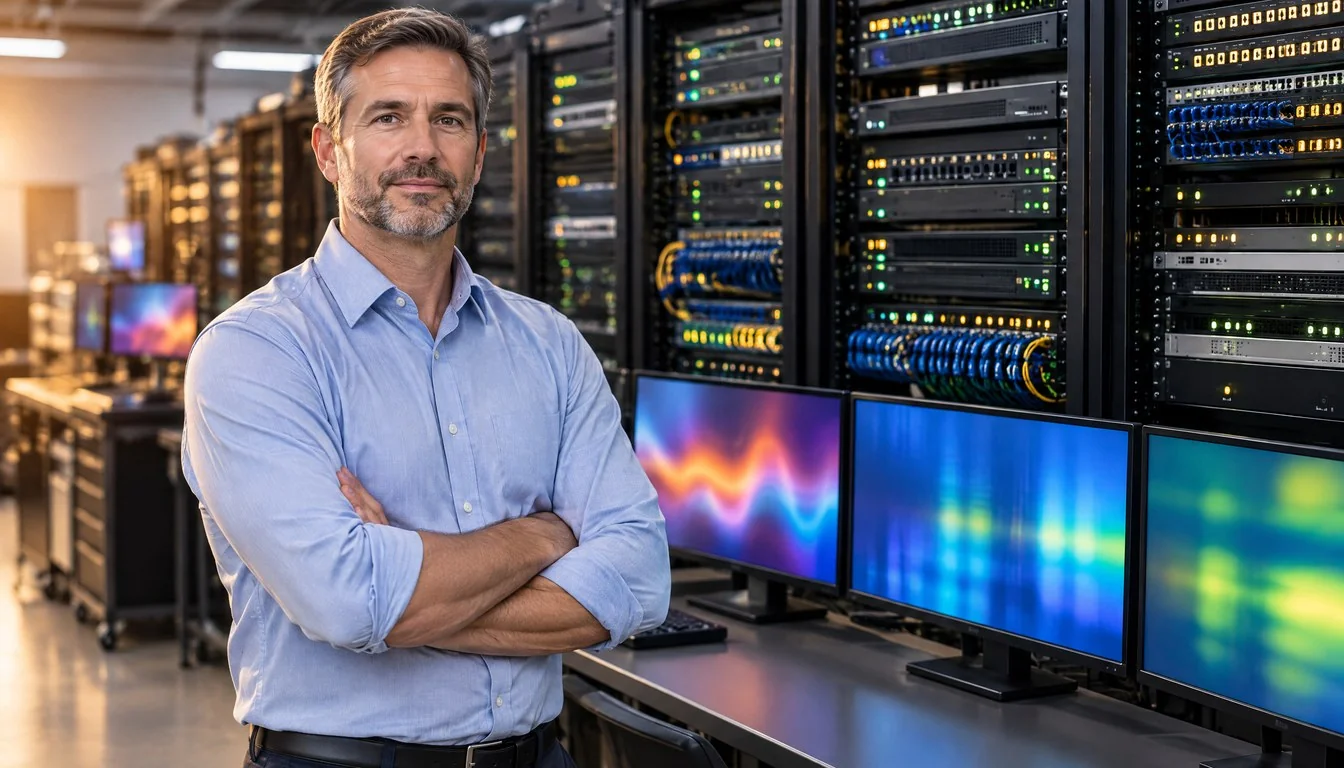
USSI Global has promoted Ted Korte to chief technology officer, capping a 12-day stretch in which the Melbourne, Florida broadcast systems integrator rewired three seats on its executive bench. The announcement, dated October 20, 2026, hands Korte oversight of technology, engineering and technical-management teams across the company’s three business units. He reports directly to USSI Global President and CEO Anthony Morelli, according to TV Tech, which broke the news.
Korte’s promotion is the third senior leadership change USSI Global has made since October 8, 2026, following the appointment of Ed McGivern as chief revenue officer and the elevation of Amanda Flynn to chief operating officer. Taken together, the moves point to a company restructuring its top ranks just as the broadcast industry heads into another round of spectrum disruption, cloud migration and infrastructure consolidation. For a 40-year-old systems integrator that has quietly built out satellite, IP and cloud testing capability through its Media Transport Solutions Lab, the timing of a CTO promotion is not incidental.
Don't miss new tech stories on Google
Add TrendinTech once in the Google app and our stories appear in your news suggestions.
USSI Global Elevates Ted Korte to Chief Technology Officer
Korte moves into the CTO role from his previous post as vice president of engineering and technology, a title he held before the October 20 announcement. USSI Global says his new mandate covers new technology evaluation, systems-level engineering, and technical management across the company’s broadcast-media, digital-signage and retail-technology business units. That is a wider remit than his prior job, which focused primarily on engineering operations and the development of the company’s in-house testing facility.
Anthony Morelli, who has run USSI Global as president and CEO through this month’s reshuffle, framed the promotion as recognition of work already done rather than a fresh mandate handed to an outsider. “Ted has played an instrumental role in transforming how USSI Global approaches technology, engineering and customer engagement,” Morelli said, according to TV Tech’s report on the appointment. He added: “His promotion to CTO recognizes the leadership he has already demonstrated while positioning us to expand those capabilities across every part of our business.”
Korte, for his part, pointed to the testing environment he built as the clearest evidence of what a centralized technology strategy can do for a systems integrator that sells into broadcast, digital signage and retail markets at once. “We have built an environment where we can experiment with new technologies, understand how different systems work together and translate those discoveries into practical solutions,” Korte said in the same announcement.
Who Is Ted Korte? A 25-Year Broadcast Engineering Career
Korte brings more than 25 years in the broadcast industry to the CTO chair, a career that runs through some of the sector’s more consequential engineering shops. He spent 22 years at Harris Corporation, the broadcast and communications equipment maker whose technology and personnel have since scattered across the industry through spinoffs, acquisitions and new ventures. Before joining USSI Global, Korte served as chief operating officer and chief technology officer at Qligent, a monitoring and compliance technology company that built its name on remote quality-control software for broadcasters.
He joined USSI Global in 2021 as vice president of Programs and Innovation Lab, a role focused on tying the company’s broadcast, digital-signage and consumer-electronics business lines closer together through shared technology development. From there he moved into the vice president of engineering and technology post he held immediately before this week’s promotion. Across both roles, USSI Global credits him with building the Media Transport Solutions Lab into the centerpiece of its engineering strategy.
That career arc matters for how the market reads this appointment. USSI Global is not hiring an outside technologist to shake up its culture. It is promoting an engineer who has spent five years inside the company building the exact infrastructure testing capability it now wants scaled company-wide. That continuity is a deliberate signal to customers who depend on USSI Global for long-cycle infrastructure decisions measured in years, not product release quarters.
Inside the Media Transport Solutions Lab
The lab Korte built is the throughline connecting his old job to his new one. USSI Global describes the Media Transport Solutions Lab as a vendor-agnostic testing and engineering environment where broadcasters and media organizations can evaluate satellite, terrestrial IP, cloud and alternative-connectivity architectures before committing to a deployment. It is not a product USSI Global sells off a price sheet. It is closer to a proving ground, a place where a broadcaster worried about satellite capacity can test a hybrid fiber-and-cloud backup plan without betting an entire regional transmission chain on an unproven configuration.
“The Media Transport Solutions Lab is a great example of that philosophy,” Korte said of the testing environment in the same TV Tech announcement. “It has helped us establish credibility as a technical partner while opening doors to new customer relationships and business opportunities.”
USSI Global opened the lab on its Melbourne campus in March 2026, positioning it explicitly around the next phase of the Federal Communications Commission’s C-band spectrum transition, a regulatory process that has forced broadcasters to rethink satellite capacity for years. The Radio & Television Business Report covered USSI Global’s C-band transition work in July 2026, describing a company preparing customers for site surveys, RF engineering, terrestrial IP connectivity, procurement, logistics and field deployment tied to the spectrum squeeze. Industry trade coverage has also reported that the FCC advanced rules in July 2026 to auction 160 megahertz of Upper C-band spectrum by July 2027, a deadline that puts a hard clock on how much runway broadcasters have to migrate their satellite links.
That regulatory deadline is the real reason a mid-size systems integrator’s internal org chart is newsworthy outside trade press. Every broadcaster relying on satellite distribution now has a finite window to decide whether it moves to terrestrial IP, cloud delivery, a hybrid of several transport methods, or stays on a shrinking slice of C-band spectrum. USSI Global’s lab exists to answer that question for paying customers, and Korte’s promotion puts the person who built it in charge of scaling it beyond media transport into digital signage and retail technology as well.
A Three-Executive Reshuffle in 12 Days
Who Else Moved, and When
Korte’s promotion did not happen in isolation. USSI Global named Ed McGivern chief revenue officer on October 8, 2026, bringing him in from Appear U.S., where he had served as president and general manager since January 2022. McGivern now leads go-to-market strategy, customer acquisition and revenue expansion, reporting to Morelli. Earlier in his career he held senior commercial roles at Harris Broadcast and Imagine Communications, Grass Valley and Snell Advanced Media, and Tektronix, giving USSI Global a revenue chief with the same kind of long-tenure broadcast-industry pedigree Korte brings on the engineering side.
Six days later, on October 14, 2026, USSI Global promoted Amanda Flynn from chief revenue officer to chief operating officer. Flynn has been with the company since 2008, an 18-year run that moved her through business development, customer relations, sales and revenue operations before she took the CRO title in March 2024. Her elevation to COO was explicitly framed around expanding service capabilities, refining internal processes and aligning operations with customer needs, according to Installation International’s coverage of the move.
McGivern’s arrival effectively freed Flynn to move up, and Flynn’s move up created the kind of settled commercial leadership that let Morelli turn his attention to formalizing Korte’s technology authority six days later. Three appointments, one reporting line, twelve days. That is an unusually compressed cadence for a privately held systems integrator that, by its own account, has no public product catalog or quarterly earnings calendar forcing the timing.
USSI Global’s October 2026 Executive Changes
| Executive | New Title | Previous Title | Effective Date | Reports To |
|---|---|---|---|---|
| Ed McGivern | Chief Revenue Officer | President and General Manager, Appear U.S. | October 8, 2026 | Anthony Morelli |
| Amanda Flynn | Chief Operating Officer | Chief Revenue Officer, USSI Global | October 14, 2026 | Anthony Morelli |
| Ted Korte | Chief Technology Officer | Vice President of Engineering and Technology | October 20, 2026 | Anthony Morelli |
Historical Context: From Harris Corporation and Qligent to USSI Global
Korte’s path to the CTO chair traces a familiar pattern in broadcast technology leadership: long tenure at a legacy equipment maker, a stint at a smaller specialized technology company, then a landing spot at an integrator that assembles other vendors’ hardware and software into working systems for customers. His 20 years at Harris Corporation would have put him inside the company through its various broadcast-division reorganizations, before that unit’s technology and talent fed into companies across the industry. His move to Qligent as COO and CTO put him on the vendor side of remote monitoring and compliance software, a discipline that depends on exactly the kind of systems-integration thinking USSI Global now wants applied company-wide.
When USSI Global first recruited Korte in 2021, the company was explicit about why it wanted him. According to USSI Global’s own announcement at the time, Korte said his career to that point had clearly led him to the opportunity, since he could draw on genuine experience from every position he had held over two decades. He also described what excited him about joining: a company with a real vision for the future, one shifting from pure hardware integration toward software integration, interactive experiences and digital out-of-home advertising. Five years later, that described shift is effectively what his CTO promotion now formalizes at the top of the org chart.
Ted Korte’s Career Path to Chief Technology Officer
| Role | Organization | Timeframe or Context |
|---|---|---|
| Broadcast engineering roles | Harris Corporation | 22 years |
| Chief Operating Officer / Chief Technology Officer | Qligent | Prior to USSI Global |
| Vice President, Programs and Innovation Lab | USSI Global | Joined 2021 |
| Vice President, Engineering and Technology | USSI Global | Before October 20, 2026 |
| Chief Technology Officer | USSI Global | From October 20, 2026 |
Why the Timing Matters: The C-Band Spectrum Squeeze
Broadcasters have been living under the shadow of C-band spectrum reallocation since the FCC first cleared the lower portion of the band for 5G mobile use. That first clearing initiative required careful planning and execution, but it left broadcasters within the same general satellite ecosystem. The next phase, the Upper C-band transition, is a tighter squeeze, and it arrives at the same time cloud delivery, terrestrial IP networks and low-earth-orbit satellite constellations have all matured into credible alternatives to a traditional satellite-only transport chain.
That is precisely the decision point the Media Transport Solutions Lab was built to address, and it is precisely the decision point every USSI Global customer running a regional or national broadcast operation now has to navigate. A CTO with direct, hands-on experience configuring satellite, fiber, cellular and cloud paths against each other inside a controlled lab is a materially different asset than a CTO who inherited that lab as a line item on an org chart. USSI Global’s decision to promote from within, rather than recruit a CTO from outside the broadcast sector, suggests the company is betting that domain depth matters more than a fresh outside perspective at this particular moment.
USSI Global’s Three Business Units Under One Technology Roof
USSI Global describes itself as a provider of customized network, broadcast-media and digital-signage systems and services, a description that understates how much ground the company actually covers. Its public materials point to network systems, broadcast-media systems, retail-media and point-of-sale systems, digital-signage installations, field engineering, logistics, technical support and electronics repair services. Korte’s new role explicitly spans “broadcast media, digital signage, retail technology, and electronics repair” business lines, according to the October 20 announcement, which is a wider span of responsibility than a traditional broadcast-only CTO role would carry at a company focused on a single vertical.
That breadth is both an opportunity and a risk for USSI Global’s new technology chief. A testing methodology built for satellite and IP transport does not automatically translate into a framework for evaluating retail point-of-sale hardware or digital-signage content pipelines. Centralizing all three business units under one CTO assumes there is enough shared technical DNA, largely around networked systems, remote monitoring and field deployment logistics, to make a single technology strategy coherent across what are otherwise fairly distinct product categories.
Market Impact: What a CTO Promotion Signals to Broadcast Customers
For a privately held systems integrator, a CTO announcement does not move a stock price. What it does move is customer confidence during a multi-year infrastructure decision cycle. Broadcasters evaluating whether to extend a satellite contract, migrate to IP transport or build a hybrid architecture are making decisions that will outlast any single sales cycle, and they want assurance that the vendor advising them will still have the same engineering leadership in two or three years. USSI Global’s decision to promote rather than hire externally, and to promote from the exact team that built its proving-ground lab, is a direct pitch to that kind of customer concern.
The reshuffle also reads as a message to competitors and partners in the broadcast-systems-integration space. By consolidating revenue leadership under McGivern, operations under Flynn and technology under Korte in the space of twelve days, USSI Global has effectively locked in a three-person executive layer beneath Morelli with decades of combined broadcast-industry tenure between them. That kind of stability can be a selling point in a market where customers worry about vendor continuity more than they worry about any single feature list.
The Engineering Leadership Parallel: Lessons From the Software World
USSI Global’s promote-from-within approach to its CTO seat mirrors a pattern playing out across the broader software and engineering world this year, where organizations are increasingly rewarding engineers who build internal tooling and testing infrastructure rather than importing outside leadership. The same logic that drove USSI Global to elevate the architect of its own testing lab shows up in how development teams now think about internal platforms, whether that is a GitHub Actions workflow lockfile keeping a build pipeline reproducible or a coding agent wired directly into an editor like VS Code’s agent host policies.
Broadcast engineering and software engineering rarely get compared directly, but both disciplines are converging on the same conclusion: infrastructure decisions made in a sandboxed testing environment, whether that is a continuous-integration pipeline running against the latest Python runtime or a media-transport lab running satellite links against cloud delivery, carry more weight with customers and investors than infrastructure decisions made on paper. USSI Global’s lab-to-CTO pipeline is, in effect, a broadcast-industry version of the same trust-building exercise that venture investors are now applying to European AI coding startups competing for a crowded funding quarter.
The parallel extends to spectrum and connectivity policy as well. Just as USSI Global’s lab exists to de-risk the C-band transition for broadcasters, a separate group of telecom operators has been organizing around its own spectrum uncertainty. A pact among European telecoms to jointly bid for satellite spectrum reflects the same underlying pressure: spectrum is scarce, deadlines are fixed by regulators, and the companies that prepare testing and bidding infrastructure ahead of time are the ones positioned to adapt when the rules change.
Competitive Picture: Where USSI Global Sits in Broadcast Systems Integration
USSI Global does not publish competitive market-share figures, and no independent source in the current reporting on this appointment puts a number on its position relative to rival integrators. What is clear from the biographies now sitting atop its executive team is the overlap with the rest of the broadcast-technology supply chain. McGivern’s prior employer, Appear U.S., operates in encoding and IP-transport technology. His earlier stops at Harris Broadcast and Imagine Communications, Grass Valley and Snell Advanced Media, and Tektronix place him squarely inside the same web of vendors whose equipment USSI Global integrates for customers. Korte’s Harris Corporation tenure and his time at Qligent place him in that same network from the engineering side.
That overlapping pedigree is common in broadcast technology, a sector small enough that senior engineers and sales executives tend to cycle through the same twenty or so companies over a career. It also means USSI Global’s new leadership team arrives with existing relationships across the vendor ecosystem it has to integrate, which can shorten the negotiating and qualification cycle when the company’s lab tests a new transport technology from a partner one of its own executives used to work for or alongside.
What Happens Next: Predictions for USSI Global Under Korte
With the executive bench now set, several outcomes look likely over the coming year, though none of them are confirmed by USSI Global or by the outlets covering the appointment:
- Expect USSI Global to position the Media Transport Solutions Lab more aggressively in its marketing as the Upper C-band auction deadline approaches, since the lab is the company’s clearest point of technical differentiation.
- Korte’s wider mandate across digital signage and retail technology suggests USSI Global will look for shared testing methodologies that apply lab-style evaluation to non-broadcast product lines, though the company has not announced specifics.
- McGivern’s go-to-market mandate and Korte’s technology mandate will likely need to move in lockstep, since selling a transport-migration strategy depends on the sales organization understanding what the lab has actually validated.
- Flynn’s operational role gives USSI Global a single executive focused on service delivery and customer experience, which could matter if transport migrations for multiple customers land on overlapping timelines as the 2027 auction deadline nears.
- Further leadership or organizational announcements from USSI Global in the near term would not be surprising given the pace of change this October, though nothing beyond the three confirmed moves has been reported.
Why a Mid-Size Integrator’s Org Chart Is National News
It is fair to ask why a privately held broadcast systems integrator’s internal promotion warrants coverage from outlets as varied as TV Tech, Progressive Grocer, Yahoo Finance and GlobeNewswire. Part of the answer is distribution: companies like USSI Global that serve broadcasters, retailers and digital-signage operators simultaneously sit at an intersection that multiple trade verticals care about. Part of the answer is timing: the Upper C-band transition touches every broadcaster in the country, and any company positioned to help navigate it draws attention when it changes technology leadership. And part of the answer is simply that executive reshuffles, compressed into twelve days and touching three C-suite seats, are unusual enough on their own to be newsworthy regardless of company size.
Frequently Asked Questions
Who is Ted Korte?
Ted Korte is USSI Global’s newly appointed chief technology officer, promoted on October 20, 2026. He joined USSI Global in 2021 and has more than 25 years of experience in the broadcast industry, including 20 years at Harris Corporation and a prior role as chief operating officer and chief technology officer at Qligent.
What is USSI Global?
USSI Global is a broadcast systems integrator based in Melbourne, Florida, that provides customized network, broadcast-media and digital-signage systems and services across three business units.
When did Ted Korte become CTO of USSI Global?
USSI Global announced Korte’s promotion to chief technology officer on October 20, 2026. He moved into the role from his previous position as vice president of engineering and technology.
What is the Media Transport Solutions Lab?
It is USSI Global’s vendor-agnostic testing and engineering environment, opened on the company’s Melbourne campus in March 2026, where broadcasters can evaluate satellite, terrestrial IP, cloud and alternative-connectivity architectures before deployment. Korte led its development before his CTO promotion.
Who else was promoted at USSI Global in October 2026?
USSI Global appointed Ed McGivern chief revenue officer on October 8, 2026, and promoted Amanda Flynn from chief revenue officer to chief operating officer on October 14, 2026, ahead of Korte’s CTO promotion on October 20, 2026.
Who does Ted Korte report to?
Korte reports to Anthony Morelli, USSI Global’s president and CEO.
What did Ted Korte do before joining USSI Global?
Korte spent 20 years at Harris Corporation in broadcast engineering roles and later served as chief operating officer and chief technology officer at Qligent before joining USSI Global in 2021.
Why does the C-band spectrum transition matter to USSI Global?
The FCC’s Upper C-band transition requires broadcasters to migrate satellite capacity within a fixed timeline, and USSI Global has positioned its Media Transport Solutions Lab and engineering leadership, now under Korte, around helping broadcast customers plan and execute that migration.
Related Coverage
Helena Marsh
Helena Marsh is the Editor-in-Chief at TrendinTech, where she leads editorial strategy and oversees coverage across artificial intelligence, cybersecurity and enterprise technology. She believes technology reporting should be rigorous and plainly written, so readers understand what actually changes for them rather than what a company's announcement promises.
All stories by Helena Marsh (269)