Han’s CNC Profit Jumps 214% on AI PCB Demand [2026]

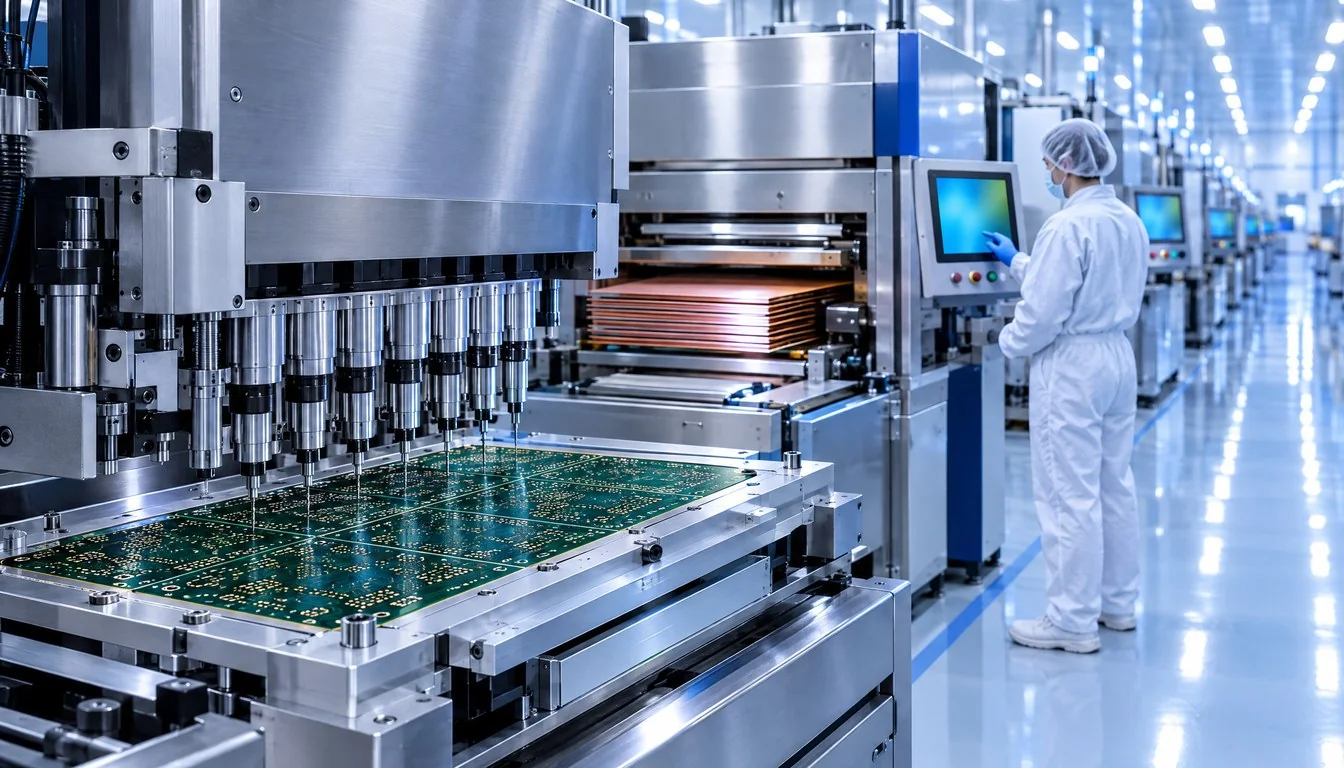
Shenzhen Han’s CNC Technology Co., Ltd. told investors on October 15, 2026 that its nine-month net profit jumped 214.03% year over year, a result the company tied directly to surging orders for the equipment that makes advanced circuit boards for AI servers, switches and optical modules. The preliminary results, covering the nine months ended September 30, 2026, showed revenue of RMB 7,840.9479 million, up 100.90% from RMB 3,902.8172 million a year earlier, according to the company’s own filing, cited by NewTimeSpace and other financial outlets tracking the Hong Kong-listed stock.
Net profit attributable to shareholders came in at RMB 1,544.1246 million, versus RMB 491.7068 million in the same period of 2025. After stripping out non-recurring items, adjusted net profit reached RMB 1,535.3974 million, up 222.52% year over year. Basic earnings per share from continuing operations rose to RMB 3.27, up from RMB 1.16 a year earlier, figures confirmed in a TradingView report citing Reuters data. For a company whose equipment sits upstream of nearly every rack server and switch shipped into China’s data center buildout, those figures read as a direct proxy for how fast AI infrastructure spending is moving through the printed circuit board supply chain.
Don't miss new tech stories on Google
Add TrendinTech once in the Google app and our stories appear in your news suggestions.
What Han’s CNC actually makes, and why it matters to AI
Han’s CNC, listed in Shenzhen under code 301200 and in Hong Kong under code 03200, does not build AI chips, AI PCBs or AI models itself. It builds the drilling, photolithography, testing, forming and lamination machines that PCB factories use to manufacture circuit boards. That distinction matters for anyone trying to size up the story: the company is a picks-and-shovels supplier to the PCB industry, and its order book is one of the clearest early readings of how much capacity China’s board makers are adding to serve AI customers.
In its October 15 statement, Han’s CNC said the jump in revenue and profit came primarily from demand for three categories of advanced boards: high-layer-count HDI (high density interconnect) boards, N+N-structure high-layer boards used in next-generation rack-server computing and switch units, and mSAP-type substrates for 800G and 1.6T high-speed optical modules. Those are the components that let a server rack move more data between GPUs, between racks, and out to the network, which is exactly the bottleneck hyperscalers have been racing to clear as GPU clusters scale past tens of thousands of accelerators.
The company said orders across its full product line grew substantially as PCB manufacturers accelerated capacity expansion and equipment upgrades, a sign that its customers are not just filling existing lines but adding new ones. That is consistent with the broader AI-infrastructure buildout; companies tracking the data center sector, including coverage already on this site of DayOne Data Centers’ IPO filing, have flagged similar capacity-expansion patterns among infrastructure suppliers feeding AI demand.
The nine-month numbers in detail
The scale of the swing is unusual even by the standards of a hot AI-adjacent supply chain. Revenue essentially doubled, but net profit more than tripled, which points to significant operating use: once the company’s PCB equipment lines are running at higher utilization, a larger share of incremental revenue flows straight to the bottom line. Operating profit for the nine months reached RMB 1,805.5151 million, up 223.54% year over year, a growth rate even steeper than the net profit line, before taxes and other items took their cut.
| Metric (nine months ended Sept. 30) | 2026 | 2025 | Change |
|---|---|---|---|
| Operating revenue | RMB 7,840.9479 million | RMB 3,902.8172 million | +100.90% |
| Net profit attributable to shareholders | RMB 1,544.1246 million | RMB 491.7068 million | +214.03% |
| Net profit excluding non-recurring items | RMB 1,535.3974 million | Not separately disclosed | +222.52% |
| Operating profit | RMB 1,805.5151 million | Not separately disclosed | +223.54% |
| Basic earnings per share | RMB 3.27 | RMB 1.16 | +181.90% |
Those figures are preliminary and unaudited, a standard practice for Chinese A-share and H-share issuers ahead of the formal quarterly report. Han’s CNC had originally scheduled a board meeting around October 20, 2026 to review the formal nine-month report, but as of this writing only the October 15 preliminary results disclosure has been confirmed; the audited quarterly filing had not been separately verified. Investors should treat the headline figures as the company’s own early read on its performance rather than the final, reviewed numbers.
Reading the third quarter on its own
Because Han’s CNC discloses cumulative nine-month figures rather than breaking out each quarter individually in the preliminary release, outside analysts have had to back into the third-quarter numbers by subtracting the first-half results. Chinese financial media, including coverage republished across multiple mainland outlets and tracked by Futunn, calculated third-quarter revenue at roughly RMB 2.86 billion, up around 87.8% year over year, with net profit of approximately RMB 590 million, up roughly 157.1%. Those are media-derived estimates rather than numbers Han’s CNC itself has broken out, so they should be read as directionally useful rather than exact.
Notably, that implied third-quarter growth rate, while still very strong, is slower than the nine-month average, which suggests the earlier part of 2026 carried more of the acceleration. That lines up with a Citi note reported by Chinese financial outlets, which said Han’s CNC’s preliminary third-quarter results came in below the bank’s expectations even as revenue and profit kept climbing by triple digits versus the prior year; the same note reportedly said sister company Han’s Laser beat its own forecasts over the same period. If that reading holds once the full quarterly report lands, it would suggest the AI-PCB order wave, while still large, may be moderating slightly quarter over quarter rather than continuing to accelerate in a straight line.
Why high-layer HDI and N+N boards are the bottleneck everyone wants to solve
HDI boards pack more connections into less space by using microvias and thinner layers than conventional multilayer boards, which is what lets a server motherboard or switch backplane carry the sheer volume of high-speed traffic that GPU clusters generate. N+N-structure boards extend that approach into very high layer counts, stacking two symmetric halves of the board together to support the dense routing a rack-server computing unit or a top-of-rack switch needs. As AI racks move toward denser GPU-to-GPU interconnects and faster switch fabrics, the PCB itself becomes a harder engineering problem, not just a commodity substrate.
That is where equipment vendors like Han’s CNC sit in the value chain: PCB fabricators cannot make thinner, higher-layer-count boards without new drilling, exposure, and inspection tools capable of the tighter tolerances those designs demand. Han’s CNC has also publicly described a six-axis independent mechanical forming machine with high-accuracy CCD alignment, built to hold production-level precision of roughly plus or minus 25 microns, a tolerance aimed squarely at the kind of high-density boards AI infrastructure requires. The memory side of the AI buildout is facing a similar precision squeeze, something covered in this site’s look at Micron’s HBM4 roadmap and the bandwidth AI workloads now demand.
The optical module angle: 800G and 1.6T mSAP substrates
The second demand driver Han’s CNC named, mSAP-type substrates for 800G and 1.6T high-speed optical modules, points to a different part of the same bottleneck: the links between racks and across the data center fabric, not just inside a single server. Modified semi-additive process (mSAP) manufacturing lets fabricators build the fine-line circuitry that optical transceiver modules need as data rates climb from 400G to 800G and now toward 1.6T, the speeds large AI clusters are adopting to keep GPUs fed with data without the network becoming the limiting factor.
Han’s CNC’s own materials describe itself as a provider of solutions for exactly this category of high-speed optical module manufacturing, alongside its established drilling, photolithography and testing equipment lines. That positions the company at a point in the supply chain that touches both the compute side of AI infrastructure, through rack-server and switch boards, and the networking side, through optical module substrates, which helps explain why a single quarter of accelerating AI capital spending could move its order book as sharply as it did. Optics and interconnect capacity has been a recurring theme elsewhere in the AI hardware stack this year, echoed in reporting on Intel’s silicon photonics supply claims for co-packaged optics.
Market and competitive context
Han’s CNC is not the only company whose results this year have been shaped by AI-linked PCB and interconnect demand, but its nine-month swing is among the sharpest disclosed by a Chinese equipment maker tied to the category, per a financial summary tracked by Investing.com. The broader picture of semiconductor and component suppliers riding the same wave was visible earlier this month when several chip names were flagged as buy picks heading into earnings season, a dynamic detailed in this site’s coverage of Nvidia, Intel, Micron and Monolithic Power ahead of Q3 results. Memory and substrate suppliers across the AI hardware chain have told a similar story of demand outrunning supply.
That said, AI-linked demand has not lifted every corner of electronics manufacturing equally. Consumer-facing hardware has told a very different story this quarter, with global smartphone shipments falling sharply as memory shortages squeezed handset makers, a trend this site covered in its report on smartphone shipments dropping 20% in their worst third quarter in 14 years. The split between booming AI-infrastructure capital spending and a strained consumer-electronics supply chain is becoming one of the defining tensions of the current hardware cycle, and Han’s CNC’s results sit firmly on the AI-infrastructure side of that divide.
| Segment | Nine-month 2026 trend | Primary driver |
|---|---|---|
| Han’s CNC (PCB equipment) | Revenue +100.90%, net profit +214.03% | AI rack-server, switch and optical-module PCB demand |
| Chip stocks flagged ahead of Q3 earnings | Multiple names named as buy picks | AI data center capex, GPU and memory demand |
| Global smartphone shipments | Down roughly 20% in Q3 | Memory component shortages, pricing pressure |
| Data center IPO activity | New listings tied to hyperscale tenant revenue | AI compute buildout and leasing demand |
Historical context: from CNC machine tools to AI-PCB equipment leader
Han’s CNC was founded in 2002 as a specialized maker of PCB production equipment, part of the broader Han’s family of companies that also includes Han’s Laser. Over two decades it built out drilling, photolithography, testing, forming, attachment and lamination equipment lines serving China’s PCB manufacturing base, which grew into the largest in the world as electronics assembly concentrated in the country. The company’s dual listing, on the Shenzhen Stock Exchange under 301200 and, since February 6, 2026, on the Hong Kong Stock Exchange under 03200, reflects an effort to widen its investor base as its growth profile shifted from a steady industrial supplier toward a company whose results now move sharply with AI infrastructure cycles.
An investor relations summary published by Quartr shows that shift has been building for more than a year. Han’s CNC’s own corporate materials describe non-IFRS net profit attributable to the parent company rising more than 100% in its 2025 first-half performance review, and the company used a January 2026 trade show appearance themed “Passion for Chips and AI, Smart Future” to position itself explicitly around AI-era PCB manufacturing. The October 2026 nine-month results are best read as the latest, and so far largest, confirmation that the AI positioning the company signaled through 2025 has translated into an order book, not just a marketing message.
Governance and leadership
Company filings reviewed by Chinese financial outlets in September identified Yang Zhaohui as chairman and executive director of Han’s CNC, with a board that also includes non-executive directors Zhang Jianqun, Zhou Huiqiang, Du Yonggang and Huang Linting, alongside independent non-executive directors Qiu Yunliang, Li Weiwei, Xin Guosheng and Xia Liya. No change to that leadership roster was reported around the October 15 results announcement, and no renaming, delisting, discontinuation or acquisition involving Han’s CNC has been confirmed in the weeks surrounding the disclosure.
What the AI-PCB demand surge signals for the broader supply chain
Equipment order books tend to lead the finished-product cycle by a quarter or more, because PCB fabricators have to buy and install new drilling, exposure and inspection tools before they can ship the boards those tools produce. That makes Han’s CNC’s order growth a useful forward indicator: if PCB manufacturers are expanding capacity for high-layer HDI, N+N boards and 800G/1.6T mSAP substrates now, the finished boards from that expanded capacity should start reaching server and switch assemblers over the following two to three quarters, assuming the capital spending holds.
That dynamic also helps explain why so much of this year’s AI-infrastructure spending story has concentrated on component and equipment suppliers rather than only on the chip designers themselves. Grid and power capacity has become its own bottleneck in the same buildout, a theme this site tracked in coverage of a 9 MVA power deal signed to support an AI data center hub in Finland. PCB equipment, memory, power delivery and optical interconnect are increasingly moving in lockstep as hyperscalers and their suppliers race to keep pace with GPU cluster deployments.
Risks and caveats in the preliminary numbers
Three caveats are worth keeping in mind. First, the October 15 figures are preliminary and unaudited; Han’s CNC’s formal nine-month and full third-quarter report had not been separately confirmed as of this writing, and the audited numbers could differ from the preliminary disclosure once released. Second, the implied third-quarter growth rate, as calculated by outside analysts rather than disclosed directly by the company, appears to have slowed from the blistering pace seen earlier in 2026, and a Citi note reported by Chinese financial media described the preliminary third-quarter print as coming in below expectations even as it kept growing at triple-digit year-over-year rates. Third, Han’s CNC’s own disclosures do not provide official list prices, specific customer names or delivery schedules for its 800G/1.6T-related equipment, so claims about future revenue from that category remain demand commentary rather than contracted backlog.
Market impact and investor reaction
For a dual-listed equipment maker, a 214% jump in nine-month net profit against a 101% revenue increase is the kind of print that tends to draw attention from both mainland A-share investors and the newer base of Hong Kong-listed shareholders who came in after the February 2026 H-share listing. The operating use embedded in the numbers, profit growing more than twice as fast as revenue, is the detail likely to matter most to analysts modeling how much further margin expansion the AI-PCB order wave can deliver if volumes keep climbing. At the same time, the gap between the stronger nine-month average and the softer implied third-quarter trend is the kind of detail that tends to show up in analyst notes as a reason for caution rather than unqualified enthusiasm, consistent with the Citi commentary reported alongside the results.
Predictions: where the AI-PCB order cycle goes next
Based on the trajectory disclosed so far, a few directional calls look reasonable, though none of them are guaranteed given how early this disclosure cycle still is.
- Expect Han’s CNC’s formal third-quarter and nine-month report, once filed, to confirm the broad direction of the preliminary numbers, even if some line items shift modestly after audit.
- Watch for other Chinese PCB-equipment and substrate suppliers to report similar, if less dramatic, order growth tied to high-layer HDI, N+N boards and 800G/1.6T optical-module substrates over the next two reporting cycles.
- If the implied third-quarter slowdown that Citi flagged proves durable rather than a one-quarter blip, expect more analyst scrutiny of whether AI-PCB equipment demand is plateauing after an unusually steep 2026 ramp.
- Optical-module substrate demand tied to 1.6T speeds looks likely to keep growing through 2027 as hyperscalers push network fabric upgrades alongside their next GPU cluster generations.
- Expect continued investor interest in Han’s CNC’s Hong Kong-listed shares as international funds look for direct exposure to China’s AI-PCB equipment supply chain without buying into chip-design-level geopolitical risk.
How Han’s CNC fits into the AI hardware stack
It is worth stepping back to place Han’s CNC’s results in the context of the full AI hardware stack rather than treating it as an isolated earnings beat. GPUs and AI accelerators sit at the top of that stack, memory suppliers feed them with high-bandwidth capacity, power and cooling infrastructure keeps the racks running, and PCBs, substrates and optical interconnects carry the signals between every one of those layers. Han’s CNC’s results are a reminder that the interconnect layer, often the least visible part of the stack to anyone outside the PCB industry, is seeing some of the sharpest percentage growth of the entire AI buildout right now, precisely because it was not built to handle today’s data rates and layer counts when most of this manufacturing capacity was first installed.
That also means Han’s CNC’s order book is a useful thing to watch for anyone trying to gauge whether AI infrastructure spending is broadening or concentrating. A continued surge in equipment orders for high-layer-count boards and high-speed optical substrates would suggest hyperscalers and their PCB suppliers are still in the early stages of upgrading capacity, with more spending still to come. A flattening of that order growth, by contrast, would suggest the current capacity-expansion wave is closer to its peak, at least for the categories Han’s CNC serves.
Frequently asked questions
What did Shenzhen Han’s CNC Technology actually report on October 15, 2026?
The company disclosed preliminary nine-month results for the period ended September 30, 2026, showing operating revenue of RMB 7,840.9479 million, up 100.90% year over year, and net profit attributable to shareholders of RMB 1,544.1246 million, up 214.03% year over year.
Does Han’s CNC make AI chips or AI PCBs itself?
No. Han’s CNC manufactures the drilling, photolithography, testing, forming and lamination equipment that PCB factories use to produce advanced circuit boards. It is an equipment supplier to the PCB industry, not a chip designer or board manufacturer.
Why did net profit grow faster than revenue?
The company’s nine-month net profit grew 214.03% against revenue growth of 100.90%, implying significant operating use as higher equipment utilization and order volume let a larger share of incremental revenue flow through to profit.
What specific AI-related demand did Han’s CNC cite?
The company pointed to demand for high-layer-count HDI boards, N+N-structure high-layer boards used in next-generation rack-server computing and switch units, and mSAP-type substrates for 800G and 1.6T high-speed optical modules.
Are these results final?
No. The October 15 figures are preliminary and unaudited, which is standard practice for Chinese-listed companies ahead of their formal quarterly report. The audited nine-month and third-quarter report had not been separately confirmed as of this writing.
Where is Han’s CNC listed?
Han’s CNC trades on the Shenzhen Stock Exchange under code 301200 and, since February 6, 2026, on the Hong Kong Stock Exchange under code 03200.
Did every part of Han’s CNC’s business grow equally?
The company said orders grew substantially across its full product line, but outside analysts, including a Citi note reported by Chinese financial media, suggested the implied third-quarter growth rate was softer than the nine-month average and came in below expectations, even though it still grew at triple-digit rates year over year.
How does this connect to the broader AI infrastructure buildout?
Han’s CNC’s equipment sits upstream of the PCBs used in AI servers, switches and optical modules, making its order growth an early indicator of how much capacity PCB manufacturers are adding to serve AI data center demand, alongside related moves in chips, memory and power infrastructure across the sector.
Related Coverage
Helena Marsh
Helena Marsh is the Editor-in-Chief at TrendinTech, where she leads editorial strategy and oversees coverage across artificial intelligence, cybersecurity and enterprise technology. She believes technology reporting should be rigorous and plainly written, so readers understand what actually changes for them rather than what a company's announcement promises.
All stories by Helena Marsh (269)