Chip CEO Sold Apartment, Cashed Pension for $200K Bet [2026]

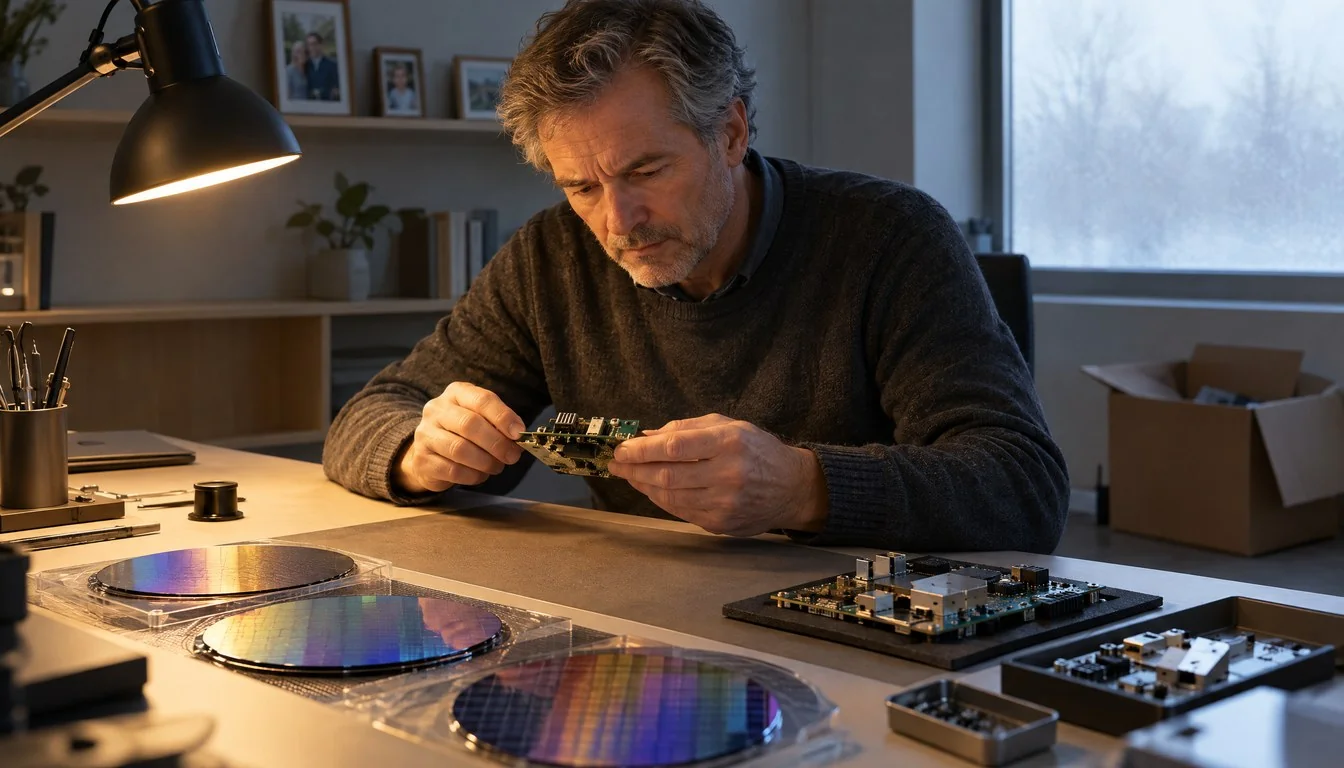
Hans Hasselby-Andersen was 38 years old, with four children between the ages of 5 and 14, when he walked away from a stable engineering career at Texas Instruments in September 2008. He sold his apartment. He sold his car. He cashed out his pension. Then he and his cofounders went looking for roughly $150,000 to $200,000 in seed capital, the kind of money that in a hardware business disappears in about six months. Eighteen years, one acquisition, and a second startup later, the Danish executive is telling that story publicly again, and the semiconductor industry is paying attention.
Business Insider published Hasselby-Andersen’s account on October 20, 2026, under the headline “I sold my apartment, cashed out my pension, and took on debt to build a semiconductor startup. I’d do it again.” He is now CEO and an investor at Lotus Microsystems, a Danish semiconductor startup, a role distinct from the one he held at his earlier company, Merus Audio, which he cofounded and which Infineon acquired in 2018, nine years after it was founded. The essay lands at a moment when chip founders everywhere are running the same math he ran in 2008: how much personal risk is reasonable to take on when the payoff, if it comes at all, is measured in years rather than months.
Don't miss new tech stories on Google
Add TrendinTech once in the Google app and our stories appear in your news suggestions.
What Hans Hasselby-Andersen Actually Said
The broad strokes of the story are straightforward, but the specifics matter because they explain why the account has traveled so quickly through chip-industry circles. Hasselby-Andersen left Texas Instruments in September 2008, at the start of the global financial crisis, to help build what became Merus Audio. He and his wife sold their apartment and moved into a rental. They sold their car and leased a replacement. He withdrew his pension savings. The founding team raised the equivalent of roughly $150,000 to $200,000 to get the company off the ground, and by his own account that money ran out in about six months, a timeline that will sound familiar to anyone who has tried to stretch a hardware budget through a single prototype run.
Merus Audio survived that stretch and nine more years of development before Infineon bought the company in 2018. That outcome is the reason Hasselby-Andersen frames his current bet at Lotus Microsystems, where he serves as CEO and investor rather than as a founder, in the same terms. Asked why he kept drawing down his retirement savings rather than treating the pension as untouchable, he put it bluntly: “I need it now. I’m not about to be retired anyway.” Asked whether he would repeat the decision today, knowing how close to the edge it pushed his family, his answer was equally direct: “Would I take that same risk again today as I did with Merus? I think the answer is yes.”
Business Insider’s account does not specify a dollar figure for the debt Hasselby-Andersen says he took on, nor does it name a product, a chip specification, or a founding date for Lotus Microsystems. Those gaps are worth flagging rather than filling in: the headline’s claim about debt is the one detail in the story that the published excerpt does not spell out in dollar terms, and no other outlet has yet added that specificity.
Why a Single Founder Story Is Resonating Industry-Wide
Semiconductor startups occupy a strange place in the current technology cycle. Software founders can ship a minimum viable product to a browser in a weekend and start iterating on real user feedback almost immediately. Chip founders cannot. A fabless semiconductor startup generally needs somewhere between $2 million and $5 million in seed funding just to reach its first tape-out, along with a stable foundry relationship and export-control compliance in place before a single wafer gets cut, according to startup-formation guidance published by JIM. That is the funding bar for a company just getting to its first silicon, not for scaling a working product into a business.
Measured against that bar, the $150,000 to $200,000 Hasselby-Andersen says his team raised in 2008 looks less like seed capital and more like survival money, enough to keep a handful of engineers fed while they tried to prove an idea was real. That gap between what a chip company actually needs and what early believers are usually willing to put in first is the structural reason founders in this industry keep ending up personally exposed. It is also why his story is being read less as a one-off hardship tale and more as a data point about how the entire category gets built.
Readers tracking the broader AI hardware buildout have seen variations on this tension play out across the supply chain all year, from Micron’s HBM4 roadmap bets on 2.6x memory bandwidth to Samsung tapping TSMC’s 3nm lines for Nvidia’s next HBM base die. Those are stories about companies with balance sheets that can absorb years of capital-intensive development. Hasselby-Andersen’s essay is a reminder of what the earliest stage of that same industry looks like from the inside, with none of that cushion.
The 2008 Backdrop: Starting a Chip Company During a Financial Crisis
Context matters here. Hasselby-Andersen did not leave Texas Instruments during a boom. He left in September 2008, the same month Lehman Brothers collapsed and credit markets froze worldwide. Raising any kind of capital for a hardware company in that window was unusually difficult, and the six-month runway his seed money provided left essentially no margin for a slow fundraising cycle or a failed prototype run. That timing is part of why the Merus Audio story has stuck with people inside the Danish and broader European chip scene for close to two decades: the company did not just survive a hard technical problem, it survived starting during the worst financing environment in a generation.
Merus Audio went on to develop audio amplifier chips and operated for roughly nine years before Infineon acquired it in 2018. Infineon, one of the largest European semiconductor manufacturers, has used acquisitions like this one as a standard way to add specialized analog and mixed-signal design teams without building that expertise in-house. For Hasselby-Andersen personally, the acquisition appears to have been the payoff that, by his telling, retroactively justified the apartment sale, the car swap, and the pension withdrawal. It is also precisely the kind of multi-year outcome that makes his willingness to “take that same risk again” a meaningful statement rather than a throwaway line: he is not speaking hypothetically about a bet he has not yet had to make twice.
Lotus Microsystems: A Different Role, the Same Appetite for Risk
What makes the current chapter notable is the change in his role. At Merus Audio, Hasselby-Andersen was a cofounder building something from zero. At Lotus Microsystems, the Danish semiconductor startup where he now serves, he is CEO and an investor, not one of the original founders. That distinction matters for how the industry is reading his comments. He is not describing the adrenaline of a first-time founder with nothing to lose; he is describing a 56-year-old executive with an established track record choosing, again, to put his own capital and financial security behind a hardware bet rather than taking a safer executive role at an established company.
Business Insider’s published account does not detail what Lotus Microsystems builds, when it was founded, or what its current product roadmap looks like, and no other verified reporting fills in those specifics as of October 20, 2026. What is on the record is the framing: Hasselby-Andersen sees his move into the CEO seat at Lotus as a continuation of the same risk calculus that defined the Merus years, applied by someone who, by his own account, no longer treats a traditional retirement timeline as a constraint.
How Semiconductor Founder Risk Compares to Software Founder Risk
It’s worth putting hard numbers next to the qualitative difference every chip founder describes when asked why their experience feels different from a software founder’s. The comparison below draws on the funding-stage guidance published by JIM and on general industry patterns for capital intensity and time-to-revenue.
| Factor | Fabless semiconductor startup | Typical SaaS software startup |
|---|---|---|
| Capital needed to reach first testable product | $2 million to $5 million for first tape-out | Often under $250,000 for an MVP |
| Time to first testable product | 12 to 24 months for first silicon | Weeks to a few months |
| Cost of a design mistake | A failed tape-out can cost months and a fresh mask set | A failed release can be patched same-day |
| Dependency chain before shipping | Foundry capacity, export-control compliance, packaging partners | Cloud hosting account and a domain name |
| Founder’s personal financial exposure (as described by Hasselby-Andersen) | Apartment sold, car sold, pension withdrawn, debt taken on | Varies widely; often limited to forgone salary |
None of the figures in the software column are drawn from Hasselby-Andersen’s own story; they are included only to illustrate why chip founders describe their funding environment as categorically harder than the one software founders navigate. The gap between “$2 million before you have anything to show a customer” and “a few hundred thousand dollars to get a working app in front of users” is the entire reason personal-asset bets like his keep showing up in semiconductor founder accounts specifically, far more often than in software ones.
Not an Isolated Case: Other Chip Founders Made the Same Bet
Hasselby-Andersen’s willingness to describe his own exposure publicly is relatively rare, but the underlying pattern, of engineers leaving stable corporate roles to absorb outsized personal risk for a chip company, is well documented elsewhere in the industry. Jonathan Ross, founder and CEO of AI-chip company Groq, has described his own 2016 decision to leave Google in similar terms. As one account of his thinking put it, “For him, the risk involved in leaving to launch Groq in 2016 was far less than the risk of staying in-house and watching the project die,” a framing laid out in a profile published by The Lean Startup. The specific risk calculus differs, Ross weighed stagnation against departure rather than apartment equity against pension savings, but the underlying logic is the same: staying in a comfortable role carried its own cost that these founders judged to be worse than the financial exposure of leaving.
That pattern shows up again in the venture data. A directory tracking debt-financed semiconductor companies lists 26 startups that have turned to debt financing as of October 2026, according to VCBacked, a sign that founder-level and company-level debt exposure in this sector is a structural feature of the financing environment rather than an outlier choice. Separately, a tally from Failory counts 41 semiconductor unicorn startups globally as of 2026, concentrated heavily in the United States and China, a reminder of just how long and capital-intensive the road from a founder’s personal sacrifice to a billion-dollar valuation actually is.
The Market Backdrop: Chip Valuations Are Volatile Even as Private Funding Stays Hot
Hasselby-Andersen’s essay is landing during a period of genuine turbulence in chip-sector financing, which adds weight to why it is resonating now rather than being read as a nostalgia piece about 2008. Private semiconductor markets have stayed active even as public chip stocks have pulled back sharply in recent sessions, a divergence detailed in an October 2026 industry note from Chip Briefing, which also pointed out how exposed large institutional holders, including major pension funds with concentrated positions in chipmakers like Samsung Electronics and SK Hynix, have become to swings in the sector. That detail lands with particular irony next to Hasselby-Andersen’s own decision to cash out a pension to fund a chip startup: pension capital and chip-sector risk are intertwined at both the individual founder level and the institutional level right now.
That volatility is visible elsewhere in TrendinTech’s recent coverage of the chip supply chain, including analysts naming Nvidia, Intel, Micron, and Monolithic Power Systems as buy picks ahead of Q3 earnings, and Nvidia’s shrinking share of the China AI chip market as domestic rivals gain ground. Those are large-company stories about public-market sentiment. Hasselby-Andersen’s account is the small-company mirror image: a reminder that behind every chip firm large enough to be a buy-side stock pick, there was usually a founder-level version of his bet made years or decades earlier.
Lotus Microsystems in the Danish and European Chip Context
Denmark is not typically listed among the largest semiconductor hubs, but it has produced a disproportionate number of specialized analog and mixed-signal design firms, Merus Audio among them, that larger players have been willing to acquire for their engineering talent rather than their manufacturing footprint. Lotus Microsystems, as a Danish semiconductor startup with Hasselby-Andersen now in the CEO seat, fits that same regional pattern of small, design-focused teams rather than companies attempting to compete with the capital intensity of a TSMC or a Samsung foundry buildout.
That regional specialization also means Lotus Microsystems is likely competing for the same scarce pool of specialized analog design engineers and early-stage European chip capital that firms like Micrel Semiconductor’s design-heavy predecessors once drew from, rather than competing head-on with the AI-accelerator giants dominating headlines elsewhere in the industry. It is a narrower, more technical lane, and historically it has been the lane where European chip founders have had their clearest exits, Merus Audio’s sale to Infineon being the exact template.
What the Story Says About Founder Mental Health and Family Risk
One detail in Hasselby-Andersen’s account deserves more attention than it has gotten in early coverage: he had four children, ages 5 to 14, when he made the decision to leave Texas Instruments. Most founder-risk narratives in tech media center on young, unattached engineers with little to lose. His story is explicitly the opposite case, a mid-career parent with dependents choosing to liquidate the family’s housing stability and retirement savings at the exact moment, September 2008, when job security elsewhere in the economy was also disappearing fast.
That combination, young children plus a collapsing broader economy plus a six-month runway, is about as high-stakes a founder scenario as exists in hardware entrepreneurship, and it is a large part of why his “I’d do it again” framing carries weight rather than reading as bravado. He is not saying the choice was easy or safe. His own words, “I need it now. I’m not about to be retired anyway,” suggest a pragmatic reckoning with mortality and opportunity rather than reckless optimism about the odds.
Who Else Is Building Chips on Founder Capital Right Now
Hasselby-Andersen’s story is surfacing at a moment when chip-startup formation is unusually active, driven heavily by the AI buildout. The table below sketches how his 2008 funding round compares with broader current patterns in semiconductor seed financing, based on figures from JIM’s 2026 startup-formation guidance and the VCBacked debt-financing directory.
| Metric | Hasselby-Andersen’s 2008 Merus Audio round | Typical fabless chip startup, 2026 guidance |
|---|---|---|
| Reported seed capital | Approximately $150,000 to $200,000 | $2 million to $5 million recommended before first tape-out |
| Runway on that capital | About 6 months | Typically structured for 18 to 24 months to first silicon |
| Personal asset exposure | Apartment sold, car sold, pension withdrawn, debt taken on | Varies; founder debt financing documented across at least 26 startups industry-wide as of October 2026 |
| Path to exit | Acquisition by Infineon in 2018, 9 years after founding | Varies widely; 41 semiconductor unicorns counted globally in 2026 |
The contrast is stark. Hasselby-Andersen’s team ran its venture on roughly a tenth of what current guidance recommends as a minimum seed round, with a runway about a third as long as a well-capitalized fabless startup would target today. That he still reached a nine-year path to acquisition suggests either unusual resilience, unusually favorable early traction, or some combination the public account does not fully detail. What is clear is that the gap between what he had and what the playbook now says a chip founder needs has only grown wider since 2008, even as more capital overall has flowed into the sector.
How Engineers Weigh This Decision in 2026
For engineers currently employed at large chip companies and weighing whether to leave for a startup, Hasselby-Andersen’s account functions less as a motivational story and more as an unusually candid cost disclosure. Most founder interviews gloss over the personal balance-sheet details; his does not. That candor is likely part of why the piece is circulating widely among hardware engineers specifically, a population that tends to be skeptical of survivorship-biased success stories and more receptive to accounts that show the actual mechanics of how a founder covered payroll during the lean months.
It also arrives alongside a wave of recent coverage of AI-driven engineering productivity tools that, on paper, should lower the capital bar for hardware startups over time, from Silicon Labs wiring AI coding agents directly into its chip development SDK to broader moves by Nvidia opening roughly 1,400 AI tools to European developers at no cost. Whether tools like those meaningfully shrink the $2 million to $5 million tape-out threshold JIM describes, or whether they simply speed up the design phase without touching the fabrication costs that dominate chip-startup budgets, is an open question the industry has not yet answered.
Predictions: Where This Story and the Broader Trend Go Next
Based on the funding patterns and market signals around this story, a few developments look likely over the coming months.
- Expect more founder-level personal-finance disclosures from chip entrepreneurs as AI-driven interest in semiconductor startups pulls in a new wave of founders who have not yet internalized how capital-intensive the category is compared with software.
- Lotus Microsystems is likely to face increased scrutiny and interest from Danish and broader Nordic tech press simply because of the attention this essay has generated, regardless of what the company’s actual product roadmap looks like.
- Debt financing for semiconductor startups, already documented across at least 26 companies as of October 2026 according to VCBacked, will likely keep growing as a financing tool, since equity rounds alone have not closed the gap between the $2 million to $5 million tape-out threshold and what early-stage investors are willing to commit before a company has working silicon.
- Institutional exposure to chip-sector volatility, including pension fund holdings concentrated in companies like Samsung Electronics and SK Hynix, will likely remain a recurring financial-press storyline given the swings documented by Chip Briefing in October 2026.
- Stories that combine personal financial risk with hardware entrepreneurship will likely keep outperforming conventional founder profiles in engagement, since they offer a level of specificity, actual numbers on an apartment, a pension, a six-month runway, that generic “founder journey” content rarely provides.
The Bigger Picture for Semiconductor Entrepreneurship
Hasselby-Andersen’s account is a reminder that the chip industry’s current AI-driven boom sits on top of a financing structure that has not fundamentally changed since he left Texas Instruments in 2008. The capital requirements have grown, not shrunk, even as more total venture money has flowed into the sector. Founders still routinely bridge the gap between what investors are willing to put in early and what a tape-out actually costs with their own assets, their own pensions, and in his case, debt he says he took on but has not detailed publicly.
What makes his story land differently from the usual founder-risk genre is the combination of candor and outcome. He is not a 25-year-old recounting a gamble that paid off before he had much to lose. He is a 56-year-old executive, a parent of four at the time of his original decision, describing a calculated reckoning with mortality, opportunity, and risk that he says he would still make the same way today. For an industry that depends on a steady supply of engineers willing to make exactly that calculation, his willingness to spell out the real numbers, rather than the usual sanitized founder-journey version, may end up being the more consequential part of the story.
Frequently Asked Questions
Who is Hans Hasselby-Andersen?
He is the 56-year-old CEO and an investor at Lotus Microsystems, a Danish semiconductor startup. He previously cofounded Merus Audio, which Infineon acquired in 2018, nine years after it was founded. He left Texas Instruments in September 2008 to help start Merus Audio.
What did Hans Hasselby-Andersen say he sacrificed to fund his startup?
According to his account published by Business Insider on October 20, 2026, he and his wife sold their apartment and moved into a rental, sold their car and leased a replacement, and withdrew his pension savings. He also says he took on debt, though the published account does not specify an amount.
How much money did he raise for Merus Audio?
He says the founding team raised the equivalent of roughly $150,000 to $200,000, and that the money was spent in about six months.
Is Hans Hasselby-Andersen a founder of Lotus Microsystems?
No. He is CEO and an investor at Lotus Microsystems, a role distinct from his position as a cofounder of Merus Audio.
What happened to Merus Audio?
Infineon acquired Merus Audio in 2018, nine years after the company was founded.
Why does starting a semiconductor company require more capital than a software startup?
Fabless chip startups typically need $2 million to $5 million just to reach a first tape-out, along with a foundry relationship and export-control compliance, according to 2026 startup-formation guidance from JIM. Software startups can often reach a testable product for a fraction of that cost in a fraction of the time.
Is debt financing common among semiconductor startups?
Yes. A directory tracking the sector lists at least 26 semiconductor startups that have used debt financing as of October 2026, according to VCBacked, suggesting founder and company-level debt exposure is a structural feature of chip financing rather than a rare choice.
Would Hans Hasselby-Andersen make the same decision again?
Yes, according to his own words: “Would I take that same risk again today as I did with Merus? I think the answer is yes.”
Related Coverage
Helena Marsh
Helena Marsh is the Editor-in-Chief at TrendinTech, where she leads editorial strategy and oversees coverage across artificial intelligence, cybersecurity and enterprise technology. She believes technology reporting should be rigorous and plainly written, so readers understand what actually changes for them rather than what a company's announcement promises.
All stories by Helena Marsh (268)