Intel’s Oct. 16 FCC Filing Challenges Robot Ban [2026]

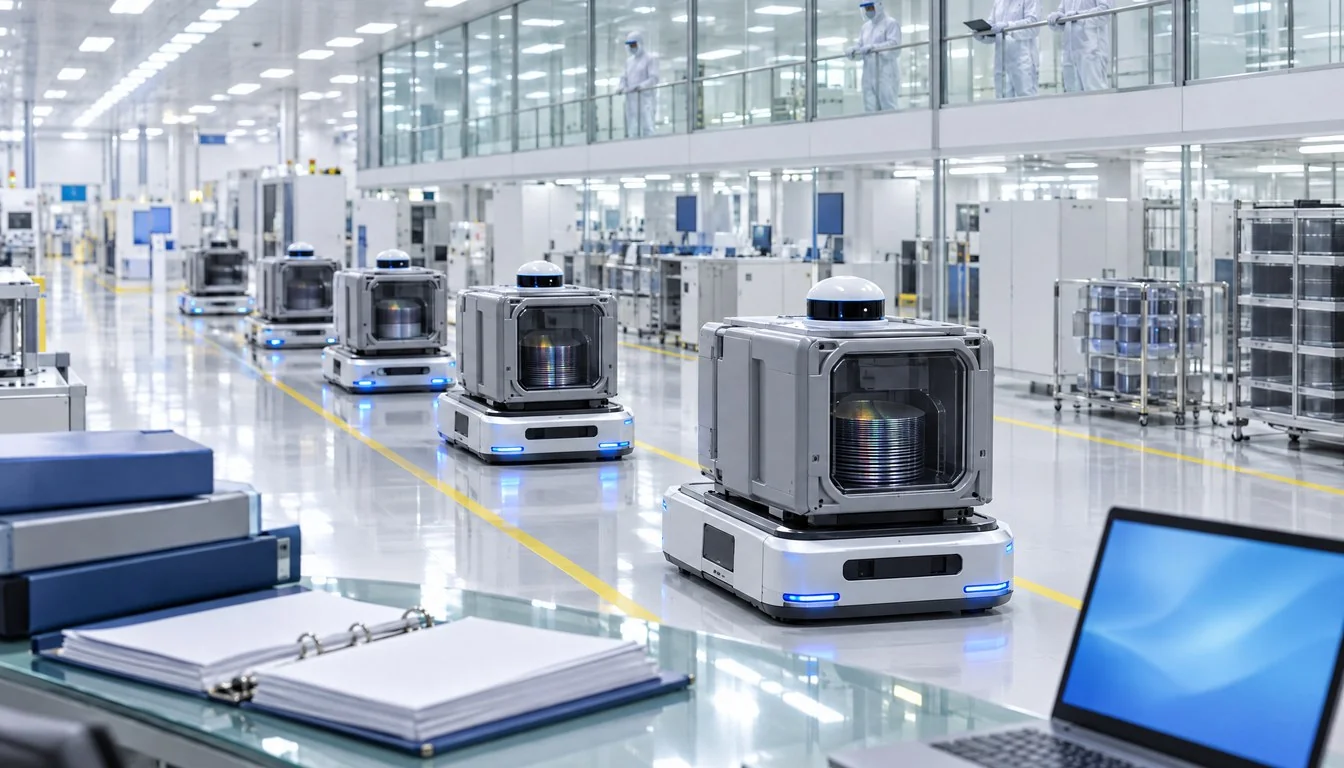
Intel Corp. has asked the Federal Communications Commission to carve out an exception to a ban on foreign-made advanced robotics, telling the agency that a fleet of automated guided vehicles inside its chip plants cannot simply be swapped out or left to rot on the factory floor. The petition, filed October 16, 2026, and made public three days later, puts one of the country’s largest semiconductor manufacturers in the odd position of asking federal regulators for permission to keep servicing machines that move wafers and materials around its own buildings.
Bloomberg Law broke the filing first, reporting that Intel is seeking relief tied to its automated guided vehicles, commonly called AGVs, which ferry raw materials and in-process components through its semiconductor manufacturing lines. Law360 followed with its own account of the filing, describing the equipment as vehicles used in the chipmaking process that could otherwise fall under a prohibition on new, non-domestic advanced robotic technology.
Don't miss new tech stories on Google
Add TrendinTech once in the Google app and our stories appear in your news suggestions.
What Intel Actually Told the FCC
According to Bloomberg Law’s reporting on the petition, Intel described the equipment at issue as “niche” machinery that is critical to American semiconductor manufacturing. The company argued that keeping its AGVs operational is “critical” to national security, a framing that leans directly on the same security language the FCC itself used when it built the restriction in the first place. Intel’s filing does not ask the FCC to lift the broader ban. Instead, it asks for an exception narrow enough to cover the specific vehicles the company already has installed and running inside its fabs.
That distinction matters. Intel is not claiming its AGVs were wrongly added to a blocked category. It is arguing that continued access, the ability to service, patch, or upgrade machines it already owns, should not be treated the same as importing brand-new foreign robots. Law360’s coverage frames the ask as a waiver for vehicles already in use, not a request to bring in additional new units built abroad.
Neither Bloomberg Law nor Law360 named the manufacturer behind Intel’s AGV fleet, the countries where the vehicles were built, or what specific upgrades Intel wants to make. Those details were not available in the public reporting as of October 19, 2026. What is confirmed is simpler: a major American chipmaker thinks a federal robotics restriction could reach equipment it depends on daily, and it has gone to the regulator that wrote the rule to ask for room to keep operating.
The FCC’s Covered List Ban, Explained
To understand why Intel needed to file anything at all, you have to go back to July 28, 2026. That is the date the FCC added foreign-produced mobile robots and networked power inverters to its Covered List, according to a client alert from Kirkland & Ellis. The Covered List is the FCC’s running catalog of equipment and services the agency has determined pose an unacceptable risk to US national security or to the safety of American citizens. Once something lands on that list, the practical effect is immediate: new models generally cannot receive the equipment authorization required to be imported, marketed, or sold in the United States.
Law firm Fenwick laid out the mechanics in its own client note, pointing out that the restriction is forward-looking rather than retroactive. Models that already held FCC authorization before July 28, 2026 can keep being sold. Devices that companies already own and have deployed are not affected by the ban itself. The line the FCC drew sits specifically at new foreign-made models seeking authorization for the first time after that date.
Security coverage site The Hacker News summarized the move under the headline “FCC Blocks New Foreign-Produced Robots and Power Inverters Over Cyber Risks,” tying the decision to the same category of cyber-risk reasoning the commission has applied to telecom gear and networking equipment in prior Covered List actions. The addition of power inverters alongside robots is notable on its own: networked inverters sit inside solar installations, battery storage systems, and increasingly inside data center backup power, which gives the ban a reach well beyond factory floors.
The Narrow Exception That Already Exists
The FCC did not leave zero room to maneuver when it built the rule. Fenwick’s analysis notes that the commission issued a temporary waiver covering qualifying software and firmware changes, applicable to advanced robotic devices and power inverters that were authorized before July 28, 2026. That waiver runs through at least January 1, 2029, and its stated purposes include patching security vulnerabilities and making older hardware compatible with different operating systems. In plain terms, companies that already have FCC-authorized robots or inverters in the field can keep updating the code that runs on them for roughly two and a half more years, even though brand-new foreign models cannot get fresh authorization.
That waiver is almost certainly the opening Intel’s lawyers are trying to widen. If Intel’s AGVs were authorized before the cutoff date, the software and firmware waiver may already cover basic patching. Intel’s petition appears to ask for something broader, given that Bloomberg Law describes the company’s request in terms of keeping the robots “operational,” a phrase that suggests hardware upgrades or replacement parts rather than code pushes alone.
Why Chip Plants Run on Robots in the First Place
Semiconductor fabs are not factories in the traditional sense. A modern fab is closer to a sealed clean room the size of several football fields, where airborne particles measured in fractions of a micron can ruin a wafer worth thousands of dollars. Human foot traffic through these spaces is minimized by design, both to protect worker safety around hazardous chemicals and to cut the particle contamination that comes with people simply walking around. Automated guided vehicles exist to solve that problem: they move wafer carriers, chemical canisters, and raw materials between process stations without a person needing to carry anything by hand.
Losing access to parts, upgrades, or replacement units for that fleet is not a cosmetic inconvenience. If an AGV breaks down on a production floor and there is no authorized path to repair or replace it, the fallback is manual material handling, which slows throughput and reintroduces exactly the contamination risk the automation was built to eliminate. That is the practical case behind Intel calling the equipment “niche,” a word that undersells how specialized this machinery actually is. Very few vehicle categories are purpose-built for semiconductor clean rooms, and the supplier base for that kind of hardware is small by design.
That scarcity is also why a blanket restriction on foreign robotics creates sharper problems for chipmaking specifically than it does for, say, consumer robot vacuums. A homeowner who cannot buy a new foreign-made robovac has dozens of domestically authorized alternatives. A fab operator whose AGV supplier happens to be based outside the US, and whose equipment now falls on the wrong side of a Covered List addition, may not have an equivalent domestic option sitting on a shelf.
Timeline: From Covered List Addition to Intel’s Petition
The sequence of events laid out across Bloomberg Law, Law360, Fenwick, and Kirkland & Ellis’s reporting and analysis gives a clear picture of how quickly this moved from regulatory action to corporate pushback.
| Date | Event | Source |
|---|---|---|
| July 28, 2026 | FCC adds foreign-produced advanced robotic devices and networked power inverters to its Covered List | Kirkland & Ellis |
| Before July 28, 2026 | Previously authorized robot and inverter models remain eligible for continued sale; owned devices unaffected | Fenwick |
| October 2, 2026 | Matic robot vacuum (model 4MA0001) and its charging dock become the first devices added to the FCC’s ban waiver list | GNN HD |
| October 16, 2026 | Intel files its petition seeking an exception for chip plant automated guided vehicles | Bloomberg Law, Law360 |
| October 19, 2026 | The FCC makes Intel’s petition public | Bloomberg Law |
| Through January 1, 2029 | FCC’s software and firmware waiver window stays open for patching and compatibility updates on pre-ban devices | Fenwick |
Less than ten weeks separate the July 28 restriction from the first device clearing the ban waiver list in early October, and Intel’s petition landed just two weeks after that. This is not a slow-moving regulatory fight playing out over years. Companies that depend on foreign robotics are moving fast to figure out where they stand.
The Matic Case Shows How the Waiver Process Actually Works
Intel is not the first entity to test the FCC’s waiver mechanism, and the first real-world example is almost comically low-stakes by comparison. Coverage from GNN HD detailed how, on October 2, 2026, the FCC added the original Matic robot vacuum, model 4MA0001, and its charging dock, model 4DK0008, to its ban waiver list. The twist in that story is that the Matic reportedly did not need the waiver at all, because its radio hardware was not the type the restriction targets in the first place. The company applied anyway, and the agency approved it, giving the public its first look at how a waiver application actually moves through the FCC.
That precedent matters for reading Intel’s chances. If the FCC was willing to grant a waiver to a consumer robovac maker that arguably did not even need one, a request from a chipmaker arguing that its AGVs are tied to national security interests, using nearly the same language the FCC used to justify the original ban, has a reasonable procedural path forward. The question is less whether the FCC will engage with Intel’s filing and more how narrowly or broadly it defines the exception it grants.
Who Actually Reviews These Requests
Industry newsletter Robots and Startups, written by robotics investor Andra Keay, published an analysis after the ACTUATE robotics conference that sheds light on how the FCC’s approach has evolved. According to that newsletter, the FCC has shifted its posture from targeting individual companies toward blocking entire product categories of foreign-made devices, a framing that applies to any qualifying country of origin rather than singling out one nation. The newsletter also noted that conditional approval typically takes four to eight weeks once a petition is filed, giving Intel a rough window for when it might hear back.
That category-based approach explains why Intel’s filing reads the way it does. Rather than arguing that its specific AGV supplier should be cleared by name, Intel’s petition is built around the functional role the vehicles play inside chip manufacturing, which is the kind of argument that lines up with a regulator evaluating equipment classes rather than individual vendors.
What’s Blocked, What’s Not: Reading the Covered List Rule Correctly
A lot of confusion around Covered List actions comes from treating them as outright sales bans on existing products, which is not accurate. Consumer Reports, in a segment covered by local station KRGV, explained that federal cybersecurity restrictions are changing which new routers, robot vacuums, drones, and other connected devices can be sold in the US going forward, but that many devices already approved for sale remain available on store shelves. The organization’s reporting also flagged that the changes could eventually narrow product selection over time as older authorizations age out, even though nothing disappears from the market overnight.
| Category | Status Under the Ban | Note |
|---|---|---|
| New foreign-made advanced robotic devices | Blocked from new FCC equipment authorization | Added to Covered List July 28, 2026 |
| New foreign-made networked power inverters | Blocked from new FCC equipment authorization | Added to Covered List July 28, 2026 |
| Previously authorized robot and inverter models | Can still be sold | Authorization predates July 28, 2026 cutoff |
| Devices already owned and deployed | Unaffected by the ban | Applies to existing fleets, including Intel’s AGVs |
| Software and firmware updates on pre-ban devices | Permitted under temporary waiver | Waiver window runs through at least January 1, 2029 |
| Intel’s requested AGV exception | Pending FCC review | Filed October 16, 2026, made public October 19, 2026 |
Read against that table, Intel’s existing AGV fleet was probably never in danger of being physically shut down or confiscated. The real risk sits downstream: no clear path to buy replacement parts, add new units from the same supplier, or make hardware-level changes that fall outside the scope of the software and firmware waiver. That is a slower, quieter kind of pressure than an outright ban, but over a few years it can still force a company to either qualify a new supplier, redesign its material-handling process, or absorb higher costs finding domestic alternatives.
Market Impact for US Chipmaking
Intel’s position inside the US semiconductor industry gives this filing weight beyond its own factories. The company continues to be treated as a bellwether for domestic chip manufacturing capacity, and its petition arrives while the US government is simultaneously pushing to reshore more advanced chip production and tightening restrictions on the foreign hardware that keeps factories running. Those two policy goals, building more domestic fab capacity while restricting foreign-made automation equipment that fabs depend on, are not automatically compatible, and Intel’s filing is one of the clearest public examples yet of where they can collide.
Startups building general-purpose robot foundation models for industrial use are watching this process too, since any precedent the FCC sets for Intel could shape how fast newer robotics suppliers can get equipment authorized for American factories. Other chipmakers with similar automated material-handling setups are likely watching the outcome closely, even if none have filed a comparable public petition yet. A ruling that grants Intel a workable exception could effectively set the template other semiconductor manufacturers use to request their own waivers. A ruling that holds the line narrowly could push fabs across the industry toward re-qualifying domestic AGV suppliers faster than planned, adding cost and schedule risk to facilities that are often already running behind construction timelines tied to federal incentive programs.
The power inverter half of the Covered List addition carries its own ripple effects worth tracking alongside the robotics side. Networked inverters sit inside solar farms, battery storage systems, and backup power for data centers, all of which are expanding rapidly to support AI infrastructure buildouts. Export control actions aimed at other parts of the technology supply chain, from chip export restrictions tied to China to sanctions packages targeting dual-use hardware, have already shown how quickly a single Covered List style decision can cascade into procurement headaches for companies several steps removed from the original target.
Historical Context: The Covered List Before Robots and Inverters
The FCC’s Covered List did not start with robots. The list has existed for several years as the agency’s mechanism for identifying communications and networking equipment it judges to pose a national security risk, historically covering categories like certain telecom infrastructure gear and video surveillance equipment from specific manufacturers. The July 28, 2026 addition of foreign-produced advanced robotic devices and power inverters marked one of the broadest category-level expansions of the list to date, moving well beyond telecom hardware and into physical automation equipment used across manufacturing, logistics, energy, and consumer electronics.
That expansion reflects a broader pattern in US tech policy: regulators increasingly treat connected hardware, anything with a radio, a network connection, or remote update capability, as a potential security surface regardless of its primary function. A robot vacuum, a power inverter, and a semiconductor fab’s material-handling vehicle have almost nothing in common functionally, but under the Covered List framework they are grouped together because they all connect to networks and all originate, in this case, from outside the US.
Competitive Comparison: How Different Industries Are Handling the Ban
Looking at how different sectors have responded to the same rule highlights just how unevenly the restriction lands depending on what a company actually makes or uses.
- Consumer robotics, represented by the Matic case covered by GNN HD, found the waiver process straightforward enough to apply for coverage it may not have strictly needed, suggesting low friction for companies whose devices sit closer to the edge of the restricted category.
- Semiconductor manufacturing, represented by Intel’s petition, is treating the restriction as a potential operational risk serious enough to warrant a formal national-security argument rather than a routine compliance filing.
- Energy infrastructure, covered by the power inverter half of the July 28 Covered List addition, has not yet produced a comparably public petition, but the category’s overlap with solar and battery storage buildouts makes it a likely source of future waiver requests as that infrastructure continues to scale.
- European defense planners, working on an entirely separate track, have pursued their own robotics adaptation strategy by retrofitting legacy military hardware into uncrewed ground vehicles rather than navigating import restrictions on new foreign robotics.
That last comparison is worth sitting with for a moment. Where US regulators are restricting new foreign robotics imports and letting companies like Intel argue for narrow exceptions, some allied governments are sidestepping foreign-supplier dependence altogether by converting equipment they already own into robotic platforms. Different problems, different solutions, but both point to the same underlying trend: robotics supply chains are now a national security conversation in multiple countries at once, not a purely industrial one.
How This Connects to Broader Federal Technology Restrictions
Intel’s petition lands in the middle of a year that has already seen federal agencies move aggressively on foreign technology restrictions across multiple fronts. The Department of Homeland Security’s move to bar DeepSeek’s AI models across US agencies is one recent example of the same instinct playing out in software rather than hardware: a federal body deciding that a foreign-origin technology carries enough risk to warrant a blanket restriction, regardless of how useful or widely adopted that technology has become. China’s own expanding list of tech export controls, which now covers roughly 40 categories including a dozen solar-related technologies, shows the restriction dynamic running in the opposite direction as well, with Beijing tightening what leaves its own borders.
The common thread across all of these actions, DeepSeek’s federal ban, China’s export control list, the EU’s sanctions package targeting chips and drones tied to Russia, and now the FCC’s robotics and inverter restriction, is that governments on every side are increasingly comfortable regulating entire technology categories by country of origin rather than evaluating products one at a time. Intel’s petition is a direct, concrete example of what that approach costs an individual company once it meets a piece of equipment the company cannot easily replace.
What Happens Next in the FCC Review
Based on the four-to-eight week conditional approval window described in the Robots and Startups newsletter, Intel could plausibly hear back from the FCC sometime in November or December 2026, though the agency has not committed to a specific timeline publicly as of October 19, 2026. The petition itself is now a matter of public record, which means other companies facing similar AGV or industrial robotics exposure will have a template to study regardless of how the FCC rules in the end.
Three outcomes seem realistic. The FCC could grant Intel a narrow exception scoped tightly to its existing fleet, resolving Intel’s immediate problem without changing the underlying rule for anyone else. It could use Intel’s petition as the basis for a broader carve-out covering semiconductor manufacturing equipment generally, the more consequential outcome for the rest of the chip industry. Or it could deny the request and ask Intel to refile with more technical detail, which given the agency’s willingness to engage with the Matic case looks like the least likely of the three.
Five Predictions for Where This Goes
Based on the pattern established by the Matic waiver, the four-to-eight week review window, and the FCC’s category-based approach to the Covered List, a few outcomes look more likely than others over the next year.
- Intel will likely receive some form of exception, given the FCC’s demonstrated willingness to process waiver requests quickly and the national-security framing Intel used, which mirrors the agency’s own justification for the original rule.
- Other semiconductor manufacturers with comparable AGV fleets will file similar petitions once Intel’s outcome becomes public, using Intel’s filing as a procedural reference point.
- Power inverter manufacturers and energy infrastructure operators will become the next visible group to test the waiver process, as solar and battery storage buildouts continue to scale through 2027.
- The FCC will continue expanding the Covered List’s robotics and connected-hardware categories rather than narrowing them, consistent with the category-level approach described by industry analysts following the ACTUATE conference.
- Domestic AGV and industrial robotics suppliers will see increased demand from fabs looking to reduce exposure to future Covered List actions, even if that shift happens gradually rather than as an immediate supplier swap.
The Bigger Picture for Manufacturing Technology Policy
What makes Intel’s filing worth paying attention to beyond the specifics of one company’s robot fleet is what it reveals about how national security policy is increasingly written at a level of abstraction that catches equipment nobody was originally thinking about. The FCC’s Covered List addition in July was aimed at the cybersecurity risk posed by networked foreign hardware broadly. Semiconductor fab material-handling vehicles were almost certainly not the headline concern driving that decision. But because AGVs are networked, foreign-sourced in at least some cases, and fall under the same “advanced robotic devices” umbrella as the consumer and industrial robots the rule was more obviously aimed at, Intel ended up needing to file a federal petition just to keep its existing equipment serviceable.
That kind of unintended collateral exposure is likely to keep showing up as more governments regulate technology by broad category rather than by specific product. Companies that build or deploy anything connected, whether that is a robot vacuum, a solar inverter, or a wafer-handling vehicle, now have to treat country-of-origin restrictions as a standing compliance category rather than a one-time check. Intel’s petition is simply the most visible example yet of a semiconductor manufacturer doing exactly that.
Frequently Asked Questions
What did Intel ask the FCC for?
Intel asked the Federal Communications Commission for an exception to its ban on foreign-made advanced robotic devices, specifically covering the automated guided vehicles Intel uses to move materials through its semiconductor plants. The petition was filed October 16, 2026, and made public October 19, 2026.
Are Intel’s robots currently banned?
Not exactly. The FCC’s restriction blocks new foreign-made advanced robotic devices from receiving the equipment authorization needed for import or sale after July 28, 2026. Devices already owned and in use, which likely includes Intel’s existing AGV fleet, are not affected by the ban itself. Intel’s concern is about continued access to upgrades, parts, or additional units going forward.
When did the FCC ban foreign robots and power inverters?
The FCC added foreign-produced mobile robots and networked power inverters to its Covered List on July 28, 2026, according to a Kirkland & Ellis client alert.
Is there any way to update foreign robots that are already banned from new sales?
Yes. The FCC issued a temporary waiver for qualifying software and firmware changes on devices that were authorized before July 28, 2026. That waiver window runs through at least January 1, 2029, and covers purposes like patching security vulnerabilities and enabling compatibility with different operating systems.
What are automated guided vehicles used for in chip manufacturing?
AGVs move wafer carriers, chemical canisters, and raw materials through semiconductor clean rooms without requiring a person to carry them by hand, which reduces both safety risk around hazardous materials and particle contamination from foot traffic.
Has any other company received a waiver under this FCC rule?
Yes. On October 2, 2026, the FCC added the Matic robot vacuum, model 4MA0001, and its charging dock, model 4DK0008, to its ban waiver list, making it the first device to clear that process, according to GNN HD.
How long does the FCC take to review a waiver petition?
Industry analysis from the Robots and Startups newsletter indicates conditional approval for Covered List waiver petitions typically takes four to eight weeks, though the FCC has not published a specific timeline for Intel’s filing.
Does this ban affect products other than robots?
Yes. The same July 28, 2026 Covered List action also restricted certain foreign-produced networked power inverters, which are used in solar installations, battery storage systems, and backup power for data centers.
Related Coverage
Helena Marsh
Helena Marsh is the Editor-in-Chief at TrendinTech, where she leads editorial strategy and oversees coverage across artificial intelligence, cybersecurity and enterprise technology. She believes technology reporting should be rigorous and plainly written, so readers understand what actually changes for them rather than what a company's announcement promises.
All stories by Helena Marsh (269)