France Tests Tank-to-Robot Kit: 1 of 2 AMX-32s Used [2026]

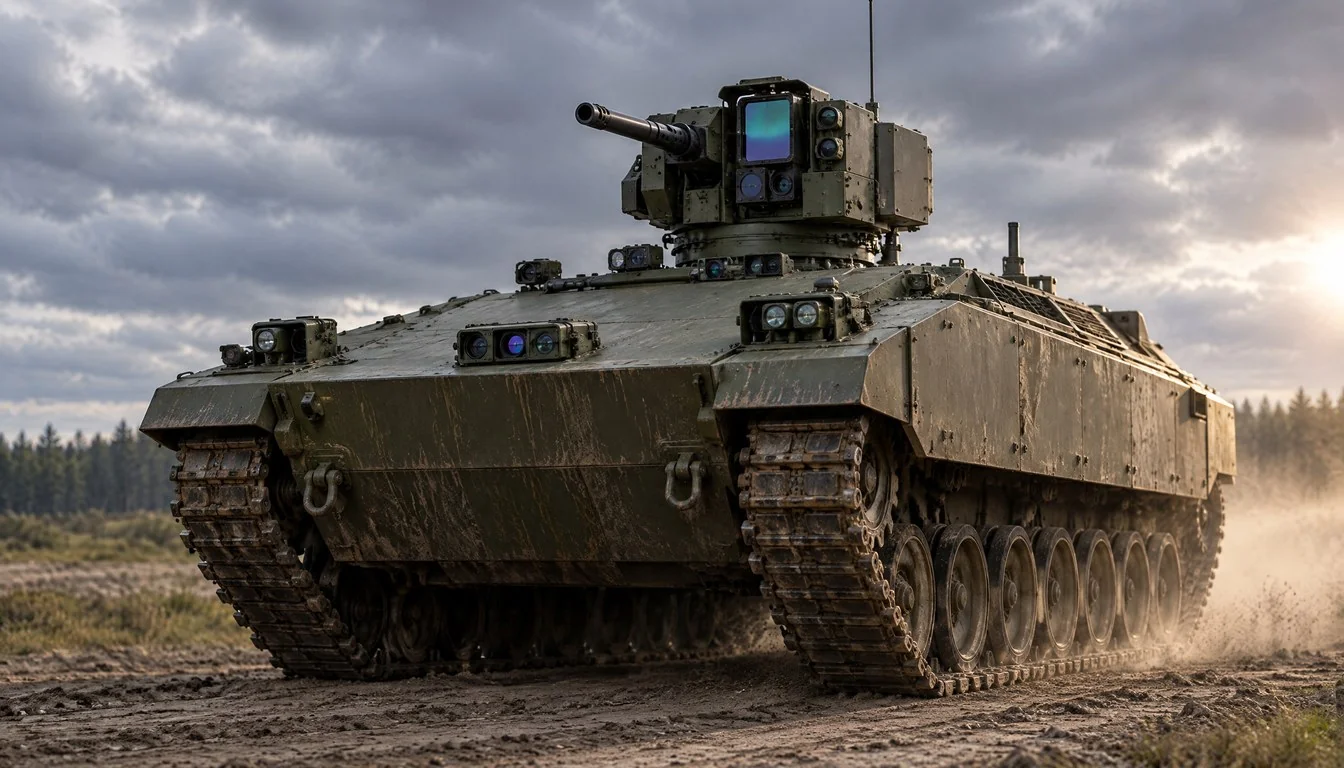
A French defense contractor has shown off a way to give retired battle tanks a second career: as remote-controlled robot mules. KNDS France and S2M Equipment have unveiled TOXO, a robotisation kit built to convert aging tank hulls into unmanned ground vehicles, with a demonstrator called REFURBOT built on the chassis of an AMX-32, a Cold War era export tank that never found a foreign buyer. The pitch, reported first by TechRadar, is blunt: turn any tank into your next UGV.
The idea lands at an odd moment for French ground forces. The Foreign Legion and the wider French Army have hundreds of armored hulls sitting in storage depots, many too old to fight as crewed tanks but structurally sound enough to carry a turret, sensors, and a battery pack. TOXO is built to exploit exactly that gap. Rather than scrapping old hulls or selling them for parts, KNDS and S2M want to strip out the crew compartment, bolt on a remote weapon station, and hand the whole machine over to autonomous driving software.
Don't miss new tech stories on Google
Add TrendinTech once in the Google app and our stories appear in your news suggestions.
What TOXO and REFURBOT actually are
TOXO is the name KNDS and S2M Equipment have given to the robotisation kit itself: a package of hardware and software meant to be fitted onto decommissioned armored hulls. REFURBOT is the specific demonstrator vehicle built to show what the kit can do. According to coverage from Army Recognition, the project pairs a legacy tank hull with the ARX25 turret, a remotely operated weapon station armed with a 25 mm gun. The vehicle is designed so that all of the tank’s original functions, from steering to the weapon system, can be controlled from a distance.
What separates this from a simple remote-control retrofit is the software layer. KNDS and S2M say the demonstrator integrates artificial intelligence modules to handle autonomous mobility, meaning the vehicle is meant to navigate terrain and avoid obstacles without an operator steering every meter of the route. That is the part of the story that should interest people who build autonomy stacks rather than people who collect tank trivia: a 1970s hull with a 2026 software brain riding on top of it.
The demonstrator’s donor hull is an AMX-32, a French export tank developed in the late 1970s by what was then the state arsenal at Issy-les-Moulineaux. The AMX-32 never secured a single foreign order, which is itself part of why this story has legs. Six prototype hulls were built for the export push, according to historical production records, and some registries place four surviving examples in storage at the armor museum in Saumur. The TechRadar report that broke the story described the demonstrator as sitting on one of only two AMX-32s ever made, a figure that conflicts with the production and preservation counts found elsewhere, including Tank Encyclopedia’s survey of French Cold War armor.
The numbers that do not line up yet
Two figures are circulating around this story, and neither has been confirmed by KNDS, S2M, or the French Army. The first is the claim that the Foreign Legion could eventually field thousands of these converted vehicles. No procurement contract, budget line, or formal acquisition decision has been published to support that number. The second is the claim about the AMX-32 demonstrator being one of only two surviving hulls of its type. Polish defense outlet Defence24 covered the same demonstrator without repeating that specific count, and French outlet Zone Militaire framed the base platform as an AMX-30B derivative rather than isolating it to a two-unit AMX-32 run.
That discrepancy matters for how readers should weigh this story. The underlying hardware demonstration, a robotised tank hull fitted with a remote 25 mm turret and AI-assisted mobility, is real and has been shown publicly at defense exhibitions. The scale of any future rollout, the price tag, and the exact rarity of the donor vehicle are not established facts yet. Treat the TOXO kit and the ARX25 turret as confirmed hardware, and treat “thousands of units” and “one of two tanks” as claims still waiting on a primary source.
| Claim | Status | What is actually documented |
|---|---|---|
| TOXO robotisation kit exists | Confirmed | Developed by S2M Equipment with KNDS France, publicly demonstrated |
| REFURBOT demonstrator built on AMX-32 hull | Confirmed | Shown at a defense exhibition fitted with the ARX25 turret |
| ARX25 turret carries a 25 mm gun | Confirmed | Reported by Army Recognition and cited in follow-up coverage |
| AI modules support autonomous mobility | Confirmed | Described by KNDS and S2M as integrated into the demonstrator |
| Foreign Legion could get “thousands” of units | Unconfirmed | No procurement contract or budget figure published |
| Demonstrator is “one of only two” AMX-32s | Disputed | Production records cite six prototypes; some registries list four preserved at Saumur |
| Formal French Army acquisition decision | Not reported | No named program of record or delivery date found |
Why a retired tank makes sense as a robot chassis
The logic behind TOXO is more about logistics than nostalgia. A tank hull already solves several problems that engineers building a new unmanned ground vehicle from scratch have to solve themselves: it has a proven armored structure, a drivetrain rated for rough terrain, and enough internal volume to house batteries, compute, and actuators. Converting an existing hull also sidesteps a multi-year development cycle for a brand-new chassis. For an army sitting on decommissioned armor that would otherwise be scrapped or sold for low value, repurposing it into an unmanned platform is a way to extract additional utility from a sunk cost.
This is also where the project connects to a broader trend in defense robotics: using proven mechanical platforms as a base for new autonomy software rather than building both the hardware and the software stack from zero. It mirrors how Dream Labs’ approach to a universal robot API treats the control software as the differentiator, with hardware increasingly treated as interchangeable. The AI modules KNDS and S2M describe for REFURBOT’s autonomous mobility would, in theory, be portable to other hull types in the future, which is consistent with the “turn any tank into your next UGV” framing of the TOXO kit itself.
The remote weapon station question
The ARX25 turret puts REFURBOT in a different category from most unmanned ground vehicles currently fielded by Western militaries, which are typically logistics carriers or sensor platforms rather than armed combat vehicles. A 25 mm gun is substantial enough to engage light armored vehicles, not just infantry targets, which raises the demonstrator above the level of a scout robot. Because the vehicle is described as capable of having all tank functions controlled remotely, the operator retains the ability to fire the weapon system from a standoff position, keeping personnel out of the vehicle during combat.
That combination, an armed platform with AI-assisted mobility, is precisely the kind of system that has drawn scrutiny elsewhere. Armed forces in Ukraine and Russia have both experimented with remote weapon stations on tracked platforms over the past two years, but most of those systems rely on direct line-of-sight teleoperation rather than onboard autonomy for navigation. If REFURBOT’s AI mobility modules genuinely reduce the operator’s burden to target selection and firing decisions, it would represent a meaningful step up in autonomy level compared to systems already seen on European battlefields, a context reflected in how closely outlets have tracked drone and robotic strike activity in the region this year.
Historical context: the AMX-32’s long detour
The AMX-32 is an unlikely star for a 2026 robotics story. Developed in the late 1970s as an export-oriented evolution of the AMX-30, it was pitched to foreign militaries looking for a mid-weight battle tank cheaper than contemporaries from Germany, the UK, and the Soviet Union. It never won a single export contract, and the French Army itself did not adopt it as a frontline tank, leaving the small number of prototypes built in that era as the entire production run. For nearly five decades those hulls sat as museum pieces or storage yard curiosities, a footnote in French armor history rather than a working weapon system.
That obscurity is part of what makes the TOXO conversion notable. KNDS and S2M did not reach for a mainstream, widely-fielded chassis like the Leclerc or an AMX-30B2 variant still in wider service. They used a hull whose main claim to fame until now was commercial failure. Whether that was a deliberate choice to prove the robotisation kit works on almost anything, or simply a matter of which spare hull happened to be available for a trade show demonstration, has not been explained publicly by either company.
How this compares to other unmanned ground vehicle programs
Most unmanned ground vehicle programs currently in service or in testing across NATO militaries were purpose-built from the start, rather than converted from retired crewed vehicles. That makes the TOXO approach a genuine outlier in the field. The table below lines up what is publicly known about REFURBOT against the general shape of purpose-built UGV programs that have drawn attention in the same period.
| Attribute | REFURBOT (TOXO kit) | Typical purpose-built combat UGV |
|---|---|---|
| Base platform origin | Converted retired AMX-32 tank hull | New chassis designed from scratch |
| Weapon station | ARX25 turret, 25 mm gun | Varies, often smaller caliber remote weapon stations |
| Autonomy approach | AI modules for autonomous mobility, per KNDS and S2M | Usually teleoperation with partial autonomy |
| Development path | Retrofit of existing armored stock | Multi-year ground-up design program |
| Procurement status | Demonstrator stage, no confirmed order | Varies by program, several already fielded in limited numbers |
| Cost rationale | Reuses existing hulls instead of new manufacturing | New tooling and production lines required |
What a conversion program could mean for France’s defense budget
France has been increasing defense spending steadily since 2022, driven in large part by the war in Ukraine reshaping how European militaries think about ground forces and attritable systems. A program that converts existing armored hulls into unmanned platforms, rather than commissioning entirely new vehicle lines, would fit a budget environment where procurement officials are under pressure to stretch existing stockpiles further. KNDS, as the Franco-German group that also builds the Leclerc and co-develops the planned Main Ground Combat System with Germany, has an obvious commercial interest in positioning itself as the supplier capable of bridging legacy hardware and next-generation autonomy software, rather than ceding that market to smaller robotics specialists.
None of this confirms that the French Foreign Legion has actually committed to buying REFURBOT units in any quantity. What it does suggest is a plausible commercial motive: KNDS and S2M have an incentive to publicize a low-cost, high-visibility demonstrator ahead of any formal competition for unmanned ground vehicle contracts, using a decommissioned hull to make the pitch more dramatic and the per-unit cost story more compelling than a from-scratch build would allow.
Software and autonomy angle developers should watch
For people who work on autonomy and robotics software rather than defense procurement, the more interesting detail buried in this story is the AI mobility layer. Fitting navigation and obstacle-avoidance software onto a chassis that was never designed with sensors, compute racks, or drive-by-wire control in mind is a nontrivial integration problem. It requires retrofitting actuators onto mechanical steering and braking systems that were built for a human driver, then layering perception and planning software on top without the benefit of a clean-sheet design. That is a different engineering challenge than building an autonomy stack for a vehicle designed around the sensors from day one, closer in spirit to aftermarket self-driving retrofits than to a purpose-built autonomous platform.
It also raises a question that will matter if TOXO ever moves from demonstrator to production: how much of the kit’s AI mobility software is reusable across different donor hulls with different drivetrains, suspension types, and control linkages, versus how much has to be rebuilt for every new chassis. KNDS and S2M have not published technical detail on that point, and reporters covering the demonstrator, including TradingView’s coverage of KNDS’ infantry combat showcase, have focused on the weapons and mobility hardware rather than the software architecture underneath it.
Market impact: who benefits if this scales
If France does move toward a larger robotisation program, the most direct beneficiaries would be KNDS itself and S2M Equipment, along with sensor, battery, and compute suppliers that would need to be brought in to outfit each converted hull. It would also set a template other European militaries holding aging armored stockpiles, including Poland, Germany, and several Eastern European NATO members, could look at as a lower-cost alternative to new UGV acquisition programs. Several of those countries have already been dealing with their own defense-adjacent technology disruptions this year, a backdrop visible in reporting on incidents like the Poland Starlink fire investigation, which has kept European attention on hybrid threats to defense infrastructure broadly.
There is also a sanctions and supply chain angle worth watching. Export controls on components that feed both commercial and military robotics, an issue already shaping policy moves like the EU’s expanded Russia sanctions covering chips and drones, could eventually touch the semiconductor and sensor supply chains that any scaled-up TOXO program would depend on. None of that is confirmed to affect this specific project, but it is the kind of adjacent pressure that tends to shape how fast a defense robotics program can move from demonstrator to fielded units.
What remains unverified, and why it matters
Three things separate this story from a confirmed procurement announcement. First, no government body or KNDS press statement has published a specific unit count for any Foreign Legion order, so the “thousands” figure currently traces back to reporting rather than an official number. Second, the claim that the AMX-32 demonstrator is one of only two surviving examples conflicts with production records showing six prototypes built and preservation records showing four examples held at Saumur, so readers should treat the rarity claim as disputed rather than settled. Third, there is no confirmed budget, delivery timeline, or named program office attached to any future rollout. Until KNDS, S2M, or the French Ministry of Armed Forces publish a formal statement with numbers attached, this remains a demonstrator story, not a procurement story.
That distinction matters because defense trade press coverage of demonstrators at exhibitions like Eurosatory routinely gets read as confirmation of a sale that has not actually happened. Readers tracking this story should watch for a specific signal: a published contract value, a named delivery schedule, or a statement from the French Ministry of Armed Forces referencing REFURBOT or TOXO by name. Until one of those appears, the safest framing is that a working demonstrator exists, and everything about scale remains speculative.
Predictions for where this goes next
- KNDS and S2M are likely to publish additional technical detail on the ARX25 turret and TOXO kit at the next major European defense exhibition, given how much attention the AMX-32 angle has already generated.
- A formal French procurement statement, if one comes, is more likely to describe a small pilot batch for evaluation than a large multi-hundred-unit order, consistent with how most European UGV programs have scaled so far.
- Other NATO members holding retired armored stock, particularly those with large Cold War era tank inventories, will likely explore similar robotisation kits rather than committing to clean-sheet UGV designs, simply because the economics favor reuse.
- Expect continued ambiguity around the AMX-32 “one of two” claim until a museum, archive, or KNDS itself publishes a leading accounting of how many hulls remain and in what condition.
- The AI mobility software demonstrated on REFURBOT is likely to be positioned by KNDS as portable across multiple future hull types, reinforcing the “turn any tank into your next UGV” branding attached to the TOXO kit.
The bigger picture for defense robotics
What makes the REFURBOT demonstrator worth tracking beyond its novelty value is the underlying bet: that the fastest and cheapest way to field more unmanned ground combat vehicles is not to design new ones, but to retrofit the thousands of armored hulls European militaries already own and are not using. That bet will be tested the moment any government actually commits budget to it, which is also the moment the unconfirmed claims in this story either get resolved with hard numbers or quietly disappear from future coverage. For now, TOXO and REFURBOT sit in the same category as a lot of defense trade show hardware: real, working, and publicly demonstrated, but still a long way from a signed contract.
Frequently asked questions
What is TOXO?
TOXO is a robotisation kit developed by S2M Equipment in cooperation with KNDS France, designed to convert existing or retired armored tank hulls into unmanned ground vehicles.
What is REFURBOT?
REFURBOT is the demonstrator vehicle built using the TOXO kit, based on the hull of an AMX-32 tank and fitted with the ARX25 remotely operated turret.
What weapon does REFURBOT carry?
The demonstrator is fitted with the ARX25 turret, which is armed with a 25 mm gun, according to reporting from Army Recognition.
Is it true the French Foreign Legion will receive thousands of these vehicles?
That figure has not been confirmed by KNDS, S2M Equipment, or the French Ministry of Armed Forces. No procurement contract or budget figure has been published to date.
Is the AMX-32 demonstrator really one of only two ever built?
That specific claim is disputed. Historical production records point to six prototype hulls built for export in the late 1970s, while some preservation registries list four examples held at the armor museum in Saumur.
Why use a retired tank hull instead of building a new UGV chassis?
Reusing an existing armored hull avoids the multi-year development cycle and tooling cost of a new vehicle design, while taking advantage of a drivetrain and structure already rated for rough terrain.
Does REFURBOT operate fully autonomously?
KNDS and S2M describe artificial intelligence modules integrated to support autonomous mobility, but no independent test data on the vehicle’s level of autonomy has been published.
Who are KNDS and S2M Equipment?
KNDS is the Franco-German defense group that produces the Leclerc main battle tank and co-develops future armored vehicle programs. S2M Equipment is the company publicly credited alongside KNDS with developing the TOXO robotisation kit.
Related Coverage
Helena Marsh
Helena Marsh is the Editor-in-Chief at TrendinTech, where she leads editorial strategy and oversees coverage across artificial intelligence, cybersecurity and enterprise technology. She believes technology reporting should be rigorous and plainly written, so readers understand what actually changes for them rather than what a company's announcement promises.
All stories by Helena Marsh (269)