US Teens Teach Seniors Tech Skills Across 7 Nations [2026]

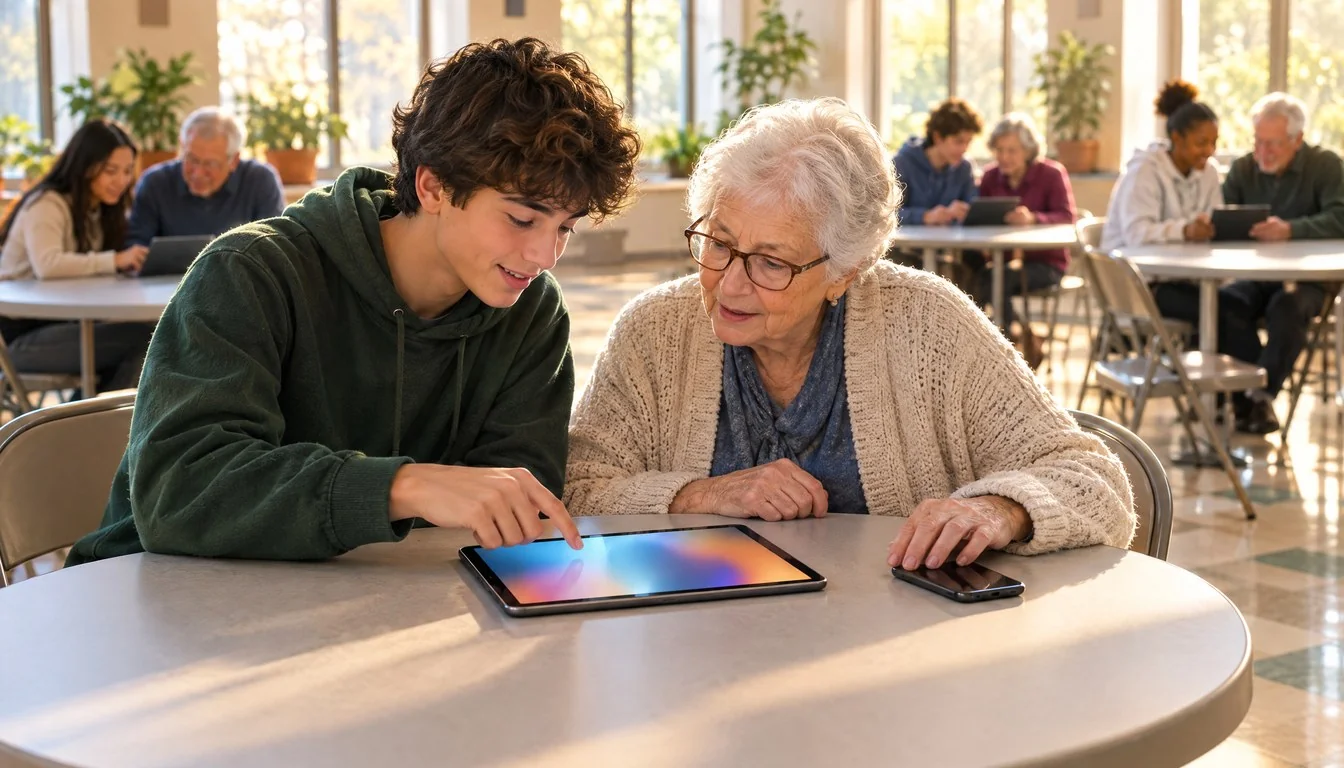
A Florida high school program built around teaching older adults to use phones, tablets and basic software has pushed a quieter trend back into the national spotlight this week: teenagers, not call centers or corporate help desks, have become one of the most consistent sources of tech support for seniors in the United States. Gulf Coast News Now, the WBBH affiliate covering southwest Florida, reported that students at a local high school started a program called CLEO, short for Computer Literacy Education Outreach, six years ago after noticing how many older residents in their community were being left behind by smartphones, apps and basic digital tools.
CLEO is not an isolated case. It sits inside a wider, loosely connected network of student-run nonprofits and school clubs that have quietly scaled across the country, and in some cases overseas, over the past six years. The programs share a common structure: teenagers who grew up fluent in software interfaces volunteer to sit down with older adults and walk them through the operating systems, apps and settings menus that increasingly gate access to banking, healthcare, family photos and even grocery delivery. What is new in 2026 is the scale and the degree to which these efforts have become formal, recognized nonprofit organizations rather than one-off volunteer afternoons.
Don't miss new tech stories on Google
Add TrendinTech once in the Google app and our stories appear in your news suggestions.
Engage STEM and the Tech Literacy for Seniors Network
At the center of the current wave of coverage is Tech Literacy for Seniors, an initiative run by Engage STEM, a student-run 501(c)(3) nonprofit. MIT News, which has tracked the group through its AgeLab scholarship program, described Engage STEM’s mission as being “to provide and promote accessible STEM education.” The organization sets up student-run chapters inside senior centers and community centers, a model that lets the program expand without needing a large paid staff or a single physical headquarters. According to MIT News, Engage STEM kept its chapters running through the pandemic by shifting to virtual technology training and remote workshops, a pivot that several similar groups made around the same period.
Engage STEM was founded by a student identified in MIT’s reporting only by the surname Yang. The chapter-based structure is the part of the model worth paying attention to from a software-education standpoint: rather than centralizing instruction, Engage STEM trains student leaders who then run their own local curriculum, adapting lessons to whatever devices and apps the seniors in their specific center already own. That decentralization is exactly how enterprise software training programs scale inside large companies, and it is notable that a youth-run nonprofit arrived at the same structure independently.
Teens Teach Technology Scales Across Seven Countries
Engage STEM is not the largest group working this problem. Teens Teach Technology describes itself as a youth-led nonprofit founded in May 2020, built by high school students who wanted to bridge what they call the generational technology gap. The organization’s own account of its history says it now counts international members across seven countries, running both in-person sessions, including one documented program at the Southampton Free Library in Pennsylvania, and remote lessons for seniors who cannot easily travel to a community center.
That seven-country footprint matters for how this story should be read. A single viral local-news segment about one high school club is a feel-good item. A structure that has replicated itself across seven countries in roughly five years, without major corporate funding or a franchise model, is closer to a grassroots software-adoption movement, and it is one that has largely operated under the radar of the broader technology press until this week’s coverage pushed it back into trending searches.
SavvySeniors, Gen2Gen Tech and the Local Chapter Pattern
Woodbury Magazine reported on a near-identical program called SavvySeniors, founded by three then-seniors at East Ridge High School, Emily Zhou, Mirella Janssen and Eliza Kubicek, who graduated in 2025. Their program follows the same core format as Engage STEM and Teens Teach Technology: students teach older adults how to use the technology already in their homes so they can stay connected with family and manage daily tasks online.
Defender Network, covering Houston-area schools, documented a comparable effort at Alief Taylor High School, where senior Mykah Edison built a program called Gen2Gen Tech as her Girl Scouts Gold Award project. Edison’s program helps older adults build the confidence to navigate digital tools, following the same one-on-one, patience-first teaching style described across nearly every outlet covering this trend. The fact that a Gold Award project and a 501(c)(3) nonprofit converged on the same program design, independently, suggests the format itself has become something close to a known template among tech-minded students: identify a senior center, recruit volunteers, teach device basics first, then move into apps.
Mittler Senior Tech and a Decade-Long Head Start
Some of these programs are older than the current news cycle suggests. West Side Spirit profiled Mittler Senior Tech, a program launched in 2017 on Manhattan’s Upper East Side that offered free, in-person classes to local seniors learning how to use smartphones and computers. The outlet’s reporting included a telling anecdote about one student who had never owned a phone before the classes and later learned to type, send email and browse the internet. Programs like Mittler Senior Tech show that the current wave of teen-led tech education did not appear overnight. It has been building, chapter by chapter, for close to a decade, and 2026’s coverage is less a new phenomenon than a moment when several separate efforts hit critical mass at the same time.
The Public-Sector Version: Baltimore’s 4-H Model
Not every version of this idea runs through a standalone nonprofit. The University of Maryland Extension documented a Baltimore City 4-H program in which teenage volunteers partnered directly with the city’s Department of Aging and Department of Economic and Workforce Development to teach seniors computer and internet skills over a summer. That partnership model, run through an established public institution rather than a new nonprofit, is a meaningful variant worth tracking, because it suggests city and county governments can plug directly into the existing teen-volunteer pipeline instead of waiting for a new 501(c)(3) to form locally.
Why This Is Fundamentally a Software Literacy Story
It is tempting to file this under human-interest news and move on. That undersells what is actually happening. Every one of these programs, whether it is CLEO, Engage STEM’s Tech Literacy for Seniors, Teens Teach Technology, SavvySeniors, Gen2Gen Tech or Mittler Senior Tech, is solving the same underlying problem: software interfaces have changed faster than large parts of the population can keep up with, and the professional software industry has not solved onboarding for people who did not grow up using a mouse, let alone a touchscreen.
That gap is the same one that keeps showing up in workplace research. A recent industry study on the judgment gap between experienced and newer workers found that skill transfer between generations is harder than most organizations assume, and the same dynamic is playing out here in reverse: it is the younger generation transferring software fluency downward to an older one. Technical education providers have noticed similar gaps. Coverage of Cox Automotive’s push into technical schools pointed to a widening skills gap between what schools teach and what the workforce actually needs. Teen-led senior tech programs are an informal, volunteer-driven answer to a version of that same problem, aimed at consumers rather than workers.
What Software and Apps Volunteers Actually Teach
None of the outlets covering these programs published a formal curriculum, but the pattern across their reporting is consistent. Lessons start with device basics, such as unlocking a phone, adjusting text size and connecting to Wi-Fi, before moving into communication software like video calling and messaging apps, and only later into higher-risk areas such as online banking, password management and scam recognition. That sequencing matters, because it mirrors the order in which security professionals recommend teaching any new user: get comfortable with the device first, then communication tools, then anything touching money or personal data.
That last step, the one involving money and personal data, is also where seniors are most exposed and where teen volunteers are least equipped to help without backup from real security tools. A senior who has just learned to use email for the first time is also a prime target for phishing, and most of these volunteer programs are not set up to teach account security in depth. That is a gap that tools built for exactly this purpose can close. A password manager removes the need for a senior to remember or reuse weak passwords across banking and email accounts, and a multi-factor authenticator app adds a second layer of protection that is far more resistant to phishing than a password alone. Basic endpoint protection, the kind covered in setup walkthroughs for Windows 11’s built-in Defender antivirus, is another low-cost addition that volunteer tutors could fold into a first lesson without adding real complexity for a new user.
What the Student Volunteers Say
Several of the students involved in these programs have spoken publicly about why they started, and their reasoning is strikingly consistent across unrelated programs in different states.
“Knowledge is not meant to be kept to oneself but shared with others to better their lives.”
Yasmin Shalin, Northview High School student
Sajan Parikh, a sophomore at Johns Creek High School who has taken part in similar sessions, described a similar motivation after helping seniors with their devices.
“I’ve also done a couple of technology classes in the past, and I enjoy helping others and sharing my knowledge.”
Sajan Parikh, Johns Creek High School sophomore
In Chicago, students at Conant High School framed their volunteer work in almost generational terms. Kareem Hamidof, a junior at the school who has helped older residents with FaceTime and social media, called the work a kind of obligation.
“It’s a duty of our generation.”
Kareem Hamidof, Conant High School junior
Classmate Anvith Kotha, a senior at the same school, was more direct about the exclusion he and his peers were trying to address when they organized lessons for residents at a senior home.
“This was like a group of people excluded from technology. We wanted to change that.”
Anvith Kotha, Conant High School senior
Historical Context: This Did Not Start in 2026
The pattern of teenagers tutoring seniors on technology is older than smartphones themselves. NPR reported in January 2012 on programs across the country enlisting high school and college students to train seniors on Facebook, Skype and early smartphones, often through National Honor Society chapters. One of the students profiled, 15-year-old Tucker Rampton, described how the experience changed his own perspective on how recent most digital tools actually are.
“It has made me think about what life was like without Facebook and the Internet.”
Tucker Rampton, 15-year-old high school student and senior-technology tutor
What has changed since 2012 is not the core idea but the infrastructure around it. The technology being taught has shifted from Facebook and Skype to a far wider set of apps covering banking, telehealth, grocery delivery and government services, and the organizations teaching it have formalized into registered nonprofits with scholarship recognition, rather than remaining informal school-club efforts. The 2012 version of this story was about a handful of local clubs. The 2026 version is a loosely federated, multi-state and in some cases multi-country network.
Academic Recognition: The MIT AgeLab OMEGA Scholarships
One sign that this volunteer movement has matured is the academic attention it has drawn. MIT News reported in October 2021 that MIT’s AgeLab had awarded five $5,000 OMEGA scholarships, given in a virtual ceremony, to high school students across the United States who had demonstrated leadership in building intergenerational programs in their communities. The scholarship winners that year had each built programs that forged social connections with older adults while also teaching practical skills, with Engage STEM’s Tech Literacy for Seniors specifically named among the recognized efforts.
That kind of formal recognition from a research institution like MIT’s AgeLab, which studies aging and technology professionally, gives these programs a credibility bump that a purely local news story cannot. It also creates an incentive structure: scholarship money and institutional recognition reward students for building exactly the kind of chapter-based, replicable program that Engage STEM and Teens Teach Technology have scaled.
Teen-Led Nonprofits at a Glance
| Program | Founders or Chapter Type | Reported Scope | Reporting Outlet |
|---|---|---|---|
| CLEO (Computer Literacy Education Outreach) | Canterbury High School students | Local Florida chapter, operating six years | Gulf Coast News Now (WBBH) |
| Tech Literacy for Seniors (Engage STEM) | Founded by a student surnamed Yang | Chapters in senior and community centers nationwide | MIT News |
| Teens Teach Technology | Youth-led nonprofit, founded May 2020 | International members across seven countries | Teens Teach Technology (self-reported) |
| SavvySeniors | Emily Zhou, Mirella Janssen, Eliza Kubicek (East Ridge High School, 2025 graduates) | Local chapter model | Woodbury Magazine |
| Gen2Gen Tech | Mykah Edison, Alief Taylor High School senior | Girl Scouts Gold Award community project | Defender Network |
| Mittler Senior Tech | Launched 2017, Upper East Side | Free in-person classes for local seniors | West Side Spirit |
| Baltimore City 4-H tech program | Partnership with city Department of Aging | Public-sector summer program | University of Maryland Extension |
Digital Skills Volunteers Typically Teach First
| Skill Area | Typical Software or Tool | Why It Comes First |
|---|---|---|
| Device basics | Smartphone or tablet operating system settings | Unlocking, text size and Wi-Fi are prerequisites for everything else |
| Communication | Video calling and messaging apps | Highest emotional payoff, connecting with family, builds confidence fast |
| Account security | Password managers and authenticator apps | Reduces phishing and account-takeover risk before banking access is introduced |
| Online services | Banking, telehealth and government portals | Highest real-world utility but also highest risk if security basics are skipped |
| Device protection | Built-in antivirus and security software | Low-effort, one-time setup that protects everything taught afterward |
Competitive Field: Nonprofits, Public Programs and Solo Efforts
Three distinct models are now operating side by side in this space. The first is the registered-nonprofit model represented by Engage STEM and Teens Teach Technology, both of which operate as formal organizations capable of recruiting chapters, raising donations and winning scholarship recognition on behalf of their student leaders. The second is the single-school or single-project model, represented by CLEO, SavvySeniors and Gen2Gen Tech, where a small group of students builds a program tied to one school or one community without necessarily registering as a national nonprofit. The third is the public-institution partnership model, represented by Baltimore’s 4-H program, where teen volunteers plug into an existing government department rather than building new infrastructure from scratch.
Each model has different durability. Registered nonprofits can outlast their founders because leadership can be passed to younger students as older ones graduate, which is likely why Engage STEM and Teens Teach Technology have been able to report multi-year and multi-country reach. Single-school projects tied to one Girl Scout award or one graduating class, like Gen2Gen Tech and SavvySeniors, risk losing momentum once their founders move on to college unless a school formally adopts the program as an ongoing club. Public-institution partnerships are the most durable of the three in theory, since a city department does not graduate, but they depend on continued government funding and staff willingness to keep recruiting new teen volunteers each year.
Market and Policy Impact
These programs operate with essentially no budget compared to the broader digital-equity funding conversation that has played out in Washington this year, including separate fights over school-connectivity subsidies. That contrast is worth flagging because it shows a volunteer-driven, bottom-up fix emerging in the same window where top-down funding programs are under pressure. Schools have been pushing back against federal plans to scale back connectivity subsidies, a separate but related fight over who pays for digital access.
For local governments and libraries, the practical takeaway from this week’s coverage is that a functioning teen-tutor pipeline for senior tech literacy does not require new legislation or a large grant. It requires a school willing to sponsor a club, a senior center willing to host sessions, and in the stronger versions of this model, an outside institution like MIT’s AgeLab willing to recognize and reward the students who build it.
Five Predictions for the Teen Tech-Literacy Movement
- More of these programs will formalize into registered 501(c)(3) nonprofits over the next year, following the Engage STEM and Teens Teach Technology template, since nonprofit status appears to correlate with longer program survival once founders graduate.
- Expect the reported international footprint to grow beyond the current seven countries cited by Teens Teach Technology, as remote and virtual lesson formats make cross-border chapters easier to run than in-person ones.
- Academic recognition programs similar to MIT AgeLab’s OMEGA Scholarships are likely to expand or be imitated by other universities, since the scholarship model gives institutions a low-cost way to associate with a popular, low-controversy cause.
- Security-focused lessons, such as password manager and authenticator app setup, are likely to become a more standard part of these curricula as volunteers and the families of seniors grow more aware of phishing risks tied to new internet users.
- Public libraries and extension services will likely formalize more partnerships similar to Baltimore’s 4-H model, since it offers governments a way to tap the existing teen-volunteer pipeline without building new nonprofit infrastructure.
The Bigger Picture for Software Makers
There is a lesson here for the software industry that goes beyond charity coverage. Every one of these programs exists because mainstream consumer software, from banking apps to messaging platforms, still assumes a baseline of digital fluency that a large share of older adults do not have and that companies have not solved through onboarding design alone. Teenagers filling that gap for free is a reasonable short-term fix, but it is also a signal that accessibility and onboarding teams at major software companies have more work to do, particularly around account security defaults, text scaling and simplified settings menus that would reduce how much hand-holding a new senior user needs in the first place.
It is also worth noting how closely this volunteer structure resembles enterprise software rollout training, just without the budget. Companies that deploy new internal software to thousands of employees typically rely on a tiered training model: a small group of power users trains team leads, who then train everyone else. Engage STEM, Teens Teach Technology and the other chapter-based programs have landed on the same structure independently, which suggests it is close to the most efficient way to transfer software skill at scale, regardless of whether the learners are new employees or first-time smartphone owners.
Frequently Asked Questions
What is Tech Literacy for Seniors?
Tech Literacy for Seniors is a program run by Engage STEM, a student-run 501(c)(3) nonprofit, according to MIT News. It sets up student-led chapters inside senior and community centers to teach older adults how to use everyday technology.
Is Engage STEM a registered nonprofit?
Yes. MIT News described Engage STEM as a student-run 501(c)(3) nonprofit founded by a student identified by the surname Yang, with a mission to provide and promote accessible STEM education.
How many countries do teen-led tech literacy programs reach?
Teens Teach Technology, a separate youth-led nonprofit founded in May 2020, says on its own website that it now has international members across seven countries, in addition to in-person sessions at locations such as the Southampton Free Library in Pennsylvania.
What software do these programs actually teach?
Reporting across multiple outlets points to a consistent sequence: device basics first, then communication apps like video calling and messaging, then higher-risk areas such as online banking, password management and scam awareness.
Are there scholarships for students who run these programs?
Yes. MIT News reported that MIT’s AgeLab awarded five $5,000 OMEGA scholarships in 2021 to high school students who built intergenerational technology programs, with Engage STEM’s Tech Literacy for Seniors among the recognized efforts.
Is this a new trend in 2026?
No. NPR reported on near-identical teen-tutor programs back in January 2012. What is new in 2026 is the scale, with multiple programs now formalized as nonprofits and at least one reporting chapters across seven countries.
How is this different from library tech classes for seniors?
Most of these programs are student-initiated and student-run, rather than staffed by library employees. Some, like Baltimore’s 4-H program, partner directly with public institutions, while others, like Engage STEM and Teens Teach Technology, operate as independent nonprofits that place volunteers in senior and community centers.
Can seniors protect themselves once they start using more apps?
Pairing any new-user tech lesson with basic security habits, such as a password manager, a multi-factor authenticator app and built-in antivirus software, significantly lowers the risk of account takeover or phishing once a senior begins using banking and email apps regularly.
Related Coverage
Helena Marsh
Helena Marsh is the Editor-in-Chief at TrendinTech, where she leads editorial strategy and oversees coverage across artificial intelligence, cybersecurity and enterprise technology. She believes technology reporting should be rigorous and plainly written, so readers understand what actually changes for them rather than what a company's announcement promises.
All stories by Helena Marsh (269)