Cox Automotive’s Xtime Hits Schools as Gap Hits 29% [2026]

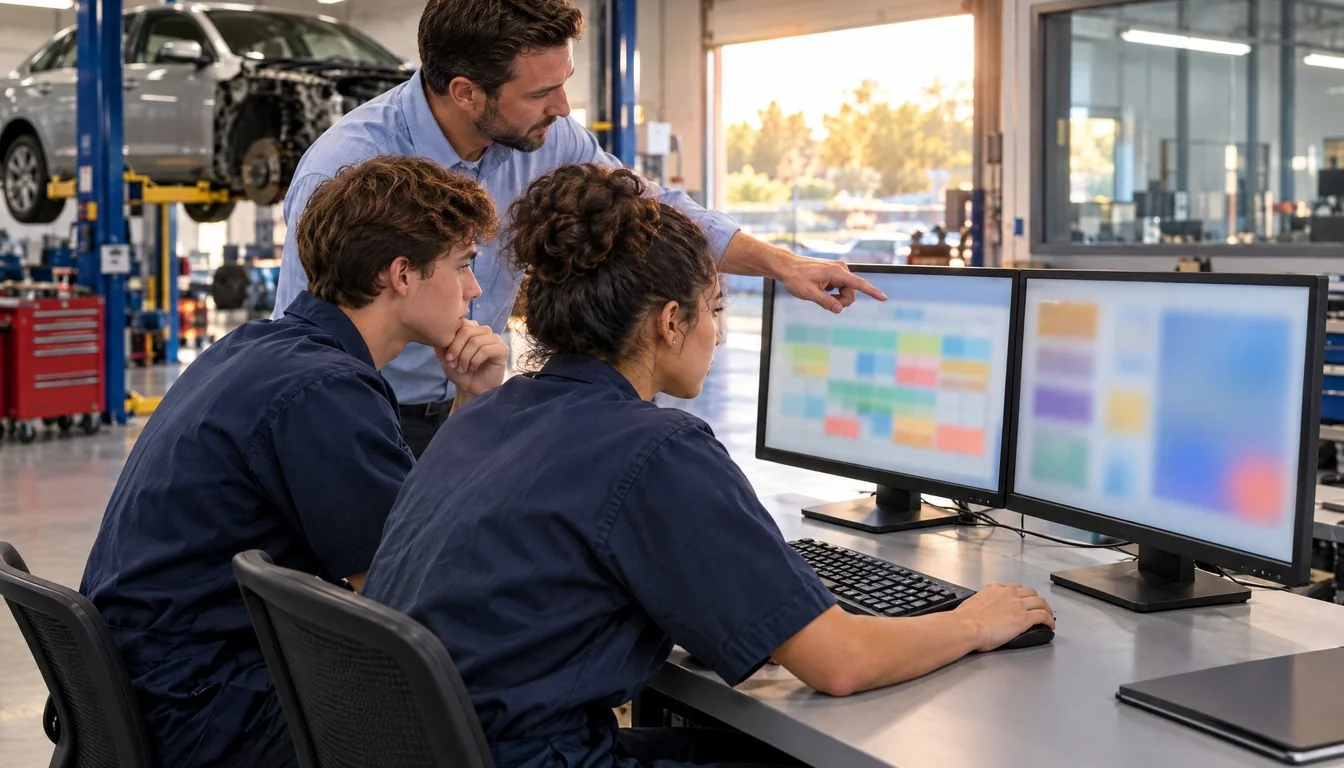
Cox Automotive Inc. said on Oct. 19, 2026 that it is putting its Xtime dealership service software directly into automotive classrooms, launching a pilot program that gives technical-school students free access to the platform, instructor training materials, and hands-on learning resources normally reserved for working dealership staff. The first school in the program is Southern Union State Community College in Opelika, Alabama, according to the announcement published on Cox Automotive’s own newsroom.
The move lands at a moment when the US auto repair industry is openly worried about where its next wave of technicians will come from. Software is no longer a back-office convenience in a service bay, it is the system technicians and advisors use to log every job, so Cox Automotive’s bet is that familiarity with that system before graduation shortens the runway between classroom and paycheck. The announcement was picked up by PR Newswire, the-tech.kz, ASHARQ AL-AWSAT English and Tech.eu, among other outlets, within hours of release.
Don't miss new tech stories on Google
Add TrendinTech once in the Google app and our stories appear in your news suggestions.
What Cox Automotive Actually Announced
According to Cox Automotive’s press release, the pilot gives students at participating automotive technical schools access to Xtime software, training, and learning resources at no cost. Southern Union State Community College is named as the initial participating school. The company frames the goal plainly: let students get hands-on experience with real dealership service workflows before they ever clock in for a first job.
Four program features are specified in the announcement. Students get access to dealership service workflows inside the platform itself, not a stripped-down demo. Instructors receive onboarding resources, including playbooks, videos, and ongoing learning materials, so faculty can run the software without becoming Xtime support specialists. Students get hands-on platform experience in a technician role rather than observing from the sidelines. And schools get training environments tailored to their own curricula rather than a generic walkthrough.
The format is instructor-led. Cox Automotive says educators are expected to fold Xtime into existing coursework rather than treat it as a bolt-on elective, which suggests the company wants the software woven into whatever automotive service curriculum a school already runs, from brake jobs to diagnostics. Whether that expands to other schools depends, in the company’s own words, on pilot results, participant feedback, and resource requirements. There is no confirmed timeline for expansion beyond Southern Union State Community College, and Cox Automotive has not released a student count, a dollar figure for the program’s internal cost, or a list of participating dealerships tied to the rollout.
Why Southern Union State Community College Went First
Southern Union State Community College sits in Opelika, Alabama, a stretch of the state with a dense concentration of auto plants and suppliers feeding assembly lines across the Southeast. Picking a community college rather than a four-year university fits the pattern of where most working technicians actually train. Technician certification in the United States runs overwhelmingly through community colleges, vocational schools, and dedicated technical programs rather than traditional degree tracks, and postsecondary transportation-program completions reached 37,449 in 2023, according to TechForce Foundation data cited by Wards Auto. That is the pipeline Cox Automotive is trying to plug Xtime into directly, rather than waiting for graduates to encounter dealership software for the first time on a shop floor.
Xtime itself is built around that shop-floor reality. The platform brands itself as a service experience system connecting advisors, technicians, and parts departments inside the same tool, with features for real-time customer communication during a repair. Cox Automotive’s own resources page for the product describes it as something advisors and technicians both live inside during a shift, alongside the parts team, which is precisely the multi-role workflow a technical-school curriculum would need to simulate if it wants graduates who are not starting from zero.
The Technician Shortage Behind the Timing
The announcement does not happen in a vacuum. The US automotive service sector has spent the past two years talking openly about a widening gap between how many technicians retire or leave the trade and how many new ones are trained to replace them. TechForce Foundation’s technician supply, demand and opportunity research, cited by Ratchet+Wrench, found that “automotive technician demand is projected to exceed supply by 20,780 technicians annually between 2025 and 2029, representing a 29% gap”, a figure that frames just how large the hole is that programs like this one are trying to fill. TechForce Foundation’s broader projection, also reported by Ratchet+Wrench, put total sector need at “354,323 new technicians between 2025 and 2029, or an average of 70,865 technicians annually”.
Separate research from MOTOR underlines how that shortage is already landing on shop floors. Among 752 surveyed auto-repair shops, 31% identified technician shortages as their biggest challenge, according to MOTOR’s State of General Auto Repair Shops report. That is not a future problem for the industry, it is the single most cited pain point right now, ahead of parts costs, customer volume, or equipment spending in the same survey pool.
Cox Automotive is not new to trying to patch that gap with its own money. Reporting from FleetOwner on the company’s mobile fleet services business notes that Cox Automotive runs FleeTec Academy, an all-expenses-paid, four-week training program for qualified applicants at a facility in Indianapolis, aimed at building a pipeline of fleet technicians separate from the dealership-facing Xtime business. The Xtime schools pilot looks like the dealership-service equivalent of that same instinct: if the open positions are not filling themselves, train people before they are job seekers.
Dealership Software as a Skilled Trade, Not an Afterthought
There is a broader software story tucked inside this announcement that is easy to miss if you read it purely as an auto-industry item. Dealership service platforms like Xtime have quietly become mission-critical enterprise software, the kind of system where a technician who cannot navigate the interface loses real minutes on every single job ticket. That is not fundamentally different from the productivity debates playing out in white-collar software right now, where a widely discussed METR study found developers measurably slower when new tools disrupt established workflows rather than faster. Cox Automotive’s logic seems to be that it is cheaper to teach the workflow before someone is on payroll than to absorb that slowdown after they start.
It is also part of a pattern of big software vendors pushing their platforms into education pipelines as a customer-acquisition and workforce strategy at once, something that shows up in very different corners of the software world, from Microsoft positioning its own AI coding platforms as a way to turn ordinary PCs into software-production tools to startups chasing established desktop software incumbents, as seen when a challenger vowed to clone AutoCAD and Solidworks workflows for a cheaper audience. Cox Automotive is not trying to sell Xtime to students directly, but it is trying to make Xtime the default muscle memory before those students ever evaluate a competing platform.
How Xtime Fits the Dealership Service Software Field
Xtime operates in a dealership service-software category that includes other large, established platforms used across franchised dealer networks for scheduling, repair orders, and customer communication during service visits. Cox Automotive positions Xtime as connected to its own broader suite of dealership solutions, which the company says is meant to improve sales and customer experience outcomes alongside service efficiency, according to Cox Automotive’s brand page for the product. The schools pilot is a workforce play layered on top of that existing commercial business, not a new product launch.
What makes the schools angle distinct from an ordinary enterprise software rollout is the audience. Cox Automotive is not selling Xtime licenses to Southern Union State Community College, it is giving the software away to the school at no cost, which reframes the relationship entirely. The company is underwriting the training cost itself in exchange for a generation of technicians who do not need onboarding time once they are hired, whether they end up at a Cox-affiliated dealership or a competitor’s lot.
The Numbers Behind the Technician Pipeline Gap
| Metric | Figure | Source |
|---|---|---|
| Projected new technicians needed, 2025-2029 | 354,323 total (70,865 per year) | TechForce Foundation, via Ratchet+Wrench |
| Annual technician supply-demand gap, 2025-2029 | 20,780 technicians short (29% gap) | TechForce Foundation, via Ratchet+Wrench |
| Postsecondary transportation-program completions (2023) | 37,449 completions | TechForce Foundation, via Wards Auto |
| Repair shops citing technician shortage as top challenge | 31% of 752 shops surveyed | MOTOR, State of General Auto Repair Shops (2025) |
Read together, those numbers describe an industry where training capacity is not close to matching turnover. Roughly 37,000 students complete transportation programs a year against a need for more than 70,000 new technicians annually, and the resulting gap is wide enough that nearly a third of repair shops now call staffing their top operating problem. A program that puts dealership software directly into the hands of the existing training pipeline does not create new graduates on its own, but it narrows the gap between what a graduate knows on day one and what a dealership service department actually needs.
Cox Automotive Xtime Schools Pilot at a Glance
| Program detail | What Cox Automotive confirmed |
|---|---|
| Company | Cox Automotive Inc. |
| Software | Xtime dealership service platform |
| Announcement date | Oct. 19, 2026 |
| Initial participating school | Southern Union State Community College, Opelika, Alabama |
| Cost to students and schools | No cost |
| Format | Instructor-led, folded into existing curricula |
| Student access | Hands-on platform experience in a technician role, using real dealership service workflows |
| Instructor resources | Playbooks, videos, ongoing learning materials |
| Expansion plan | Dependent on pilot results, participant feedback, and resource requirements |
A Longer History of Cox Automotive Betting on Technician Supply
This is not Cox Automotive’s first attempt to shape the technician labor market rather than simply hire from it. The company’s FleeTec Academy, covered by FleetOwner as part of the company’s mobile fleet services expansion, runs a four-week, all-expenses-paid training track in Indianapolis for applicants pursuing fleet technician roles, separate from the Xtime dealership business. Cox Automotive has also described itself, through its careers site, as one of the largest employers of vehicle technicians in the country, spanning brands that range from Manheim auctions to EV battery servicing to fleet maintenance.
That history matters for reading the Xtime schools pilot correctly. It is not a one-off marketing gesture tied to a single press cycle, it is the latest entry in a pattern of the company treating technician supply as a problem worth solving with direct investment rather than waiting on the broader labor market to fix itself. Where FleeTec Academy builds technicians for Cox Automotive’s own fleet-service brands, the Xtime pilot builds familiarity with a tool used far more broadly across the franchised dealer network, which is a wider bet than training staff for its own payroll alone.
What the Software Industry Can Learn From a Workforce-First Rollout
The timing also lines up with a broader moment in enterprise software where companies are rethinking how new tools reach frontline workers rather than assuming adoption will happen organically. In the AI coding world, that same tension between tool access and real skill-building has become its own debate, visible in how aggressively vendors are competing on head-to-head feature races between platforms like GitHub Copilot and Cursor. Cox Automotive is applying a slower, more deliberate version of the same instinct: instead of racing to add features for already-trained professionals, it is trying to shrink the distance between “never used this software” and “productive on day one” before someone is even hired.
That logic also echoes outward into the vehicles themselves. As dealerships increasingly service electric and hybrid drivetrains alongside traditional combustion vehicles, the software layer tracking those repairs has to keep pace with a more complex vehicle mix. Growth in that mix is already showing up in sales data, with US EV sales reaching 266,630 units in the third quarter and models like the Honda Super-ONE EV arriving at a $36,900 price point with smart charging features that service technicians will eventually need to diagnose. A technician trained on Xtime today is also a technician who will be logging EV-specific repair workflows inside that same platform tomorrow.
Competitive Field: Where Xtime Sits Among Dealership Platforms
Dealership service software is not a one-vendor category. Franchised dealers across the country run a mix of platforms for scheduling, repair orders, and customer communication, and Xtime competes for that business against other established dealership-management and service-scheduling providers in the same space. Cox Automotive’s advantage in this particular announcement is not a technical one, it is distributional: by giving the software to a technical school for free, the company is shaping which platform a new technician considers “normal” before they ever compare options professionally.
That is a different kind of competitive move than a feature release or a price cut. It does not show up in a benchmark chart, and Cox Automotive has not published any figures on how many dealerships plan to hire Southern Union State Community College graduates or how this translates into measurable market share. But workforce familiarity has long been an underrated lever in enterprise software adoption, since market leadership in one category can compound once a platform becomes the default choice for a large enough population of buyers or, in this case, workers.
Market Impact for Dealerships, Schools, and Software Vendors
For dealerships, the near-term impact is modest but real: a small, specific pool of future hires out of one Alabama community college who will not need baseline Xtime training on arrival. For Cox Automotive, the impact is longer-horizon brand positioning inside a labor pool that the entire industry is competing over. For other dealership software vendors, the pilot sets an informal bar. If a free, curriculum-integrated training pathway becomes something technical schools expect from major platforms, competitors may feel pressure to offer similar access rather than ceding that pipeline entirely to Cox Automotive.
For technical schools themselves, the calculus is straightforward. Programs like Southern Union State Community College’s automotive track get a no-cost addition to their curriculum that makes graduates more immediately useful to employers, which is exactly the kind of outcome that justifies continued state and federal funding for vocational training in an era when four-year degree enrollment is under scrutiny for cost and return on investment.
Predictions: Where This Program Goes From Here
- Cox Automotive is likely to add a small number of additional technical schools within the next academic year if Southern Union State Community College’s pilot shows measurable placement gains, though the company has not committed to a timeline.
- Competing dealership software vendors could roll out their own technical-school partnerships within 12 to 18 months to avoid ceding an entire generation of new technicians to one platform by default.
- Expect Cox Automotive to eventually publish placement or hiring data tied to the pilot, since that kind of outcome metric is the clearest way to justify expanding a free program to more schools.
- As EV and hybrid service volume grows, Xtime’s curriculum modules inside the pilot will likely need updates to cover electrified-drivetrain repair workflows, not just conventional combustion service tickets.
- The broader technician shortage flagged by TechForce Foundation is unlikely to close by 2029 through training programs alone, meaning pay, scheduling flexibility, and career-path clarity will remain just as important as software fluency in solving the gap.
Historical Context: Software Training Has Always Trailed the Shop Floor
Dealership service departments have run on some form of digital work-order software for more than two decades, but technical-school curricula have historically lagged behind whatever system a given dealership happens to use, since no single platform dominated every regional dealer network. That mismatch meant most technicians learned the actual software after hiring, often during their first weeks on a job that was already short-staffed. Cox Automotive’s pilot is a direct answer to that lag, betting that closing the software-familiarity gap before graduation is worth giving the product away for free during the training years.
Frequently Asked Questions
What did Cox Automotive announce on Oct. 19, 2026?
Cox Automotive announced a new pilot program giving automotive technical-school students free access to its Xtime dealership service software, along with instructor training materials and hands-on learning resources, starting with Southern Union State Community College in Opelika, Alabama.
Is Xtime software free for students?
Yes, Cox Automotive confirmed that students and participating schools get access to Xtime software, training, and learning resources at no cost through the pilot program.
Which school is the first to join the Xtime pilot program?
Southern Union State Community College in Opelika, Alabama is named by Cox Automotive as the initial participating school in the program.
Will Cox Automotive expand the Xtime schools program to other colleges?
Cox Automotive has said any expansion will depend on the results of the pilot, feedback from participants, and available resources. No additional schools or a specific timeline for expansion have been confirmed as of Oct. 19, 2026.
How big is the US auto technician shortage right now?
TechForce Foundation research cited by Ratchet+Wrench projects that technician demand will outpace supply by 20,780 workers annually between 2025 and 2029, a 29% gap, with total demand reaching 354,323 new technicians over that period.
What is Xtime used for inside a dealership?
Xtime is a service experience platform used by advisors, technicians, and parts departments inside dealerships to manage scheduling, repair orders, and customer communication during a vehicle service visit, according to Cox Automotive’s own product resources.
Does Cox Automotive have other technician training programs?
Yes. Cox Automotive also runs FleeTec Academy, a four-week, all-expenses-paid training program for fleet technician applicants in Indianapolis, as reported by FleetOwner, separate from the Xtime dealership schools pilot.
Why is this announcement significant for the software industry, not just automotive?
It reflects a broader trend of enterprise software vendors treating workforce training pipelines as a strategic asset rather than an afterthought, giving platforms away during education in exchange for default familiarity once students enter the job market.
Related Coverage
Helena Marsh
Helena Marsh is the Editor-in-Chief at TrendinTech, where she leads editorial strategy and oversees coverage across artificial intelligence, cybersecurity and enterprise technology. She believes technology reporting should be rigorous and plainly written, so readers understand what actually changes for them rather than what a company's announcement promises.
All stories by Helena Marsh (251)