Russia’s Drones Hit 2,800 a Month: Ukraine Adapts [2026]

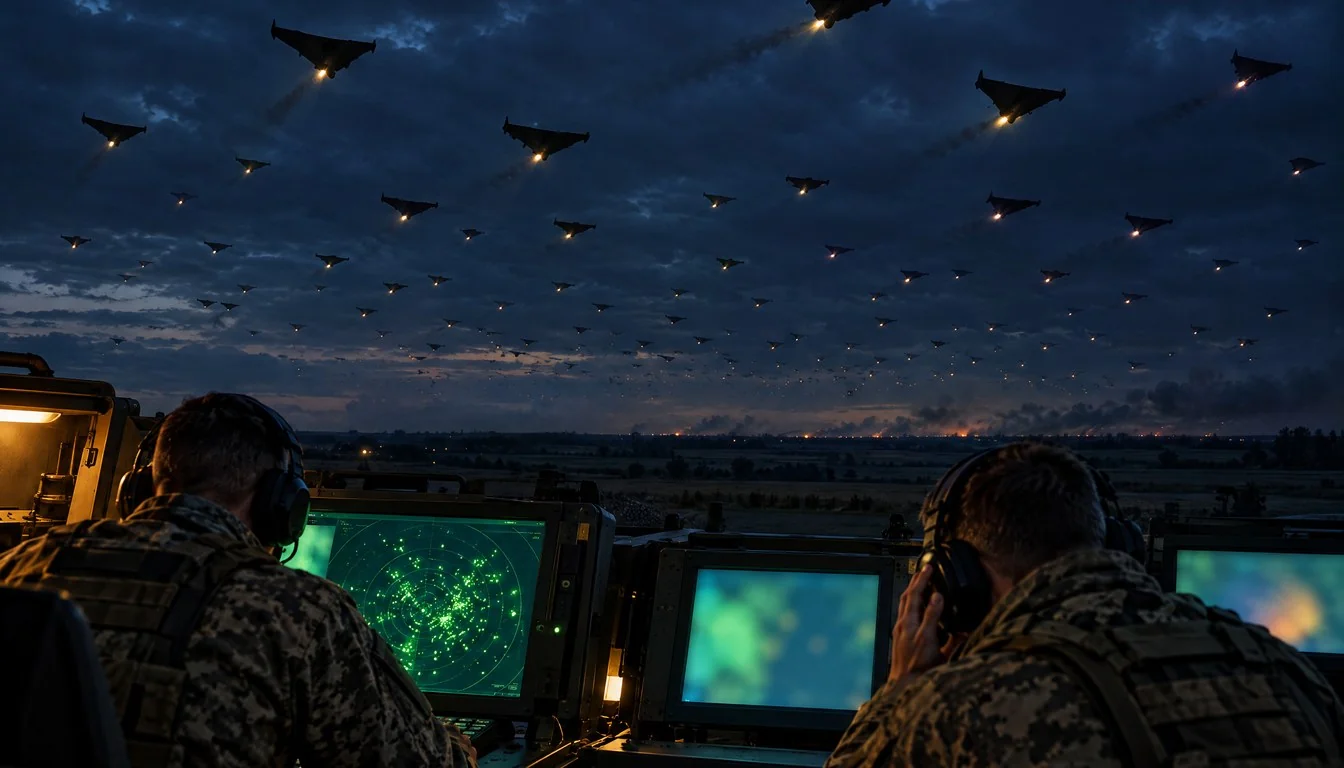
Russia’s drone war against Ukraine has entered a new phase, and the numbers tell the story on their own. Jet-powered drone sorties climbed from 350 in June to 1,600 in July and 2,800 in August, according to an analysis the BBC published using Ukrainian military data. That is not a gradual uptick. It is an eightfold jump in three months, and it is forcing Ukraine’s air defense network, along with the American satellite infrastructure that feeds it targeting and warning data, to adapt faster than at any point since the full-scale invasion began.
The shift is twofold. Russia is swapping slower, propeller-driven Shahed-style drones for faster, jet-powered Geran variants that are harder to shoot down. At the same time, Moscow is experimenting with new flight paths designed to slip past Ukrainian radar coverage and interceptor patrols. Both trends are now colliding with an open question that Western analysts have not fully answered: how much of Ukraine’s ability to track and intercept these drones depends on satellite data supplied by the United States, including SpaceX’s Starlink and Starshield networks.
Don't miss new tech stories on Google
Add TrendinTech once in the Google app and our stories appear in your news suggestions.
What changed: Russia’s jet-powered drone surge
For most of the war, Russia leaned on the Shahed-136, a slow, piston-engine drone built in Iran and later produced domestically under names like Geran-2. Those drones cruise at roughly the speed of a small aircraft, which gives Ukrainian gun crews, mobile fire teams and older air-defense systems time to react. That calculus has now changed. The BBC reported that jet-powered drones, which fly significantly faster than the propeller-driven generation, were launched by Russia every day throughout August, according to BBC Verify’s analysis of Ukrainian Air Force data.
Dr Marina Miron, who studies military technology at King’s College London, said the jet-powered drones outrun Ukraine’s existing interceptors specifically because of that added speed, making the older generation of countermeasures far less effective against them. Michael Bohnert, a researcher at the RAND think tank, described a tactic in which Russia layers jet-powered drones together with decoy drones and ballistic missiles in the same wave, a combination designed to overwhelm air defense operators who have only seconds to classify each incoming threat and decide which ones are real.
BBC Verify’s review of Kyiv’s own data found that Russia is now firing more than 15 times as many drones per attack as it was four years earlier. That scaling is not just about raw drone output from Russian factories. It reflects a doctrine shift: instead of occasional large raids, Russia is running near-continuous, high-volume saturation attacks meant to exhaust Ukrainian interceptor stockpiles and crew endurance night after night.
The numbers: from 350 to 2,800 drone sorties a month
The clearest way to see the escalation is to line up the monthly totals BBC Verify pulled from Ukrainian military data. The table below shows jet-powered drone sorties by month, based on that reporting.
| Month (2026) | Jet-powered drone sorties | Change from prior month | Source |
|---|---|---|---|
| June | 350 | Baseline | BBC Verify analysis of Ukrainian military data |
| July | 1,600 | Up roughly 4.6x | BBC Verify analysis of Ukrainian military data |
| August | 2,800 | Up roughly 1.75x | BBC Verify analysis of Ukrainian military data |
| September | 3,520 (Geran jet-powered drones specifically) | Up roughly 1.26x | Colonel Yuriy Ihnat, Ukrainian Air Force spokesperson, cited by The Wall Street Journal |
Colonel Yuriy Ihnat, the Ukrainian Air Force spokesperson, gave the most granular public figure to date when he told The Wall Street Journal that Russia launched 3,520 jet-powered Geran drones in September. Ukrainian forces intercepted about 54 percent of them. For comparison, Ihnat said Russia also launched roughly 4,900 piston-engine drones that same month, and Ukraine’s interception rate against those slower weapons held near 90 percent. The gap between those two numbers, 54 percent against jet-powered drones versus 90 percent against the older generation, is the single clearest measure of how much ground Ukraine’s air defense has lost to drone speed alone.
Inside a single night: the October 7 and 8 attacks
Monthly totals can obscure what a single night of fighting actually looks like, so it helps to zoom in. Valerii Romanenko, an aviation expert and leading researcher at the State Aviation Museum, told Radio NV that Russia launched 130 drones in its October 7 attack, of which 46 were jet-powered. Ukrainian forces shot down 38 of those 46, a interception rate of 82.5 percent, a notably better outcome than the 54 percent monthly average Ihnat cited for September’s Geran barrage.
The following night told a similar but larger story. The Ukrainian Air Force reported that Russia launched dozens of missiles alongside 130 Shahed-type drones overnight into October 8, of which 46 were jet-powered. Ukrainian air defenses intercepted 161 targets in total that night, including 117 unmanned aerial vehicles. Put together, those two nights show Ukraine capable of strong single-engagement interception numbers against jet-powered drones when conditions favor it, even as the monthly aggregate trend keeps sliding in Russia’s direction.
| Attack window | Total drones/targets | Jet-powered drones | Jet-powered intercepted | Interception rate |
|---|---|---|---|---|
| September 2026 (monthly) | 3,520 jet-powered Geran drones | 3,520 | ~1,901 | 54% |
| September 2026 (monthly, piston-engine) | ~4,900 piston-engine drones | 0 | ~4,410 | ~90% |
| Night of October 7 | 130 drones | 46 | 38 | 82.5% |
| Overnight into October 8 | 130 Shahed-type drones plus missiles | 46 | Included in 161 total intercepted targets (117 UAVs) | Not separately broken out |
Why jet-powered drones are harder to stop
The physics are straightforward even if the air-defense math is not. A piston-engine Shahed cruises slowly enough that a truck-mounted machine gun, a mobile fire team, or even small-arms fire can sometimes bring one down, provided operators have enough warning time to get into position. A jet-powered Geran variant compresses that warning window dramatically. Less time to detect, classify and engage means Ukraine needs either faster-reacting systems or a head start on knowing where the drone is headed before it is overhead, which is exactly where satellite-fed early warning data becomes decisive rather than optional.
Vadym Skibitskyi, deputy chief of Ukraine’s Defense Intelligence directorate, put the shift in blunt terms, saying turbojet-powered drones already accounted for 50 percent of the total in one recent Russian attack. That is a fundamental change in the threat mix that Ukraine’s Western-supplied and domestically built interceptor fleet was not originally designed around, since most of that fleet was built to chase slower piston-engine targets.
The US satellite question: Starlink, Starshield, and what remains unconfirmed
This is where the story gets harder to pin down, and where caution matters most. Reporting cited in the latest Russian Offensive Campaign Assessment from the Institute for the Study of War states plainly that Ukraine’s ability to use SpaceX’s low-Earth-orbit satellite communication technology, specifically Starlink and Starshield, to intercept Russian jet-powered drones remained unclear as of October 18. No public source has confirmed the specific mechanism, contract terms, or technical specification connecting US satellite data to a particular interception.
What is confirmed is the broader dependency. Ukrainian President Volodymyr Zelenskyy has previously said that only the United States has the unique intelligence capability to warn Ukraine when Russia launches ballistic missiles, highlighting how much of the country’s early-warning architecture, drone tracking included, rests on American-supplied data rather than domestic sensors alone. That reliance cuts both ways: it is a strength when the data flows freely, and a vulnerability whenever access, bandwidth, or coverage gets restricted, a tension TrendInTech has covered previously in the context of Starlink’s own operating limits inside Ukraine.
What the record does not yet show
It is worth being precise about the limits of what has actually been verified. There is no confirmed US satellite-data provider, product, contract value, or named American official tied specifically to the recent spike in jet-powered drone interceptions. There is also no confirmed causal link establishing that US satellite data directly triggered a specific change in Ukrainian air-defense tactics. Those gaps matter, because headlines compressing “satellite data” and “changing tactics” into a single cause-and-effect claim are running ahead of what named sources have actually confirmed on the record.
Russia targets the satellites themselves
While the drone numbers dominate headlines, a quieter escalation is happening in orbit. Ars Technica reported that a Russian spacecraft maneuvered in what the outlet described as extreme proximity to a satellite used by Ukraine, a maneuver consistent with Russia’s known interest in disrupting or surveilling the commercial and military satellites feeding Kyiv’s situational awareness. Separately, Defense Express reported on how Russia nearly struck an ICEYE satellite that has been supplying intelligence to Ukraine’s armed forces, raising the question of what that satellite was doing in a position to draw Russian attention in the first place.
On the ground, satellite imagery has also become the evidence base for tracking Russia’s own buildup. Imagery reviewed in connection with BBC’s reporting showed longer munitions rails at a new Russian base at Tsymbulova in the Oryol region, a detail consistent with preparations to launch larger or longer-range drones from a site further from the front line, complicating Ukraine’s early-warning timeline even further.
How analysts actually track the data
None of these monthly sortie counts or interception percentages exist as a single official release. They are stitched together from open-source intelligence work, satellite imagery analysis, and government data releases that outlets like BBC Verify cross-check against Ukrainian Air Force statements. That verification pipeline, built largely on publicly available data analysis tools rather than classified feeds, is itself a reason the figures in this story carry real weight: they are reproducible by independent analysts rather than resting on a single government’s say-so.
monthly_jet_powered_sorties = {
  "2026-06": 350,
  "2026-07": 1600,
  "2026-08": 2800
}
# September figure (Geran-specific, WSJ/Ihnat): 3520
# Interception rate, jet-powered: 0.54
# Interception rate, piston-engine: 0.90
That kind of structured tracking, simple as it looks, is exactly how open-source analysts turn scattered Telegram posts, Ukrainian Air Force statements, and satellite passes into a defensible monthly trend line. It is also why a single bad night, or a single unusually effective intercept, should not be read as reversing the broader trend shown in the table above.
Expert voices on the shifting threat
Several officials and analysts have put the scale of the problem in their own words over the past few weeks. Keith Kellogg, the US special envoy, described the practical danger facing civilians when he said, “When you have 500 inbound Shaheeds, jet-powered Shaheeds, and I was hit within 400 meters twice this week, you need to have interceptors going out to protect Ukrainian civilians.” That comment, reported by RFE/RL, frames the interceptor shortfall as a direct civilian-safety issue rather than an abstract battlefield statistic.
Skibitskyi’s warning about turbojet drones making up half of a recent attack wave, reported by RBC-Ukraine, reinforces how quickly Russia has retooled its arsenal. Zelenskyy’s comment on US intelligence sharing, reported by The Independent, reinforces how structurally dependent Ukraine’s early-warning system has become on American data streams. And Robert Brovdi, commander of Ukraine’s Unmanned Systems Forces, warned about Russia’s own push to build satellite communications meant to rival Starlink, telling the Associated Press that such capability represents a risk for the entire planet because a dictatorship would gain access to information across the whole globe. Taken together, these comments describe a fight that has moved well beyond the drones themselves and into the satellite layer underneath them.
How Ukraine’s air-defense tactics are shifting
Russia is not the only side adapting. UA.News reported that Russian drones have begun flying new routes specifically designed to bypass Ukrainian air-defense systems, a tactic that forces Ukraine to redistribute mobile fire teams and radar coverage rather than concentrate defenses along previously predictable corridors. That cat-and-mouse dynamic, route versus coverage, is now layered on top of the speed problem created by jet-powered engines, meaning Ukrainian defenders are solving two moving variables at once instead of one.
The practical response has included wider deployment of interceptor drones built specifically to chase other drones, an approach Ukraine has scaled over the past two years, alongside continued requests for Western-supplied systems tuned for faster targets. The widening gap between the roughly 90 percent interception rate against piston-engine drones and the roughly 54 percent rate against jet-powered ones is effectively Ukraine’s current scorecard on how well that retooling is working, and it suggests the retooling is still a work in progress rather than a solved problem.
Market and industry impact
The fallout extends past the battlefield into the commercial tech sector. TechRadar reported that Kaspersky’s VPN and password manager products went dark for days worldwide, a global outage whose timing raised awkward questions about whether Russian drone strikes on data centers played a role. Whether or not that specific link holds up, the episode shows how physical attacks tied to this drone campaign can ripple into commercial software products used far outside Ukraine’s borders, a dynamic also visible in recent drone strikes on Yandex-linked data centers inside Russia itself.
There is also a defense-industrial angle. Western interceptor manufacturers and satellite-imagery firms such as ICEYE are operating in a market where demand for faster, cheaper counter-drone systems is climbing in near real time, a trend that lines up with separate US Army testing of anti-drone systems in Morocco aimed at building a broader allied response to exactly this class of threat. Export-control policy is moving in parallel, with the European Union recently expanding sanctions aimed at the chip and drone-component supply chains that feed Russia’s production lines, a step covered in TrendInTech’s reporting on the EU’s broader Russia sanctions package.
Satellite and space industry stakes
SpaceX’s own commercial trajectory is tangled up in this story whether the company wants it to be or not. The firm’s satellite constellation underpins both Ukrainian battlefield connectivity and a growing share of its long-term revenue ambitions, a backdrop worth keeping in mind against SpaceX’s recent multi-trillion-dollar market projections. Any disruption, whether from Russian anti-satellite maneuvers or policy restrictions on military use, carries reputational and operational weight well beyond this single conflict.
Historical context: from Shahed waves to jet-powered swarms
Russia’s large-scale drone campaign against Ukrainian cities and infrastructure dates back to autumn 2022, when Iranian-designed Shahed-136 drones first appeared over Ukrainian skies in meaningful numbers. For roughly three years, the fight centered on a predictable weapon: slow, loud, and comparatively easy to intercept once spotted. What has changed in 2026 is not just volume, it is the character of the weapon itself. BBC Verify’s finding that Russia now fires more than 15 times as many drones per attack than it did four years ago captures the scale shift, while the jet-powered Geran’s emergence captures the qualitative one. Put simply, Ukraine is no longer fighting the same war it was fighting in 2022, even though the headlines still describe it using the same word: drones.
Competitive comparison: Russia’s drone arsenal versus Ukraine’s defense stack
Framing this as a competitive matchup helps clarify where each side currently holds an edge. Russia’s advantage is production volume and weapon diversity, mixing piston-engine Shaheds, jet-powered Gerans, decoy drones and ballistic missiles in the same wave specifically to overload Ukrainian classification systems, a tactic RAND’s Michael Bohnert described directly. Ukraine’s advantage remains its intercept rate against the older, slower threat class, holding near 90 percent against piston-engine drones even as volumes climb. The contested middle ground is the jet-powered category, where Ukraine’s 54 percent monthly interception rate in September, improving to 82.5 percent in the isolated October 7 engagement, shows real but inconsistent progress rather than a settled advantage for either side.
| Capability | Russia | Ukraine |
|---|---|---|
| Primary drone type in use | Piston-engine Shahed/Geran-2 plus newer jet-powered Geran variants | Domestically built interceptor drones plus Western air-defense systems |
| Monthly volume (September 2026) | 3,520 jet-powered plus ~4,900 piston-engine | Must engage all incoming sorties in real time |
| Interception rate against piston-engine drones | Not applicable (attacker) | ~90% |
| Interception rate against jet-powered drones | Not applicable (attacker) | 54% (monthly average), 82.5% (October 7 engagement) |
| Key dependency | Domestic production plus new basing, including Tsymbulova | US satellite data, including Starlink/Starshield, role still unclear |
What comes next: five predictions
- Expect Western governments to accelerate delivery of interceptor systems specifically tuned for jet-powered drone speeds, since the September interception gap between piston-engine and jet-powered threats (90 percent versus 54 percent) is now a quantified, public problem rather than an internal estimate.
- Expect continued ambiguity, not clarity, around the precise role of US satellite data in drone interception, since the Institute for the Study of War’s own assessment as of October 18 could not confirm the mechanism, and neither side has strong incentives to publicize operational details.
- Expect Russia to keep probing new drone flight paths, following the pattern UA.News reported, forcing Ukraine into continuous radar and fire-team redistribution rather than a one-time fix.
- Expect more reported incidents of Russian spacecraft maneuvering near satellites that support Ukraine, following the pattern Ars Technica and Defense Express both documented around the ICEYE satellite, as orbital harassment becomes a lower-cost way to pressure Ukraine’s intelligence pipeline.
- Expect the commercial fallout from drone strikes on data centers and infrastructure, as seen in the Kaspersky outage TechRadar covered, to keep surfacing in unrelated consumer software products, widening the audience that feels the war’s effects even without direct military involvement.
Why this matters beyond the battlefield
It would be a mistake to read this purely as a military story. The interception-rate gap between drone types is, at its core, a data and sensor-fusion problem: Ukraine needs to classify and prioritize threats faster than human operators can manage unaided, which is exactly the kind of workload that satellite data, radar feeds and automated tracking software are built to compress into seconds. Every improvement in that pipeline, whether it comes from a satellite operator, a software vendor building classification tools, or an allied government sharing raw sensor data, has a direct and measurable effect on how many drones get stopped before they hit a target. That is also why the unresolved questions about Starlink and Starshield’s specific contribution matter so much: until someone on the record confirms the mechanism, outside analysts are left estimating the size of a dependency that could be decisive.
Frequently asked questions
How many jet-powered drones is Russia launching against Ukraine each month?
According to BBC Verify’s analysis of Ukrainian military data, jet-powered drone sorties rose from 350 in June to 1,600 in July and 2,800 in August. Colonel Yuriy Ihnat, the Ukrainian Air Force spokesperson, told The Wall Street Journal that Russia launched 3,520 jet-powered Geran drones specifically in September.
What is Ukraine’s interception rate against jet-powered drones?
Ihnat said Ukraine intercepted about 54 percent of the 3,520 jet-powered Geran drones launched in September. In a more isolated engagement on the night of October 7, aviation expert Valerii Romanenko said Ukraine shot down 38 of 46 jet-powered drones, an 82.5 percent rate.
Does US satellite data, including Starlink and Starshield, directly help Ukraine intercept drones?
That link remains unconfirmed. The Institute for the Study of War’s Russian Offensive Campaign Assessment noted as of October 18 that Ukraine’s ability to use SpaceX’s Starlink and Starshield networks to intercept Russian jet-powered drones remained unclear. No official source has confirmed a specific mechanism, product, or contract.
Why are jet-powered drones harder for Ukraine to stop than older Shahed drones?
Dr Marina Miron of King’s College London said the added speed of jet-powered drones shortens the detection and engagement window, making older interceptor systems built for slower, piston-engine drones far less effective.
Is Russia also targeting satellites that support Ukraine?
Ars Technica reported that a Russian spacecraft maneuvered in extreme proximity to a satellite used by Ukraine. Defense Express separately reported on a close call involving an ICEYE satellite supplying intelligence to Ukraine’s armed forces.
How is Russia changing its drone tactics beyond adding jet engines?
UA.News reported that Russian drones have begun flying new routes specifically designed to bypass Ukrainian air-defense systems, forcing Ukraine to redistribute radar coverage and mobile fire teams rather than rely on previously predictable flight corridors.
What does Russia combine with jet-powered drones in a single attack?
RAND researcher Michael Bohnert said Russia is combining jet-powered drones, decoy drones and ballistic missiles in the same wave, a mix designed to overwhelm Ukrainian classification and response systems.
Has this drone campaign affected anything outside Ukraine?
TechRadar reported that Kaspersky’s VPN and password manager products experienced a multi-day global outage, with the timing raising questions about links to Russian drone strikes on data centers, illustrating how the campaign’s effects can surface in commercial software far from the front line.
Related Coverage
Helena Marsh
Helena Marsh is the Editor-in-Chief at TrendinTech, where she leads editorial strategy and oversees coverage across artificial intelligence, cybersecurity and enterprise technology. She believes technology reporting should be rigorous and plainly written, so readers understand what actually changes for them rather than what a company's announcement promises.
All stories by Helena Marsh (269)