SpaceX Posts $4.4B Profit, Backs Tesla Merger Talks [2026]

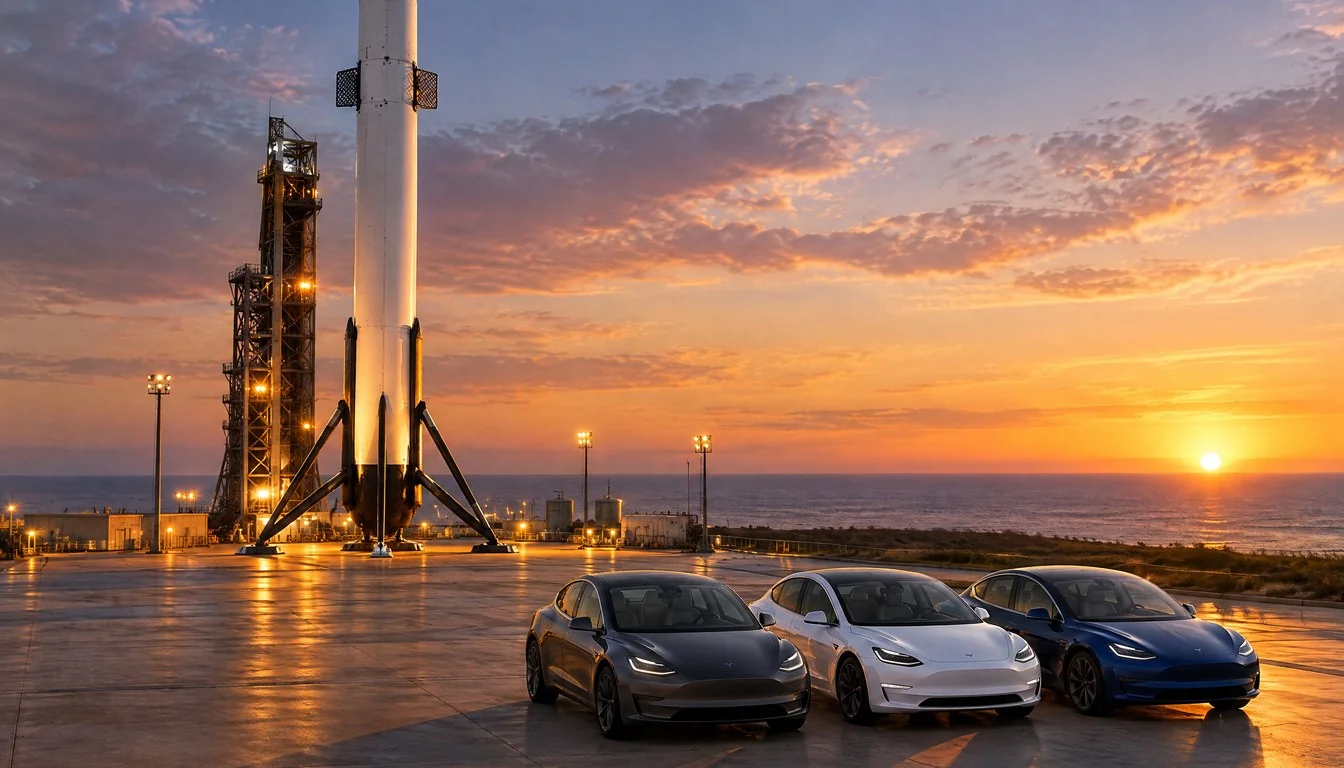
Elon Musk confirmed on Tuesday, October 20, 2026, that SpaceX and Tesla have formed special committees of independent directors to study a possible merger between the two companies he leads. The disclosure came during SpaceX’s third-quarter earnings call, the same call in which the rocket maker reported its first profitable quarter as a public company. It is the clearest signal yet that a spacex tesla merger is moving from years of market chatter into something boards are actually examining on paper.
Musk was blunt about his own role in the process. He said he supports the idea but cannot sit in the room while the committees negotiate, because he runs both companies and holds large stakes in each. Reuters, CNN and the BBC all carried versions of his remarks within hours of the call, and the story quickly became one of the most searched business topics of the day. What follows is a look at what was actually said, what remains unverified, and what analysts, investors and company watchers are saying about a tie-up that could reshape two of the most closely watched companies in the world.
Don't miss new tech stories on Google
Add TrendinTech once in the Google app and our stories appear in your news suggestions.
What Musk Actually Said on the Earnings Call
Asked directly whether SpaceX would consider merging with Tesla, Musk answered without hesitation. “Do I think it would be a good idea? Yes,” he told analysts, according to the BBC. He followed that with a more careful framing a moment later, telling the call, “I think it would be a good idea, but it’s really up to the special committees of both companies,” a quote distributed by Reuters and picked up across financial media within the hour.
Musk also addressed why he is stepping back from the negotiating table himself. Because he is chief executive of both companies and a major shareholder in each, he described himself as a conflicted party who cannot take part in the committees’ deliberations. He added that the committees had not reached agreement on terms of any transaction and that there is no guarantee one will happen at all. That is a meaningfully different statement than confirming a deal. It is confirmation that formal, board-level talks exist, paired with an explicit warning that they might go nowhere.
The timing matters. This is the first time Musk has put the words “special committees” on the record, rather than leaving the subject to analyst speculation. Searches around a possible tie-up had already spiked earlier in October after SpaceX president Gwynne Shotwell started following Tesla’s account on X, a move that fueled days of guesswork before either company said anything official. Tuesday’s call replaced that guesswork with an actual, on-record company disclosure.
Inside the Special Committees: How a Tesla-SpaceX Deal Would Work
Special committees are a standard corporate-governance tool for exactly this kind of situation. When a controlling executive or founder sits on both sides of a potential transaction, boards typically hand the negotiation to independent directors who have no financial stake in the outcome beyond their fiduciary duty to shareholders. That structure is designed to produce a deal, or a rejection of a deal, that can survive a shareholder lawsuit.
In this case, Tesla and SpaceX each have their own committee, and Musk said the two groups have not yet agreed on terms. No valuation, no exchange ratio, and no structure, whether that means SpaceX acquiring Tesla, Tesla acquiring SpaceX, or a new holding company absorbing both, has been settled. Reports that SpaceX could be structured as the acquirer of Tesla trace back to a single unnamed source and have not been confirmed by either company. Readers should treat that detail as unverified until one of the companies says otherwise.
Musk did confirm one hard requirement: shareholders at both companies would have to approve any transaction before it could close. That alone sets a high bar. Tesla’s own annual meeting, where investors are expected to vote on multiple governance matters including the re-election of Musk and two other directors in December, gives analysts a natural date to watch for any further disclosure, though neither company has tied a merger vote to that meeting.
SpaceX’s First Profitable Quarter as a Public Company
The merger disclosure landed inside a broader earnings story that was itself significant. SpaceX went public in June 2026, and Tuesday’s call covered its second quarterly report since the IPO. The company posted revenue of $14.58 billion, up 161 percent year over year, well ahead of a Wall Street consensus that had clustered closer to $12.8 billion to $12.9 billion. Adjusted EBITDA came in at $8.8 billion, up 306 percent from the same quarter a year earlier. On the bottom line, SpaceX reported GAAP net income of $4.4 billion, compared with a $1.1 billion net loss in the prior-year period, making it the company’s first solidly profitable quarter since going public.
Adjusted earnings per share landed around $0.35, well above the roughly $0.13 to $0.16 range analysts had modeled heading into the report. Income from operations was $2.8 billion. Much of the growth came from the company’s AI and connectivity-related business lines, which had been flagged as the key swing factor by analysts previewing the quarter before results were released.
| Metric | Q3 2026 Actual | Analyst Consensus | Year-Over-Year Change |
|---|---|---|---|
| Revenue | $14.58 billion | ~$12.8 billion to $12.9 billion | +161% |
| Adjusted EBITDA | $8.8 billion | Not separately disclosed | +306% |
| GAAP net income | $4.4 billion | Prior-year: $1.1 billion loss | Swing to profit |
| Adjusted EPS | ~$0.35 | ~$0.13 to $0.16 | Beat estimate |
| Income from operations | $2.8 billion | Not separately disclosed | n/a |
| Starlink subscribers | 13.6 million | n/a | Reported growth |
| Starlink revenue | $5.2 billion | n/a | +69% |
That Starlink growth came with a wrinkle. Average monthly revenue per consumer subscriber fell to roughly $69 from about $83 a year earlier, a sign that SpaceX is adding subscribers in markets and plans with lower average spending even as total Starlink revenue climbs. It is the kind of mixed signal that typically shows up in a maturing consumer business, more users at a lower blended price, rather than a company losing pricing power outright.
The $3.5 Trillion Number: Where It Comes From and Why It Is Not a Deal Price
Almost every headline about this story, including Fortune’s own coverage, has attached a figure to it: roughly $3.5 trillion. That number comes from adding a reported SpaceX valuation above $2 trillion to a Tesla market value near $1.5 trillion. It is worth being precise about what that figure is and is not. It is not a merger price, not an exchange ratio, and not a number either company has put in a filing. It is a back-of-envelope sum of two separately reported valuations, repeated so often across outlets that it has started to sound more official than it is.
Tesla’s market value is public and verifiable at any moment the stock trades. SpaceX’s valuation is different, since the company only went public in June 2026 and its share price has been comparatively thin on trading history. Combine a hard number with a soft one and the result reads cleaner than it is. Gary Black, managing partner at The Future Fund, was more direct about where he thinks this is headed, describing a Tesla-SpaceX combination as something close to inevitable given Musk’s voting control over both companies, according to Yahoo Finance. That is an opinion from an investor who tracks Tesla closely, not a confirmed outcome.
Separately, bullish SpaceX watchers have floated even larger long-run numbers for the space and connectivity business on its own. One widely discussed total addressable market estimate put SpaceX’s long-term opportunity at $28.5 trillion, a figure that dwarfs the current combined-value estimate and highlights how wide the range of outside projections for this company already is, with or without Tesla attached.
Why Now? The xAI Precedent and the Terafab Connection
This is not the first time a SpaceX-Tesla combination has been on the table. According to reporting cited in coverage of Tuesday’s call, SpaceX had previously weighed merging with Tesla at an earlier point before deciding instead to acquire xAI, Musk’s artificial-intelligence venture. That history matters for understanding why the subject resurfaced now rather than, say, a year ago. The companies have spent the past several months deepening technical cooperation rather than drifting apart.
Musk pointed to several areas of overlap as his rationale for favoring a merger: artificial intelligence software, chip design, robotics, and connectivity. Reporting around the call also referenced a jointly developed semiconductor project known as Terafab, described as a facility intended to produce chips for both Tesla’s vehicle and robotics programs and SpaceX’s own systems. Tesla’s physical AI ambitions, including its Optimus humanoid robot and Robotaxi software, sit alongside SpaceX’s satellite and AI computing infrastructure in that framing. Whether combining balance sheets actually accelerates any of that work, or simply adds legal complexity to a relationship that already cooperates informally, is the real question the special committees have been asked to answer.
What Wall Street and Analysts Are Saying
Merger talk around these two companies did not start on Tuesday’s call. Barclays analyst Dan Levy had already been telling clients in mid-October that a combination looked increasingly likely, and reportedly suggested an announcement could arrive before Tesla’s annual shareholder meeting. That is an analyst forecast, not a company statement, and it should be read that way. Market commentary gathered by outlets including a wire roundup of reaction to the announcement shows a split between analysts who view the combination as a logical next step for Musk’s empire and those who caution that two companies this large, with different ownership structures, different investor bases and different regulatory exposure, do not combine quickly or cleanly.
Separately, some of the market’s more bullish SpaceX voices, including investor Cathie Wood, have argued the standalone company is already underpriced relative to its long-term potential, a view laid out in detail following SpaceX’s IPO earlier this year. A merger narrative tends to amplify that kind of bull case, since it bundles two growth stories into one, but it also means any valuation debate about a combined company inherits all the same disagreements that already exist about each business on its own.
Historical Context: From Merger Rumors to Formal Committees
Speculation about combining Tesla and SpaceX has circulated, on and off, for years, largely because Musk controls both and has occasionally mused publicly about synergies between rockets, batteries, software and robotics. What changed over the past three months is the shift from informal musing to an actual corporate process. SpaceX’s own IPO in June 2026 is part of that story. Before SpaceX went public, there was no shared shareholder base and no mechanism for public-market investors to even ask the question in a proxy filing. Once SpaceX shares started trading, the idea of a stock-for-stock combination between two publicly traded Musk companies stopped being a thought experiment and became something boards could plausibly be asked to evaluate.
| Date | Development | Status |
|---|---|---|
| June 2026 | SpaceX completes its initial public offering | Confirmed |
| Mid-October 2026 | Barclays analyst flags rising odds of a merger before Tesla’s annual meeting | Analyst forecast |
| October 2026 | SpaceX president Gwynne Shotwell follows Tesla’s account on X, sparking speculation | Observed, not an official statement |
| October 20, 2026 | Musk confirms special committees on SpaceX’s Q3 earnings call | Confirmed |
| Ongoing | Committees negotiate potential terms | Unresolved, no agreement reached |
That table is a useful reminder of how fast this story has compressed. A single analyst note in mid-October and a follow on a social network were treated as meaningful signals for days, precisely because there was no official statement to replace them. Tuesday’s call did not resolve the underlying question of whether a deal happens, but it did replace rumor with an actual disclosure, which is a different kind of news even though the outcome remains the same: unresolved.
Competitive and Market Impact
A combined SpaceX-Tesla would not operate in a vacuum. SpaceX already competes with Amazon’s Kuiper satellite network and traditional telecom carriers in connectivity, while Tesla competes with a growing field of EV and AI-robotics rivals. Investors reacted quickly to Tuesday’s news: SpaceX shares reportedly moved higher in extended trading immediately after Musk’s comments, according to CNN’s reporting on the call, even though nothing about the deal itself had actually changed.
That kind of reaction is common around merger headlines generally, where price action often runs ahead of substance. If anything, Tuesday’s move shows how much investor appetite already exists for a combined entity, independent of whether the special committees ultimately agree on terms. For competitors in satellite connectivity, EV manufacturing and AI chip design, a combined SpaceX-Tesla balance sheet, even a partially combined one, would be a company worth watching closely on capital allocation, since it could in theory direct Tesla’s manufacturing scale and SpaceX’s satellite and launch infrastructure toward the same AI and robotics bets rather than funding them separately.
The Shareholder Approval Hurdle
Musk was explicit that shareholders at both companies would need to approve any transaction. That is standard for a deal of this size, but it is not a formality to dismiss. Tesla’s board has already faced scrutiny this year over executive compensation, including the size of Musk’s pay package tied to robotaxi software milestones, and a merger vote would land on a shareholder base that has shown it is willing to push back on governance questions. SpaceX’s shareholder base is newer and smaller, having only existed in its current public form since June 2026, which adds a layer of uncertainty about how that vote would play out compared with a company that has been publicly traded for more than a decade.
Beyond the shareholder vote itself, a deal this size would likely draw regulatory attention given Musk’s existing government contracts through SpaceX and Tesla’s own regulatory relationships around vehicle safety and autonomous driving. None of that process has formally started, since the special committees have not even agreed on terms to take to a vote in the first place.
What a Combined SpaceX-Tesla Would Look Like
It is worth separating the financial case from the operational one. Financially, a merger would combine SpaceX’s newly profitable, high-growth connectivity and launch business with Tesla’s larger but slower-growing vehicle and energy business. Operationally, the pitch Musk has made publicly centers on shared infrastructure: chip design through the planned Terafab facility, AI software development across both companies’ robotics programs, and satellite-based connectivity supporting Tesla’s vehicle fleet alongside SpaceX’s existing Starlink customer base.
Skeptics point out that many of those benefits are already achievable through ordinary commercial contracts between two companies that share a chief executive and already cooperate closely, without the legal and governance complexity of an actual merger. Supporters counter that formal combination would simplify capital allocation and remove friction in long-term joint projects like Terafab. Both arguments are legitimate, and the special committees exist specifically to weigh them against each other on behalf of shareholders who are not in the room.
Risks and Open Questions
Several open questions will shape whether this goes anywhere. First, valuation: with SpaceX’s public trading history still short, agreeing on a fair exchange ratio between the two companies could be contentious. Second, structure: whether SpaceX would acquire Tesla, the reverse, or some new combined entity remains unconfirmed and is currently sourced to a single unnamed report rather than either company. Third, timing: Musk’s comments gave no date, and analyst guesses about an announcement before Tesla’s annual meeting remain speculation rather than a company commitment. Fourth, and most simply, the deal may not happen at all. Musk himself said as much on the call.
There is also the matter of SpaceX’s own operational calendar competing for attention. The company is simultaneously working toward the next Starship flight, which Musk has said will attempt the first catch of the vehicle’s upper stage, a milestone covered in detail around SpaceX’s Flight 15 planning. A major corporate transaction and a high-stakes technical milestone landing in the same window would stretch leadership attention at a company that is still proving out its post-IPO financial footing.
Predictions: What Happens Next
Based on what has been confirmed so far, a few outcomes look more likely than others over the coming months.
- Expect both companies to stay quiet on specific terms for an extended stretch. Special committees typically negotiate privately for months before any term sheet becomes public, and Musk’s own comments suggest talks are still early.
- Expect continued analyst speculation about timing, including renewed attention around Tesla’s December shareholder meeting, even though neither company has tied a vote to that date.
- Expect SpaceX’s own standalone execution, particularly Starship’s next flight and continued Starlink subscriber growth, to matter as much to its stock as merger headlines, since the company only just posted its first profitable public quarter.
- Expect regulatory and governance scrutiny to intensify if and when actual terms emerge, given the size of both companies and Musk’s existing compensation and control questions at Tesla.
- Expect the $3.5 trillion figure to keep circulating in headlines regardless of whether any real valuation work supports it, simply because it is now attached to the story.
Frequently Asked Questions
Has the SpaceX-Tesla merger been confirmed?
No. Elon Musk confirmed on October 20, 2026, that both companies have formed special committees to examine a possible merger. He also said the committees have not agreed on terms and that there is no guarantee a deal will happen.
What did Elon Musk say about the merger on the earnings call?
Musk said he thinks a merger “would be a good idea” but that the decision rests with the special committees of both companies, not with him personally, since he is a conflicted party as chief executive of both.
Why isn’t Musk part of the merger negotiations?
Musk said he cannot take part in the special committees’ discussions because he leads both companies and holds significant ownership in each, creating a conflict of interest that independent directors are meant to manage on shareholders’ behalf.
How much would a combined SpaceX and Tesla be worth?
Media reports have cited a combined figure of roughly $3.5 trillion, based on a SpaceX valuation above $2 trillion and a Tesla market value near $1.5 trillion. That number is an estimate built from two separately reported valuations, not a confirmed merger price or exchange ratio.
Would shareholders have to approve a SpaceX-Tesla merger?
Yes. Musk said any transaction would require approval from shareholders at both companies before it could close.
When could a SpaceX-Tesla merger be announced?
No date has been confirmed by either company. Some analysts have speculated an announcement could come before Tesla’s annual shareholder meeting, but that is analyst speculation, not a company commitment.
What happened with SpaceX’s third-quarter 2026 earnings?
SpaceX reported revenue of $14.58 billion, up 161 percent year over year, and GAAP net income of $4.4 billion, marking its first solidly profitable quarter since its June 2026 initial public offering.
Did SpaceX consider merging with Tesla before?
Reporting around Tuesday’s call referenced an earlier period in which SpaceX had reportedly weighed a Tesla combination before deciding instead to acquire the AI venture xAI. The current committee process is the first time the subject has returned to a formal, disclosed stage.
Related Coverage
Helena Marsh
Helena Marsh is the Editor-in-Chief at TrendinTech, where she leads editorial strategy and oversees coverage across artificial intelligence, cybersecurity and enterprise technology. She believes technology reporting should be rigorous and plainly written, so readers understand what actually changes for them rather than what a company's announcement promises.
All stories by Helena Marsh (280)