Nasdaq Jumps 0.56% as SpaceX Profit, SMCI Up 12% [2026]

The Nasdaq Composite led Wall Street higher on October 21, 2026, after SpaceX and Super Micro Computer delivered results that reignited investor appetite for artificial intelligence stocks following weeks of unease over whether the AI buildout can pay for itself. The tech-heavy index climbed to 26,572.61, up 147.79 points, or 0.56%, while the Dow Jones Industrial Average added 90.86 points, or 0.17%, to reach 52,586.74, and the S&P 500 gained 18.12 points, or 0.23%, to close at 7,730.06.
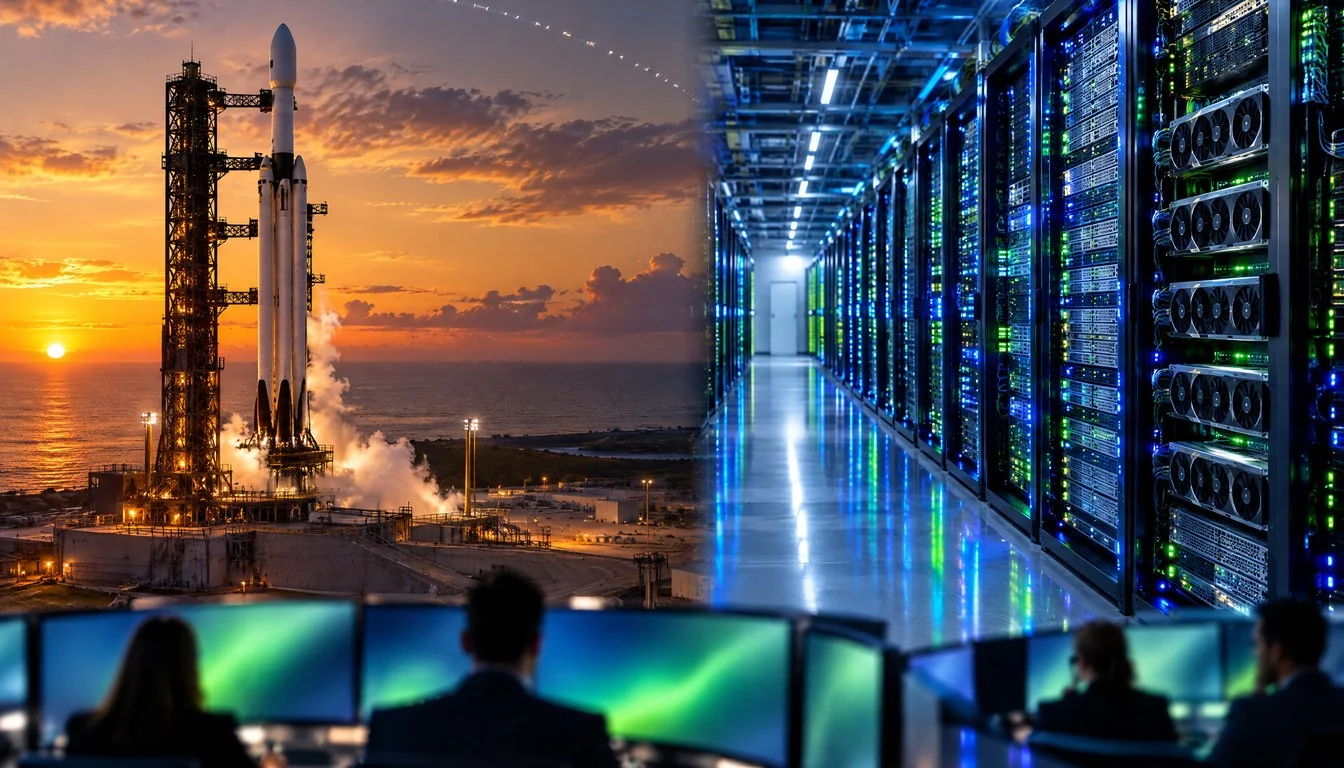
The spark came from two very different companies that both sell exposure to the same trade: AI infrastructure. SpaceX, Elon Musk’s rocket and satellite-internet company, reported its first profit as a public company. Super Micro Computer, the server maker that has become a bellwether for AI hardware demand, raised its revenue outlook well above what Wall Street had expected. Together, the two reports did what weeks of Federal Reserve commentary and chipmaker earnings could not: they convinced traders that the AI spending cycle still has room to run.
Don't miss new tech stories on Google
Add TrendinTech once in the Google app and our stories appear in your news suggestions.
SpaceX posts its first public-company profit
SpaceX shares jumped 10.7% after Musk said on October 20 that a merger between SpaceX and Tesla would be “a good idea,” a comment that landed alongside the company’s third-quarter results and amplified the stock’s move. The numbers underneath that rally were strong on their own. SpaceX reported third-quarter revenue of $14.58 billion, comfortably ahead of the roughly $13 billion analysts had modeled, and earnings per share of $0.35 against a consensus estimate of just $0.13, according to The Standard.
The headline figure that mattered most to AI-focused investors was SpaceX’s AI-related revenue, which came in at $7.56 billion for the quarter, a jump that reflects how quickly the company’s computing business has scaled alongside its satellite and launch operations. Reports tracking the earnings call described Starlink ending the quarter with roughly 13.6 million consumer subscribers, up from about 12 million in the prior quarter, though that figure comes from a single market report and has not been independently confirmed by SpaceX. The company’s third-quarter call also named Bret Johnsen as chief financial officer, according to reporting on the earnings call, though SpaceX has not published a full current list of executive titles.
What remains unconfirmed is any claim that SpaceX has officially acquired the AI coding startup Cursor. Some market commentary has tied part of SpaceX’s AI revenue growth to an August acquisition, but nothing in the company’s own disclosures establishes a confirmed Cursor deal, and readers should treat that connection as unverified. For context on how SpaceX framed its AI ambitions heading into this earnings cycle, see the SpaceX earnings preview that first flagged the Cursor speculation.
Super Micro Computer’s guidance shocks Wall Street
Super Micro Computer shares rose 12% after the company forecast quarterly revenue and profit margins above Wall Street estimates, a move that put SMCI among the session’s top gainers. In its own preliminary business update for the first quarter of fiscal year 2027, the AI-server maker said it now expects revenue of $18.5 billion to $19.5 billion, compared with its prior guidance of $14.5 billion to $15.5 billion. Supermicro also said gross margins should land between 12.0% and 12.5%, up from a previous range of 10.4% to 10.8%, attributing the improvement to “increased demand for AI platforms” and a shift in customer and product mix.
That is a jump of roughly $4 billion at the midpoint of the revenue range in a single update, which is the kind of swing that tends to move a stock far more than a typical earnings beat. Super Micro has not yet released final numbers. Those are scheduled for a full earnings call on November 3, 2026, meaning Wednesday’s preliminary figures could still shift once the audited results are filed. The company also disclosed a leadership change during the period, naming Mark Long as senior vice president and chief financial officer, reporting directly to founder, president, CEO, and chairman Charles Liang.
Super Micro’s updated guidance follows a separate move on October 13, when the company expanded its Open Compute Project-based rack-scale portfolio, adding 44OU and 48OU racks rated for a 5,000-pound static load, liquid-cooling-ready architecture, and a new switch design built for 102.4 terabits per second across 128 ports. That expansion is a reminder that Super Micro’s upgraded forecast is not happening in isolation. It follows months of hardware investment aimed squarely at the kind of rack-scale AI deployments that hyperscalers and cloud providers are ordering in bulk, a dynamic also visible in recent coverage of chip and memory makers being flagged as buys ahead of third-quarter earnings.
Wednesday’s market snapshot, by the numbers
| Index or stock | Level or move | Change | Driver |
|---|---|---|---|
| Nasdaq Composite | 26,572.61 | +147.79 (+0.56%) | SpaceX and Super Micro results |
| Nasdaq Composite (at the open) | 26,601.732 | +176.9 (+0.67%) | Pre-market optimism on AI results |
| Dow Jones Industrial Average | 52,586.74 | +90.86 (+0.17%) | Broad market follow-through |
| S&P 500 | 7,730.06 | +18.12 (+0.23%) | Tech and AI sector gains |
| SpaceX (SPCX) | Shares higher | +10.7% | First public-company profit, Musk’s merger comment |
| Super Micro Computer (SMCI) | Shares higher | +12% | Raised fiscal Q1 2027 revenue forecast |
The gap between the Nasdaq’s opening move of 0.67% and its 0.56% gain by the time figures were reported shows how volatile the AI trade has become this earnings season. Indexes that open sharply higher on a couple of marquee reports can give back some of that gain within hours as traders digest other results, including Netflix’s forecast, which reportedly failed to impress investors and weighed on the streaming giant’s shares even as AI names rallied.
SpaceX’s guidance table: where the AI revenue is coming from
| Metric | Q3 2026 figure | Comparison |
|---|---|---|
| Total revenue | $14.58 billion | Above the roughly $13 billion analyst estimate |
| Earnings per share | $0.35 | Above the $0.13 consensus estimate |
| AI-related revenue | $7.56 billion | Largest single disclosed revenue component |
| Share price reaction | +10.7% | Tied to earnings and Musk’s Tesla merger comment |
| Profit status | First public-company profit | Reported for the quarter ended September 30, 2026 |
The scale of SpaceX’s AI revenue is notable given that the company’s public identity has historically centered on Falcon rocket launches and Starlink broadband. A reported $7.56 billion in AI-linked revenue in a single quarter would put SpaceX’s computing business in the same conversation as dedicated cloud and AI infrastructure providers, a shift that helps explain why traders reacted to the earnings as an AI story first and a space story second.
The Musk merger comment that moved two stocks at once
Elon Musk’s remark that a SpaceX-Tesla merger would be “a good idea” is, by its own description, a comment and not a confirmed transaction. No terms, timeline, or structure for any such combination have been disclosed. What is confirmed is that the comment came a day ahead of SpaceX’s earnings and was cited by multiple outlets as a factor in SpaceX’s share-price gain. Readers who want the fuller history of how this idea developed should see the earlier coverage of SpaceX’s $4.4 billion profit and the special-committee talks around a possible Tesla tie-up.
That combination of a real earnings beat and a speculative corporate-structure comment is a pattern worth watching for the rest of this earnings season. It means some of Wednesday’s rally in SpaceX stock reflects durable, reported revenue growth, and some of it reflects a one-line comment about a deal that may never happen. Separating those two threads is important for anyone trying to gauge how much of the AI-stock rally is fundamentals-driven versus sentiment-driven.
What analysts and executives are saying
Charles Liang, Super Micro’s founder, president, CEO, and chairman, tied the company’s improved outlook directly to enterprise demand during the quarter. “As demand accelerates, we are improving profitability through a richer enterprise customer mix and broader adoption of our optimized Data Center Building Block Solutions® (DCBBS) architecture,” Liang said, according to Business Insider.
Liang also sized the scope of the opportunity Super Micro is chasing. “Around $60 billion, I would like to say 70% are pure AI,” he said of the business opportunity he described during the company’s earnings call, according to a transcript published by StockAnalysis.com. He framed the shift in broader terms as well, saying “the world is being transformed by AI, and Super Micro is transforming as well,” per a transcript carried by Yahoo Finance.
On the SpaceX side, Musk described the scale of demand the company is seeing for its computing capacity. “We could rent out our compute several times over if we said yes to everyone,” Musk said, according to The New York Times. Outside the two companies, Ipek Ozkardeskaya, a senior analyst at Swissquote, offered a more measured read on SpaceX’s AI pivot. “There is potential for substantial gains in its AI business, as AI infrastructure is capital intensive, and SpaceX has more means than many smaller companies,” Ozkardeskaya said, according to the Star-Telegram.
Why Wednesday’s rally differs from recent AI jitters
Wednesday’s gains stand in contrast to a rougher stretch for AI-linked equities earlier in October, when worries about overbuilt data-center capacity and the financing structures behind that spending pulled down tech-heavy benchmarks around the world. That selloff was visible well beyond the Nasdaq, including in the sharp drop in South Korea’s Kospi covered in the prior report on tech stocks tumbling amid AI jitters. The difference this week is that two companies with very different business models both produced hard numbers, rather than forward-looking promises, that supported the AI capital-spending thesis.
That is also the broader argument that investors like Cathie Wood have made about SpaceX’s valuation story, framing the company as a long-duration bet on compute and connectivity rather than a conventional aerospace stock, a thesis detailed in the earlier piece on Cathie Wood calling SpaceX a deep-value bet. Wednesday’s earnings give that framing a fresh data point, even if the market’s reaction to a single quarter does not settle the larger debate about AI infrastructure returns.
How SpaceX and Super Micro stack up against AI infrastructure peers
SpaceX and Super Micro occupy different points in the AI infrastructure chain, which is part of why their results moving the market together on the same day is notable. Super Micro builds and sells the physical servers, racks, cooling systems, and networking gear that AI compute runs on, competing with established server and systems vendors for hyperscaler and enterprise orders. SpaceX, by contrast, is both a consumer of that kind of infrastructure and, through its satellite network and reported AI business, an operator selling compute and connectivity services directly.
That distinction matters for how each company’s results should be read. Super Micro’s raised guidance is a demand signal from the supply side of the AI buildout, an indicator that the companies ordering racks and servers are still placing larger orders than expected. SpaceX’s AI revenue growth is a demand signal from the consumption side, suggesting that whoever is renting SpaceX’s compute capacity is paying enough to make it a multibillion-dollar line item in a single quarter. Seeing both signals arrive on the same day is part of why the Nasdaq’s reaction was broad rather than confined to either stock.
Super Micro’s guidance revision in detail
| Metric | Prior guidance | Updated guidance |
|---|---|---|
| Fiscal Q1 2027 revenue | $14.5 billion to $15.5 billion | $18.5 billion to $19.5 billion |
| Gross margin | 10.4% to 10.8% | 12.0% to 12.5% |
| Share price reaction | n/a | +12% |
| Full results release | n/a | Scheduled for November 3, 2026 |
Because these are preliminary figures rather than audited final results, some caution is warranted. Super Micro has previously had to revise and clarify prior financial disclosures, so the market’s enthusiastic reaction to Wednesday’s preliminary numbers assumes the November 3 release will confirm the stronger outlook rather than walk it back. That timing gap between a preliminary update and a final report is itself a mechanism that can add volatility to the stock in either direction over the next two weeks.
Historical context: a volatile year for the AI trade
2026 has been a year of sharp swings for AI-linked stocks, alternating between rallies built on strong earnings and selloffs built on concerns about overbuilding. SpaceX’s own trajectory this year illustrates the pattern. The company went public earlier in 2026 and has since moved from reporting losses to posting what Wednesday’s results describe as its first profit as a public company, a turn that followed a period in which analysts debated whether its AI ambitions were overstated. Super Micro, for its part, has spent much of the past year rebuilding investor confidence after earlier governance and reporting concerns, making Wednesday’s guidance increase a meaningful data point in that recovery story.
The broader AI infrastructure sector has followed a similar up-and-down path, with chipmakers, memory suppliers, and server vendors all seeing their shares swing on both earnings results and any sign that hyperscaler capital spending plans might slow. That volatility is why single-day moves like Wednesday’s, however large, are typically read by analysts as one data point in a longer argument rather than a final verdict on the AI buildout’s economics.
Market impact beyond SpaceX and Super Micro
The two companies’ results lifted sentiment across AI-adjacent names even though the Nasdaq’s 0.56% gain was more modest than the double-digit moves in SpaceX and Super Micro shares individually. That gap between a strong narrow rally and a more muted broad-index move suggests that while traders were enthusiastic about these two specific reports, they remain more cautious about extrapolating the same strength across every company touching AI infrastructure. It is a dynamic consistent with the mixed signals seen in recent coverage of chip and memory names being named as buys ahead of their own upcoming earnings reports, where optimism is often selective rather than uniform.
Netflix’s weaker session, driven by a forecast that reportedly failed to impress investors, served as a reminder that Wednesday’s gains were concentrated in AI infrastructure rather than lifting every large-cap tech name. That divergence is itself a data point for anyone trying to assess whether the market is rewarding AI exposure specifically, or growth and technology stocks broadly.
What is still unconfirmed
Several details tied to Wednesday’s rally remain unconfirmed and deserve caution before they get repeated as settled fact. There is no confirmed record of SpaceX officially acquiring Cursor, despite some commentary linking the two companies. There are no disclosed terms, valuation, or timeline for a potential SpaceX-Tesla merger beyond Musk’s comment that he considers the idea “a good idea.” And Super Micro’s new guidance is preliminary, pending the company’s full fiscal first-quarter report on November 3. Each of these threads could develop significantly in the coming weeks, and each is worth tracking separately rather than treating as part of a single confirmed story.
Predictions: what to watch next
- Super Micro’s November 3 earnings call will be scrutinized closely to see whether its preliminary $18.5 billion to $19.5 billion revenue range holds up in audited results, given the size of the upward revision from prior guidance.
- Expect continued volatility in SpaceX shares tied to any further comments from Musk about a Tesla merger, independent of whether the companies’ special committees produce an actual proposal.
- Other AI server and infrastructure vendors are likely to face pressure to match or explain why they cannot match Super Micro’s demand signals when they report their own quarterly results in the coming weeks.
- Analysts will likely push for more disclosure from SpaceX on how its AI compute revenue is split between enterprise customers, internal use, and any named partners, given how large that revenue line has become.
- Days with mixed results, like Netflix’s weaker session alongside SpaceX and Super Micro’s gains, suggest the market will keep rewarding AI infrastructure exposure selectively rather than lifting all technology stocks uniformly for the rest of this earnings season.
The bottom line for investors
Wednesday’s session showed that the AI trade is not dead, but it is getting more selective about which earnings reports it rewards. SpaceX and Super Micro both delivered concrete numbers, a 161% jump in SpaceX’s reported year-over-year revenue growth and a multibillion-dollar increase in Super Micro’s own guidance, that gave the Nasdaq a reason to climb even as other parts of the market, including Netflix, lagged. The gains came with real caveats: a merger comment with no disclosed terms, a preliminary guidance update still awaiting final confirmation, and an AI revenue figure at SpaceX that invites more scrutiny the larger it grows. None of that erases the strength investors saw on October 21, but it does mean the next few weeks of earnings, including Super Micro’s November 3 report, carry real weight for whether Wednesday’s optimism holds.
Frequently asked questions
Why did the Nasdaq rise on October 21, 2026?
The Nasdaq Composite climbed 0.56% to 26,572.61 after SpaceX and Super Micro Computer both reported results that improved investor appetite for AI-linked stocks, offsetting broader concerns about AI infrastructure spending.
What did SpaceX report in its third-quarter 2026 results?
SpaceX reported revenue of $14.58 billion, earnings per share of $0.35 against a $0.13 estimate, and AI-related revenue of $7.56 billion. The company also said it posted its first profit as a public company.
Why did Super Micro Computer shares jump 12%?
Super Micro raised its fiscal first-quarter 2027 revenue guidance to $18.5 billion to $19.5 billion, up from $14.5 billion to $15.5 billion, and increased its expected gross margin range, citing stronger demand for AI platforms.
Is a SpaceX-Tesla merger official?
No. Elon Musk said on October 20, 2026, that a merger between SpaceX and Tesla would be “a good idea,” but no terms, timeline, or formal proposal have been confirmed. It remains a comment, not a completed or announced transaction.
Did SpaceX officially acquire the AI startup Cursor?
That is not confirmed. Some commentary has linked part of SpaceX’s AI revenue growth to an earlier acquisition, but there is no confirmed official record establishing a Cursor acquisition in SpaceX’s own disclosures.
When will Super Micro report final fiscal first-quarter 2027 results?
Super Micro has scheduled its full earnings call for November 3, 2026, at 5 p.m., when it is expected to confirm or revise the preliminary revenue and margin figures it disclosed this week.
How does Wednesday’s rally compare with earlier AI stock selloffs this year?
It stands in contrast to recent sessions where worries about AI infrastructure financing pulled down tech stocks globally. Wednesday’s gains were driven by concrete earnings and guidance numbers rather than forward-looking promises, which is part of why they lifted the Nasdaq broadly.
What risks remain for the AI infrastructure trade?
Key risks include whether Super Micro’s preliminary guidance survives its November 3 audited report, whether SpaceX’s AI revenue growth continues at the same pace, and whether broader doubts about the financing behind large-scale AI data center spending resurface in future earnings seasons.
Related Coverage
Helena Marsh
Helena Marsh is the Editor-in-Chief at TrendinTech, where she leads editorial strategy and oversees coverage across artificial intelligence, cybersecurity and enterprise technology. She believes technology reporting should be rigorous and plainly written, so readers understand what actually changes for them rather than what a company's announcement promises.
All stories by Helena Marsh (281)