SpaceX Earnings Preview: $12.9B Forecast, Cursor Deal [2026]

Big Technology founder Alex Kantrowitz joined CNBC’s Closing Bell on October 20, 2026 to walk through what Wall Street expected from SpaceX’s third quarter results, the second earnings report the rocket and satellite company has filed since going public earlier this year. The segment landed hours before SpaceX’s own scheduled release, at a moment when analyst models for the quarter were unusually scattered.
Revenue forecasts compiled across multiple outlets ranged from $12.72 billion to $12.89 billion, and per share earnings estimates spanned $0.13 to $0.23, a gap wide enough to show that modeling a company this young as a public filer, one running a launch business, a satellite internet arm, and a fast growing AI unit under a single income statement, is still more art than science. Kantrowitz’s appearance, alongside Odyssey Capital Advisors principal and chief investment officer Jason Snipe, treated spacex earnings as one of the most closely watched prints of the week, trailing only Tesla and Netflix on investor calendars that day.
Don't miss new tech stories on Google
Add TrendinTech once in the Google app and our stories appear in your news suggestions.
What Kantrowitz and CNBC Flagged Heading Into the Print
CNBC titled the segment Big Technology’s Alex Kantrowitz on SpaceX earnings expectations, and the network identified him as the founder of Big Technology, the newsletter and podcast he has run since 2020. The timing mattered. SpaceX’s own investor relations page had the Q3 2026 release and management webcast scheduled for the afternoon of October 20, meaning the Closing Bell conversation functioned as a last word before the numbers actually landed.
Snipe joined the same segment to discuss Netflix’s results, which were also due that day, giving the appearance a dual purpose: framing two of the most anticipated non Tesla tech prints of the week back to back. CNBC did not publish a transcript of Kantrowitz’s specific calls on SpaceX’s numbers, so his detailed predictions are not part of the public record. What is on the record is the broader setup he was asked to unpack: a company barely a year removed from private status now reporting quarterly results that institutional investors are still struggling to model with any precision.
SpaceX’s Short, Eventful Run as a Public Company
SpaceX’s shift from the most closely held private company in the industry to a public filer reporting quarterly spacex earnings is itself the backdrop for Tuesday’s segment. Reports have described the company completing its initial public offering around June 2026, with Gwynne Shotwell, who serves as president, chief operating officer, and a director, having previously argued for years that staying private gave SpaceX room to pursue long term goals without quarterly pressure. That changed with the August 4, 2026 release of the company’s first quarter as a public filer, when SpaceX reported revenue of $7.8 billion, adjusted EBITDA of $3.5 billion, and a net loss, according to a transcript of that call. Management reiterated an aggressive AI and infrastructure investment plan and pointed toward a $100 billion annualized revenue run rate by the end of 2026.
The company’s history stretches back much further than its public listing. SpaceX first reached orbit with Falcon 1 in 2008, and by the time of a recent mission the company had logged its 100th successful Falcon rocket flight. It restored human spaceflight launches from US soil in 2020, and in February 2022 it announced the Polaris Program with Jared Isaacman, an effort aimed at advancing human spaceflight capability while supporting causes on the ground. That long runway of crewed and uncrewed missions is part of why Wall Street has struggled to value SpaceX using the same multiples applied to traditional launch or telecom companies: no other public filer combines an orbital launch monopoly in large parts of the market with a satellite broadband network and, increasingly, an AI compute business.
Wall Street’s Pre Earnings Numbers: Where the Estimates Landed
Ahead of the release, sell side and media estimates for spacex earnings clustered in a tight but not identical band. Yahoo Finance reported analysts modeling $12.74 billion in revenue and $0.14 per share, up 63 percent from the prior quarter’s $7.8 billion base. Pepperstone, citing Bloomberg’s consensus, put the number higher at $12.89 billion in revenue, $0.149 in adjusted earnings per share, and $6.62 billion in adjusted EBITDA, implying roughly 65 percent sequential growth. Other coverage put the revenue consensus at $12.84 billion, while Investor’s Business Daily described a sharper, more bullish private forecast of $0.23 per share sitting alongside a more conservative $0.14 consensus.
| Source | Revenue estimate | EPS estimate | Other detail cited |
|---|---|---|---|
| Yahoo Finance | $12.74 billion | $0.14 | Up 63% from Q2’s $7.8 billion |
| Pepperstone (Bloomberg consensus) | $12.89 billion | $0.149 | Adjusted EBITDA $6.62 billion, ~65% sequential growth |
| Motley Fool coverage | $12.84 billion | Not specified | Described as more than doubling year over year |
| Investor’s Business Daily | Not specified | $0.14 consensus, $0.23 sharper forecast | Cited AI revenue surge and merger speculation |
That kind of spread between a consensus figure and a sharper, more bullish outlier forecast is unusual for a company of SpaceX’s size, and it is the exact dynamic Kantrowitz was brought on to help explain. A newly public company with a short trading history, limited year over year comparisons, and a business mix that is changing quarter to quarter gives analysts far less to anchor on than an established mega cap.
Inside the Print: AI Becomes the Story of the Quarter
Same day coverage following the release described SpaceX posting revenue of roughly $14.58 billion and profit of about $4.4 billion, well ahead of the consensus estimates analysts had set going in, according to a transcript of the earnings call. That reported top line breaks down into approximately $7.56 billion from AI, $5.25 billion from connectivity, and $1.77 billion from launch and space activity, based on the same call. If that breakdown holds up under scrutiny, it marks the quarter AI infrastructure revenue overtook both Starlink connectivity and the core launch business combined, a reordering of SpaceX’s business mix that would have seemed unlikely even a year earlier.
What is firmly confirmed, independent of any single transcript, is that SpaceX’s AI business grew roughly ninefold year over year in the period and that management is targeting more than two gigawatts of compute capacity by the end of the year, a target rather than a completed build. Connectivity revenue, tied to Starlink, came in at $5.25 billion, and launch revenue reached $1.77 billion. Starlink’s subscriber base grew to 13.6 million from 12 million in the prior quarter, with average revenue per user around $69.
| Metric | Q3 2026 | Change |
|---|---|---|
| Starlink subscribers | 13.6 million | Up from 12 million in Q2 2026 |
| Starlink average revenue per user | $69 | Not previously disclosed at this granularity |
| Connectivity revenue | $5.25 billion | Up from $4.3 billion in Q2 2026 |
| Launch and space revenue | $1.77 billion | Separately disclosed segment |
| AI business growth | Grew roughly ninefold year over year | Target of more than 2 gigawatts of compute by year end |
| Q3 capital spending | Approximately $18.4 billion | Largely AI data centers, similar Q4 spending expected |
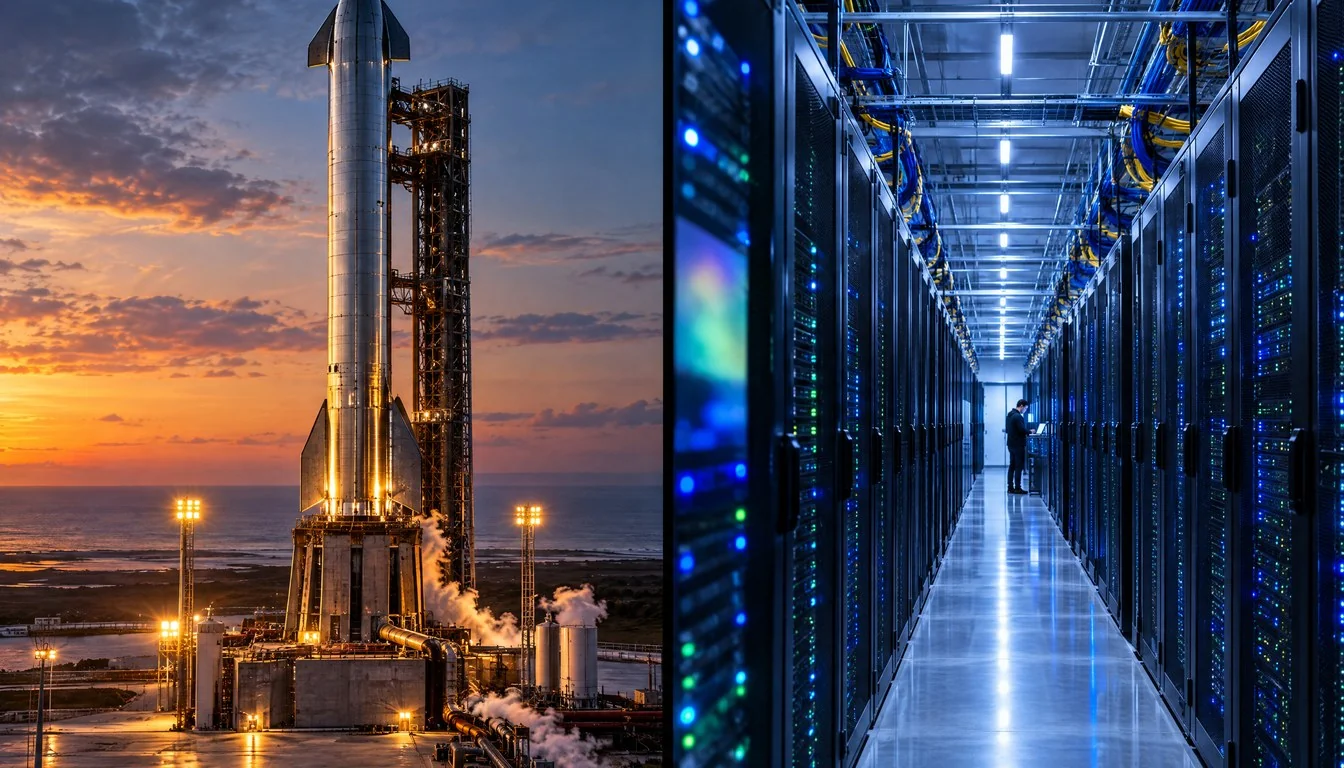
SpaceX’s own description of itself as building integrated infrastructure across “space, connectivity, and Super Intelligence” is a useful lens for that shift. A company that was, until recently, defined almost entirely by reusable rockets and a satellite internet constellation is now explicitly positioning its data center and AI compute build out as a third core pillar of the business, alongside Starlink and Falcon.
Starlink’s Build Out: V3 Satellites, Pricing, and the Mobile Push
Starlink itself kept moving during the quarter. SpaceX’s own updates describe V3 as the newest Starlink broadband satellite generation, designed for up to 1 terabit per second of downlink capacity and 160 gigabits per second of uplink capacity per satellite, a sharp jump from the prior hardware generation. Reports place the first 26 V3 satellites launching on September 28, 2026 aboard Starship’s 14th flight. On the regulatory side, SpaceX’s updates describe an agreement to acquire a nationwide low band spectrum portfolio to support Starlink Mobile, the company’s push into direct to device and carrier style connectivity.
Consumer pricing has also shifted recently. The Starlink Mini kit dropped to $149 in the United States on October 2, 2026, down from its earlier $199 price point. Current Residential and aviation pricing, pulled directly from Starlink’s own plan pages, is below.
| Plan | Price | Notes |
|---|---|---|
| Residential 100 Mbps | $55/month | Standard home internet tier |
| Residential 200 Mbps | $85/month | Higher speed home tier |
| Residential Max | $130/month | Top home internet tier |
| General Aviation Local 50GB | $200/month | Up to 300 mph, land and territorial waters |
| General Aviation Global 50GB | $1,000/month | Up to 450 mph, land and ocean coverage |
Shotwell has previously said SpaceX expects to bring Starlink Mobile service to consumers by late 2027, with the ambition of outperforming established US carriers on coverage in areas without terrestrial towers. That timeline sits well outside the current earnings cycle, but it is part of why analysts keep folding Starlink Mobile’s spectrum and regulatory progress into their spacex earnings models even before the product generates meaningful revenue.
Capital Spending and the AI Data Center Build Out
SpaceX’s roughly $18.4 billion in third quarter capital spending, concentrated on AI data centers, puts the company in the same conversation as the hyperscalers it is increasingly competing with for compute. Analysts expect similarly heavy spending in the fourth quarter, which means the capex line, not the launch cadence, may be the single biggest swing factor in how investors judge the next several quarters of spacex earnings.
That spending pattern mirrors what is playing out elsewhere in the industry. Meta’s own third quarter AI spending preview has drawn similar scrutiny from investors trying to decide how much AI infrastructure investment a company’s core business can absorb before it starts pressuring margins. The difference for SpaceX is that its AI build out sits alongside a capital intensive rocket and satellite business that was already spending heavily before AI compute entered the picture, which is part of why the $18.4 billion figure drew as much attention from analysts previewing the quarter as the revenue estimate itself.
The Reported $60 Billion Cursor Deal and Why It Matters for Coding Tools
One of the more unusual threads tied to this earnings cycle involves Cursor, the AI native code editor that has become one of the most widely used tools among professional developers over the past two years. Reports circulating around the print referenced a deal for SpaceX to acquire Cursor in a transaction valued at approximately $60 billion, though the available material does not establish the transaction’s legal status, its closing date, or whether Cursor is formally part of SpaceX today. That uncertainty matters: a deal of that size, if confirmed, would be one of the largest acquisitions of an AI coding tools company to date, rivaling or exceeding recent enterprise software deals in the space.
Cursor has built its reputation by competing directly with GitHub Copilot and a growing field of AI coding assistants, and this site has previously covered its expansion into mobile tooling with an iOS app and its Bugbot review feature. A SpaceX tie up, even an unconfirmed one, would be a notable departure for a rocket and satellite company whose software efforts have historically been internal, mission critical, and tightly scoped to flight systems rather than general purpose developer tools. If SpaceX is in fact building out a coding tools and AI software arm alongside its compute infrastructure push, it would put the company in more direct competition with cloud providers and AI labs that already bundle coding assistants with their infrastructure offerings, rather than just supplying the data centers those assistants run on.
Until SpaceX or Cursor issue an on the record statement, the safest reading is that this is a reported transaction awaiting confirmation, not a completed one. Investors modeling spacex earnings for the next several quarters will likely be watching for any segment disclosure that would indicate Cursor’s revenue, if the deal closes, is being folded into the AI business line that already grew ninefold in the third quarter.
Tesla and SpaceX Special Committees: Merger Speculation Resurfaces
Adding another layer to Tuesday’s news cycle, CNBC reported that Musk said Tesla and SpaceX had formed special committees to discuss a possible merger between the two companies. That is a materially different claim than ordinary market chatter: a special committee process typically signals that a board level, legally structured conversation is already underway, even if no transaction has been proposed or agreed. The report landed the same day as both companies’ earnings activity, feeding speculation that a combination, or at least a closer financial relationship, could be on the table.
Shotwell’s own public behavior added fuel to the speculation. Reports noted she began following Tesla’s official account on X around October 18, a small but closely watched signal given how frequently Musk’s own social media activity has preceded corporate announcements in the past. None of this confirms a transaction is imminent, and no terms, valuation, or timeline for any merger have been disclosed. It does mean that anyone parsing Tesla’s own earnings preview this week has an additional variable to track beyond vehicle deliveries and energy storage numbers.
Competitive Comparison: SpaceX’s AI Pivot Against Rivals
No other launch provider is anywhere close to replicating what SpaceX reported this quarter. Rocket Lab, which has pushed its own heavy lift Neutron rocket debut into 2027, remains focused primarily on launch and spacecraft components rather than a parallel AI infrastructure business, and does not report anything resembling SpaceX’s gigawatt scale compute targets. Blue Origin, still working to establish a reliable cadence with its New Glenn vehicle, is similarly not positioned as an AI infrastructure operator in the way SpaceX’s own disclosures now describe the company.
The more relevant comparison set, at least for the AI and capex side of the business, is the hyperscale cloud providers and AI labs spending tens of billions of dollars a quarter on data centers. SpaceX’s roughly $18.4 billion in Q3 capital spending and ninefold AI revenue growth put it in a similar conversation to those companies, even though its origins and most of its workforce remain rooted in aerospace engineering rather than enterprise software. That positioning, part launch provider, part satellite operator, part AI infrastructure company, is precisely what makes spacex earnings so difficult for analysts to model using a single comparable company.
Historical Context: From Rocket Startup to AI Infrastructure Company
SpaceX’s path to this point has been unusually long for a company now being valued on quarterly AI infrastructure metrics. It reached orbit for the first time with Falcon 1 in 2008, after three earlier failed attempts, and spent the following decade and a half building out Falcon 9, Dragon, and ultimately Starship. The company’s Florida launch operations alone were on track to exceed 100 flights in a single year as of 2025, a cadence that would have seemed implausible for the broader launch industry a decade earlier.
That operational track record is part of why bullish forecasts about SpaceX’s long term value have multiplied since its IPO. Some market commentary has floated total addressable market estimates running into the trillions of dollars, while prominent investors including Cathie Wood have described SpaceX as a long duration value bet worth trillions rather than a conventional aerospace stock. Whether those figures hold up is a separate question from what the company actually reported this week, but they help explain why a single earnings call, delivered by a company that spent most of its existence avoiding public markets entirely, now draws the kind of CNBC airtime usually reserved for mega cap technology names.
Market Reaction and What Analysts Are Watching Next
Prediction markets and options pricing ahead of the release, according to Yahoo Finance’s earnings preview coverage, reflected genuine uncertainty about where SpaceX would land relative to the scattered analyst estimates. That uncertainty is itself a data point. For an established mega cap, a dispersion of $0.13 to $0.23 in per share estimates would be unusual enough to draw scrutiny on its own. For a company that has reported results publicly only twice, it reflects how little historical data analysts have to anchor their models against, and how much of SpaceX’s valuation now depends on assumptions about AI infrastructure growth rather than historical launch or connectivity revenue trends.
Going forward, the questions investors are likely to keep asking include how durable the AI segment’s ninefold growth rate is once it is measured against a larger base, whether Starlink’s subscriber growth from 12 million to 13.6 million can be sustained as Starlink Mobile adds a second consumer product line, and whether the Tesla merger speculation around the special committees produces any formal proposal before the next earnings cycle.
Five Predictions for SpaceX Heading Into 2027
- AI compute spending keeps climbing past the stated 2 gigawatt year end target, with capital expenditure becoming the single largest swing factor in how investors react to spacex earnings each quarter.
- The reported Cursor transaction gets clarified, confirmed, denied, or restructured, within the next one or two reporting cycles, as investors push for cleaner segment disclosure on where AI software revenue originates.
- Starlink Mobile’s consumer rollout, which Shotwell has pointed to for late 2027, faces at least one public timeline adjustment given how much regulatory and spectrum work still needs to close before a commercial launch.
- Tesla and SpaceX merger speculation keeps resurfacing around each earnings cycle until Musk or the special committees issue a leading public statement, formal or otherwise.
- Analyst estimate dispersion for SpaceX narrows over the next three to four quarters as more trading history accumulates, even as near term prints continue to surprise in both directions given the AI business’s early growth stage.
None of these are guarantees, and all of them depend on SpaceX continuing to disclose enough segment detail for outside analysts to track. What is already clear from Tuesday’s coverage is that SpaceX’s quarterly reports have stopped being a story about rockets and satellites alone, and started being a story about how much of the company’s future value rides on an AI compute business that barely existed in its public disclosures a year ago.
Frequently Asked Questions
What did Alex Kantrowitz discuss on CNBC’s Closing Bell?
Kantrowitz, identified by CNBC as the founder of Big Technology, joined Closing Bell on October 20, 2026 alongside Odyssey Capital Advisors principal and chief investment officer Jason Snipe to discuss expectations for SpaceX’s earnings release and Netflix’s results, both due the same day.
When did SpaceX report third quarter 2026 earnings?
SpaceX’s investor relations page scheduled the Q3 2026 results and management webcast for October 20, 2026, the same day as the Kantrowitz segment.
Who leads SpaceX today?
Elon Musk is listed as chief executive officer, chief technology officer, and chairman of the board. Gwynne Shotwell serves as president, chief operating officer, and a director. Bret Johnsen is identified as chief financial officer.
What is Starlink V3?
V3 is SpaceX’s newest Starlink broadband satellite generation, designed for up to 1 terabit per second of downlink capacity and 160 gigabits per second of uplink capacity per satellite. The first 26 V3 satellites were reported to have launched on Starship’s 14th flight.
How much do Starlink plans cost?
Starlink’s Residential plans run $55 a month for 100 Mbps, $85 a month for 200 Mbps, and $130 a month for the Residential Max tier, according to Starlink’s own plan pages. The Starlink Mini kit dropped to $149 in the United States on October 2, 2026.
Is SpaceX’s reported acquisition of Cursor confirmed?
No. Reports have referenced a deal for SpaceX to acquire the AI coding tool Cursor valued at approximately $60 billion, but the transaction’s legal status, closing date, and whether Cursor is formally part of SpaceX have not been established.
Are Tesla and SpaceX actually merging?
No merger has been confirmed. CNBC reported that Musk said the two companies had formed special committees to discuss a possible merger, which indicates a formal conversation is underway, not that a deal has been agreed or proposed with terms.
What is SpaceX’s AI compute target?
SpaceX has said it is targeting more than two gigawatts of AI compute capacity by the end of 2026, following AI revenue growth the company described as roughly ninefold year over year in the third quarter.
Related Coverage
Helena Marsh
Helena Marsh is the Editor-in-Chief at TrendinTech, where she leads editorial strategy and oversees coverage across artificial intelligence, cybersecurity and enterprise technology. She believes technology reporting should be rigorous and plainly written, so readers understand what actually changes for them rather than what a company's announcement promises.
All stories by Helena Marsh (272)