Synaptics Astra SR200: 400 GOPS Edge AI Chips Debut [2026]

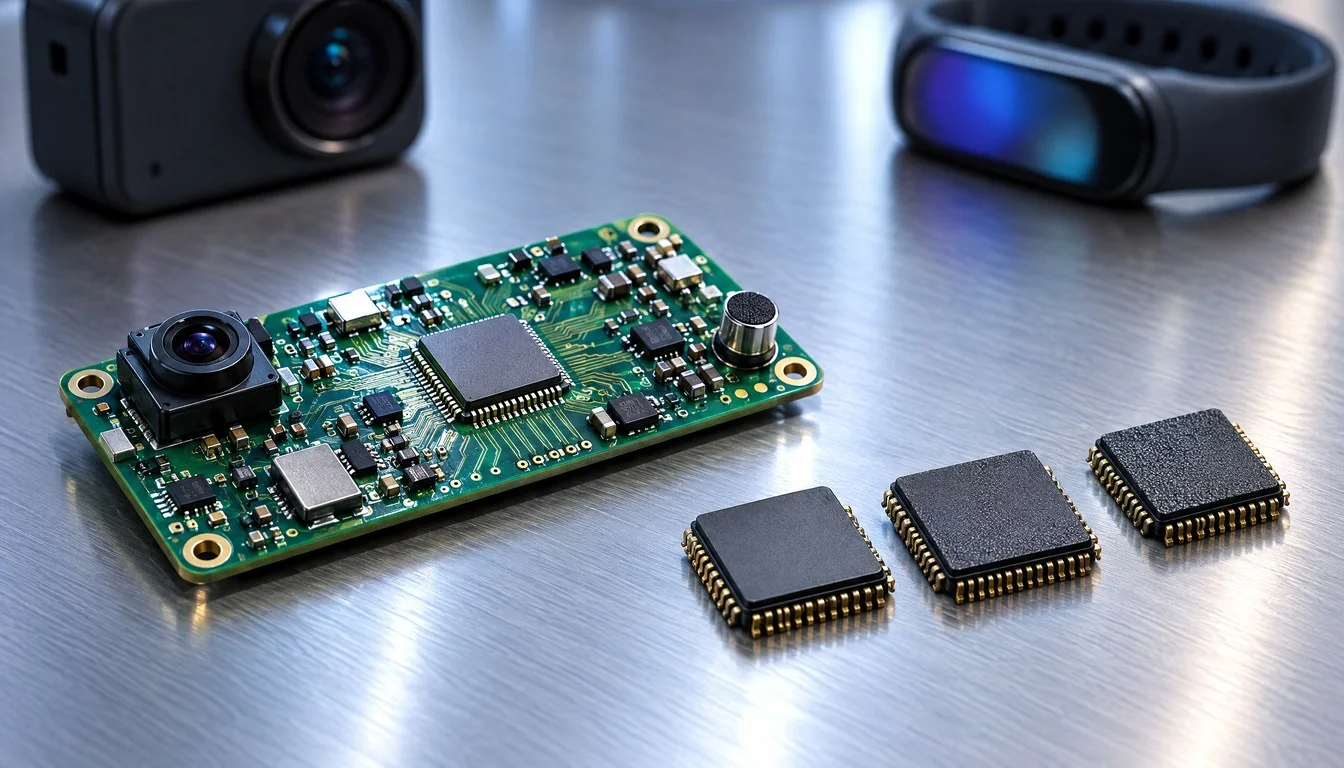
Synaptics Incorporated (Nasdaq: SYNA) used October 20, 2026 to open what it calls the xMCU era, unveiling the Astra SR200 Series, a three-chip family of multimodal edge AI processors that tops out at 400 GOPS of on-device inference. The San Jose chipmaker is pitching the launch as a new category of silicon sitting between a traditional microcontroller and a full application processor, aimed at battery-powered devices that need to see, hear and respond without phoning home to the cloud.
The announcement lands at a pivotal moment for Synaptics. The company is mid-process on a revised acquisition by onsemi, and it is racing rivals in AI silicon such as Qualcomm, Ambiq, and Nordic Semiconductor to own the low-power edge AI slot before an expected wave of AI wearables, smart cameras, and industrial sensors ships in 2027. Whether the SR200 Series becomes a volume product or a footnote in Synaptics’ history will depend on pricing and supply details the company has not yet published.
Don't miss new tech stories on Google
Add TrendinTech once in the Google app and our stories appear in your news suggestions.
What Synaptics Actually Announced on October 20
Synaptics introduced the Astra SR200 Series as a new class of microcontroller it brands xMCU, short for a chip meant to deliver microcontroller-level power efficiency alongside microprocessor-class AI performance. The series ships as three pin-compatible parts sharing one hardware foundation and one software development kit, which lets a hardware team design a single board and swap silicon as a product moves from prototype to shipping unit without a board respin.
The three parts are the Astra SR210, SR230, and SR250. Synaptics positions the SR210 as the power-optimized entry point for always-on voice and sensing, rated at 200 GOPS. The SR230 steps up to 300 GOPS and adds vision, display, and optional audio support for mainstream multimodal devices. The SR250 tops the lineup at 400 GOPS with dual vision and display paths, aimed at premium edge applications that need to process more than one camera feed or run richer on-device models.
Each chip pairs Arm Cortex-M85 and Cortex-M52 processor cores with Synaptics’ own Torq AI engine, which integrates Google Research’s Coral NPU technology. That partnership matters here. Coral NPU is Google’s effort to standardize a compact, efficient neural processing architecture for edge devices, and Synaptics using it instead of designing an NPU from scratch signals how much of the edge AI silicon market is now consolidating around shared accelerator IP rather than each vendor building bespoke cores.
The xMCU Category: A New Tier Between MCU and MPU
The term xMCU is Synaptics’ own coinage, and it is worth unpacking why the company felt it needed a new label at all. Traditional microcontrollers are cheap, sip power, and run simple control logic, but they choke on anything resembling a neural network. Microprocessors handle AI workloads well but burn through battery life fast and cost more in bill of materials. Synaptics is arguing the SR200 Series sits in a gap between those two tiers, delivering what it describes as MCU-level efficiency with MPU-class multimodal AI performance.
That framing is a bet on where the next wave of connected devices will live. Smart glasses, AI-enabled earbuds, doorbell cameras, and industrial sensors all share a common constraint: they run on small batteries, often need to operate for days or weeks between charges, yet increasingly need to classify sound, recognize faces, or flag anomalies without a cloud round trip. A chip that can do that locally, cheaply, and without draining a coin cell is the product category every edge silicon vendor is chasing. Synaptics’ own earlier Astra SR80 and SRW1500 families, announced back in March 2026 for premium audio and connected distributed intelligence, were a first step in that direction. The SR200 Series is the company’s attempt to generalize the approach across voice, vision, and sensing in one shared platform.
Readers tracking the broader shift toward distributed AI compute have seen similar logic play out elsewhere this year. Liquid AI’s on-device model work made a related argument from the software side, pushing larger models onto local hardware to cut cloud dependency and latency. Synaptics is making the same argument from silicon.
Coralboard SR: The Developer Platform Synaptics Shipped Alongside It
Launches of new silicon rarely move fast unless developers can get hardware in hand quickly, and Synaptics addressed that directly by introducing the Coralboard SR development board on the same day as the chip family. The board is built around the Astra SR250, the top-tier 400 GOPS part, and Synaptics confirmed it would be available to order through distributor DigiKey starting October 20, 2026.
Coralboard SR expands what had been a single-board Coralboard lineup into a two-board portfolio. The original Coralboard SL, built on the Astra SL2619 chip, moved from a limited-edition phase shown at Google I/O 2026 into general availability on the same day, with a reported DigiKey listing price of $99.79. Synaptics has not published an equivalent price for the newer Coralboard SR, and no official per-unit pricing exists yet for the SR210, SR230, or SR250 chips themselves.
According to Synaptics, the SR board includes microSD and NOR flash storage, Wi-Fi and Bluetooth connectivity, QWICC and mikroBUS expansion connectors, CSI and DSI camera and display interfaces, USB camera and display support, dual image signal processors, and digital microphone support. Both Coralboard variants share Synaptics’ MLIR-based Torq compiler and runtime, giving developers one consistent toolchain whether they are building on the SL or SR hardware. That shared software layer is arguably as important as the silicon itself: a fragmented toolchain across chip tiers would undercut the entire pitch of a pin-compatible, scalable product line.
Why Google Research’s Coral NPU Is the Quiet Story Here
Synaptics did not build the SR200 Series’ neural accelerator alone. The chips embed Google Research’s Coral NPU inside Synaptics’ Torq AI engine, extending a partnership the two companies first showed publicly at Google I/O 2026 with the original Coralboard. Pairing a merchant silicon vendor’s compute fabric with a tech giant’s open accelerator architecture is becoming a recognizable pattern in edge AI, and it mirrors other recent moves in the hardware cluster where companies bolt existing AI tooling onto their chip roadmaps rather than reinventing accelerator cores from zero. Earlier this month, for instance, Silicon Labs wired AI coding agents directly into its chip development SDK, a different flavor of the same instinct: lean on outside AI infrastructure to accelerate a hardware company’s own roadmap.
For Google, getting Coral NPU embedded in a commercial chip family from an established MCU vendor is a meaningful validation point. Google has pushed Coral NPU as an open, efficient reference architecture for edge inference, and third-party silicon adoption is the clearest signal that the approach has legs outside Google’s own hardware. For Synaptics, it means the company did not have to shoulder the full R&D cost of a from-scratch NPU design while still shipping a differentiated product built on its own Torq software stack.
Specifications at a Glance: SR210, SR230, SR250
The table below lays out what Synaptics has confirmed for each tier of the Astra SR200 Series as of launch day. Several fields remain unconfirmed, which is typical for a chip family announced at launch but not yet in the hands of distributors in finished, priced form.
| Spec | Astra SR210 | Astra SR230 | Astra SR250 |
|---|---|---|---|
| AI performance | 200 GOPS | 300 GOPS | 400 GOPS |
| Target use case | Always-on voice and sensing | Vision, display, optional audio | Dual vision and display paths |
| Positioning tier | Power-optimized entry | Mainstream multimodal | Premium edge applications |
| Processor cores | Arm Cortex-M85, Cortex-M52 | Arm Cortex-M85, Cortex-M52 | Arm Cortex-M85, Cortex-M52 |
| AI engine | Torq with Coral NPU | Torq with Coral NPU | Torq with Coral NPU |
| Official price | Not disclosed | Not disclosed | Not disclosed |
| Dev board | Shared SDK | Shared SDK | Coralboard SR |
The pin-compatible design across all three tiers is the practical takeaway for hardware teams. A device maker can prototype against the SR250 for its full feature set, then drop down to the SR210 or SR230 for a cost-reduced production variant, without redesigning the board. That kind of scalability has become table stakes in embedded AI silicon, where product cycles move faster than a typical MCU refresh and companies can no longer afford a full redesign every time they want to hit a lower price point.
Market Context: Synaptics’ Business While It Launches New Silicon
The SR200 launch does not happen in isolation from Synaptics’ corporate situation. The company is in the middle of a proposed acquisition by onsemi, first agreed in principle on June 25, 2026, and then revised on October 1, 2026 to a cash deal valued at approximately $5.7 billion, or $123 per share, down from roughly $7 billion under the original terms. Synaptics has set a shareholder vote on the merger for November 17, 2026, according to its SEC filing. The transaction has not closed, and nothing in Synaptics’ public materials ties the SR200 launch to the pending deal, but the timing highlights that Synaptics is pushing new product lines to market even as its corporate ownership is in flux.
Synaptics also disclosed a leadership change during the same window. On October 13, 2026, Esther Song resigned as Vice President, Corporate Controller, and Principal Accounting Officer, effective October 28, 2026. Kermit Nolan, the company’s Vice President of Finance, was appointed to take over as Principal Accounting Officer effective the same date. Rahul Patel remains Synaptics’ President and Chief Executive Officer, a role he has held through the company’s recent product pushes in edge AI and connectivity.
Financially, Synaptics has been leaning harder on its Core IoT business, the segment that houses products like the Astra family. The company’s fiscal second-quarter 2026 results, reported February 5, 2026, showed Core IoT product sales up 53% year over year, with total revenue of $302.5 million, up 13% year over year, and non-GAAP gross margin of 53.6%. That growth gives some indication of why Synaptics keeps expanding its Astra edge AI portfolio even with an acquisition in progress: the IoT and edge AI business has been the fastest-growing part of the company.
Competitive Field: Where SR200 Fits Against Rival Edge AI Silicon
Synaptics is not launching into an empty field. The low-power edge AI chip market now includes Ambiq’s Apollo series, Nordic Semiconductor’s nRF54 family, Qualcomm’s Snapdragon wearable platforms, and a growing bench of RISC-V-based accelerators from startups chasing the same always-on, battery-constrained AI workloads. What differentiates the SR200 Series on paper is the combination of a pin-compatible three-tier lineup with a shared SDK and a third-party NPU architecture from Google Research rather than a proprietary design.
That approach has tradeoffs. Leaning on Coral NPU gives Synaptics a credible, externally validated accelerator without years of in-house NPU development, but it also means Synaptics’ core AI performance ceiling is partly dictated by Google’s roadmap rather than its own. Competing approaches that keep NPU design fully in-house, as Qualcomm and most dedicated AI chip startups do, retain more control over performance tuning at the cost of higher development spend. For now, the SR200’s 400 GOPS top-end figure gives Synaptics a specific, comparable number to put next to rivals’ marketing claims, even without pricing to complete the picture.
The broader AI chip market has also seen consolidation around NPU IP and accelerator standards this year. Synaptics’ own earlier moves, including adding support for its Astra edge AI processors in NVIDIA Isaac Sim and Holoscan in September 2026, show a pattern of plugging into established AI development ecosystems rather than building competing ones. That mirrors how other hardware vendors have approached the AI chip race through partnerships rather than pure vertical integration. Memory suppliers have taken a similar tack: Micron’s HBM4 roadmap work is built around feeding data-hungry AI accelerators rather than designing the compute itself, while the broader AI chip supply chain has also been shaped by geopolitics, as seen in how Nvidia’s China market share has ceded ground to Huawei amid export restrictions.
Historical Context: From Astra SR80 to SR200
The SR200 Series did not appear out of nowhere. Synaptics has been building out its Astra edge AI brand in stages across 2026. In March 2026, the company announced the Astra SR80 Series for AI-enhanced premium audio and the Astra SRW1500 Series for connected distributed intelligence, with sampling expected in the second quarter and production targeted for the fourth quarter of 2026. Those two families established the Astra name as Synaptics’ umbrella for AI-native embedded compute before the company broadened it into multimodal processing with SR200.
Synaptics also built developer momentum through the Coralboard platform well before the SR version appeared. The original Coralboard SL debuted as a limited-edition product at Google I/O 2026, giving developers early access to Synaptics’ Coral NPU integration months before the broader SR200 launch. That staged rollout, premium audio chips, then connectivity chips, then a limited developer board, then a full multimodal processor family with general-availability hardware, reflects a deliberate sequencing strategy rather than a single big-bang product announcement. It is the kind of roadmap that lets a chip company validate demand and software maturity at each stage before committing to a wider launch.
What’s Missing: Pricing, Availability, and Production Timelines
For all the detail Synaptics provided about the SR200 Series’ architecture and positioning, several commercially important facts remain unconfirmed. The company has not published official prices for the SR210, SR230, SR250, or the Coralboard SR development board. There is no confirmed volume-production date, and Synaptics has not stated whether the chips are currently in customer sampling, engineering sampling, or already in limited production. The Coralboard SR is confirmed as orderable through DigiKey starting October 20, 2026, but that applies to the development board, not necessarily to the underlying SR250 silicon shipping in finished consumer or industrial products.
That gap between announcement and shipping product is common in the embedded chip business, where companies announce a family to start design-in conversations with device makers months or quarters before volume parts actually reach store shelves inside a finished gadget. Buyers and developers evaluating the SR200 Series today should treat the October 20 announcement as the start of a design-in cycle, not a signal that SR200-powered products are imminent on retail shelves.
Analysis: What the xMCU Bet Signals About Synaptics’ Direction
Stepping back from the spec sheet, the SR200 launch tells a clear story about where Synaptics wants to compete. The company is not trying to win the high end of AI compute against GPU makers or data center accelerator vendors. It is staking its future on the space just above a basic microcontroller, where cost, power, and AI capability all have to be balanced simultaneously, and where the winning vendor is likely to be whoever makes it easiest for a device maker to move from prototype to shipping product without redesigning hardware at every step.
The pin-compatible, shared-SDK approach across SR210, SR230, and SR250 is a direct answer to that problem. It is also a bet that the market for AI wearables, connected cameras, and industrial sensing devices is large and varied enough that a single chip family with three performance tiers can serve a meaningfully broad swath of it, rather than requiring a device maker to pick among entirely separate chip families for each price point.
How that bet plays out will depend heavily on information Synaptics has not yet released, chiefly pricing and firm production timelines. Chip buyers tend to make design-in decisions on a combination of performance, power, software maturity, and cost, and right now the SR200 Series has clear answers to the first three and no answer at all to the fourth. Synaptics has given developers a board to start building on immediately, but the commercial reality of this product line will not be clear until pricing and volume availability follow.
Market Impact: Reading the Synaptics Stock and Sector Reaction
Synaptics shares trade on Nasdaq under the ticker SYNA, and the company’s broader financial narrative in 2026 has been dominated by two threads running in parallel: the pending onsemi acquisition and the growth of its Core IoT and edge AI product lines. The SR200 launch adds a third data point for analysts tracking whether Synaptics’ edge AI strategy can generate enough revenue momentum to matter independently of the acquisition outcome. With Core IoT sales already growing faster than the company average, a well-received new processor family gives Synaptics another lever to point to regardless of how the onsemi vote resolves on November 17.
For the broader edge AI chip sector, the SR200 Series adds to a growing list of merchant silicon vendors chasing multimodal, battery-constrained AI compute in 2026. Combined with moves like AMD’s continued push into AI-accelerated processor lineups and the steady drumbeat of new NPU-equipped chips from across the industry, the SR200 launch reinforces that on-device AI inference, not just cloud-scale training and inference, has become a central battleground for chipmakers heading into 2027.
Predictions: Where the Astra SR200 Series Goes From Here
Based on Synaptics’ launch pattern with earlier Astra products and the current state of the SR200 rollout, a few outcomes look likely over the next two to three quarters.
- Pricing for the SR210, SR230, and SR250 will likely surface through distributor listings such as DigiKey before Synaptics issues an official press-released price sheet, mirroring how the Coralboard SL’s $99.79 price became public through a retail listing rather than a formal announcement.
- Synaptics will probably expand the Coralboard family further, potentially adding a board built on the SR210 or SR230 to give developers a lower-cost entry point alongside the SR250-based Coralboard SR.
- Expect device design wins to be announced gradually through 2027 rather than immediately, consistent with the typical six-to-twelve month gap between chip family announcement and finished-product availability in the embedded MCU market.
- The outcome of the onsemi acquisition vote on November 17, 2026 will shape how aggressively Synaptics can invest in scaling SR200 production and marketing, regardless of the chip family’s technical reception.
- Google Research’s Coral NPU adoption by Synaptics will likely encourage other MCU and MPU vendors to evaluate the same accelerator architecture rather than developing competing proprietary NPU designs from scratch, continuing a broader industry trend toward shared AI accelerator IP.
Technical Deep Dive: Torq, Coral NPU, and the SDK Layer
Beyond the headline GOPS figures, the software layer underpinning the SR200 Series is where a lot of the real engineering work lives. Synaptics’ Torq AI engine uses an MLIR-based compiler and runtime, MLIR being an increasingly common intermediate representation framework for AI model compilation across different hardware targets. Building Torq on MLIR gives Synaptics a more direct path to supporting standard machine learning frameworks without forcing every developer to hand-tune models specifically for Synaptics silicon.
That same compiler and runtime stack is shared across both Coralboard SL and Coralboard SR, which matters for developers who might start a project on the lower-cost SL board and later need to port it to SR-class hardware for added vision or dual-stream capability. A consistent toolchain reduces the engineering cost of that kind of migration, which is often a hidden expense in embedded AI projects that is easy to underestimate during initial planning.
Who Should Be Watching This Launch
Three groups have the most immediate reason to pay attention to the Astra SR200 Series. Hardware engineering teams building AI wearables, smart cameras, or industrial sensing products now have a new pin-compatible chip family to evaluate against incumbents from Qualcomm, Ambiq, and Nordic Semiconductor. Software teams working on compact on-device models get another target platform built around Google Research’s Coral NPU, which could matter for cross-platform model portability if Coral NPU adoption keeps growing across vendors. And investors tracking Synaptics’ stock through its pending onsemi acquisition now have a concrete new product data point to weigh against the deal’s fundamentals heading into the November 17 shareholder vote.
What happens next is largely in Synaptics’ hands. The company has shown it can execute a staged product rollout, from SR80 and SRW1500 in March, through the Coralboard SL’s path to general availability, to the full SR200 Series and Coralboard SR this week. The next milestone worth watching is whether Synaptics follows through with pricing, sampling details, and confirmed production dates in the weeks ahead, turning an architecture announcement into a shippable product line.
Quick Reference: Astra SR200 Series Launch Timeline
| Date | Event |
|---|---|
| March 10, 2026 | Synaptics announces Astra SR80 (audio) and SRW1500 (connectivity) series |
| Google I/O 2026 | Synaptics and Google Research show the original Coralboard, SL variant, in limited-edition form |
| June 25, 2026 | onsemi and Synaptics agree in principle to an acquisition |
| September 15, 2026 | Synaptics adds Astra support in NVIDIA Isaac Sim and Holoscan |
| October 1, 2026 | onsemi and Synaptics revise the merger to about $5.7 billion, $123 per share |
| October 13, 2026 | Synaptics announces accounting leadership change effective October 28 |
| October 20, 2026 | Astra SR200 Series (SR210, SR230, SR250) and Coralboard SR launch; Coralboard SL reaches general availability |
| November 17, 2026 | Synaptics shareholder vote scheduled on the onsemi merger |
Frequently Asked Questions
What is the Synaptics Astra SR200 Series?
It is a family of three multimodal edge AI processors Synaptics calls xMCU chips: the Astra SR210, SR230, and SR250, delivering 200, 300, and 400 GOPS of AI performance respectively, announced October 20, 2026.
What does xMCU mean?
Synaptics coined xMCU to describe a new class of microcontroller that combines the power efficiency of a traditional MCU with the multimodal AI performance typically associated with a microprocessor.
How much do the SR210, SR230, and SR250 cost?
Synaptics has not published official prices for any of the three chips as of the October 20, 2026 launch.
What is Coralboard SR and when can I buy it?
Coralboard SR is a development board built on the Astra SR250 chip. Synaptics said it would be available to order through DigiKey starting October 20, 2026, though no price has been confirmed for the SR board specifically.
What is the Coral NPU and why does it matter for this launch?
Coral NPU is Google Research’s neural processing architecture for edge devices. Synaptics integrated it into its own Torq AI engine inside the SR200 Series, rather than designing a fully proprietary NPU, giving the chips a shared, externally developed accelerator foundation.
Is Synaptics being acquired?
Yes. onsemi agreed to acquire Synaptics, with a revised agreement announced October 1, 2026 valuing the deal at approximately $5.7 billion, or $123 per share in cash. Synaptics has scheduled a shareholder vote on the merger for November 17, 2026. The deal had not closed as of the SR200 launch.
What devices will use the Astra SR200 Series?
Synaptics is targeting AI wearables, battery-powered sensing devices, connected cameras, streamers, and industrial vision and voice systems, though no named device partners have been disclosed yet.
How does the SR200 Series compare to Synaptics’ earlier Astra chips?
The SR200 Series builds on Synaptics’ Astra brand, following the SR80 audio-focused series and SRW1500 connectivity series announced in March 2026, but it is the company’s first Astra family positioned specifically around multimodal voice, vision, and sensing in one pin-compatible lineup.
Related Coverage
Yusuf Demir
Yusuf Demir is the Cloud & Software Reporter at TrendinTech, where he covers cloud infrastructure, enterprise platforms, developer tools and the digital transformation of businesses in the UK and the United States. He is most interested in the gap between vendor roadmaps and the systems engineers actually run, and in what the cloud bill looks like once the free credits expire.
All stories by Yusuf Demir (394)