Huosheng Lands 200-Ton Engine Deal in Ningbo [2026]

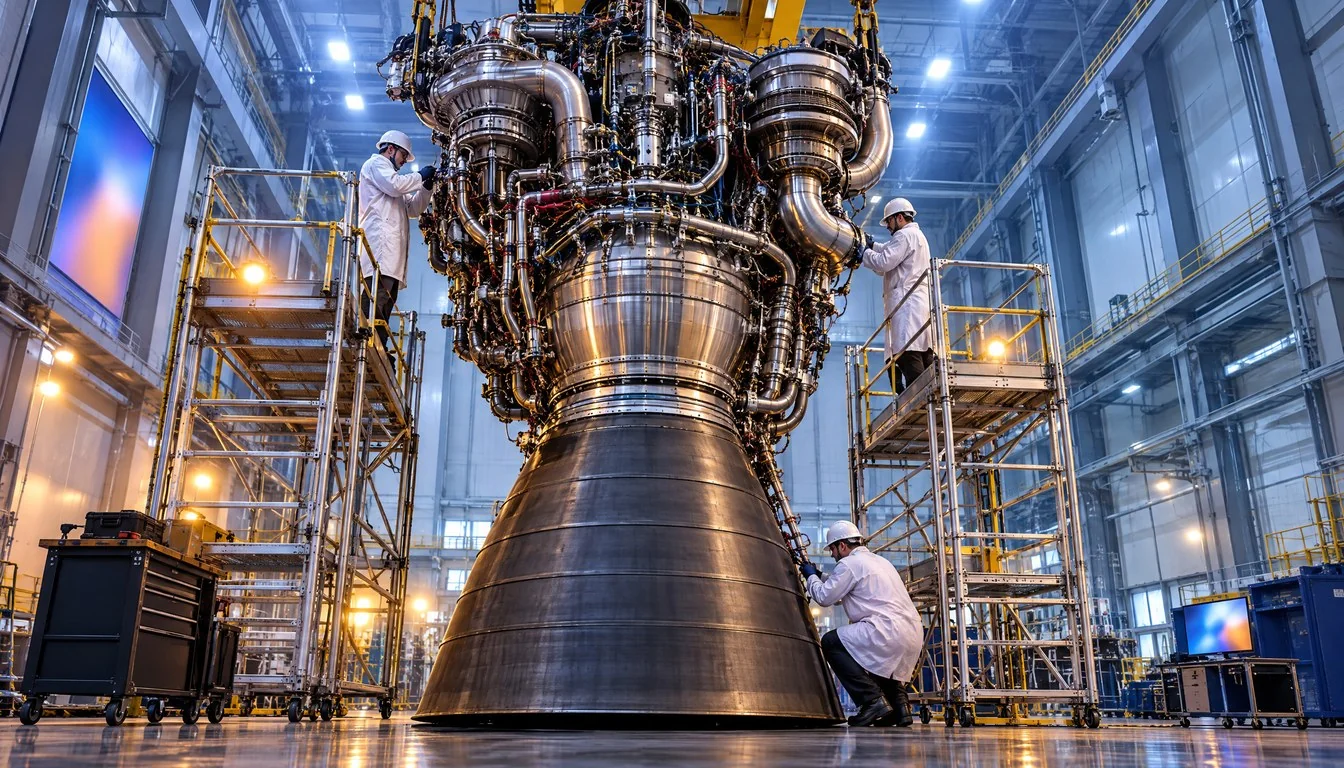
A rocket engine company most of the world has never heard of just picked up one of the biggest industrial backers in Chinese commercial space. On October 17, 2026, Huosheng Aerospace signed a deal to build a production line for a 200-ton-class liquid oxygen methane engine inside Ningbo’s planned commercial space base, a project with a total investment figure of 86.6 billion yuan attached to it, according to 36Kr and Eastmoney.
The company is small, young, and largely unknown outside Chinese financial media. But the executive behind it is not a stranger to rocket propulsion: he previously served as vice president of LandSpace and ran its propulsion research and development department, where he worked on the “Tianque” family of liquid oxygen methane engines and the Zhuque-2 Y2 mission, per 36Kr’s reporting. Now he is building his own engine, called Huosheng No.1, using the same broad architecture that powers SpaceX’s Raptor: a full-flow staged combustion cycle, known in Chinese as quan liuliang buran xunhuan.
Don't miss new tech stories on Google
Add TrendinTech once in the Google app and our stories appear in your news suggestions.
Huosheng Aerospace Signs Its First Major Production Deal
Huosheng Aerospace, registered formally as Huosheng Aerospace (Beijing) Technology Co., Ltd., was founded in 2024 and is headquartered in Beijing. For most of its short life it has operated well outside the spotlight that follows better-funded Chinese rocket startups. That changed this past weekend when the company formally signed its 200-ton-class liquid oxygen methane engine project for the Ningbo Marine Economic Development Demonstration Zone, according to reporting from 36Kr and corroborated by Eastmoney’s financial desk.
The agreement covers construction of an engine final-assembly and integration production line along with supporting facilities. In plain terms, Huosheng Aerospace is moving from a research shop testing individual engine components toward a manufacturing operation capable of building finished engines at scale. That is a meaningful jump for any propulsion company, let alone one that is only two years old. Chinese financial outlets including Cailianshe have tracked the broader Ningbo commercial aerospace push for months, but Huosheng’s signing is the first concrete tenant news tied to a named engine architecture and a named production target.
For a city like Ningbo, landing an engine manufacturer with staged-combustion ambitions is a statement. Liquid oxygen methane engines using a full-flow cycle sit at the technically hardest end of rocket propulsion, and very few organizations anywhere in the world have gotten one to fly reliably. Signing a production deal does not mean Huosheng has solved that problem yet, but it does mean the company has convinced a major industrial zone to bet real money on the attempt.
Inside the Huosheng No.1 Engine: What the Numbers Show
Eastmoney’s report lays out the first-generation production specifications Huosheng Aerospace is targeting for Huosheng No.1. The engine is rated for a sea-level thrust of 140 tons, with a sea-level specific impulse of 315 seconds. Combustion chamber pressure is listed at 20 MPa, and the single-engine structural mass comes in at 1.5 tons. Those four numbers, taken together, describe a mid-size, high-performance liquid engine broadly comparable in thrust class to engines already flying on Chinese orbital rockets, though built around a more demanding combustion cycle than most of them use.
| Specification | Huosheng No.1 (First-Generation Production Model) |
|---|---|
| Propellant combination | Liquid oxygen and methane |
| Engine cycle | Full-flow staged combustion |
| Sea-level thrust | 140 tons-force |
| Sea-level specific impulse | 315 seconds |
| Combustion chamber pressure | 20 MPa |
| Single-engine structural mass | 1.5 tons |
| Developer | Huosheng Aerospace (Beijing) Technology Co., Ltd. |
| Company founded | 2024 |
Those numbers describe the engine Huosheng Aerospace says it intends to put into production, not a figure pulled from an active flight vehicle. The project signed in Ningbo is specifically about building the assembly line for that engine, a step that typically comes before a company has finished proving the design through repeated full-engine test campaigns. Readers should treat the 140-ton thrust and 315-second specific impulse figures as the company’s stated production target rather than a confirmed, flight-proven result.
What Full-Flow Staged Combustion Actually Means
Most liquid rocket engines burn their propellants once, in a single combustion chamber, and use some of that same chamber’s exhaust or a smaller side-stream to drive the turbopumps that feed propellant into the engine. A full-flow staged combustion cycle splits the job differently. It runs two preburners instead of one: one burns fuel-rich to drive the fuel turbopump, the other burns oxidizer-rich to drive the oxidizer turbopump. Both preburner exhaust streams, already partially combusted and extremely hot, then feed into the main combustion chamber where the burn finishes.
The payoff is real: every bit of propellant does useful work turning a turbine before it ever reaches the main chamber, which lets engineers run the system at higher pressure and efficiency while keeping turbine inlet temperatures lower than a simpler staged-combustion design would require at the same power level. The catch is that building two preburners, two sets of hot-gas plumbing, and two turbopumps that have to stay perfectly balanced against each other is an order of magnitude harder than a conventional gas-generator or single-preburner engine. That difficulty is exactly why so few organizations have ever gotten a full-flow staged-combustion engine to fly. SpaceX’s Raptor family, which powers Starship, is the architecture most commonly cited as the benchmark the rest of the industry is chasing.
The “SpaceX-identical” framing attached to this story in Chinese financial media deserves a caveat, though. Huosheng No.1 and Raptor share the same broad combustion architecture, full-flow staged combustion with dual preburners, but sharing an architecture is not the same as sharing a design, a performance envelope, or a flight record. 36Kr’s own reporting is careful to describe the technology as “identical to that of SpaceX” only in the sense of the cycle itself, not as a claim that Huosheng has replicated Raptor’s hardware or its years of iterative flight testing.
The Ex-LandSpace Executive Steering the New Venture
36Kr identifies the founder behind Huosheng Aerospace only by his prior role, not by name: the former vice president of LandSpace and general manager of its propulsion research and development department. That background matters because LandSpace is one of the handful of Chinese commercial launch companies that has already put a methane-fueled rocket into orbit, and its propulsion unit is where a lot of the country’s practical full-flow and staged-combustion engineering knowledge currently sits.
According to 36Kr, the executive led development of the Tianque series of liquid oxygen methane engines during his time at LandSpace and was involved in the Zhuque-2 Y2 mission. Leaving an established, well-funded company with a working rocket to start a new engine-focused venture is a significant bet, and it mirrors a pattern seen across China’s commercial space sector over the past several years: senior propulsion engineers cycling out of the first wave of startups to found more specialized, engine-only companies. Huosheng Aerospace fits that mold closely, positioning itself as a propulsion supplier first rather than a full launch-vehicle operator.
Ningbo’s 86.6 Billion Yuan Commercial Space Bet
The Huosheng deal did not happen in a vacuum. It is the latest tenant announcement tied to Ningbo’s planned commercial space industrial base, a project that Cailianshe and other Chinese financial outlets have been tracking for months. The base carries a planned total investment of 86.6 billion yuan and is designed to cover 67 square kilometers, split by Cailianshe’s reporting into roughly 35 square kilometers earmarked for a launch site and 32 square kilometers for industrial supporting facilities. The stated ambition behind the project is a planned annual launch capacity of 100 launches per year once built out, a figure that would put Ningbo in the same conversation as the busiest launch sites anywhere in the world if it is ever realized at that scale.
| Ningbo Commercial Space Base | Reported Figure |
|---|---|
| Total planned investment | 86.6 billion yuan |
| Total planned area | 67 square kilometers |
| Launch site area | 35 square kilometers |
| Industrial support area | 32 square kilometers |
| Planned annual launch capacity | 100 launches per year |
| Project operator | Ningbo Commercial Aerospace Development Co., Ltd. |
| Operator founded | January 2026 |
| Operator registered capital | 1 billion yuan |
Numbers of this size are common in Chinese industrial zone planning documents, and they describe an intended build-out rather than a completed facility. The Huosheng engine production line is one specific, named piece of that broader plan now moving from announcement to signed agreement, which is why it stands out against the backdrop of the base’s much larger headline figures.
Who’s Behind Ningbo Commercial Aerospace Development
The entity carrying the base forward is Ningbo Commercial Aerospace Development Co., Ltd., reported as established in January 2026 with registered capital of 1 billion yuan. Zhu Haibin is listed as the company’s legal representative and chairman. Ownership is split evenly between two state-linked investors: Ningbo Development and Investment Group Co., Ltd. and Ningbo Xiangbao Cooperation Zone Investment and Development Co., Ltd., each holding 50 percent, according to Sina’s finance desk.
That 50/50 structure is a familiar template in Chinese municipal industrial policy: a city-level development and investment arm paired with a district-level investment vehicle, jointly capitalizing a project-specific company that then signs deals directly with tenants like Huosheng Aerospace. It gives Ningbo’s municipal government direct financial exposure to, and direct control over, how the commercial space base is built out and who gets space inside it.
How Far Along Is the Engine, Really
This is the part of the story that gets flattened in a lot of the headline coverage. According to 36Kr’s reporting, Huosheng No.1 has completed testing of a scaled-down preburner. It has not yet entered complete-engine final assembly, and it has not yet undergone a full-engine test firing. That is a meaningfully earlier stage than a company with a flying engine or even a fully assembled test article sitting on a stand.
Preburner testing is a real and necessary milestone, since the preburners are arguably the hardest single components in a full-flow staged-combustion engine to get right. But the gap between a validated scaled-down preburner and a complete engine that has survived a full-duration hot fire at its rated 140-ton thrust is where most propulsion programs, in any country, run into their biggest schedule slips. Ningbo’s production-line investment is a bet that Huosheng Aerospace will close that gap. It is not evidence that the gap has already been closed.
Huosheng vs SpaceX’s Raptor: Same Architecture, Different Stage
Precision matters here on what “SpaceX-identical” does and does not mean, since that phrase is doing a lot of work in the Chinese headlines around this story. Raptor is the production full-flow staged-combustion engine that SpaceX has flown, in multiple iterations, on Starship test flights for several years now, accumulating a flight and ground-test history that very few propulsion programs anywhere can match. Huosheng No.1 uses the same combustion cycle on paper but has, by Huosheng’s own reported testing status, completed only a scaled-down preburner test.
Architecture parity is a genuinely significant technical claim on its own. Getting a full-flow cycle to work at all has defeated well-funded, experienced propulsion teams in multiple countries. But architecture parity is not performance parity, and it is not flight-history parity. The honest way to read this story is that Huosheng Aerospace is attempting to join a very short list of organizations capable of building this class of engine, not that it has already joined it.
China’s Crowded Field of Full-Flow Engine Builders
Huosheng Aerospace is not working in isolation. LandSpace, the company its founder left, has its own liquid oxygen methane engine program built around the Tianque series and has already flown orbital missions using methane propulsion, including the Zhuque-2 Y2 mission the founder worked on before departing. The fact that a senior LandSpace propulsion executive chose to start a competing, narrowly focused engine company rather than stay inside an already-flying program says something about how much appetite there is in China’s commercial space sector for more full-flow engine suppliers, not fewer.
That dynamic is part of a broader pattern across Chinese commercial space, where propulsion talent increasingly moves between a small number of companies and occasionally splits off to found new ones, each chasing the same high-difficulty engine architecture. It is a similar dynamic, structurally, to what has played out among AI chip suppliers trying to close the gap with established leaders. Nvidia’s own position in China has shifted in ways that illustrate how quickly a technical lead can erode once well-funded domestic competitors enter a field, a pattern covered in recent chip market reporting that mirrors what is now unfolding in Chinese rocket propulsion.
Why Ningbo Is Betting Big on Commercial Space
Ningbo is a major port and manufacturing city, not a traditional aerospace hub, which makes its push into commercial space launch infrastructure notable on its own terms. Municipal and provincial governments across China have increasingly treated commercial aerospace as a strategic industrial category worth subsidizing directly, similar to how semiconductor fabrication and electric vehicle battery production were treated a decade earlier. A 100-launch-per-year target, if it is ever reached, would represent a serious industrial commitment rather than a symbolic one.
Locking in an engine manufacturer as an early tenant gives Ningbo’s base a concrete anchor tenant with a specific, named production target, which is useful for attracting further investment and additional tenants. It is a familiar playbook: land one credible, technically ambitious anchor company, then use that signing to recruit the launch vehicle integrators, satellite manufacturers, and ground-systems suppliers that would eventually need to colocate around it.
The Global Reusable Rocket Race Huosheng Is Entering
Zoom out past China and the timing of this announcement lands in the middle of an unusually active period for commercial launch infrastructure worldwide. Rocket Lab has pushed back the debut of its medium-lift Neutron rocket into 2027, a reminder that even well-capitalized Western launch companies are still working through the same kind of schedule pressure Huosheng now faces with its own engine. In Europe, Isar Aerospace’s orbital attempt has been framed explicitly as the continent’s answer to SpaceX’s dominance, the same competitive framing now being applied to Huosheng inside China. Meanwhile in the United States, Blue Origin has been adding launch pad capacity in Florida as it works toward a much higher flight cadence, the same kind of infrastructure build-out Ningbo is now attempting on a larger scale for an entire industrial zone.
SpaceX itself remains the reference point every one of these programs gets measured against, and its market valuation has become its own story. Investor Cathie Wood has described SpaceX as a deep-value bet worth trillions, a valuation built substantially on the operational maturity of exactly the full-flow staged-combustion architecture that Huosheng Aerospace is now trying to replicate from a much earlier starting point. The gap between where SpaceX’s propulsion program sits today and where Huosheng’s scaled-down preburner test sits is, in effect, the gap separating a company already worth trillions from one that just signed its first production-line agreement.
Market Impact: What This Means for Investors and Suppliers
For investors tracking China’s commercial space sector, the practical takeaway from this signing is narrower than the headline suggests. Huosheng Aerospace is a private company, and reporting from 36Kr, Eastmoney, and Cailianshe does not disclose a public valuation, external funding round, or stock ticker tied to the company. What is concretely verifiable is the scale of Ningbo’s committed industrial-zone investment and the specific engine specifications the company has stated for its production target.
That distinction matters for how suppliers and component manufacturers in China’s aerospace supply chain should read this news. A signed production-line agreement for engine final assembly typically triggers downstream procurement for specialized valves, turbopump components, and cryogenic systems, well before any engine actually flies. Companies supplying those parts to Chinese commercial launch firms are likely to see Huosheng Aerospace added to their customer pipeline discussions regardless of whether Huosheng No.1 ever matches its stated 140-ton thrust target on a test stand.
Historical Context: China’s Commercial Space Pivot
China opened its launch sector to private capital roughly a decade ago, and the first wave of companies that emerged, including LandSpace, spent years working through solid-fuel vehicles before several of them pivoted to the much harder problem of liquid oxygen methane propulsion. LandSpace’s own methane-fueled orbital missions, including the Zhuque-2 Y2 mission referenced in connection with Huosheng’s founder, represented a milestone for that pivot. Huosheng Aerospace represents a second-order effect of that same shift: a spinout company founded specifically to chase the next technical rung, full-flow staged combustion, rather than simply iterate on an already-proven gas-generator or conventional staged-combustion design.
Industrial zones like Ningbo’s have followed a similar historical arc to what happened earlier with China’s electric vehicle battery supply chain: provincial and municipal governments identifying a strategically important manufacturing category, committing large, multi-year capital figures to physical infrastructure, and then recruiting technically credible anchor tenants to fill it. The scale of the 86.6 billion yuan figure attached to Ningbo’s base places it solidly inside that pattern of state-backed industrial policy applied to a frontier manufacturing sector.
What’s Confirmed and What’s Still Unverified
The confirmed elements of this story are worth separating from the parts that remain open. Confirmed, per 36Kr and Eastmoney: the project signing date of October 17, 2026, the 200-ton-class project designation, the stated engine specifications for Huosheng No.1, the 86.6 billion yuan total investment figure for Ningbo’s base, and the company’s founding year of 2024. Also confirmed, per Sina’s finance reporting: the January 2026 establishment date and 1 billion yuan registered capital of Ningbo Commercial Aerospace Development Co., Ltd., along with its 50/50 ownership structure and Zhu Haibin’s role as chairman.
Not confirmed by 36Kr, Eastmoney, Sina, or any other outlet covering the story: the personal name of Huosheng Aerospace’s founder, who is identified only by his prior LandSpace title; any on-record quotation from that founder, from Huosheng Aerospace as a company, or from a Ningbo government official about the deal; and any technical claim that Huosheng No.1’s hardware is a literal copy of SpaceX’s Raptor design rather than a separate engine built around the same general combustion cycle. Readers should treat the “SpaceX-identical” framing as a description of architecture, not a verified claim of engineering equivalence.
Predictions: Where This Goes From Here
Based on where Huosheng Aerospace’s development status stands today, a few things look likely to follow. First, expect the next major public milestone from the company to be a full-engine assembly announcement rather than a flight announcement, since the preburner-to-full-engine gap is the step the company has not yet closed. Second, Ningbo is likely to announce additional tenants for its commercial space base in the coming months, using the Huosheng signing as a credibility anchor to recruit launch-vehicle integrators and component suppliers.
Third, scrutiny of the “SpaceX-identical” framing will likely intensify as Huosheng Aerospace moves closer to an actual test firing, since full-engine hot-fire results are the point at which architecture claims either hold up or get revised. Fourth, expect comparisons to LandSpace to keep surfacing in Chinese financial media given the founder’s direct lineage from that company’s propulsion division, and expect LandSpace itself to be watched for any competitive response. Fifth, given how closely Ningbo’s industrial-zone playbook mirrors earlier state-backed pushes into batteries and semiconductors, additional Chinese provinces are likely to announce their own commercial space industrial bases over the next year, using similarly large headline investment figures.
Frequently Asked Questions
What is Huosheng Aerospace?
Huosheng Aerospace is a Beijing-based rocket propulsion company, formally registered as Huosheng Aerospace (Beijing) Technology Co., Ltd. and founded in 2024, focused on developing a full-flow staged-combustion liquid oxygen methane engine called Huosheng No.1.
Who founded Huosheng Aerospace?
According to 36Kr, the company was founded by a former vice president of LandSpace who previously served as general manager of that company’s propulsion research and development department and worked on the Tianque engine series and the Zhuque-2 Y2 mission. The founder’s personal name has not been disclosed in available reporting.
What does full-flow staged combustion mean?
It is a rocket engine cycle that uses two preburners, one fuel-rich and one oxidizer-rich, to drive separate turbopumps before both exhaust streams combine in the main combustion chamber. It allows higher efficiency and pressure than simpler cycles but is significantly harder to engineer, which is why only a small number of engines worldwide use it.
Is Huosheng No.1 really identical to SpaceX’s Raptor engine?
No. Huosheng No.1 uses the same broad combustion cycle as SpaceX’s Raptor, full-flow staged combustion, but the two are separate engine designs with very different development histories. Raptor has an extensive flight and ground-test record on Starship, while Huosheng No.1 has only completed testing of a scaled-down preburner.
How much is Ningbo investing in its commercial space base?
Chinese financial outlets including Cailianshe have reported a planned total investment of 86.6 billion yuan for the Ningbo commercial space industrial base, covering a planned 67 square kilometers split between launch site and industrial support areas.
When will Huosheng No.1 complete a full engine test fire?
No date has been disclosed. As of this signing, 36Kr reports the engine has completed testing of a scaled-down preburner only, and has not yet entered complete-engine final assembly or full-engine test firing.
What is Ningbo Commercial Aerospace Development Co., Ltd.?
It is the project company carrying forward Ningbo’s commercial space base, reported as established in January 2026 with registered capital of 1 billion yuan. It is owned 50/50 by Ningbo Development and Investment Group Co., Ltd. and Ningbo Xiangbao Cooperation Zone Investment and Development Co., Ltd., with Zhu Haibin serving as legal representative and chairman.
How does this fit into China’s broader commercial space push?
Huosheng Aerospace is part of a wider pattern of Chinese propulsion engineers leaving established launch companies like LandSpace to found specialized engine startups, while municipal governments like Ningbo’s commit large industrial-policy investments to attract and house those companies, similar to earlier state-backed pushes into battery and semiconductor manufacturing.
Related Coverage
Helena Marsh
Helena Marsh is the Editor-in-Chief at TrendinTech, where she leads editorial strategy and oversees coverage across artificial intelligence, cybersecurity and enterprise technology. She believes technology reporting should be rigorous and plainly written, so readers understand what actually changes for them rather than what a company's announcement promises.
All stories by Helena Marsh (251)