SpaceX Plans Flight 15 Double Starship Catch [2026]

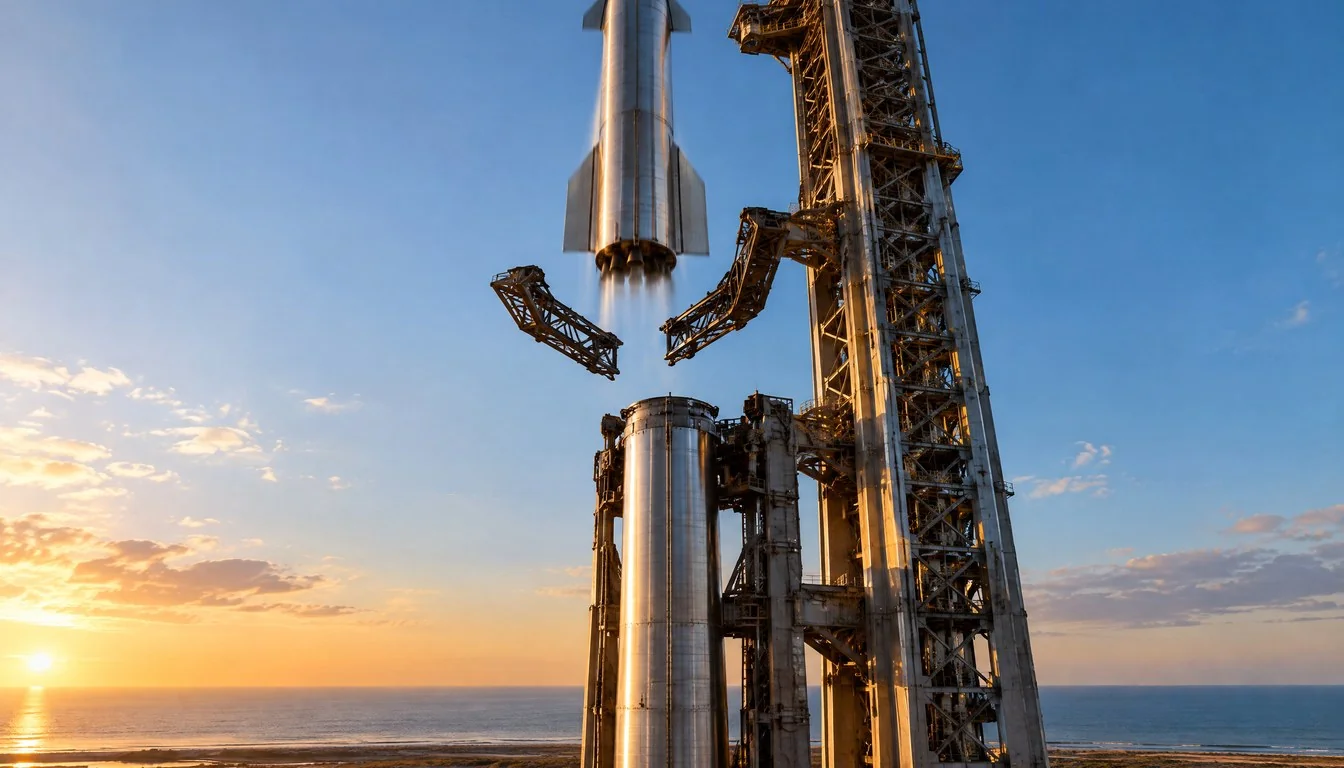
SpaceX will try to catch both halves of its Starship rocket for the first time on Flight 15, the company’s next test launch. CEO Elon Musk confirmed the plan on October 20, 2026, during SpaceX’s third-quarter earnings call, and president Gwynne Shotwell said the company expects its Federal Aviation Administration license to cover the attempt. No firm launch date has been set, but Musk said the flight is expected “next month,” pointing to a November 2026 attempt.
Don't miss new tech stories on Google
Add TrendinTech once in the Google app and our stories appear in your news suggestions.
What SpaceX Just Announced on Flight 15
Starship is SpaceX’s fully stacked launch system: the Super Heavy booster on the bottom and the Starship upper stage, commonly called Ship, on top. SpaceX has already caught Super Heavy with its launch tower on multiple occasions, most recently in a catch confirmed on October 8, 2026. It has never caught Ship. Every previous upper stage either splashed down in the ocean or was lost during flight.
That track record is what makes Flight 15 different. According to Space.com, Musk told investors on the earnings call that SpaceX intends to catch both stages on the same flight, something no orbital rocket program has done. Musk said: “For Flight 15, which we expect to happen next month, we’re going to attempt to catch both the booster and the ship,” a statement reported by Teslanorth.
Why the Upper-Stage Catch Matters
Catching Super Heavy was already a milestone when SpaceX first pulled it off, but the booster never leaves the atmosphere and follows a fairly predictable return path. Ship is a different problem. It flies to orbital or near-orbital velocity, reenters through hotter atmosphere, and has to steer itself back to a tower thousands of miles from where it started, all without a crew on board to make corrections.
Musk framed the stakes plainly. “It will be the first time that an orbital launch vehicle has been fully recovered,” he said, a remark Teslanorth captured from the same call. No government or commercial program, including the Space Shuttle, has recovered and reused both the booster and the upper stage of an orbital rocket. If SpaceX pulls it off, Starship would be the first to do it on a single mission.
Super Heavy’s Catch Record So Far
Super Heavy’s side of the equation is the known quantity. SpaceX has caught the booster with the launch tower’s mechanical arms on three separate flights as of the catch confirmed on October 8, 2026. The booster returns to the launch site, reignites a subset of its engines, and settles into the tower’s arms, a maneuver that has gone from experimental to close to routine over the past year of testing.
Three Catches, Zero Losses on the Booster Side
That three-for-three run on Super Heavy is why SpaceX feels comfortable adding the harder half of the equation to Flight 15 rather than running another booster-only test first. Shotwell told the earnings call that SpaceX has had, in her words, “significant constructive engagement” with the FAA and expects the Flight 15 license to cover return-to-launch-site operations and tower catches for both stages, a detail also reported by Teslanorth.
The Ship Has Never Been Caught, Here’s Why
Every Starship upper stage flown to date has either ended its mission with an ocean splashdown or been lost before reaching that point. None has attempted a tower catch. Flight 15 would be the first time SpaceX tries to bring Ship all the way back to Starbase and into the arms of the same tower that already catches Super Heavy.
SpaceX has previously attributed at least one upper-stage failure, on an earlier flight, to a problem with the main fuel tank’s pressurization system diffuser, and the company said it corrected that issue in subsequent flights. The bigger unknown for Flight 15 is simply that landing an orbital-class vehicle on a tower, rather than in open ocean, has a much smaller margin for error.
Inside the Mechazilla Tower Catch System
The Starbase launch tower’s catch arms are widely nicknamed “chopsticks,” and the combined tower and catch system is informally known as Mechazilla, terminology that has stuck since SpaceX first built the structure. The arms are designed to close around the returning vehicle’s grid fins or catch points and hold it in place, letting SpaceX skip the kind of landing legs that add weight and complexity to reusable rockets.
For Flight 15, SpaceX released a new simulation video on October 20, 2026, showing both the booster and Ship returning to Starbase and being caught by the tower’s arms in sequence, a visualization covered by Basenor. The simulation does not guarantee the real flight will go the same way, but it is the clearest public look yet at how SpaceX plans to pull off a dual catch.
What Elon Musk and Gwynne Shotwell Said
Beyond confirming the attempt, Musk was candid about the odds. “Success is not guaranteed on these first flights, but I’d say it’s more likely than not that this succeeds next flight,” he said on the earnings call, according to Teslanorth’s report. That is a notably measured statement from an executive who has, in the past, been accused of overpromising on Starship timelines.
Musk has also described the stakes of the Ship catch in blunter terms elsewhere, saying SpaceX is “going to try to catch the ship, which is a super big deal,” according to Teslarati. Shotwell’s comments focused on the regulatory side rather than the technical one, telling investors the FAA relationship has been cooperative as the company works toward a launch license that covers both catch attempts.
FAA Licensing Still a Hurdle
SpaceX has not published a firm launch date for Flight 15, and part of the reason is that the FAA has not yet issued the license covering the mission. Shotwell’s remarks suggest SpaceX expects that approval to arrive in time to support a November attempt, but the agency’s sign-off remains the gating factor rather than anything purely technical on SpaceX’s side.
This is a familiar pattern for Starship. Previous flights have also slipped while SpaceX and the FAA worked through licensing requirements, environmental reviews, or anomaly investigations tied to earlier test flights. The dual-catch objective adds another layer of review, since the agency has to sign off on recovery operations for two separate stages rather than one.
Flight 15 Timeline: What’s Confirmed and What Isn’t
Independent spaceflight trackers have floated November 8, 2026, as a “no earlier than” planning date, a figure reported by outlets following FAA planning documents. SpaceX itself has not confirmed that date. Musk’s own public statements have shifted over the past two weeks, from describing Flight 15 as roughly four to six weeks away in comments on October 10, to the firmer “next month” framing he used on October 20.
The table below separates what SpaceX and its executives have actually said from what remains outside reporting or speculation.
| Flight 15 detail | Status as of October 21, 2026 |
|---|---|
| Dual catch attempt (booster and Ship) | Confirmed by Musk and Shotwell, Oct. 20 earnings call |
| General timing (“next month”) | Confirmed by Musk, implies November 2026 |
| Firm launch date | Not published by SpaceX |
| November 8, 2026 as the launch date | Unconfirmed, third-party tracker estimate only |
| FAA license covering both catches | Expected by SpaceX, not yet finalized |
| Vehicles assigned to Flight 15 (Booster 22, Ship 42) | Reported by spaceflight trackers, not confirmed by SpaceX |
Starship V3 and the Road to Flight 15
Flight 15 does not happen in isolation. SpaceX has been moving through what it calls the Starship V3 architecture, an upgraded version of the vehicle introduced for the next phase of flight testing. Flight 14, which preceded the dual-catch attempt, reportedly reached orbit for the first time and deployed operational Starlink V3 satellites, according to coverage of SpaceX’s own flight updates.
That orbital success on Flight 14 is part of why SpaceX feels ready to attempt the harder Ship catch on the very next flight rather than waiting for additional ocean-splashdown tests. Musk has also talked about cadence goals well beyond Flight 15, saying SpaceX could reach weekly Starship launches in the first half of 2027 and two or more per week by the end of that year, though those remain forward-looking targets rather than a locked schedule.
Market Reaction and What’s at Stake Financially
SpaceX made the Flight 15 announcement during a public earnings call, a format the company did not use a few years ago, highlighting how its investor profile has changed. That call doubled as a venue for SpaceX’s Q3 2026 earnings results, and the Starship update was one of the headline items alongside the company’s financial figures.
Why Investors Are Watching This Specific Flight
A successful Ship catch would be a tangible proof point for the economics SpaceX has pitched to investors: that full reusability, not just booster reuse, is what ultimately drives down the cost of each Starship launch. Wall Street has already started pricing in some of that upside. Morgan Stanley flagged Flight 15 as a catalyst for its own SpaceX valuation work, and other analysts have floated enormous addressable-market numbers tied to Starship’s long-term launch economics, a topic covered in separate market-sizing estimates for the company. Investor Cathie Wood has also staked out a long-term bullish position on SpaceX tied to exactly this kind of reusability milestone, a case laid out in her public comments on the company.
How Starship’s Catch Plan Compares to Rival Reusable Rockets
No other orbital rocket program has attempted, let alone achieved, a tower catch of its upper stage. SpaceX’s own Falcon 9 reuses its first stage through propulsive landings on drone ships or landing pads, not tower catches, and its second stage is not recovered at all. Other new entrants in the reusable-rocket race, including Rocket Lab’s Neutron program, are targeting first-stage reuse comparable to Falcon 9 rather than the full two-stage recovery SpaceX is attempting with Starship.
That gap is the clearest way to measure how far ahead of the field SpaceX’s ambitions sit, even if Flight 15 does not succeed on the first try. Catching a booster that falls back along a mostly vertical, low-energy path is one engineering problem. Catching an upper stage that has to shed orbital or near-orbital velocity and still land precisely on a tower is a substantially harder one, and nobody else has publicly committed to attempting it yet.
| Stage | Catch method targeted | Catches achieved to date | Status entering Flight 15 |
|---|---|---|---|
| Super Heavy (booster) | Launch tower “chopstick” catch | 3 successful catches as of Oct. 8, 2026 | Attempting a fourth catch |
| Starship / Ship (upper stage) | Launch tower “chopstick” catch | 0; prior ships splashed down in ocean or were lost | First-ever tower catch attempt |
Historical Context: From Expendable Rockets to Tower Catches
For most of the history of orbital spaceflight, rockets were single-use. Falcon 9’s first-stage landings, which SpaceX normalized over the past decade, were themselves considered a long shot when the company first attempted them. Tower catches of a booster were an even bigger step, something SpaceX only started demonstrating with Super Heavy as Starship testing matured.
Attempting to catch the upper stage, too, is the logical next rung on that ladder, but it is also the steepest one. According to reporting aggregated by Ground News, SpaceX has spent months building toward this specific attempt, following a path from booster-only recovery, to Starship reaching orbit on Flight 14, to now targeting a dual catch on Flight 15.
What Happens After Flight 15: Reuse and Cadence Goals
SpaceX’s stated ambitions do not stop at catching Ship once. Musk has talked about Flight 16 potentially attempting to refly both the Super Heavy booster and the Starship upper stage recovered from Flight 15, assuming that catch succeeds. That would move Starship from “recoverable” to “reused” within a single additional flight, a much faster turnaround than Falcon 9 took to go from first landing to first reflight.
SpaceX describes Starship, as a program, on its own site as designed to return to the launch site and be caught following flight, with the ability to rapidly turn around and launch again without refurbishment. Flight 15 is the first real test of whether that design intention holds up for the upper stage, not just the booster.
What Could Go Wrong on Flight 15
SpaceX’s own history with Starship upper-stage anomalies is the clearest reason for caution. The company has previously traced at least one Ship failure to a fuel-tank pressurization diffuser problem, and reentry heating, guidance precision, and engine relight timing all remain areas where a single misstep could force an ocean splashdown instead of a catch, or worse, a loss of the vehicle before it gets that far.
Even a partial success, such as a clean reentry and controlled descent that misses the tower catch, would still count as meaningful progress by SpaceX’s usual standards for Starship testing, where incremental data from “failures” has repeatedly fed directly into fixes for the next flight.
Predictions for Flight 15 and Beyond
Based on SpaceX’s public statements and its recent testing cadence, a few outcomes look most likely. First, expect SpaceX to confirm a firm launch date only once the FAA license is finalized, likely within days of that approval rather than weeks ahead of it. Second, a November 2026 launch attempt is plausible given Musk’s “next month” comment, but readers should treat any specific calendar date, including November 8, as unconfirmed until SpaceX says otherwise.
Third, expect SpaceX to attempt the booster catch first in sequence and the Ship catch second, mirroring the order shown in its October 20 simulation. Fourth, if the Ship catch fails on the first try, expect SpaceX to attempt it again on Flight 16 rather than reverting to an ocean splashdown strategy, consistent with Musk’s stated preference for iterating quickly on hard problems. Fifth, expect continued investor attention tied to Starship’s recovery progress, given how directly it feeds into the reusability economics that underpin bullish long-term SpaceX valuations.
Frequently Asked Questions
What is SpaceX attempting on Starship Flight 15?
SpaceX plans to catch both the Super Heavy booster and the Starship upper stage, known as Ship, with its launch tower on the same flight. It has caught Super Heavy before but has never caught Ship.
When will Starship Flight 15 launch?
SpaceX has not published a firm date. Elon Musk said on October 20, 2026, that the flight is expected “next month,” pointing to November 2026, though some trackers have floated November 8 as an unconfirmed estimate.
Has SpaceX ever caught the Starship upper stage before?
No. Every previous Starship upper stage has either splashed down in the ocean or been lost during flight. Flight 15 would be the first attempted tower catch of Ship.
How many times has SpaceX caught the Super Heavy booster?
SpaceX had caught Super Heavy with the launch tower three times as of the catch confirmed on October 8, 2026.
What is Mechazilla?
Mechazilla is the informal name for the Starbase launch tower’s catch system, including the mechanical “chopstick” arms that close around a returning booster or, on Flight 15, potentially the Starship upper stage.
Does SpaceX have FAA approval for the dual catch?
Not yet finalized. Gwynne Shotwell said SpaceX has had constructive engagement with the FAA and expects the Flight 15 license to cover return-to-launch-site operations and tower catches for both stages, but the agency has not issued that license.
What happens if the Flight 15 catch attempt fails?
SpaceX has not detailed contingency plans publicly, but the company’s pattern on Starship has been to treat partial failures as test data and apply fixes on the next flight, which Musk has suggested could be Flight 16.
What is Starship V3 and how does it relate to Flight 15?
Starship V3 is the upgraded vehicle architecture SpaceX introduced for its next phase of flight testing. Flight 14, which came before the dual-catch attempt, reportedly reached orbit for the first time and deployed Starlink V3 satellites under this architecture.
Related Coverage
Helena Marsh
Helena Marsh is the Editor-in-Chief at TrendinTech, where she leads editorial strategy and oversees coverage across artificial intelligence, cybersecurity and enterprise technology. She believes technology reporting should be rigorous and plainly written, so readers understand what actually changes for them rather than what a company's announcement promises.
All stories by Helena Marsh (283)