Tesla Posts $1.53B Cash Flow as AI Capex Falls Short [2026]

Tesla posted a surprise $1.53 billion in free cash flow for the third quarter of 2026, a result that caught Wall Street off guard after analysts had modeled a cash burn of roughly $4.92 billion. The company released its results on October 21, 2026, and the numbers point to a specific cause: Tesla spent far less than expected on the AI, robotics and compute buildout it has promised investors for more than a year.
Third-quarter capital expenditure landed at $4.73 billion, well under the roughly $7.5 billion Wall Street had priced in. That is also down from $5.79 billion in the second quarter, even as it remains more than double the $2.25 billion Tesla spent in the same quarter of 2025. The gap between what analysts expected Tesla to spend on Optimus, Cybercab and AI compute, and what the company actually spent, is the story behind the cash flow beat, according to Transport Topics.
Don't miss new tech stories on Google
Add TrendinTech once in the Google app and our stories appear in your news suggestions.
Tesla’s Third-Quarter Numbers, By the Figures
Adjusted earnings per share came in at $0.48, ahead of the $0.44 analysts had projected. Revenue for the quarter was approximately $28.05 billion, narrowly missing Wall Street’s revenue target even as profitability beat expectations. GAAP operating income fell 56% year over year to about $0.7 billion, while GAAP net income was $0.8 billion. Operating cash flow reached $6.3 billion, and Tesla closed the quarter holding $45.4 billion in cash, cash equivalents and short-term investments as of September 30, 2026.
Those figures sit alongside a milestone Tesla highlighted in the same update: the company said it produced and delivered its 10 millionth vehicle by the end of the quarter. Production came in above 464,000 vehicles and deliveries above 486,000, alongside 13.7 gigawatt-hours of energy storage deployments, an increase of about 10% from a year earlier.
Why the Cash Flow Beat Caught Analysts Off Guard
Heading into the print, the consensus case on Wall Street was straightforward: Tesla had told investors for months that it planned to spend more than $25 billion in capital expenditure in 2026, funding everything from Optimus production lines to AI compute capacity to the Cybercab ramp. With Tesla already burning cash in the second quarter, to the tune of a reported $1.1 billion outflow, the expectation was that the AI buildout would deepen that burn in the third quarter rather than reverse it.
That is why the swing to positive free cash flow stood out. As Rolling Out put it in its coverage of the print, the biggest reason for the cash surprise was money Tesla did not spend. Instead of the heavier AI and robotics investment analysts had built into their models, Tesla’s third-quarter capital spending came in roughly $3 billion below forecasts, and that single swing was enough to flip the quarter from an expected burn into a surplus.
Finnish research firm Inderes framed the same result as a flag worth watching rather than an unambiguous win. In its note on the quarter, Inderes pointed out that the $1.5 billion in extra cash came paired with roughly $3 billion less AI investment than the market had expected, and that lower investment supporting free cash flow this quarter could simply shift the bill to the fourth quarter instead of eliminating it.
Capital Expenditure Trend: A Quarter-by-Quarter Look
The capex trajectory over the past year tells its own story about how uneven Tesla’s AI investment has been. The company has already said it still intends to spend more than $25 billion in full-year 2026 capital expenditure, which means the pullback in the third quarter raises the question of where that spending shows up instead. For context on how this quarter’s results compare with Tesla’s broader AI ambitions, Tesla’s FSD software revenue trajectory, detailed in Tesla’s $28 billion quarter reporting, shows the company has been leaning on software margins even as hardware capex has lagged.
| Period | Capital Expenditure | Free Cash Flow | Notes |
|---|---|---|---|
| Q3 2025 | $2.25 billion | Not disclosed in this release | Year-earlier baseline quarter |
| Q2 2026 | $5.79 billion | Reported negative $1.1 billion | Cash burn quarter cited ahead of Q3 |
| Q3 2026 (analyst estimate) | About $7.5 billion | Expected burn of about $4.92 billion | Wall Street consensus going into the print |
| Q3 2026 (actual) | $4.73 billion | $1.53 billion | Reported October 21, 2026 |
| Full-year 2026 plan | More than $25 billion | Not applicable | Covers Optimus, AI compute, Cybercab, Terafab |
Where the AI Dollars Are Supposed to Go
Tesla named four specific destinations for its 2026 capital plan: Optimus production lines, AI compute, the Cybercab ramp, and the Terafab chip plant. That list matters because it shows the capex slowdown was not a retreat from any single program. Tesla said on October 21 that Optimus production had begun on high-volume lines at its Fremont factory, a shift from earlier pilot-stage manufacturing, though the company has not disclosed a confirmed unit target or customer delivery schedule. No official Optimus price has been confirmed, and the widely cited $20,000 to $30,000 figure remains a long-term target rather than a current price.
The Terafab chip plant, planned jointly with contributions tied to Tesla’s broader AI compute strategy, is still an early-stage project rather than an operating facility, which helps explain why spending tied to it has not yet shown up at the scale analysts expected. Readers tracking Tesla’s robotaxi hardware roadmap can find more detail in Tesla’s Cybercab software testing coverage, which outlines how far the underlying autonomy stack still has to go before the capex ramp becomes unavoidable.
Cybercab’s Austin Fleet Keeps Scaling
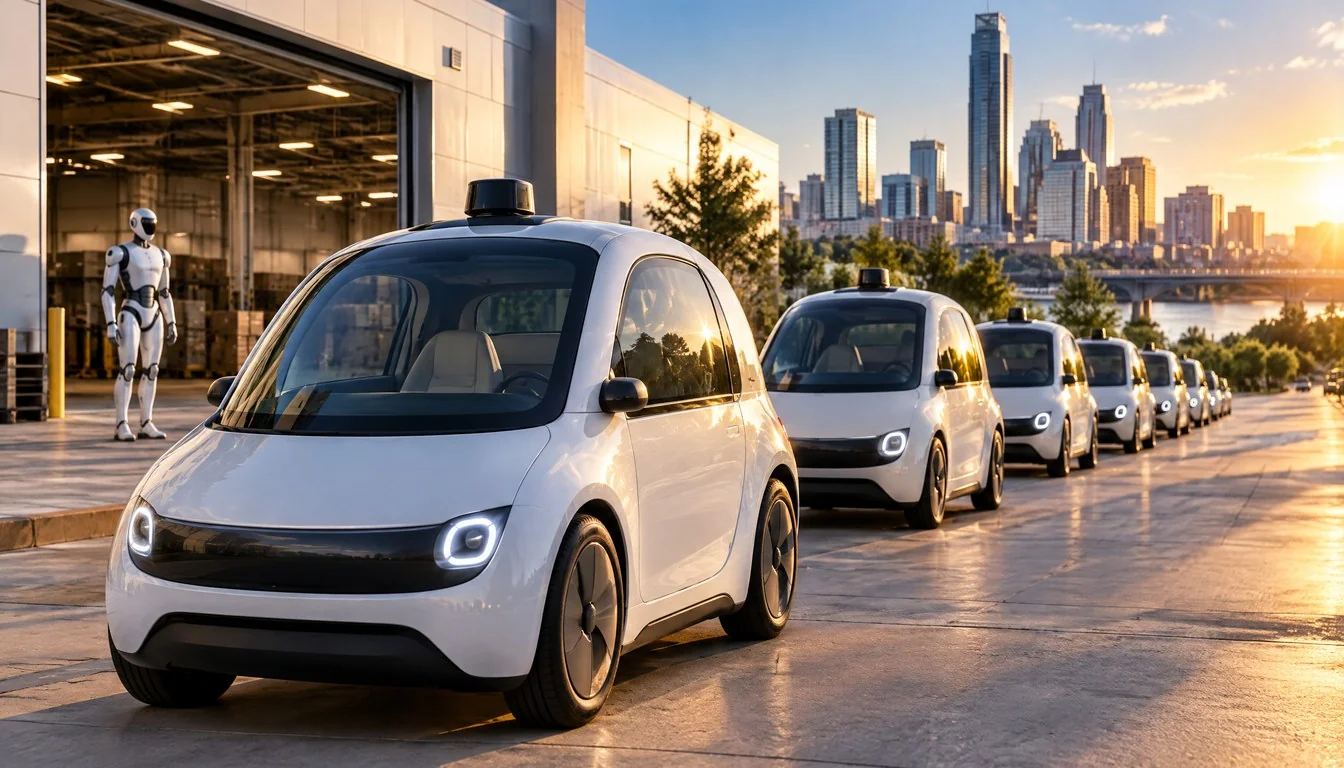
One program that did show visible movement during the quarter was Cybercab. Tesla’s Robotaxi fleet in Austin grew from fewer than 40 purpose-built vehicles to more than 300 in roughly 30 days, an expansion that Tesla’s Cybercab fleet growth reporting covered in detail. Tesla’s unsupervised Robotaxi service now operates in six cities: Austin, Dallas, Houston, Miami, Orlando and Tampa, following earlier expansions into Dallas and Houston in April 2026 and into the Florida markets in July 2026.
That fleet growth illustrates the tension in Tesla’s current spending pattern. The Robotaxi rollout is visibly accelerating on the ground even as the capital expenditure line tied to AI and robotics infrastructure came in lighter than forecast. It suggests Tesla is finding ways to scale parts of its autonomy push, including Cybercab, without yet committing the full dollar amount analysts had modeled for the AI compute and chip-plant side of the ledger.
Full Self-Driving Subscriptions Keep Climbing
Tesla disclosed 1.74 million active Full Self-Driving subscriptions in the quarter, up from 1.48 million in the second quarter, a gain of roughly 260,000 subscribers in three months. The subscription product remains priced at $99 per month in the United States. Tesla also said it is targeting more than 400 megawatts of AI-training compute capacity by the end of 2026, a figure tied directly to the same compute buildout that came in under budget this quarter.
On the naming side, Tesla has been quietly rebranding the feature in some markets. In New Zealand, the company renamed “Full Self-Driving Capability” to “Tesla Assisted Driving Basic” in mid-October, part of a broader European shift toward “Tesla Assisted Driving” branding. Tesla’s HW3 vehicles are receiving a separate v14.3 Lite software branch rather than the full version running on newer AI4 hardware, a distinction that matters for owners of older Model S and Model X vehicles checking what update applies to their car.
The Tesla-SpaceX Merger Question Hangs Over the Quarter
The earnings print landed alongside a separate, higher-stakes development: Tesla’s board has set up a special committee to evaluate a possible merger with Elon Musk’s rocket company, SpaceX. That evaluation is a proposal under review, not a completed transaction, and 24/7 Wall St described the quarter as a thin beat on the surface hiding a deeper shift in Tesla’s cost structure, one that could look very different if Tesla and SpaceX end up combining their AI infrastructure spending under one balance sheet, according to 24/7 Wall St.
Musk reportedly described combining the two companies as potentially “a good idea” in comments tied to the discussions, though no terms, timeline or confirmed transaction have been disclosed. Readers following that story in more depth can see how the market has been pricing the possibility in SpaceX’s own profit reporting and merger coverage, which outlines SpaceX’s side of the same discussions.
The timing is notable because SpaceX’s own AI division, which the company has started calling Super Intelligence, has been growing fast enough that some reports describe it as SpaceX’s largest business line by revenue contribution this year. If Tesla and SpaceX do combine, the AI compute spending that came in light at Tesla this quarter could end up folded into a much larger combined capital plan.
Historical Context: From Cash Burn Fears to Capital Discipline
Tesla’s capital spending has moved in a wide band over the past year. The company spent $2.25 billion in the third quarter of 2025, a figure that more than doubled to $5.79 billion by the second quarter of 2026 as the AI and robotics buildout accelerated. That acceleration is also what drove the negative $1.1 billion free cash flow Tesla reported for the second quarter, a result that set the stage for analysts to expect an even deeper burn in the third quarter as spending kept climbing toward the stated $25 billion annual target.
Instead, capex pulled back to $4.73 billion in the third quarter, the first sequential decline investors had seen in several quarters of ramping AI investment. Investing Live described the quarter as a case where margins and cash flow surprised to the upside while revenue narrowly missed, a pattern that leaves open the question of whether the fourth quarter will see spending snap back toward the full-year plan, according to Investing Live.
Market Impact and the Read-Through for AI Infrastructure Spending
Tesla shares moved modestly higher after the print, a reaction consistent with a market that had been bracing for a deeper cash drain. The broader significance for the AI sector is less about Tesla’s stock move and more about what the quarter signals for the pace of AI infrastructure build-out among companies that, like Tesla, have promised investors heavy compute and chip spending. A lighter-than-expected capex quarter at one of the most closely watched AI spenders in the market gives analysts a new data point when they model how quickly automakers and technology companies can actually deploy the AI capital they have budgeted.
That broader AI capital spending backdrop has been a recurring theme across markets this year, with investors rotating in and out of AI-exposed names depending on quarterly capex signals, a pattern visible in how Nasdaq’s reaction to SpaceX and Super Micro results played out earlier this year. Tesla’s own $158 billion Musk compensation package, detailed in reporting on the award’s robotaxi software conditions, is itself tied to milestones in the same Cybercab and AI programs this quarter’s capex numbers touch on.
Competitive Comparison: Tesla’s AI Spend Against Its Own Roadmap
The most useful comparison this quarter is not against a rival automaker but against Tesla’s own stated plan. Tesla has told investors it intends to spend more than $25 billion in 2026 across Optimus, AI compute, Cybercab and Terafab. Through the first three quarters, spending has been uneven: a comparatively light 2025 baseline, a sharp jump in the second quarter of 2026, and now a pullback in the third quarter that leaves the pace of spending needed in the fourth quarter to hit the full-year target meaningfully higher than what the company has delivered so far.
| Metric | Analyst Expectation | Actual Q3 2026 Result |
|---|---|---|
| Free cash flow | Burn of about $4.92 billion | $1.53 billion positive |
| Capital expenditure | About $7.5 billion | $4.73 billion |
| Adjusted EPS | $0.44 | $0.48 |
| Revenue | Above $28 billion | About $28.05 billion |
| GAAP operating income (YoY change) | Not separately modeled | Down 56% to about $0.7 billion |
That gap between the full-year commitment and the quarter’s actual spend is exactly the red flag Inderes raised: lower investment this quarter supported the cash flow surprise, but it does not erase the spending Tesla has told investors to expect across Optimus, AI compute, Cybercab and Terafab before the year closes.
What Tesla’s Finance Team Is Signaling
Tesla’s finance chief, Vaibhav Taneja, has been the company’s point person on demand and order-backlog commentary through the back half of 2026. The combination of a cash flow beat, a GAAP operating income decline, and a reiterated full-year capex target above $25 billion suggests Tesla’s finance organization is managing the AI buildout on a longer timeline than the quarter-to-quarter pace Wall Street has been modeling. That is consistent with a company trying to protect near-term cash generation while still committing to the multi-year AI and robotics investment it has promised shareholders.
Predictions: What Comes Next for Tesla’s AI Capital Plan
- Fourth-quarter capital expenditure will likely need to rise sharply if Tesla is going to hit its stated full-year target of more than $25 billion, since the first three quarters have not come close to that run rate.
- The Tesla-SpaceX merger evaluation will keep drawing investor attention through the rest of 2026, and any update from the special committees will move both stocks regardless of whether a deal is ultimately reached.
- Optimus production at Fremont will be watched closely for the first disclosed unit numbers, since Tesla has so far confirmed only that high-volume production lines have started, without a unit target or delivery schedule.
- Cybercab’s Austin fleet expansion is likely to continue into Dallas next, following the pattern Tesla has already used to scale Robotaxi service into new metro areas.
- FSD subscription growth, now at 1.74 million active subscribers, is likely to keep functioning as a software revenue offset to hardware capex swings, giving Tesla a recurring revenue cushion even in quarters when capital spending runs light.
The Bigger Picture for AI-Heavy Balance Sheets
Tesla’s quarter is a reminder that AI infrastructure spending does not move in a straight line, even at companies that have made AI central to their investment pitch. A $3 billion gap between expected and actual capex in a single quarter is large enough to flip a company from a modeled cash burn into a cash surplus, which is exactly what happened here. For a company that has tied executive compensation, new vehicle programs and its humanoid robot ambitions to the pace of AI investment, that kind of swing invites scrutiny over whether the underlying programs are progressing on schedule or simply being spread across more quarters than originally planned.
Energy storage deployment of 13.7 gigawatt-hours, up about 10% year over year, and the 10 millionth vehicle milestone both point to a core business that kept growing through the quarter. The AI and robotics side of Tesla’s story, by contrast, looks less like a retreat and more like a program that is still finding its spending cadence, one quarter after a sharp ramp and one quarter before a full-year target that still requires a much bigger fourth-quarter outlay.
Frequently Asked Questions
What was Tesla’s free cash flow in the third quarter of 2026?
Tesla reported $1.53 billion in free cash flow for the third quarter of 2026, reversing analyst expectations of a cash burn of about $4.92 billion.
Why did Tesla’s cash flow beat expectations?
Capital expenditure came in at $4.73 billion, roughly $3 billion below the approximately $7.5 billion analysts had expected, mainly tied to slower-than-modeled spending on AI compute, Optimus and Cybercab infrastructure.
How much is Tesla planning to spend on AI and robotics in 2026?
Tesla has said it still expects to spend more than $25 billion in capital expenditure in 2026, covering Optimus production lines, AI compute, the Cybercab ramp and the Terafab chip plant.
Did Tesla beat earnings expectations overall?
Adjusted earnings per share were $0.48, ahead of the $0.44 analysts expected, while revenue of about $28.05 billion narrowly missed estimates. GAAP operating income fell 56% year over year to roughly $0.7 billion.
Is Tesla merging with SpaceX?
No merger has been completed. Tesla’s board has set up a special committee to evaluate a possible combination with SpaceX, and Elon Musk has reportedly called the idea of combining the companies potentially a good one, but this remains a proposal under review, not a finalized deal.
How many Full Self-Driving subscribers does Tesla have?
Tesla disclosed 1.74 million active Full Self-Driving subscriptions in the third quarter of 2026, up from 1.48 million in the second quarter.
What is the status of Tesla’s Optimus robot?
Tesla said production of Optimus units began on high-volume lines at its Fremont factory as of October 21, 2026. No official price has been confirmed, and the commonly cited $20,000 to $30,000 figure remains a long-term target rather than a current price.
How big is Tesla’s Cybercab fleet now?
Tesla’s Austin Cybercab fleet grew from fewer than 40 vehicles to more than 300 in roughly 30 days, with unsupervised Robotaxi service now running in six cities: Austin, Dallas, Houston, Miami, Orlando and Tampa.
Related Coverage
Helena Marsh
Helena Marsh is the Editor-in-Chief at TrendinTech, where she leads editorial strategy and oversees coverage across artificial intelligence, cybersecurity and enterprise technology. She believes technology reporting should be rigorous and plainly written, so readers understand what actually changes for them rather than what a company's announcement promises.
All stories by Helena Marsh (283)