SpaceX Guides Q1 2027 Revenue to $37B on AI Compute [2026]

SpaceX told investors on October 20, 2026 to expect something close to a doubling of revenue within six months. On the company’s Q3 2026 earnings call, chief financial officer Bret Johnsen said SpaceX now sees total company revenue landing between $33 billion and $37 billion in the first quarter of 2027, a figure that CNBC reported trounced the average analyst estimate of $22.2 billion tracked by LSEG. The guidance is a forecast, not a completed quarter, and Q1 2027 has not yet happened.
The reason behind the jump is not a new rocket contract or a Starlink subscriber surge. It is AI compute. Johnsen told the call the outlook reflects “increased visibility into our compute contract pipeline over the next six months,” according to a transcript published by TradingKey. SpaceX’s newly named Super Intelligence business, built around renting out GPU capacity and the Grok family of AI models, has gone from a side project to the company’s largest reported revenue line in the space of about a year.
Don't miss new tech stories on Google
Add TrendinTech once in the Google app and our stories appear in your news suggestions.
What Bret Johnsen Actually Told Wall Street
SpaceX’s Q3 2026 results, hosted on a webcast the evening of October 20, showed total company revenue of $14.6 billion, up sharply from the year-ago quarter. The Q1 2027 guidance of $33 billion to $37 billion would, if it holds, put a single quarter of SpaceX revenue at more than double that figure. Johnsen framed the jump as a function of visibility rather than a blind leap: SpaceX, he said, can now see six months of compute demand sitting in signed or near-signed contracts, which is why the company felt comfortable giving a number that far outstrips what Wall Street analysts had modeled.
That gap between the company’s own number and outside estimates is itself notable. An average Street estimate of $22.2 billion implies analysts were pricing in steady growth from the AI compute business, not the kind of inflection SpaceX is now describing. The $33 billion to $37 billion range effectively tells investors that the compute story has moved from “promising experiment” to “primary growth driver” faster than most outside models accounted for.
Super Intelligence Becomes SpaceX’s Biggest Business
The headline number sits on top of a quarter that already showed a major shift inside SpaceX’s business mix. The company’s Super Intelligence segment, its branding for AI compute and Grok-related revenue, generated roughly $7.56 billion in Q3 2026, up from about $813 million in the same quarter a year earlier. That is a year-over-year jump of around 830%, and it means AI compute, not Starlink connectivity and not rockets, is now SpaceX’s largest reported business by revenue.
Starlink’s connectivity business generated approximately $5.25 billion in the quarter, with roughly 13.6 million subscribers after adding about 1.6 million net consumer accounts. The Space segment, covering Falcon and Starship launches, brought in close to $1.8 billion. Add it up and AI compute accounted for more than half of SpaceX’s reported $14.6 billion in quarterly revenue, a split that would have sounded far-fetched twelve months ago when the business was still a rounding error.
Within Super Intelligence, a sub-line called Solutions and Infrastructure contributed about $7.02 billion of the total, and roughly $608 million of that came from Cursor, the AI coding tool SpaceX folded into its AI business after acquiring it earlier in the quarter. That single acquisition now accounts for a meaningful slice of what has become the company’s fastest-growing unit, and it explains why SpaceX keeps getting compared to pure AI infrastructure players rather than rocket builders.
Musk’s Trillion-Dollar Framing
Elon Musk used the call to go well beyond Johnsen’s quarterly guidance. He told investors he expects SpaceX’s annual recurring revenue to land somewhere between $500 billion and $1 trillion by the end of 2027, an aspiration rather than a confirmed figure, tied directly to how much AI compute capacity the company can bring online. “I’ve never seen anything grow this fast,” Musk said on the call, describing the pace of the compute business, according to Tesla North.
Musk tied that ambition to a specific capacity target. “I am very confident we will add 10GW of new computing power in 2027,” he said, a claim that would roughly match the scale of capacity some of the largest hyperscale cloud providers run today. He went further on the revenue math behind that buildout: “If we bring 10GW of AI online by the end of next year, it will be $300 billion to $500 billion a year in revenue,” Musk told staff, a statement reported by Teslarati.
None of those longer-range figures are confirmed revenue. They are targets Musk has set for the business, built on an assumption that SpaceX can both build the gigawatts of compute it is promising and fill that capacity with paying customers at the prices it expects. The Q1 2027 guidance from Johnsen is the nearer-term, more concrete number; the trillion-dollar framing is Musk’s longer horizon bet on where that trajectory leads.
The Physical Build-Out Behind the Guidance
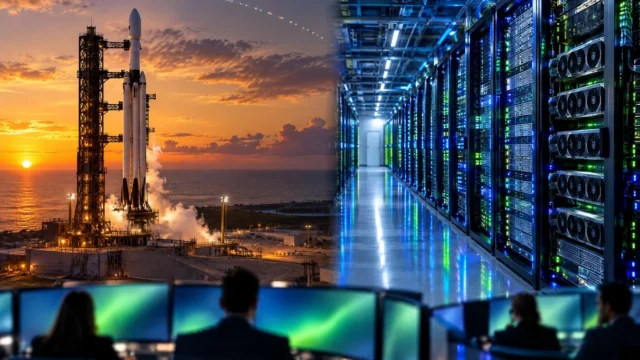
SpaceX closed the third quarter with roughly 1.7 gigawatts of nameplate AI-compute capacity, up from about 1.4 gigawatts at the end of June and just 0.6 gigawatts a year earlier. Management’s near-term target is 2.5 to 3 gigawatts by the end of 2026, with a much larger jump planned for 2027: reported goals range from 5 to 10 gigawatts of additional capacity, with Musk separately projecting SpaceX could reach at least 13 gigawatts of total AI compute by the end of 2027.
Much of that expansion centers on the Colossus II data center complex, inherited and expanded from SpaceX’s earlier absorption of xAI’s infrastructure. The scale of the ambition has already run into a supply constraint that has nothing to do with money: SpaceX has reportedly struggled to secure enough Nvidia, Google, or Amazon chips despite having billions of dollars available to spend, a dynamic Yahoo Finance UK flagged as a strategic risk to the whole compute buildout plan, one also raised in AInvest’s analysis of the gigawatt build-out timeline. Fast capital and a willing buyer do not guarantee delivery when every AI infrastructure company on the planet is chasing the same accelerators.
Grok 4.7, Grok Bot and the Products Driving Demand
The revenue behind SpaceX’s AI business runs through a specific product lineup. Grok 4.7, released through the API in mid-October 2026 under the model ID grok-4.7, is the newest flagship model, supporting a 500,000-token context window and configurable reasoning modes. Pricing for prompts under 200,000 tokens runs $2 per million input tokens, $0.50 per million cached-input tokens, and $6 per million output tokens; longer prompts cost $4, $1, and $12 per million tokens respectively. Grok Voice 3.0 launched October 14, 2026, extending the lineup into speech-to-speech interaction at $0.08 per minute.
Subscription access runs through X’s bundled tiers: Free, Plus at $8 a month, Premium at $30, Super at $100, and Ultra at $200, with Grok Bot, the agentic assistant layer, available starting at the Premium tier. Gwynne Shotwell, SpaceX’s president and chief operating officer, told the earnings call that Grok Bot had reached approximately 800,000 paid weekly users earlier in October, more than doubling over the preceding month. Musk, on the same call, suggested the agent’s appetite for compute could end up dwarfing other uses of SpaceX’s AI infrastructure: “I think Grok bot may end up being what uses most of our Super Intelligence’s compute,” he said, per a report from The Globe and Mail.
Cursor’s Place in the Revenue Mix
SpaceX’s integration of Cursor, the AI coding assistant, is one of the more unusual threads in this story. The deal closed around the middle of Q3 2026 and already contributed $608 million to the Solutions and Infrastructure line in its first partial quarter inside SpaceX. That is a meaningful chunk of change for a business segment that itself only existed in its current form for about a year, and it signals SpaceX’s intent to own distribution, not just raw compute capacity, across the AI stack it is building. Readers who want the fuller picture on how that acquisition showed up ahead of this earnings call can check our earlier preview of SpaceX’s Q3 2026 earnings and the Cursor deal.
A Tesla Merger Enters the Conversation
The earnings call did not stay confined to SpaceX’s own numbers. Musk confirmed that Tesla and SpaceX had each formed special committees to explore a potential merger between the two companies, a disclosure that added a second major storyline to the same call. No terms, timeline, or agreement were announced, and Musk was careful to describe the committees as exploratory rather than a signal that a deal is imminent. Still, pairing a record AI-compute revenue guide with merger talk between Musk’s two largest companies gave investors plenty to parse in a single evening. We covered the committee formation and what it means for both companies’ shareholders in more detail in our report on SpaceX’s profit and the Tesla merger talks.
How This Compares to the Rest of the AI Infrastructure Race
SpaceX is not the only company trying to turn spare compute into a growth story, but the speed of its pivot stands out. Hyperscale cloud providers such as Microsoft, Google, and Amazon built their AI infrastructure businesses over several years, layering compute rental on top of already-massive cloud franchises. SpaceX is attempting something closer to a sprint: a rocket and satellite company that, in roughly a year, rebranded an internal AI effort as “Super Intelligence” and pushed it past its legacy launch and broadband businesses in quarterly revenue.
The competitive backdrop matters here. Google has pushed to open its own TPU-based tooling to pull developers away from Nvidia-centric stacks, a move we detailed in our coverage of Google’s TorchTPU open-source push, while Nvidia’s own chip allocation remains the tightest resource in the industry. SpaceX’s guidance implicitly bets that demand for raw compute capacity will keep outrunning supply long enough for a rocket company turned compute landlord to capture a meaningful share of that spending, even while it competes with firms that have spent a decade building cloud infrastructure at scale.
From Reusable Rockets to AI Landlord: The Historical Arc
SpaceX spent its first two decades defined by one achievement after another in reusable spaceflight: landing Falcon 9 boosters, flying crewed Dragon missions, and building Starlink into the largest satellite broadband network in the world. As recently as a year or two ago, the company’s growth story was almost entirely about those three pillars. The AI compute business did not even register as a separate reporting segment until it began scaling through 2026.
That history matters for judging how unusual this quarter is. SpaceX did not build Super Intelligence from scratch inside a conventional aerospace business; it absorbed xAI’s infrastructure and talent earlier in 2026 and used that foundation, plus the Cursor acquisition, to build out a compute rental and AI model business that now outearns the rockets. Investors who tracked SpaceX purely as a space company are now being asked to value it, in large part, as an AI infrastructure company that happens to also launch satellites. That is a strange position for a firm whose last major public narrative, just months ago, centered on a $28.5 trillion total addressable market claim tied mostly to space ambitions, which we examined in our piece on SpaceX’s $28.5 trillion TAM claim.
Q3 2026 Segment Revenue at a Glance
| Segment | Q3 2026 revenue | Year-over-year change | Share of total |
|---|---|---|---|
| Super Intelligence (AI compute, Grok, Cursor) | ~$7.56 billion | Up from ~$813 million in Q3 2025 | ~52% |
| Connectivity (Starlink) | ~$5.25 billion | 13.6 million subscribers, ~1.6 million net adds | ~36% |
| Space (Falcon, Starship launches) | ~$1.8 billion | Not separately confirmed | ~12% |
| Total company revenue | ~$14.6 billion | Beat average analyst estimates | 100% |
Those figures come from SpaceX’s own October 20 earnings call and the transcripts and reporting built from it. They are the clearest evidence yet that AI compute has reshaped the company’s business mix faster than its own Starlink expansion did at a comparable stage of growth.
Compute Capacity Roadmap: Where SpaceX Says It Is Headed
| Period | Reported or targeted nameplate compute capacity | Status |
|---|---|---|
| Q3 2025 (year earlier) | ~0.6 gigawatts | Historical |
| End of Q2 2026 | ~1.4 gigawatts | Historical |
| End of Q3 2026 | ~1.7 gigawatts | Reported as of October 20, 2026 |
| End of 2026 (target) | 2.5 to 3 gigawatts | Management target, not yet reached |
| End of 2027 (target) | 5 to 10+ gigawatts of additions; Musk cited at least 13 gigawatts total | Forward-looking target, unconfirmed |
The gap between the “reported” rows and the “target” rows is the entire bet embedded in SpaceX’s Q1 2027 revenue guidance. Johnsen’s $33 billion to $37 billion figure assumes the contract pipeline SpaceX can already see converts into billed revenue; Musk’s 2027 capacity numbers assume SpaceX can actually secure and deploy chips at a pace that, as the Nvidia supply shortage reporting suggests, is not guaranteed even for a company willing to spend tens of billions of dollars.
What Analysts and Investors Are Watching Next
The stock and analyst reaction to the guidance has been swift. Reports on the earnings call noted the Q1 2027 figure landed well above the $22.2 billion consensus tracked by LSEG, and Basenor’s write-up of the call framed it as evidence that AI compute had already become SpaceX’s primary valuation driver rather than a side bet. That framing echoes earlier investor commentary this year arguing SpaceX deserved a far higher valuation multiple than typical aerospace peers, a theme we tracked in our coverage of Cathie Wood’s case for SpaceX as a deep-value bet ahead of any public offering.
Separately, SpaceX’s launch cadence and Starship program remain part of the broader investment case, even as AI compute takes center stage in the earnings narrative. The company’s next major Starship milestone, a planned double-booster catch on Flight 15, has drawn its own round of analyst attention, detailed in our look at Morgan Stanley’s bullish read on Flight 15. Investors are effectively being asked to underwrite two growth stories inside one company: an AI compute business growing faster than almost anything in the industry, and a legacy launch business still trying to prove out reusability at a new scale.
The Case for Skepticism
Several parts of this story deserve a more cautious read before anyone treats $33 billion to $37 billion as a sure thing. First, it is guidance, not a completed quarter; SpaceX will not report actual Q1 2027 results until well into next year. Second, the chip supply problem flagged by Yahoo Finance UK is real: SpaceX cannot bill customers for compute capacity it cannot physically deploy, and every major AI company is fighting for the same limited pool of Nvidia accelerators. Third, several of the more eye-catching figures in this story, including the $500 billion to $1 trillion annual recurring revenue projection and the 13-gigawatt 2027 capacity target, are Musk’s own stated ambitions rather than figures SpaceX’s finance team has formally guided to.
There is also a structural question about durability. Compute rental is a capital-intensive, competitive business with thin margins once supply catches up with demand, and SpaceX’s current advantage rests heavily on being early and well-capitalized rather than on a defensible technology moat distinct from what Nvidia, Google, Microsoft, and Amazon already offer. If the AI compute market cools, or if competitors undercut pricing once their own capacity comes online, the gap between a $33 billion guide and a $37 billion guide could matter a lot less than whether SpaceX hits the low end at all.
Five Predictions for SpaceX’s AI Compute Business Through 2027
- SpaceX will likely land closer to the low end of its $33 billion to $37 billion Q1 2027 range if Nvidia chip supply remains as constrained as reporting currently suggests, rather than the high end that assumes smooth capacity deployment.
- Grok Bot’s compute footprint will keep growing faster than its subscriber count, since agentic workloads consume far more compute per user than chat-style queries, pressuring margins even as revenue climbs.
- Expect SpaceX to announce at least one more compute-adjacent acquisition in the next two quarters, following the pattern set by the Cursor deal, as the company tries to own more of the AI application layer rather than just raw infrastructure.
- The Tesla-SpaceX merger talks will likely remain in the committee and exploratory stage through at least the first half of 2027, given the complexity of valuing two companies whose businesses increasingly overlap on AI and compute.
- Starlink and Space segment revenue will keep growing in absolute terms but will shrink as a share of SpaceX’s total revenue mix through 2027, cementing AI compute as the company’s primary growth narrative heading into any future public offering.
What This Means for the Broader AI Compute Market
SpaceX’s guidance is a data point in a much larger story about where AI compute capacity is coming from. Traditional cloud providers, custom chip efforts, and now a rocket company are all racing to claim a piece of the same demand curve. SpaceX’s advantage is capital and speed: it had the balance sheet to acquire xAI’s infrastructure and Cursor’s product and move fast, without the multi-year planning cycles that slow larger, more diversified companies. Its disadvantage is that none of that infrastructure is proprietary in the way a custom silicon program might be. SpaceX is, for now, a very large, very fast-moving reseller of someone else’s chips.
That dynamic is why the $33 billion to $37 billion guidance matters beyond SpaceX’s own stock price. It is a signal of how much unmet AI compute demand still exists in the market, demand large enough that a company without a cloud background can allegedly book tens of billions of dollars in projected quarterly revenue within about a year of entering the business seriously. Whether that demand sustains through 2027, or whether it is a temporary gap that gets filled as Microsoft, Google, Amazon, and chip-focused rivals scale their own capacity, is the question this guidance leaves hanging.
Frequently Asked Questions
What exactly did SpaceX guide for Q1 2027?
CFO Bret Johnsen told investors on the October 20, 2026 earnings call that SpaceX expects total company revenue of $33 billion to $37 billion in the first quarter of 2027. This is forward guidance, not a confirmed result, since Q1 2027 has not yet occurred.
Is the guidance specifically about AI compute revenue?
No. The $33 billion to $37 billion figure is total company revenue, covering AI compute, Starlink connectivity, and Space launch operations combined. AI compute, branded Super Intelligence, is the fastest-growing piece and already SpaceX’s largest segment by Q3 2026 revenue, at roughly $7.56 billion.
How much revenue did SpaceX actually report for Q3 2026?
SpaceX reported total revenue of approximately $14.6 billion for the third quarter of 2026, according to the company’s October 20 earnings call.
What is Super Intelligence?
Super Intelligence is SpaceX’s branding for its AI compute business, built largely on infrastructure absorbed from xAI earlier in 2026, plus the Grok family of AI models and the newly acquired Cursor coding assistant.
Did Elon Musk really say SpaceX could hit $1 trillion in revenue?
Musk told the earnings call he expects annual recurring revenue to reach somewhere between $500 billion and $1 trillion by the end of 2027. That is his own stated expectation, not a confirmed financial figure, and it depends on SpaceX successfully deploying roughly 10 additional gigawatts of AI compute capacity next year.
Is a Tesla and SpaceX merger confirmed?
No. Musk said on the same call that both companies had formed special committees to explore a potential merger. No terms, valuation, or timeline have been announced, and no deal is confirmed.
What is Grok 4.7, and how does it relate to SpaceX’s revenue?
Grok 4.7 is the newest flagship model in the Grok lineup, released via the API in mid-October 2026 with a 500,000-token context window. It is one of the products generating the usage billed inside SpaceX’s Super Intelligence revenue line, alongside Grok Bot and the newly acquired Cursor.
What is the biggest risk to SpaceX hitting its Q1 2027 guidance?
Chip supply. Reporting indicates SpaceX has struggled to secure enough Nvidia, Google, and Amazon chips despite having the capital to buy them, which could limit how much of its targeted compute capacity it can actually deploy and bill customers for by early 2027.
Related Coverage
Helena Marsh
Helena Marsh is the Editor-in-Chief at TrendinTech, where she leads editorial strategy and oversees coverage across artificial intelligence, cybersecurity and enterprise technology. She believes technology reporting should be rigorous and plainly written, so readers understand what actually changes for them rather than what a company's announcement promises.
All stories by Helena Marsh (280)