Tesla Starts Optimus Production: 20,000 Units a Week [2026]

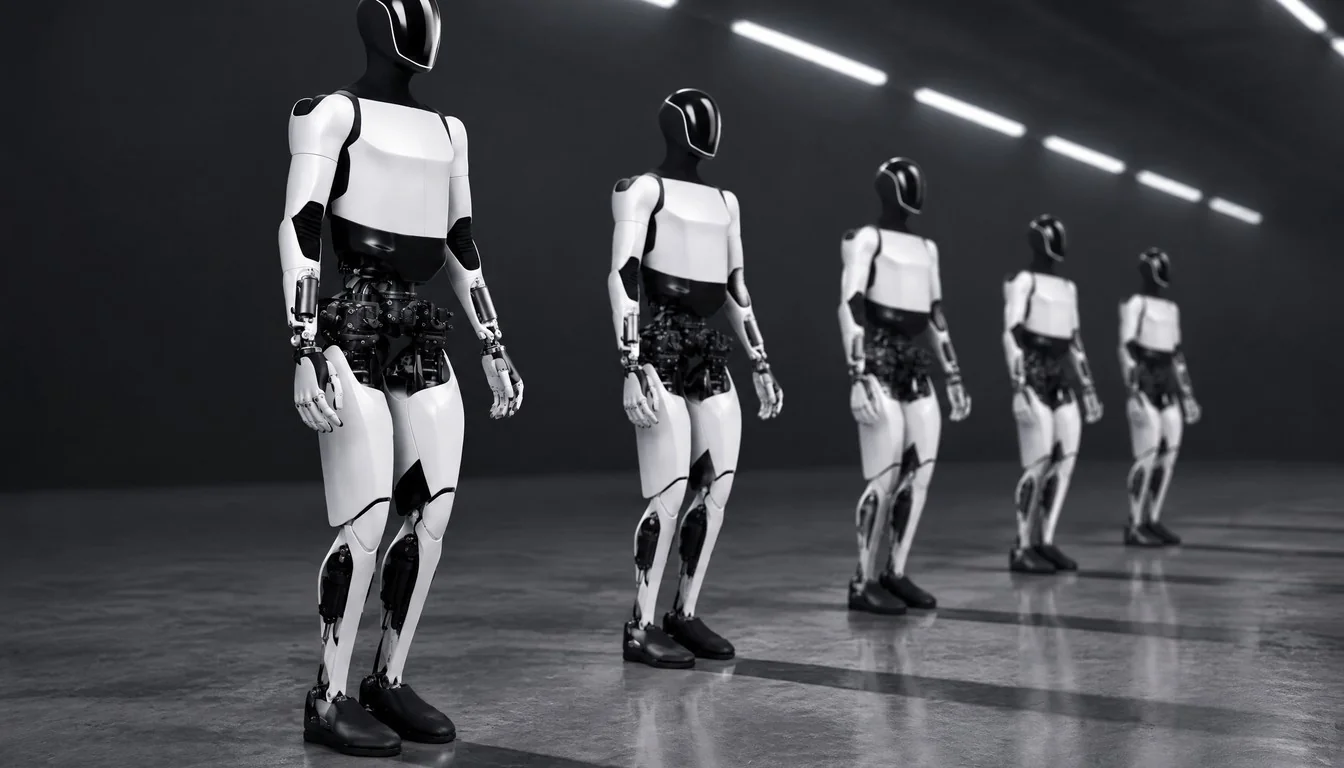
Tesla began early production of its third-generation Optimus humanoid robot at its Fremont, California factory on October 21, 2026, and Chief Executive Officer Elon Musk told investors on the company’s third-quarter earnings call that Tesla aims to start selling the machines to customers outside the company around the end of 2027. The announcement, reported the same day by the Wall Street Journal, Reuters, TechCrunch, Yahoo Finance and The Verge, marks the clearest production timeline Tesla has given for Optimus since the robot first appeared as a concept demo in 2021.
The news lands alongside a mixed earnings report. Tesla’s quarterly profit fell 43% even as the company produced more than 464,000 vehicles and delivered more than 486,000 during the third quarter, according to Yahoo Finance. Investors are now weighing whether Optimus can become a second major revenue line for Tesla at the same time the company’s core vehicle business shows signs of strain. Musk, for his part, used the earnings call to reset expectations around just how long that shift will take.
Don't miss new tech stories on Google
Add TrendinTech once in the Google app and our stories appear in your news suggestions.
Tesla Confirms Optimus Early Production in Fremont
Tesla’s own Q3 2026 update describes the robots coming off the Fremont line as the first Optimus units built to production standard, and says the current manufacturing process is ready for a commercial product. Business Insider reported that the production line sits in space at Fremont that had previously built the Model S and Model X, both of which Tesla shifted out of that facility earlier in 2026 to make room for humanoid robot manufacturing. That is a notable reversal of priorities at a factory that has built Tesla sedans since 2010.
Tesla has not published a formal model name tied to a retail SKU, but reporting around the announcement consistently refers to the hardware as third-generation Optimus, or Optimus V3. The company’s own shareholder materials, filed with the Securities and Exchange Commission on October 19, 2026 ahead of its annual meeting, stated that V3 hardware had been finalized and that production-line modifications were complete, positioning the robot as ready for mass manufacturing. Tesla did not use that filing to announce a price, a retail order process, or a confirmed external shipping date.
That distinction matters for anyone reading headlines like “Optimus for sale next year.” Tesla’s own language describes early production, not a launched consumer product. The company has repeatedly cautioned that ramps on complex hardware tend to run slower than announced, and Musk’s own comments on the earnings call leaned into that caution rather than away from it.
What Musk Said on the Q3 2026 Earnings Call
Musk told analysts that reaching a production rate of roughly 20,000 Optimus units a week will take “at least a year, possibly longer,” according to Interesting Engineering, a direct acknowledgment that volume manufacturing of a humanoid robot is a harder problem than scaling an electric vehicle line. He also said Tesla expects to begin delivering Optimus units to companies outside Tesla around the end of 2027, a target that lines up with the production ramp he described.
Musk’s framing of the opportunity was characteristically bold. In comments carried by Yahoo Finance, he said Optimus will be “the biggest product on Earth,” a claim that puts the robot ahead of Tesla’s own vehicle lineup in his stated long-term ambitions. Separately, in remarks reported by Electric Vehicles, Musk said “By the end of next year, I think we’ll be selling humanoid robots to the public,” a statement that is now the basis for most of this week’s “Tesla robot sales” headlines.
Read together, the two comments describe a plan rather than a confirmed date. Tesla has not published an official Optimus price, has not opened a reservation or order system, and has not released a specification sheet comparable to what it publishes for its vehicles. Readers hoping to reserve a unit the way they might reserve a Cybertruck will find no such option as of this writing. This is useful context next to Tesla’s separate push to put software, not just hardware, at the center of its product roadmap: the company’s Full Self-Driving software revenue jumped sharply in the same quarter, underscoring how much of Tesla’s near-term growth story now rests on code rather than sheet metal.
The Road to 20,000 Units a Week
Twenty thousand units a week, if Tesla reaches it, would put Optimus output on a scale few hardware companies ever attempt for a brand-new product category. Musk’s own math suggests the company is not promising that rate soon. “At least a year, possibly longer” from an October 2026 starting point points to sometime in late 2027 at the earliest, assuming the ramp proceeds without further delay, which is also when Musk expects external deliveries to begin.
Tesla has also described longer-range ambitions for Optimus manufacturing capacity beyond the current Fremont line, including plans for a second production line in Austin. Those figures describe planned capacity rather than demonstrated output, and Tesla has not confirmed a timeline for when a second line would come online or what its annual throughput would actually be once running. Treat any specific long-term unit-per-year figure for Optimus as a target Tesla has discussed, not a number the company has delivered against.
The production math also intersects with Tesla’s broader capital spending story. The company’s AI and robotics investments have drawn scrutiny from investors who watched Tesla’s free cash flow come in well below its AI capital expenditure plans earlier this year. Optimus is now one more claim on that capital, competing for resources against Dojo-successor compute, Full Self-Driving training infrastructure, and the Cybercab program.
Tesla Q3 2026 Optimus Production Timeline
| Date | Milestone |
|---|---|
| December 13, 2023 | Tesla unveils second-generation Optimus (Optimus Gen 2) in a demonstration video |
| June 2025 | Optimus program lead Milan Kovac and Omead Afshar leave Tesla |
| August 2025 | Tesla’s Dojo supercomputer team is disbanded; Dojo lead Pete Bannon departs |
| September 2025 | Optimus AI lead Ashish Kumar departs Tesla for Meta |
| January 22, 2026 | Musk says at the World Economic Forum he expects Tesla to be selling humanoid robots to the public by the end of 2027 |
| October 2, 2026 | Tesla reports Q3 2026 vehicle production of 464,391 units and deliveries of 486,532 units |
| October 19, 2026 | Tesla’s annual shareholder meeting filing states Optimus V3 hardware is finalized and ready for mass production |
| October 21, 2026 | Tesla announces early production of production-quality Optimus units at Fremont; Q3 profit reported down 43% |
| Target: late 2027 | Musk’s stated goal for reaching 20,000 Optimus units a week and beginning deliveries to outside customers |
No Price Yet: Why the $20,000 to $30,000 Figure Is Outdated
A price range of roughly $20,000 to $30,000 has circulated in coverage of Optimus for two years, and it keeps resurfacing in headlines about this week’s news. That figure traces back to comments Musk made at Tesla’s “We, Robot” event in October 2024, where he described it as a long-term target for a mature, high-volume product, not a launch price for the first units off the line. Tesla has not published an official Optimus price as of October 22, 2026, and nothing in this week’s earnings call or shareholder filing changes that.
That gap between a two-year-old aspirational number and an actual retail price is worth sitting with. Early units of any new hardware category typically cost manufacturers far more to build than the eventual mass-market price, which is one reason Tesla has signaled it may lease Optimus units to a limited number of commercial customers before any broader consumer sales process exists. Nothing about leasing terms, customer eligibility, or geographic availability has been confirmed.
From Model S and Model X to Robots: Fremont’s Transformation
The choice of Fremont for Optimus’s first high-volume line carries its own history. The factory has been Tesla’s original production site since the company took it over from the NUMMI joint venture between General Motors and Toyota in 2010, and it has built every Model S and Model X that Tesla has ever sold. Repurposing that space for a humanoid robot, rather than building a dedicated greenfield robot plant first, signals how much urgency Tesla is putting behind getting Optimus into volume manufacturing quickly rather than waiting for new construction.
It also means Tesla is temporarily giving up some vehicle manufacturing capacity to make room for a product that, by its own admission, is not yet generating revenue. That tradeoff is easier to justify if Optimus becomes the kind of business Musk describes. It becomes a much harder one if the 20,000-unit-a-week target slips further, especially while Tesla is simultaneously funding its robotaxi buildout, a program whose software roadmap is tied to performance milestones in Musk’s own compensation package.
The Software and AI Team Behind Optimus
Humanoid robots live or die on the software that controls balance, grasping, and task planning, not just the actuators and sensors that make up the hardware. That makes Optimus’s leadership turnover over the past 16 months relevant context for anyone assessing whether Tesla can hit its 2027 targets. Milan Kovac, who led the Optimus program, left Tesla in June 2025 alongside Omead Afshar. Two months later, Tesla disbanded its Dojo supercomputer team and lost Dojo lead Pete Bannon, removing an in-house training chip effort that had been positioned as central to Tesla’s AI ambitions. In September 2025, Ashish Kumar, who led Optimus AI development, departed for Meta.
Tesla has not announced a single named replacement structure for that leadership gap in the materials reviewed for this story, and the company’s shareholder filing focused on hardware readiness rather than the AI stack powering the robot’s perception and control systems. That is a meaningful omission: a robot can have finalized hardware and still be constrained by how quickly its software team can train it to work reliably outside a controlled factory floor. The broader robotics industry has increasingly turned toward general-purpose foundation models to solve exactly this problem, an approach reflected in independent efforts such as a robot foundation model API that recently raised seed funding specifically to give robotics developers a shared AI layer rather than building bespoke control software for every machine.
Competitive Landscape: Tesla Is Not Racing Alone
Tesla’s announcement does not happen in a vacuum. A cluster of well-funded robotics companies, along with major Chinese manufacturers, have spent the past two years building and demonstrating their own humanoid platforms aimed at warehouse, logistics, and eventually consumer use cases. None of those rivals has published a confirmed 20,000-unit-a-week production target or a Fremont-scale manufacturing commitment, which is part of why Tesla’s announcement generated as much attention as it did this week. Tesla’s advantage, if it holds, is largely about manufacturing muscle: the company has spent two decades learning how to scale complex hardware production, a skill set that does not automatically transfer to bipedal robots but gives Tesla a head start that smaller robotics startups lack.
The flip side of that advantage is scrutiny. Tesla’s core vehicle business is the reason investors hold the company to a higher bar for execution timelines, and a 43% quarterly profit decline gives skeptics a ready-made argument that Optimus capital could be better spent shoring up the car business. Tesla’s own framing is that Optimus, Full Self-Driving, and the Cybercab robotaxi program are three expressions of the same underlying AI and robotics bet, not three separate distractions from each other.
Tesla Q3 2026 Operational Snapshot
| Metric | Q3 2026 Figure |
|---|---|
| Vehicles produced | 464,391 |
| Vehicles delivered | 486,532 |
| Energy storage deployed | 13.7 GWh |
| Quarterly profit, year over year | Down 43% |
| Optimus production status | Early production started October 21, 2026 |
| Optimus external delivery target | Around the end of 2027 |
| Optimus confirmed retail price | None published |
Market Impact: What the Optimus Timeline Means for Tesla Stock
Markets tend to treat Optimus as an option on future revenue rather than a line item in current results, since the robot has generated no reported sales. That makes this week’s news a timeline update more than a financial catalyst in the traditional sense. Still, Tesla has increasingly leaned on Optimus and its broader AI and robotics narrative to justify a valuation that trades well above what its vehicle delivery numbers alone would support, a dynamic also visible in how closely investors tracked a reported rally in China’s A-share robotics supply chain on news that Optimus V3 was ready for mass production.
A confirmed slip in the 20,000-unit-a-week target, or any sign that external deliveries are pushed past 2027, would likely weigh on that part of Tesla’s story more than it would affect the company’s vehicle or energy segments. Conversely, any evidence that Tesla is ahead of its own stated schedule would give bulls a concrete data point beyond Musk’s commentary, which markets have learned to treat with some skepticism after years of shifting Optimus timelines.
Historical Context: How Optimus Got Here
Tesla first showed Optimus as a concept at its 2021 AI Day event, where a person in a robot suit stood in for hardware that did not yet exist. The company unveiled its first working prototype in 2022 and showed a more refined second generation, Optimus Gen 2, in a December 2023 demonstration video that showed the robot walking, handling an egg without crushing it, and performing basic manipulation tasks. Tesla’s 2024 “We, Robot” event introduced the long-term $20,000 to $30,000 price ambition that still shapes public expectations today, even though it was never meant to describe an early unit cost.
The past 16 months have been rockier than that public narrative suggests. Leadership departures across the Optimus AI team, the dissolution of the Dojo training-chip program, and a reported two-to-three-month supply chain delay tied to specialized magnets have all pushed against Tesla’s original internal targets, some of which had called for third-generation production before the end of 2026. The October 21, 2026 early-production announcement represents Tesla catching up to a version of its own schedule that slipped over the course of 2026, not a surprise acceleration.
What Could Still Delay the 2027 Timeline
Musk’s own language on the earnings call built in room for further delay, and several concrete risks sit behind that hedge. Supply chains for specialized rare-earth magnets used in robot actuators have already been cited as a factor that pushed the Optimus program back by two to three months earlier in 2026. Hand assembly, a part of the robot that requires dense actuation in a small space, has been flagged in reporting as a persistent engineering constraint. And the loss of several senior Optimus AI leaders over the past year and a half means Tesla’s current team is working with less institutional continuity than it had when the program began.
There is also a simpler risk: Tesla has a well-documented history of announcing ambitious timelines for Optimus, Full Self-Driving, and the Cybertruck that ultimately took longer to materialize than first stated. That history does not mean the 2027 target will slip again, but it is the single biggest reason markets and reporters are treating “sales next year” headlines with more caution than Musk’s own enthusiasm might suggest is warranted.
Predictions: Where Optimus Goes From Here
- Tesla is more likely to announce a commercial leasing program for industrial customers before it opens any form of public consumer ordering, given Musk’s own comments about an early focus on companies rather than individual buyers.
- Expect Tesla to disclose weekly or monthly Optimus production figures informally, through Musk’s public statements or investor materials, well before it publishes a formal specification sheet or price list.
- The 20,000-unit-a-week target will likely face at least one public revision over the next 12 months, consistent with the pattern seen across Tesla’s Full Self-Driving and Cybertruck production timelines.
- Tesla’s AI and robotics capital spending, including Optimus, will remain a recurring flashpoint with investors for as long as the company’s free cash flow trails its own capex commitments.
- Competing humanoid robot developers are likely to use Tesla’s announcement as a benchmark in their own fundraising and partnership pitches, even without matching Tesla’s manufacturing scale in the near term.
Why This Announcement Reads Differently Than Past Optimus Updates
What separates this week’s news from prior Optimus updates is the specificity of the production language. Tesla has shown Optimus prototypes and demo videos for years, and has discussed price ambitions since 2024, but the company had not previously stated, in its own Q3 update, that a high-volume manufacturing line was running and producing units built to a commercial production standard. Earlier announcements described testing, iteration, and prototype walks across a stage. This one describes a factory line that used to build the Model S and Model X now building robots instead, which is a different kind of commitment of capital and floor space than a demo ever required.
That does not make the 2027 sales timeline guaranteed. It does mean Tesla has, for the first time, tied a specific piece of physical infrastructure, rather than just a roadmap slide, to its humanoid robot ambitions. Whether that translates into robots on customer floors by the end of 2027, as Musk hopes, will depend on whether Tesla can solve the hand assembly, supply chain, and AI leadership gaps that have already slowed the program once this year. Tesla’s broader push to extend its autonomous fleet operations beyond the Cybercab program in Austin suggests the company sees Optimus as part of the same long-run robotics strategy, not a side project competing with it for attention.
For now, the facts are narrower than the headlines: Tesla has started building production-standard Optimus units at Fremont, Musk has set a target of 20,000 units a week and external deliveries around the end of 2027, and no price, order process, or consumer launch date exists yet. Everything else, including whether Optimus becomes “the biggest product on Earth” as Musk predicts, remains a forecast rather than a fact.
Frequently Asked Questions
Is Tesla selling Optimus robots to the public right now?
No. As of October 22, 2026, Tesla has started early production of Optimus units at its Fremont factory, but the company has not opened any public order process, published a retail price, or confirmed a consumer launch date. Musk has said Tesla aims to begin selling to companies outside Tesla around the end of 2027.
How much will Tesla Optimus cost?
Tesla has not published an official price. A figure of $20,000 to $30,000 circulating in coverage traces back to a long-term target Musk discussed at Tesla’s “We, Robot” event in October 2024, and it describes an eventual mature-product price, not a current or confirmed launch price.
What is Optimus V3?
Optimus V3, also called third-generation Optimus, is the version of Tesla’s humanoid robot that the company’s October 19, 2026 shareholder filing described as having finalized hardware and being ready for mass production. It follows the second-generation Optimus that Tesla showed publicly in a December 2023 demonstration video.
Where is Tesla building Optimus?
Tesla is building early production units at its Fremont, California factory, in manufacturing space that previously built the Model S and Model X. Tesla has also discussed plans for a second line in Austin, though specific capacity and timing for that line have not been confirmed.
How many Optimus units is Tesla currently producing?
Tesla has not published an official current output figure. Musk said reaching a target rate of roughly 20,000 units a week will take at least a year, possibly longer, from the October 2026 start of early production, which implies current output is far below that target.
Who leads Optimus’s AI and software development now?
Tesla has not named a single public successor structure in the materials covering this announcement. The program’s former lead, Milan Kovac, left in June 2025, and former Optimus AI lead Ashish Kumar departed for Meta in September 2025, alongside the August 2025 dissolution of Tesla’s Dojo supercomputer team.
Why did Tesla’s profit fall even as Optimus moved into production?
Tesla reported a 43% year-over-year decline in quarterly profit in its Q3 2026 results, the same report in which it announced Optimus early production. Tesla’s results attribute performance to its overall vehicle, energy, and investment results rather than to Optimus specifically, since the robot has not generated reported sales revenue.
Is Tesla the only company building humanoid robots for sale?
No. Several robotics companies and manufacturers are developing humanoid platforms aimed at industrial and eventually consumer markets. Tesla has not published figures directly comparing its production scale to any named competitor, so comparisons beyond general industry context remain speculative.
Related Coverage
Helena Marsh
Helena Marsh is the Editor-in-Chief at TrendinTech, where she leads editorial strategy and oversees coverage across artificial intelligence, cybersecurity and enterprise technology. She believes technology reporting should be rigorous and plainly written, so readers understand what actually changes for them rather than what a company's announcement promises.
All stories by Helena Marsh (286)