Corsair’s RM1200e PSU Adds PinProtect for $234.99 [2026]

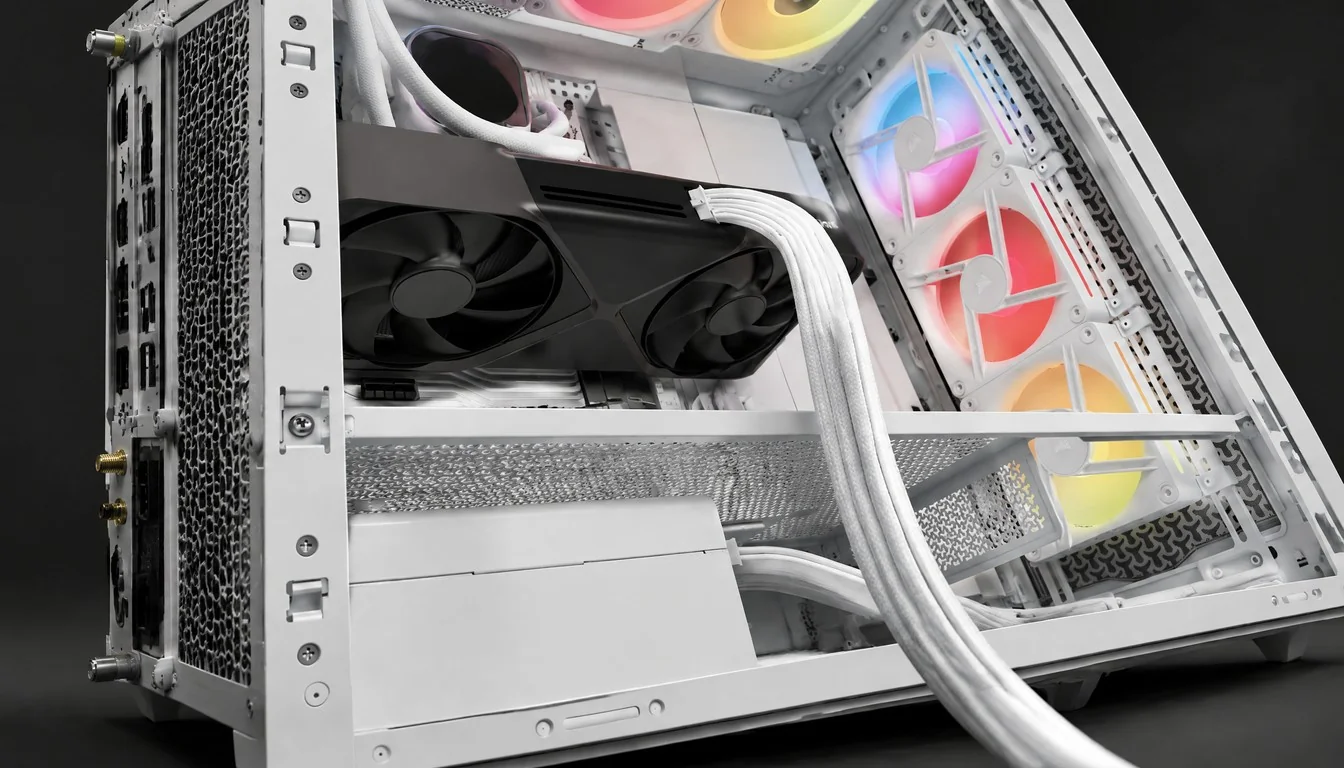
Corsair confirmed on October 21, 2026 that it has launched the RM1200e, a 1200 watt power supply built around a new safeguard the company calls PinProtect. The feature adds per-pin overcurrent protection (OCP) to the unit’s 12V-2×6 GPU power connector, monitoring each individual power pin in real time rather than treating the connector as a single current path. Corsair’s product page lists the RM1200e at $234.99.
The launch lands at a moment when GPU power connectors are under more scrutiny than at almost any point in the PC hardware market’s recent history. High end graphics cards now routinely draw several hundred watts through a single connector, and hardware outlets including TechPowerUp have spent much of 2026 documenting connector failures on flagship cards. Corsair’s pitch with PinProtect is straightforward: catch an unsafe current spike on a single pin before it turns into a melted connector, a damaged graphics card, or a warranty dispute.
Don't miss new tech stories on Google
Add TrendinTech once in the Google app and our stories appear in your news suggestions.
What Corsair Announced on October 21
The Corsair RM1200e is a fully modular ATX power supply rated at 1200 watts and certified 80 PLUS Gold for efficiency. It complies with the ATX 3.0 and PCIe 5.1 standards and ships with a PCIe 5.1 12V-2×6 cable included in the box, so builders do not need to source a separate adapter for current generation graphics cards. Corsair lists the unit in both black and white finishes, and backs it with a ten year warranty, a figure that signals how much confidence the company is putting behind the new protection circuitry.
The headline addition is PinProtect, which Corsair built specifically into the 12V-2×6 connector that feeds power-hungry GPUs. Rather than measuring only the total current flowing to the graphics card, PinProtect watches each individual pin on that connector and can intervene if one pin, rather than the connector as a whole, starts carrying more current than it should. The RM1200e also keeps Corsair’s Zero RPM cooling mode, which lets the fan stay off at low and moderate loads to keep noise down during typical gaming sessions.
Corsair has not published a dated, named executive quote alongside the launch, so the company’s public explanation of PinProtect comes from its own technical documentation rather than a press statement attributed to a specific spokesperson. That documentation describes the feature in plain terms: “This technology is built into the power supply and monitors current on the 12V-2×6 port on a per-pin basis,” Corsair wrote in its guidance comparing overcurrent and over-temperature protection.
How PinProtect’s Per-Pin Overcurrent Protection Works
Conventional overcurrent protection on a power supply tends to work at the rail or connector level. It adds up the current flowing through a 12V-2×6 connector and shuts things down once the total crosses a preset limit. The problem that has made headlines across the PC hardware press in 2026 is that a connector can fail even when the total current looks fine on paper, because the load is not shared evenly across all six power pins. One or two pins can carry a disproportionate share of the current, heat up well beyond the others, and start melting the connector housing long before the aggregate reading trips a conventional limit.
PinProtect is Corsair’s answer to that uneven-load scenario. Per the company’s own description, the feature monitors each individual GPU power pin in real time and protects against excessive current on that specific pin, rather than waiting for the whole connector’s combined draw to look abnormal. Corsair describes the RM1200e as the power supply the company built PinProtect around, positioning the feature as a built-in response to exactly the kind of localized current imbalance that has been blamed for a string of connector failures on recent flagship GPUs.
Corsair RM1200e Specifications at a Glance
The table below collects the specifications Corsair has published for the RM1200e as of its October 21 launch.
| Specification | Corsair RM1200e Detail |
|---|---|
| Manufacturer | Corsair |
| Launch date | October 21, 2026 |
| Rated output | 1200 watts |
| Efficiency certification | 80 PLUS Gold |
| Standards compliance | ATX 3.0 and PCIe 5.1 |
| GPU connector | 12V-2×6, cable included |
| GPU overcurrent protection | PinProtect per-pin OCP |
| Modularity | Fully modular |
| Cooling | Zero RPM mode |
| Warranty | 10 years |
| Colors | Black, white |
| Listed price | $234.99 |
Corsair lists the white version of the RM1200e on its regional storefronts, including its Korean product listing, alongside the standard black finish sold in other markets.
Why GPU Power Connectors Became a Flash Point
PinProtect did not appear in a vacuum. The 12V-2×6 connector exists to feed graphics cards that draw hundreds of watts through a single plug, and as GPU power budgets have climbed, so has scrutiny of whether that single connector can reliably carry the load. TechPowerUp reported in September 2026 that testers at Hardware Unboxed experienced a melted power connector on an RTX 5090 during testing, with cable temperatures reportedly reaching as high as 175 degrees Celsius. The same outlet reported a separate incident days later in which a DLSS stress test ended with a melted connector after power reportedly shot past 600 watts, and later that month reported that PNY had denied a warranty claim tied to a melted connector, reportedly arguing that native PSU cables were not covered.
Those reports, hedged as they are, line up with a broader pattern that has followed Nvidia’s highest end cards. Corsair’s own decision to pull the standard RTX 5080 and RTX 4090 class cards into a discussion of connector safety is not a coincidence. Even as Nvidia has reportedly discontinued the standard RTX 5090 in favor of its RTX Pro successors, the installed base of 500 to 600 watt graphics cards already in builders’ systems is large, and every one of those cards still depends on a 12V-2×6 connector that has repeatedly made hardware news for the wrong reasons. A power supply that can isolate a current problem on one pin before it spreads has an obvious appeal to anyone who has watched those reports pile up.
What Reviewers and Corsair Are Saying About PinProtect
Corsair’s own technical writing frames PinProtect as a feature built specifically for the RM1200e. Earlier in 2026, before the October launch, the company’s documentation stated plainly: “The upcoming RM1200e is the first power supply to feature PinProtect.” That framing has carried through to the product’s October 21 release, where PinProtect remains the RM1200e’s signature addition rather than a feature spread across Corsair’s wider lineup.
Independent reviewers have focused on the same mechanism. KitGuru, a PC hardware review publication, described PinProtect in its coverage of the power supply as “one of the key new features” of the unit, writing that it is “designed to offer an additional layer of protection for modern graphics cards using the 12V-2×6 power connector.” KitGuru went further on the technical mechanics, writing that “PinProtect continuously monitors the current flowing through each individual 12V power pin, rather than simply measuring the total power being delivered to the graphics card.” Hardware Busters, a review outlet focused specifically on power supplies, summarized the shift this way in its own review: “The main change from the first RM1200e is the native 12V-2×6 socket with per-pin overcurrent protection.”
Taken together, those independent accounts corroborate Corsair’s own description: PinProtect is not a rebranding of a feature that already existed across the RMe lineup. It is a specific, per-pin monitoring circuit that reviewers consistently tie to the RM1200e and to the 12V-2×6 connector problem described above.
How PinProtect Compares to Other GPU Protection Approaches
PinProtect is not the only tool the PC hardware industry has thrown at connector safety. The table below lays out how Corsair’s approach sits alongside the other protection methods builders already encounter, without claiming any specific rival product matches PinProtect’s per-pin granularity, since no competing power supply vendor has published that level of detail to date.
| Protection Approach | What It Monitors | Granularity | Main Limitation |
|---|---|---|---|
| Standard connector-level OCP | Total current on the whole 12V-2×6 connector | Connector-wide | Can miss an imbalance on a single pin |
| GPU vendor power telemetry | Total board power draw reported in software | Card-wide | Relies on software polling, not instant hardware response |
| Cable-level thermal protection | Temperature of the cable or connector housing | Cable segment | Reacts to heat buildup rather than the current spike causing it |
| Corsair PinProtect | Current on each individual 12V-2×6 power pin | Per-pin | Currently limited to the RM1200e |
| Manual visual inspection | Discoloration or deformation of connectors | User-dependent | Only catches damage after it has already occurred |
The comparison shows why PinProtect has attracted attention beyond the usual power supply refresh cycle. Most of the protection mechanisms already in the market either look at the connector in aggregate or react to heat after a problem has already started. Catching an imbalance at the individual pin level, before it becomes a thermal event, is a meaningfully different approach rather than a marketing repackaging of existing overcurrent protection.
Where the RM1200e Fits in Corsair’s Power Supply Lineup
Corsair positions the RM1200e as the flagship of its RMe series, aimed at builders running the kind of high wattage graphics cards that need a full 1200 watts of headroom and ATX 3.0 and PCIe 5.1 compliance. The fully modular cable set, the 80 PLUS Gold efficiency rating, and the Zero RPM cooling mode all slot the RM1200e alongside other high end enthusiast power supplies, but PinProtect is currently the differentiator that sets it apart, since Corsair has not extended that specific feature to its lower wattage units.
That positioning matters for anyone pairing the RM1200e with a current generation build. A 1200 watt supply with headroom to spare is the kind of component builders pick for systems that pair a flagship GPU with a high core count CPU, such as the enthusiast class chips Corsair’s own customer base tends to run, including processors in the mold of the Ryzen 9850X3D and Core Ultra 9 285K generation that currently anchor high end gaming builds. Builders assembling those systems around a motherboard that supports the latest platform updates, including boards tracking upcoming BIOS support for next generation Intel platforms, are exactly the audience Corsair is targeting with a $234.99 power supply built around GPU safety.
A Short History of GPU Power Safety Features
Power supplies have carried some form of overcurrent protection for as long as ATX has existed, but that protection was historically designed around the PSU’s own rails rather than the specific demands of a single graphics card. As GPUs grew from drawing tens of watts to several hundred watts through dedicated connectors, the industry introduced higher capacity connector standards specifically to keep up, moving toward the current 12V-2×6 design used across modern high wattage cards.
What has changed more recently is where the industry’s attention has shifted. Instead of only widening the connector’s current capacity on paper, PSU makers are now being pushed to prove that the protection circuitry inside the box can actually respond to uneven loads on individual pins in real time. PinProtect is Corsair’s entry into that newer phase of the conversation, arriving specifically after a run of publicized connector failures rather than as a routine, scheduled spec bump.
Market Impact: What This Means for PC Builders and Retailers
For PC builders shopping in the $200 to $250 power supply bracket, the RM1200e gives Corsair a tangible answer to a safety question that has become part of the buying conversation around every high wattage GPU purchase. A seven year warranty paired with a feature explicitly built to catch the kind of fault pattern that has shown up in melted-connector reports is a stronger pitch than efficiency certification alone, which has become table stakes across the segment.
The timing also lines up with a broader hardware category where power delivery has become a bottleneck story in its own right. The same concerns about GPU power draw and connector reliability that surround gaming cards are showing up in AI focused desktop hardware too, including compact systems like Nvidia’s RTX Spark line of AI PCs, where sustained high current draw in a small chassis raises similar questions about margin for error. Component pricing across the GPU memory market, where AMD and Nvidia have moved in different directions on GDDR pricing, is also pushing builders to think harder about protecting the expensive components they already own rather than assuming a replacement is a minor expense. Retailers selling the RM1200e alongside flagship GPUs have an easier upsell story than they did a year ago, and that is reflected in how quickly the unit has become a talking point across the hardware press covered in outlets like TechPowerUp and Wccftech.
The Business Case Behind Corsair’s Pin-Level Bet
Corsair’s decision to build PinProtect specifically into its flagship 1200 watt unit, rather than spreading a watered down version across its entire RMe range immediately, reads as a deliberate way to protect margin while it proves the feature out. Enthusiast buyers paying for a top of the stack power supply are also the buyers most likely to run the highest wattage graphics cards most exposed to connector stress, so concentrating the feature there targets the segment of the market where a failure is most expensive and most likely to generate a public complaint.
It also gives Corsair a differentiated story at a moment when efficiency certifications and modular cabling have become standard across every serious competitor’s lineup. A seven year warranty tied to a specific, explainable safety mechanism is harder for a rival PSU brand to match overnight than a marginal efficiency improvement, which gives Corsair a window to establish PinProtect as a recognizable feature before competitors can respond with their own version.
What Remains Unconfirmed About the RM1200e Rollout
Several details around the RM1200e’s rollout have not been confirmed through Corsair’s official channels as of this writing. The company has not published additional launch pricing beyond the $234.99 figure on its own product page, nor has it detailed regional availability timelines beyond the October 21 launch date. No individual Corsair spokesperson has been named in connection with the announcement, and Corsair has not confirmed whether PinProtect will expand to other models in the RMe series or remain exclusive to the RM1200e. Readers should treat any claim about a wider PinProtect rollout, additional SKUs, or a specific shipping window as unconfirmed until Corsair states it directly.
5 Predictions for GPU Power Protection in 2027
The RM1200e launch is unlikely to be the last word on connector safety in the power supply market. Based on how the category has moved over the past year, a few directions look likely heading into 2027.
- Expect rival PSU vendors to announce their own version of per-pin or per-rail GPU monitoring within the next one to two product cycles, following Corsair’s lead rather than waiting for a standards body to mandate it.
- Expect independent reviewers, including the outlets already covering melted connector incidents, to build dedicated stress tests specifically designed to trigger and verify PinProtect’s real-world trip behavior.
- Expect PSU warranty terms across the industry to spell out connector-related failures more explicitly, following the pattern of disputed claims already reported around high wattage GPUs.
- Expect Corsair to face pressure, including from its own customer base, to extend PinProtect-style protection down into lower wattage RMe and RMx tiers if the RM1200e’s reception is positive.
- Expect connector failures to keep happening even as protection improves, since a large installed base of older power supplies without per-pin monitoring will remain in service for years.
Should You Buy the Corsair RM1200e for Your Next Build
The Corsair RM1200e makes the most sense for builders running, or planning to run, a high wattage graphics card that depends on the 12V-2×6 connector, where the combination of 1200 watts of headroom, 80 PLUS Gold efficiency, and PinProtect’s per-pin monitoring directly addresses the failure pattern that has worried GPU owners through 2026. At $234.99 with a ten year warranty, it is priced as a premium option rather than a budget pick, and builders running lower wattage cards that do not stress the 12V-2×6 connector in the same way may not need to pay the premium PinProtect carries.
For anyone assembling a system around current generation hardware covered across the broader hardware category, the RM1200e is worth weighing specifically against the risk profile of the GPU going into the build, rather than treated as a universal upgrade every PC needs.
Frequently Asked Questions
What is Corsair PinProtect?
PinProtect is a per-pin overcurrent protection feature built into the Corsair RM1200e’s 12V-2×6 GPU power connector. It monitors each individual power pin in real time and protects against excessive current on that pin rather than only measuring the connector’s total current.
When did the Corsair RM1200e launch?
Corsair launched the RM1200e on October 21, 2026.
How much does the Corsair RM1200e cost?
Corsair lists the RM1200e at $234.99 on its official product page.
What efficiency rating does the RM1200e have?
The RM1200e carries an 80 PLUS Gold efficiency certification.
Does the RM1200e support PCIe 5.1 and ATX 3.0?
Yes. The RM1200e complies with the ATX 3.0 and PCIe 5.1 standards and ships with a PCIe 5.1 12V-2×6 cable included.
What colors does the RM1200e come in?
Corsair offers the RM1200e in black and white finishes.
How long is the warranty on the RM1200e?
Corsair backs the RM1200e with a seven year warranty.
Does PinProtect require any manual setup?
No. Corsair’s own documentation describes PinProtect as built into the power supply and monitoring current automatically, without requiring the user to configure anything.
Related Coverage
Owen Castellanos
Owen Castellanos is the Hardware & Gaming Reporter at TrendinTech, where he tests graphics cards, processors, consoles and peripherals and follows the games industry, from the major publishers to independent studios. He writes for readers who want to know whether a product is worth the money, and he is not shy about saying when it is not.
All stories by Owen Castellanos (416)