Windows Handhelds Catch SteamOS: $1,299 Battery Test [2026]


ASUS’s new anniversary edition handheld runs Windows 11 and Xbox Game Pass Ultimate rather than SteamOS, and it launched at $1,299 on October 15, 2026, with a 7.4 inch OLED panel, a Ryzen AI Z2 Extreme chip and an 80 watt hour battery cell. Ireland shoppers weighing it against Valve’s Linux based handheld need to look past storage upgrade paths, Proton compatibility, launcher access and real retail pricing rather than just raw frame rates.
The device is the ROG Xbox Ally X20, ASUS’s 20th anniversary take on the ROG Xbox Ally X that launched a year earlier at $999.99. IGN confirmed orders began shipping shortly after the October 15 reveal, and within days ASUS.com and Best Buy listings for the X20 and its $2,499 bundle both sold out, according to Windows Central. Meanwhile Valve’s Steam Deck OLED, the handheld that effectively created this category, keeps selling quietly in the background on a three year old chassis with no confirmed successor in sight. The question for anyone in Ireland shopping for a gaming handheld this winter is not just which device is faster. It is which operating system, storefront and price bracket actually fits how they play.
Don't miss new tech stories on Google
Add TrendinTech Ireland once in the Google app and our stories appear in your news suggestions.
What Changed on October 15, 2026: The ROG Xbox Ally X20
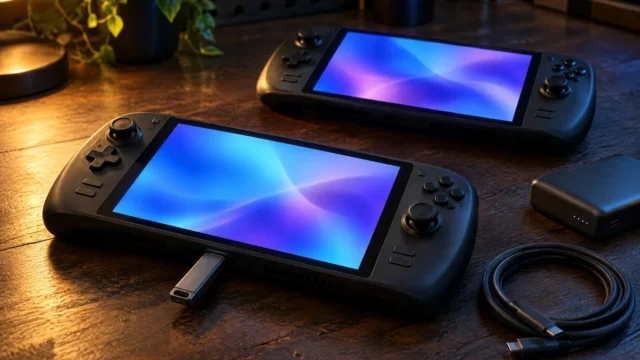
ASUS announced the ROG Xbox Ally X20 as a 20th anniversary edition of its Xbox branded handheld line, built on an AMD Ryzen AI Z2 Extreme processor, 24GB of LPDDR5X memory and a 1TB SSD. The headline upgrade is the display: a 7.4 inch ROG Nebula HDR OLED panel with an anti reflective coating ASUS says cuts environmental glare by 65 percent compared with a standard OLED screen. ASUS’s own listing also highlights a reworked analogue stick algorithm with a tighter 3 percent deadzone and millimeter level precision, plus a “Default Game Profile 2.0” system for saving per game performance settings.
The standalone X20 costs $1,299 in the United States. ASUS also sells a $2,499 bundle that throws in a pair of ROG XREAL R1 Edition 20 gaming AR glasses, a custom dbrand Killswitch case and a Pelican Protector Case, aimed squarely at collectors rather than value shoppers. Battery capacity is rated at 80 watt hours, and ASUS says a 100W charger can take the X20 from 0 to 50 percent in 30 minutes, even while a demanding game keeps running. The handheld ships with a USB4 Type-C port that is Thunderbolt 4 compatible and DisplayPort 2.1 capable, alongside a second USB 3.2 Gen 2 Type-C port, so docking to a monitor or TV is a one cable job either way.
The anniversary framing is not just marketing fluff. ASUS is treating the X20 as a showcase for the ROG brand’s 20th year rather than a mainline refresh, which explains why it sits above the existing Ally X in price instead of replacing it outright. That distinction matters for anyone trying to decide whether to wait for a cheaper, more mainstream successor: based on everything ASUS has published so far, there is no indication the X20 is a preview of where regular Ally pricing is heading. It reads more like a limited run flagship built to sell out fast and generate headlines, which is exactly what happened within days of launch.
Importantly, the X20 is not a replacement for anything. ASUS confirmed the original ROG Xbox Ally X keeps selling at its $999.99 price, and the base ROG Xbox Ally remains available at $599.99. The X20 slots in above both as a premium option, which means Irish shoppers actually have three current ASUS handhelds to choose between, not one. ASUS has not published an official Irish list price for the X20 as this piece went live on October 20, 2026, so anyone buying before an Irish launch price appears should budget around the US figure plus currency conversion and VAT, not assume parity with euro pricing on the older Ally X.
Steam Deck OLED in Late 2026: Valve’s Steady Hand
Valve’s Steam Deck OLED has not changed hardware generation since its November 16, 2023 launch, and nothing in Valve’s own channels confirms a next generation Steam Deck as of October 20, 2026. What has changed is software. Valve shipped a stable Steam Client update on October 13, 2026 adding a “Big Art Mode” display option, new screensavers and a string of fixes, while the parallel beta channel updated the desktop environment from KDE Plasma 6.4.3 to 6.7.3 and bumped the Linux kernel to version 7.2. A beta update on October 15 and 16 fixed a long standing pairing bug affecting the original 2015 Steam Controller, and Valve’s Steamworks developer notes show it expanded Steam Deck Verified performance data for developers on October 1, 2026.
Valve also continues iterating on streaming features: a July 29, 2026 beta added HDR Remote Play support, though an October update disabled HDR specifically when streaming from an OLED Steam Deck, and Steam Achievement Sets entered the client beta in October 2026. None of this touches the actual silicon inside the box, which is the point. SteamOS keeps getting incremental, free improvements on hardware Valve has not had to redesign in three years, and that stability is part of the pitch against a brand new, unproven anniversary edition from ASUS.
Stock has been the bigger story. A dedicated Steam Deck restock tracker, steamhardwarestock.com, recorded the device in stock in just 1 of the 31 countries Valve sells hardware in at its last check on October 20, 2026. Valve discontinued the original LCD Steam Deck on December 20, 2025, leaving the 512GB and 1TB OLED models as the only current configurations, and reported pricing after a May 27, 2026 adjustment put Irish retail listings at roughly €779 for the 512GB model and €919 for the 1TB model, though those figures come from retail trackers rather than a Valve Ireland storefront confirmation.
Specs Compared: ROG Xbox Ally X20 vs Steam Deck OLED vs Ally X
Here is how the newest ASUS handheld stacks up against both Valve’s Steam Deck OLED and its own direct predecessor, the standard ROG Xbox Ally X. Figures for the Steam Deck OLED’s processor, memory, display refresh rate and battery capacity come from a specifications comparison published by Pacific Brief, since Valve does not publish a full spec sheet update alongside its software notes.
| Spec | ROG Xbox Ally X20 | ROG Xbox Ally X (2025) | Steam Deck OLED |
|---|---|---|---|
| Release date | October 15, 2026 | October 16, 2025 | November 16, 2023 |
| Official US price (standalone) | $1,299 | $999.99 | Not published by Valve; tracked near $789 to $949 |
| Operating system | Windows 11, Xbox full screen experience | Windows 11, Xbox full screen experience | SteamOS (Linux based) |
| Processor | AMD Ryzen AI Z2 Extreme | Same Ryzen Z2 Extreme silicon, per Gizmodo’s teardown comparison | Custom AMD APU, 4 Zen 2 cores, 8 RDNA 2 compute units (Pacific Brief) |
| Memory | 24GB LPDDR5X, 8,000MHz | Up to 24GB LPDDR5X | 16GB LPDDR5 (Pacific Brief) |
| Storage | 1TB SSD | 1TB SSD configuration available | 512GB or 1TB SSD |
| Display | 7.4 inch ROG Nebula HDR OLED, 120Hz with VRR | 7 inch FHD IPS, 120Hz | 7.4 inch OLED, 90Hz (Pacific Brief) |
| Peak brightness | Up to 1,400 nits HDR peak, 600 nits typical (Gizmodo) | Not directly comparable, IPS panel | Not independently verified for this piece |
| Battery capacity | 80 watt hours | 80 watt hours | 50 watt hours (Pacific Brief) |
| Weight | 1.66 lb (Gizmodo) | 1.58 lb (Gizmodo) | Unchanged since 2023 launch |
| Fast charging | 100W adapter, 0 to 50% in 30 minutes | Comparable 65W to 100W charging support | 45W charger, no official fast charge claim found |
| Storefront access | Xbox Game Pass Ultimate, Battle.net, EA App, Ubisoft Connect, Steam via browser | Same storefront access | Steam native, other PC storefronts via Proton or third party layers |
| Security update support window | 5 years, through 2030 | 5 years, through 2030 | No fixed end date published; SteamOS updated continuously since 2022 |
The table makes one thing obvious: on paper, the ROG Xbox Ally X20 and the year old ROG Xbox Ally X share almost the same core silicon. The X20’s real upgrades are the OLED screen, the anti reflective coating, the anniversary styling and a handful of software refinements, not a generational leap in processing power. That matters a lot once you look at what reviewers actually measured rather than what ASUS advertised.
Ireland Pricing: What’s Confirmed and What Is Still a Retailer Guess
The only pricing that can be stated as fact right now comes directly from ASUS and from Valve’s own US storefront history. Everything involving euro figures for either device in Ireland is, as of October 20, 2026, reported by third party retailers and trackers rather than confirmed by ASUS Ireland or Valve’s EU storefront for the newest model.
| Product | Official US price | Reported Ireland status |
|---|---|---|
| ROG Xbox Ally X20 (standalone) | $1,299 | No official ASUS Ireland price published; sold out in the US within days of launch |
| ROG Xbox Ally X20 bundle (XREAL R1 glasses, dbrand case, Pelican case) | $2,499 | Not offered in Ireland as of publication |
| ROG Xbox Ally X (2025, predecessor) | $999.99 | Irish retailers have reportedly listed the 1TB model near €1,099, unconfirmed by ASUS |
| ROG Xbox Ally (base, 2025) | $599.99 | Still sold at its original MSRP; not the focus of this comparison |
| Steam Deck OLED 512GB | Tracked near $789 by steamhardwarestock.com | Reportedly around €779 after Valve’s May 27, 2026 pricing update, per retail tracking |
| Steam Deck OLED 1TB | Tracked near $949 by steamhardwarestock.com | Reportedly around €919 after the same update, per retail tracking |
If the reported Irish figures hold, a Steam Deck OLED still undercuts even the three year old ROG Xbox Ally X by a meaningful margin, and it undercuts the new X20 by considerably more once currency conversion and Irish VAT are applied to that $1,299 US price. ASUS has priced the X20 as a premium, limited run anniversary product rather than a mainstream replacement, which is exactly how buyers should treat it until an Irish retailer confirms an in market price.
Battery Life and Charging: Bigger Cell, Unclear Runtime
ASUS confirms an 80 watt hour battery in the X20, which matches the cell already used in the standard Ally X, so this is not actually a battery upgrade over its direct predecessor. According to Pacific Brief’s specifications comparison, Valve’s Steam Deck OLED uses a smaller 50 watt hour cell, giving the Ally line a nominal capacity advantage on paper. What nobody, including ASUS, has published is a verified hour by hour runtime figure for the X20 under real gameplay, so a bigger battery does not automatically translate into longer sessions away from a charger.
Real world runtime on any Windows handheld depends heavily on background processes, the Xbox full screen shell, Windows Update checks and whichever game engine is running, all of which tend to draw more power than SteamOS’s leaner Linux based stack. ASUS’s quoted charging numbers are the clearest verified data point here: a 100W adapter brings the X20 from empty to half charge in 30 minutes, and the device can keep charging even while a demanding title is running without draining further. Until independent reviewers publish matched runtime tests for both devices on the same games at the same settings, the honest answer is that the X20’s larger relative capacity is a specification advantage, not a confirmed real world one.
Windows vs SteamOS: The Ecosystem Question That Actually Matters
This is where the two devices genuinely diverge, and it is a bigger factor than any frame rate chart. The ROG Xbox Ally X20 runs Windows 11 with an Xbox branded full screen shell layered over the top, giving it native access to Xbox Game Pass Ultimate, Battle.net, the EA App and Ubisoft Connect, alongside Steam itself through a browser install. The Steam Deck OLED runs SteamOS, Valve’s Linux based operating system, with the Steam library front and center and Proton translating most Windows only titles on the fly.
That breadth of storefront access on the ASUS side is real, but it comes with friction SteamOS mostly avoids. GamingBible’s review of the X20 described a recurring problem booting non Xbox titles through Windows’ PC gaming app: “Sometimes I’ll try launching a game on the Xbox PC app, and the system will hang up for a good 30 or 60 seconds.” That is the tradeoff in plain terms. SteamOS gives you one polished, console like interface built around one library, with everything else routed through Proton. Windows gives you every storefront at once, at the cost of a shell that is still, by GamingBible’s account, prone to stalls that a Deck owner simply never sees.
Readers who have already set up SteamOS on third party hardware will recognise the tradeoff from the other direction too. Our walkthrough of installing SteamOS 3.8 on supported third party handhelds covers exactly how much simpler the Valve controlled software stack is to live with once it is running, compared with managing a full Windows install on the same class of hardware.
Game Compatibility and Anti-Cheat: Where Windows Still Has an Edge
Native Windows support remains the deciding factor for a specific category of player: anyone chasing competitive multiplayer titles whose anti cheat systems are built around kernel level Windows drivers. Proton has closed most of the single player and co-op compatibility gap over the past few years, but some anti cheat vendors still either block Linux entirely or require publishers to opt in to Proton support game by game, which means SteamOS compatibility for any individual competitive title can change without warning. A Windows handheld like the X20 or the standard Ally X sidesteps that uncertainty completely, because it is running the exact operating system every anti cheat vendor builds for first.
That advantage narrows the moment you are talking about single player, story driven or older multiplayer titles with no kernel level anti cheat, where Proton’s compatibility layer is mature enough that most Steam Deck owners never notice they are not running native Windows. The practical takeaway: if your library leans toward live service shooters with strict anti cheat, budget for a Windows handheld. If it leans toward single player RPGs, platformers, strategy games or older multiplayer titles, SteamOS will almost certainly run them without drama.
Benchmarks: What Reviewers Actually Measured on the X20
Two outlets ran the X20 through real game testing shortly after launch, and their numbers tell a more nuanced story than ASUS’s marketing. Gizmodo’s review ran 3DMark Steel Nomad and found the X20 scored only about 3 percent higher than the original 2025 Ally X, concluding plainly that “the updated handheld is running on the same AMD Ryzen Z2 Extreme APU…functionally the same as the original from 2025.” In Gears of War: E-Day, Gizmodo measured roughly 16fps at max 1080p settings without upscaling, rising to around 35fps average with upscaling enabled, though frame rates still dipped into the high 20s in places. Star Wars: Galactic Racer stayed above 30fps at high settings with upscaling turned on, but also dropped into the 20s during busier third person sections. Gizmodo also noted that in Forza Horizon 6 and Cyberpunk 2077, a rival handheld, the MSI Claw, ran nearly 40 percent faster than the X20, a reminder that ASUS’s anniversary edition is not automatically the fastest machine in its own price bracket.
GamingBible’s testing painted a rosier picture in different titles: Middle-earth: Shadow of War ran between 80 and 90fps, and Dishonored held a consistent 90 to 100fps. Cyberpunk 2077 hit 60fps once GamingBible dropped to a reduced “Steam Deck” style preset, a telling detail in itself given the game being referenced in a Windows handheld review. 007 First Light mostly held around 40fps with dips into the low 30s during intense sequences, and The Blood of Dawnwalker fluctuated between 30 and 40fps depending on combat load. GamingBible’s overall verdict was blunt: it called the X20’s processor power, storage capacity, screen size and battery capacity enough that “the X20 outclasses the Steam Deck in every way.” That conclusion sits in direct tension with Gizmodo’s 3 percent benchmark delta over the 2025 Ally X, and both reviews are worth reading before assuming either verdict settles the argument on its own.
| Game | Reported result on ROG Xbox Ally X20 | Source |
|---|---|---|
| Middle-earth: Shadow of War | 80 to 90fps | GamingBible |
| Dishonored | 90 to 100fps | GamingBible |
| Cyberpunk 2077 (reduced preset) | 60fps | GamingBible |
| 007 First Light | Around 40fps, dips to low 30s | GamingBible |
| The Blood of Dawnwalker | 30 to 40fps, fluctuating | GamingBible |
| Gears of War: E-Day (max settings, no upscaling) | Around 16fps | Gizmodo |
| Gears of War: E-Day (with upscaling) | Around 35fps average | Gizmodo |
| Star Wars: Galactic Racer (upscaling, high settings) | 30fps or higher, dips to 20s | Gizmodo |
| 3DMark Steel Nomad vs 2025 Ally X | Approximately 3 percent higher | Gizmodo |
No outlet in our research published a matched, same settings benchmark comparing the X20 directly against Steam Deck OLED frame rates, which is itself useful context: anyone citing a precise X20 versus Steam Deck OLED frame rate chart for these exact titles should be treated with some skepticism until a reviewer publishes one running both devices side by side under identical conditions.
Storage and Upgrade Paths
Every configuration ASUS sells of the X20 ships with a 1TB SSD as standard, matching the top tier Ally X configuration from 2025. Valve splits the Steam Deck OLED into 512GB and 1TB tiers, so buyers choosing the smaller Deck need to be more deliberate about which games stay installed versus which get removed and redownloaded as needed. Modern AAA titles routinely run past 100GB with day one patches, so the gap between a fixed 512GB drive and a 1TB drive is no longer a marginal consideration for either platform.
Neither ASUS’s official X20 materials nor Valve’s current Steam Deck OLED documentation that we reviewed specify external storage expansion details precisely enough to publish exact card compatibility figures here, so anyone planning to rely on expandable storage on either device should confirm current specifications directly with ASUS or Valve before buying based on that assumption alone.
The practical difference shows up fastest in how each platform handles a crowded library. SteamOS surfaces per game Steam Deck Verified ratings and storage footprint estimates before you install anything, which makes triage easier on a 512GB unit. Windows offers no equivalent unified view across Game Pass, Battle.net, the EA App and Ubisoft Connect, so X20 owners juggling several storefronts have to manually track how much of that 1TB drive each launcher is quietly consuming, particularly once shader caches and launcher overhead from four separate storefront clients are added on top of the games themselves.
Display, Design and Controls
Both handhelds now use 7.4 inch OLED panels, which is itself notable: ASUS grew the Ally line’s screen from 7 inches on the standard Ally X to 7.4 inches on the X20, bringing it in line with the size Valve settled on for the Steam Deck OLED back in 2023. ASUS’s panel runs at 120Hz with variable refresh rate support, according to Gizmodo’s testing, with brightness up to 600 nits typical and 1,400 nits at HDR peak, while Pacific Brief lists the Steam Deck OLED’s panel at a 90Hz refresh rate. ASUS also highlights its anti reflective coating, claimed to cut environmental glare by 65 percent compared with an uncoated OLED screen, which should help visibility in bright rooms or outdoor use regardless of which device you are holding.
On the design side, the X20 ships in what ASUS describes as a translucent black and gold anniversary chassis, distinct from the more utilitarian black finish on the standard Ally X and base Ally. Gizmodo measured the X20 at 1.66 pounds against 1.58 pounds for the original Ally X, a small but noticeable increase likely tied to the larger battery and reworked internals. ASUS also promotes a reworked analogue stick setup with a tighter 3 percent deadzone and what it calls millimeter level precision, paired with the Default Game Profile 2.0 system for saving tuned per game control and performance profiles.
Docking, Accessories and Desktop Mode
ASUS announced a new ROG Bulwark Dock DG310 accessory on October 16, 2026, built to pair with the Ally line’s Thunderbolt 4 compatible USB4 port, which also carries DisplayPort 2.1 output. That combination means the X20 can realistically function as a desktop replacement when docked to a monitor, keyboard and mouse, running the same Windows desktop most PC owners already know, rather than a stripped down console style interface. Valve offers its own official dock for the Steam Deck line, and SteamOS’s desktop mode gives similar monitor and peripheral support, but it is built around KDE Plasma rather than full Windows, which means desktop grade productivity software support leans toward whatever runs on Linux or through a compatibility layer.
Anyone planning to dock either handheld for serious desktop work, rather than just casual streaming to a TV, should weigh that difference carefully. A Windows handheld docked at a desk behaves like a genuine, if modestly powered, Windows PC. For readers specifically comparing discrete desktop GPU performance against what these handhelds can manage docked, our RTX 5070 versus RX 9070 Ireland pricing comparison is a useful reality check on just how much more raw graphics power a proper desktop card still delivers over any handheld APU.
Software Roadmap: What’s Coming Next for Both Platforms
AMD confirmed that FSR Upscaling 4.1 is arriving as a preview update on October 23, 2026 for both the standard ROG Xbox Ally X and the new X20, which should meaningfully help frame rates in supported titles without ASUS needing to change any hardware. On the Xbox side, Microsoft also announced a Nano Controller on October 14, 2026, a smaller, lower priced controller slated to reach Ireland in November 2026, rounding out the accessory ecosystem around the Ally line. Xbox’s Game Pass lineup keeps expanding too, with its October 2026 wave 1 update adding titles including Battlefield 6, Valor Mortis and Neon Abyss 2, all playable directly on the X20 through Game Pass Ultimate.
Valve’s roadmap for Steam Deck OLED stays focused on client polish rather than new hardware. Beyond the Big Art Mode and Achievement Sets beta features already mentioned, Valve’s Steamworks developer documentation shows it is actively expanding the pool of community submitted Steam Deck Verified performance data, which helps shoppers judge compatibility and expected frame rates before buying a specific game for the handheld. Reports have also circulated about a revived Steam Controller returning to sale and a separate Steam Machine console style product from Valve during 2026, though neither has an official Valve confirmation tying it directly to Steam Deck OLED’s own roadmap, so treat those as adjacent product news rather than Deck specific updates.
It is also worth noting that the X20 launched into a period of visible change inside Xbox itself. Xbox published a post titled “Continuing Our Reset” on September 22, 2026, authored by Matt Booty, followed on October 8, 2026 by an announcement of new leadership appointments and changes to the Xbox division structure. Neither post spells out a direct line to Ally hardware pricing or strategy, but both confirm that Xbox’s wider organisation was actively repositioning itself around the time the X20 shipped, alongside the October 14, 2026 Xbox Nano Controller announcement and a continuing stream of Game Pass additions. Buyers weighing a long term bet on the Xbox branded handheld ecosystem should keep that organisational backdrop in mind rather than assuming the current hardware and software roadmap is fixed in stone.
Five Real-World Use Cases: Which Handheld Fits Your Habits
Specs and benchmarks only matter in the context of how you actually play. Here is how the tradeoffs break down for specific types of buyers in Ireland.
- The Game Pass subscriber: if you already pay for Xbox Game Pass Ultimate and want its full library, including day one releases like Battlefield 6, running natively without a workaround, the ROG Xbox Ally X20 or the cheaper standard Ally X are the only sensible choices.
- The competitive multiplayer player: titles that rely on kernel level anti cheat still favour native Windows. A Windows handheld avoids the compatibility uncertainty that can affect specific titles running through Proton on SteamOS.
- The budget conscious buyer: with Steam Deck OLED reportedly priced hundreds of euro below even the standard Ally X, let alone the $1,299 X20, Valve’s handheld remains the value pick for anyone whose library is Steam native.
- The desktop dock user: anyone wanting to dock their handheld and get a genuine Windows desktop experience for productivity as well as gaming should lean toward the X20 and its Thunderbolt 4 compatible port paired with the new ROG Bulwark Dock DG310.
- The collector or early adopter: the X20’s anniversary chassis, bundled AR glasses option and premium accessories make sense only for buyers who specifically want ASUS’s newest hardware regardless of the thin performance gap over the 2025 Ally X that Gizmodo measured.
Readers who want a lower cost entry point into handheld gaming entirely, rather than choosing between these two premium devices, may also want to look at budget focused alternatives like our coverage of the AYANEO KONKR Pocket BLOCK setup, which sits well under either the Ally X20 or Steam Deck OLED on price.
Switching Guide: Moving Between a Windows Handheld and SteamOS
If you are migrating from one ecosystem to the other rather than buying your first handheld, the process is more about accounts and libraries than hardware. Here is a practical walkthrough for each direction.
Moving from Steam Deck OLED to a ROG Xbox Ally (X or X20)
- Sign into Steam Cloud on the new device first, since most Steam titles will sync saves automatically once installed, avoiding the need to manually copy save files.
- Install the Xbox app and sign into Game Pass Ultimate if you plan to use it, since that library sits entirely outside Steam and needs its own setup.
- Install the EA App, Battle.net and Ubisoft Connect separately for any non Steam titles in your existing library, then re-download rather than transfer those installs.
- Recreate your Steam Deck control layouts using ASUS’s Armoury Crate SE software and save them with Default Game Profile 2.0 so per game settings persist.
- Check storage headroom before reinstalling your heaviest games. A 1TB drive fills up fast once several 100GB plus AAA titles with day one patches are installed.
- Pair any accessories, including a dock like the ROG Bulwark Dock DG310, and update Windows fully before your first long play session to avoid mid game update interruptions.
Moving from a ROG Xbox Ally to Steam Deck OLED
- Confirm which non Steam titles you rely on have confirmed Proton compatibility before assuming they will run, particularly competitive multiplayer games with strict anti cheat.
- Install Steam and let Steam Cloud saves sync automatically for any titles you already owned and played on Windows.
- Set launch options or Proton versions per game where needed. Most popular titles run out of the box, but older or niche games sometimes need a specific Proton version selected manually.
- Update SteamOS fully before heavy use, since Valve ships frequent client and kernel updates, including the October 2026 Plasma and kernel bumps covered earlier in this piece.
- Rebuild your control and performance profiles inside SteamOS’s own per game settings menu, which works differently from ASUS’s Armoury Crate software.
Readers who want to go further and actually replace a Windows handheld’s operating system entirely rather than just switching devices can also follow our existing guide to installing Bazzite on ROG Ally hardware, which brings a SteamOS style experience to ASUS’s own machines for buyers who want Ally hardware without sticking with stock Windows.
Pros and Cons
ROG Xbox Ally X20
- Pros: widest storefront access of any handheld here, including Game Pass Ultimate, Battle.net, EA App and Ubisoft Connect; 1TB SSD standard; sharper, anti reflective 7.4 inch OLED display with VRR; Thunderbolt 4 compatible docking; 5 year security update commitment from ASUS.
- Cons: $1,299 price with no confirmed Irish listing yet; Gizmodo measured only a 3 percent performance gain over the 2025 Ally X it is meant to upgrade; GamingBible reported the Windows shell stalling for up to a minute when launching some games; sold out within days of its US launch, making availability a real concern.
Steam Deck OLED
- Pros: reportedly priced hundreds of euro below either ASUS handheld; SteamOS avoids the Windows app shell issues reviewers flagged on the X20; continuous free software improvements including Big Art Mode and Achievement Sets; Proton compatibility mature enough that most single player and co-op libraries run cleanly.
- Cons: smaller 50 watt hour battery per Pacific Brief’s figures; stock has been extremely tight, with only 1 of 31 tracked Valve markets showing availability at last check; some competitive multiplayer titles with strict anti cheat remain a gamble; no confirmed next generation hardware after three years on the same chassis.
The Verdict: Which Handheld Actually Wins in Ireland
Treat this as two separate decisions rather than one winner. For buyers whose library and habits are Steam centric, with little interest in Game Pass or competitive anti cheat titles, Steam Deck OLED remains the stronger buy on the evidence here: a confirmed three year software track record, reportedly lower pricing, and none of the Windows shell friction GamingBible documented on the X20. Gizmodo’s own benchmarks, showing only a 3 percent gain over the year old Ally X, undercut the idea that the X20 is a clear generational leap worth a $300 premium over its own predecessor, let alone over Steam Deck OLED’s reported pricing.
For buyers deep in the Xbox and PC storefront ecosystem, particularly anyone who wants Game Pass Ultimate, Battle.net or EA App titles running natively, or who plans to dock the handheld as a genuine desktop replacement, the Ally line remains the only option that makes sense, and the standard $999.99 Ally X is the more rational buy right now than the $1,299 X20 given how close Gizmodo’s benchmarks put them. The X20 earns its premium primarily through its OLED screen, anniversary design and accessory bundle, not through a meaningfully faster gaming experience. Buy the X20 specifically if that design and display upgrade matters to you and you can find a confirmed Irish listing. Otherwise, the standard Ally X or the Steam Deck OLED both deliver more value per euro today.
Readers who already covered the previous generation matchup can revisit our earlier frame rate focused comparison of the standard Ally X and Steam Deck OLED for the performance context that still largely applies to the X20 given how similar its underlying silicon is. For broader coverage of handheld and console hardware in Ireland, our gaming section tracks these launches as they happen.
Frequently Asked Questions
Is the ROG Xbox Ally X20 officially available to buy in Ireland?
ASUS has not published an official Irish list price for the X20 as of October 20, 2026. The standalone unit and its $2,499 bundle both sold out at ASUS.com and Best Buy in the US within days of the October 15 launch, according to Windows Central, so stock anywhere may be limited even once Irish pricing appears.
How much does the Steam Deck OLED cost in Ireland right now?
Retail trackers have reported prices of roughly €779 for the 512GB model and €919 for the 1TB model following a May 27, 2026 pricing update from Valve, though these figures come from retailer reporting rather than a confirmed Valve Ireland storefront listing.
Can the ROG Xbox Ally X20 run SteamOS instead of Windows?
Not officially. The X20 ships as a Windows 11 device with an Xbox full screen shell. Enthusiasts have previously installed SteamOS style alternatives like Bazzite on earlier ROG Ally hardware, but that is a community modification, not an ASUS supported configuration, and ASUS’s own materials do not describe the X20 as SteamOS compatible.
Is the ROG Xbox Ally X20 actually faster than the 2025 Ally X?
Barely, according to independent testing. Gizmodo’s 3DMark Steel Nomad benchmark put the X20 only about 3 percent ahead of the original Ally X, and both devices use the same AMD Ryzen Z2 Extreme APU. The X20’s real upgrades are its 7.4 inch OLED screen, anti reflective coating and anniversary design rather than raw processing power.
Does the ROG Xbox Ally X20 support Xbox Game Pass Ultimate?
Yes. As a Windows 11 device with an Xbox full screen shell, the X20 runs Game Pass Ultimate natively, including October 2026’s wave 1 additions such as Battlefield 6, Valor Mortis and Neon Abyss 2, alongside Battle.net, the EA App and Ubisoft Connect.
Which handheld has the better battery?
The ROG Xbox Ally X20 and the standard Ally X both use an 80 watt hour battery, versus 50 watt hours for Steam Deck OLED according to Pacific Brief’s specifications comparison. No outlet has yet published a verified, matched hour for hour runtime test, so the larger capacity is a specification advantage rather than a confirmed real world runtime figure.
Is Valve launching a new Steam Deck soon?
No official Valve announcement confirms a next generation Steam Deck as of October 20, 2026. The Steam Deck OLED, launched in November 2023, remains Valve’s current and newest released handheld, and ongoing reports about a successor remain unconfirmed rumours.
Which handheld is better for competitive multiplayer games?
Windows handhelds like the ROG Xbox Ally X20 and Ally X have the edge here, since some anti cheat systems used in competitive multiplayer titles either block Linux outright or require publisher opt in for Proton support on SteamOS. Single player and older multiplayer titles generally run fine on Steam Deck OLED through Proton.
Related Coverage
Eoin Mulcahy
Eoin Mulcahy is the Hardware & Gaming Reporter at TrendinTech, where he tests graphics cards, processors, consoles and peripherals and follows the games industry, from major publishers to the independent studios of Dublin, Galway and Cork. He writes for readers who want to know whether a product is worth the money, not whether it won the spec sheet.
All stories by Eoin Mulcahy (14)