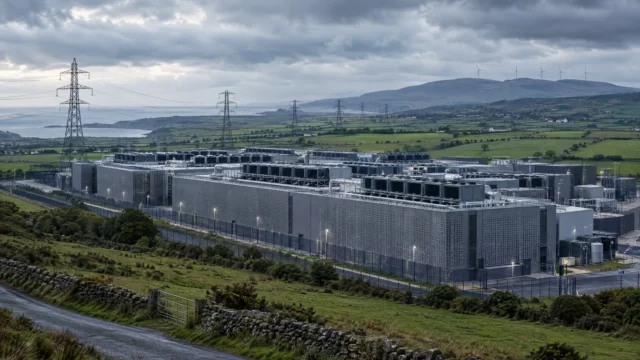
EirGrid Signals a Calmer Winter for Ireland’s Grid


Ireland’s grid operator has delivered its most reassuring winter message in years. EirGrid says the risk of insufficient generation to meet demand this winter is “now notably lower than it has been in recent years,” according to a report published by RTE on 20 October 2026. The forecast covers the peak winter period running from November 2026 to the beginning of April 2027, and it lands with a specific number attached: a buffer of more than 1,000MW now sits between expected supply and expected demand.
For a country that has spent the better part of a decade bracing for winter grid alerts, that is a meaningful shift in tone. EirGrid’s own probability modelling puts the expected risk of outages at just 0.8 hours this winter, down from 1.1 hours last winter, 3.6 hours the winter before that, and a startling 21 hours in the winter before that. The sections below cover down what the new figures actually mean, how they compare with EirGrid’s own published Winter Outlook 2025/26, and what is still uncertain about the headline 1,000MW buffer number.
Don't miss new tech stories on Google
Add TrendinTech Ireland once in the Google app and our stories appear in your news suggestions.
EirGrid Signals a Calmer Winter for Ireland’s Grid
EirGrid operates and develops Ireland’s electricity transmission grid, and every autumn it publishes a forecast of how tight the margin between supply and demand is likely to get once cold weather pushes consumption to its annual peak. This year’s message, as reported by RTE, is that adequate generation capacity is now in place and the overall outlook has improved compared with previous years.
That is a notable reversal in narrative. For several winters running, Irish households and businesses have been warned about the possibility of planned power cuts if a cold snap coincided with low wind output and unplanned plant outages. This year, EirGrid’s language has shifted from caution to relative confidence, built on a combination of new generation coming online, demand management tools, and emergency backup contracts that have been renewed and extended.
The Numbers Behind the Notably Lower Risk
The headline figure in the new forecast is a projected 0.8 hours of expected outage risk for the winter of 2026/27. That measure, known in grid planning as Loss of Load Expectation, estimates the average number of hours per winter during which demand could outstrip available supply if conditions align badly. It is not a prediction that outages will happen for 0.8 hours. It is a statistical expectation drawn from thousands of simulated weather and demand scenarios.
What makes the trend striking is the direction of travel over four winters. The table below sets out the reported sequence exactly as EirGrid presented it.
| Winter Period | Reported Loss of Load Expectation | Trend |
|---|---|---|
| 2023/24 (previous winter) | 21 hours | Peak risk year |
| 2024/25 (the winter before last) | 3.6 hours | Sharp improvement |
| 2025/26 (last winter) | 1.1 hours | Continued improvement |
| 2026/27 (this winter, forecast) | 0.8 hours | Lowest reported figure |
Read across those four winters, the risk measure has fallen by roughly 96 percent from its 21 hour peak to the 0.8 hours now forecast for 2026/27. That is the basis for EirGrid describing this winter’s risk as notably lower, and it is also the clearest evidence that whatever capacity additions and contractual backstops Ireland has put in place over the past three years are having a measurable effect on the numbers.
Where the Reported 1,000MW Buffer Comes From
The figure getting the most attention in coverage of this story is the buffer of more than 1,000MW that EirGrid is reported to have in place heading into winter. It is worth being precise about what is and is not confirmed here. The exact composition of that buffer, the date on which it was measured, and the specific plants or contracts that make it up have not been laid out in detail in the public reporting so far. What is confirmed is the direction: more spare capacity sits above expected peak demand than has been the case in recent winters.
That figure should be read alongside EirGrid’s own published Winter Outlook 2025/26 document, which covers the period from 3 November 2025 to 5 April 2026, one winter earlier than the forecast now being reported. In that official document, EirGrid put the minimum de-rated margin, essentially the cushion between available generation and forecast peak demand once planned and unplanned outages are accounted for, at a range of 688MW to 973MW. The newly reported buffer of over 1,000MW for the 2026/27 winter sits above the top end of that prior range, which is consistent with EirGrid’s own characterisation of the risk as improving further.
Inside EirGrid’s Official Winter Outlook 2025/26
EirGrid’s Winter Outlook 2025/26 is the most recent fully published document of this kind and it gives useful context for how the operator builds its margin calculations. The Loss of Load Expectation figure in that document was 1.1 hours, which lines up precisely with the “last winter” figure cited in the new 2026/27 forecast. That consistency between the officially published document and the figure now being quoted for the prior winter is a useful sanity check on the broader numbers being reported.
The 2025/26 outlook also detailed the additional out-of-market generation EirGrid had secured as a backstop beyond the ordinary electricity market. That included 750MW of Retained Existing Units and 649MW of Temporary Emergency Generation, according to the Commission for Regulation of Utilities. Combined, those two sources alone represent close to 1,400MW of emergency capacity sitting outside the normal market, which is a large part of why the modelled risk has kept falling even as electricity demand in Ireland continues to climb.
| Metric | Figure | Source |
|---|---|---|
| Loss of Load Expectation (2025/26) | 1.1 hours | EirGrid Winter Outlook 2025/26 |
| Minimum de-rated margin (2025/26) | 688MW to 973MW | EirGrid Winter Outlook 2025/26 |
| Retained Existing Units | 750MW | Commission for Regulation of Utilities |
| Temporary Emergency Generation | 649MW | Commission for Regulation of Utilities |
| Combined emergency backup capacity | Approximately 1,399MW | Calculated from the two figures above |
Retained Existing Units and Temporary Emergency Generation Explained
Two mechanisms do most of the heavy lifting behind EirGrid’s improved outlook, and both sit outside the normal wholesale electricity market.
Retained Existing Units
Retained Existing Units are older power stations that would otherwise have been retired or mothballed but have instead been kept available under contract specifically to support security of supply during peak winter periods. These units do not typically compete in the day-to-day electricity market. They exist as insurance, available to be called on when the margin between supply and demand gets tight.
Temporary Emergency Generation
Temporary Emergency Generation refers to short-term generation capacity, often diesel or gas powered mobile or modular units, contracted specifically to plug gaps while longer-term grid infrastructure and renewable capacity catches up with demand. The Commission for Regulation of Utilities directed EirGrid to retain these arrangements for the winters ahead specifically because forecast electricity capacity shortfalls remained a risk to security of supply, a decision that predates this latest, more positive forecast but clearly underpins it.
Why Previous Winters Were So Much Riskier
The 21 hour risk figure reported for the 2023/24 winter represents the high water mark of grid anxiety in Ireland in recent memory. That period followed years of rapid demand growth, driven heavily by data centre expansion, running up against a generation fleet that had not kept pace and a renewables build out that was still ramping up. EirGrid issued multiple amber and system alerts during that stretch, asking large energy users to reduce consumption at short notice and warning the public that planned outages were a real possibility during cold, low wind conditions.
The specific plants or generation events responsible for that elevated 21 hour figure have not been detailed in the current reporting, so it is worth being cautious about attributing it to any single cause. What is clear is that the subsequent three winters show a consistent, steep decline in modelled risk, which points to a combination of new capacity, demand side measures, and the emergency contracts discussed above working together rather than any single fix.
Data Centres and Ireland’s Demand Side Problem
No discussion of Irish grid capacity is complete without addressing data centres, which have become the single biggest driver of electricity demand growth in the country. Dublin’s data centre cluster alone now accounts for a substantial share of national electricity consumption, a trend covered in detail in TrendinTech’s reporting on the Irish data centre revolt and the growing local opposition to new builds.
That demand pressure has not gone away simply because this winter’s forecast has improved. Planning disputes over new facilities continue, including the rejection of the proposed Kilmeaden data centre in Waterford and the Supreme Court’s separate decision to uphold approval for a large data centre project near Ennis. Infrastructure contractors such as Ethos Engineering continue to report strong revenue growth tied directly to that data centre build out, which is itself a signal that demand side pressure on the grid is far from over even as this winter’s supply side risk eases.
Cloud providers operating in Ireland, compared in detail in TrendinTech’s AWS versus Azure versus GCP Ireland growth analysis, are among the largest individual electricity consumers connected to the grid. Their continued expansion plans are part of the reason EirGrid’s long-range planning documents still flag capacity as tight beyond this winter, even while the immediate 2026/27 outlook has improved.
How Ireland’s Approach Compares With Other European Grids
Ireland is not alone in leaning on emergency generation contracts to bridge a capacity gap while renewable build out and grid reinforcement catch up with demand. Grid operators across Europe, including Great Britain’s National Grid ESO, have used broadly similar tools, from capacity market auctions to winter contingency contracts, to manage tight margins during cold snaps. What sets Ireland apart is the scale of data centre driven demand growth relative to the size of its grid, which has made the margin between supply and demand proportionally tighter than in most comparable European markets.
Where Ireland differs most clearly is in the speed of its swing from crisis to relative stability. A fall from 21 hours of modelled risk to 0.8 hours across just three winters is a sharper improvement curve than most European grid operators have reported over the same period, reflecting both the scale of emergency intervention and the fact that Ireland’s risk had climbed from an unusually low base before the data centre boom began.
Historical Context: A Decade of Tightening Margins
Ireland’s current grid planning challenge traces back to roughly the mid 2010s, when a wave of data centre investment coincided with the closure or scaling back of several older fossil fuel power stations. EirGrid’s long-term adequacy assessments began flagging capacity shortfalls as early as the late 2010s, warning that the margin between generation and peak demand would fall below the required reliability standard without new investment.
Those warnings proved accurate. The winters between roughly 2021 and 2024 saw a string of system alerts and amber warnings as the predicted squeeze materialised, culminating in the 21 hour risk figure for 2023/24. The subsequent recovery, which has brought the figure down to 0.8 hours for 2026/27, reflects several years of emergency generation contracts, new gas and battery storage connections, and continued offshore and onshore wind additions working their way into the system. It is a reminder that grid adequacy is a slow moving problem that responds to sustained investment rather than any single policy announcement.
Market and Industry Reaction to the Improved Outlook
The improved forecast is likely to be welcomed by large energy users and businesses that depend on continuous power, from manufacturing plants to the cloud and software sector that has become so central to the Irish economy. A lower probability of system alerts reduces the chance that large industrial and data centre customers will be asked to curtail consumption at short notice during the coldest weeks of the year, a scenario that has disrupted operations in previous winters.
At the same time, the improved outlook is unlikely to ease the underlying planning tension around new data centre connections. Local authorities and residents who have opposed new facilities, including those behind the objections that led to the Kilmeaden refusal, are likely to continue pointing to the years of elevated risk as evidence that grid capacity should not be taken for granted when weighing new large scale electricity users against existing supply.
What Could Still Go Wrong This Winter
A Loss of Load Expectation of 0.8 hours is a statistical average across many simulated scenarios, not a guarantee. A severe cold spell that coincides with low wind output across the country, combined with unplanned outages at one or more large power stations, could still produce a period of tight margins even in a winter forecast to be comparatively calm. EirGrid’s own alert system exists precisely because these low probability, high impact scenarios remain possible.
There is also the question of how much of the reported 1,000MW buffer depends on contracted emergency generation continuing to perform as expected. Temporary Emergency Generation units, by their nature, are not always held to the same long-term reliability standards as permanent grid infrastructure, and any unexpected unavailability among those units would narrow the margin EirGrid is currently reporting.
Five Predictions for Ireland’s Grid Through 2027
- EirGrid’s next official Winter Outlook document, covering 2026/27 in full detail, will likely confirm a Loss of Load Expectation close to the 0.8 hour figure already being reported, along with a precise breakdown of the 1,000MW buffer.
- Pressure to connect new data centres will continue to outpace the rate at which new generation and grid reinforcement comes online, keeping planning disputes like those seen in Waterford and Ennis a recurring feature of Irish energy policy.
- Temporary Emergency Generation and Retained Existing Units contracts are likely to be extended again for the winters beyond 2026/27, since replacing that capacity with permanent generation or storage will take several more years.
- Demand from cloud and AI infrastructure providers will keep growing faster than efficiency gains can offset, keeping the underlying tension between data centre growth and grid capacity firmly in place even as short-term risk figures improve.
- Battery storage and interconnection capacity will play a growing role in future winter outlooks, gradually reducing reliance on the diesel and gas backed emergency contracts that currently make up a large share of Ireland’s safety margin.
What This Means for Ireland’s Software and Cloud Sector
For technology teams running infrastructure out of Irish data centres, this winter’s improved outlook is a genuinely positive signal, but not one that removes grid capacity from the list of operational risks worth planning around. Engineering teams that build in Ireland, whether running workloads on public cloud or in colocated facilities, have spent the past few winters factoring in the possibility of curtailment requests during system alerts. A lower modelled risk reduces, but does not eliminate, that possibility for 2026/27.
Businesses evaluating where to host critical workloads in Ireland should still weigh grid capacity alongside the usual considerations of latency, compliance, and cost when comparing providers, a decision covered in more depth in TrendinTech’s comparison of cloud platforms operating in the Irish market.
Frequently Asked Questions
What did EirGrid actually announce?
EirGrid said the risk of insufficient electricity generation to meet demand this winter is now notably lower than in recent years, with a buffer of more than 1,000MW in place for the period from November 2026 to the beginning of April 2027.
What does a 0.8 hour outage risk figure actually mean?
It is a Loss of Load Expectation estimate, a statistical measure of the average number of hours per winter during which demand could exceed available supply across many simulated scenarios. It is not a prediction that an outage of that exact length will happen.
How does this winter compare with previous years?
EirGrid reported 1.1 hours of risk last winter, 3.6 hours the winter before that, and 21 hours in the winter before that, making 0.8 hours the lowest figure in the reported sequence.
What exactly makes up the reported 1,000MW buffer?
The precise composition, measurement date, and underlying contracts behind the reported buffer have not been detailed in full in public reporting. EirGrid’s prior official Winter Outlook 2025/26 document put the minimum de-rated margin at 688MW to 973MW, which gives useful context for how these figures are built.
What are Retained Existing Units and Temporary Emergency Generation?
Retained Existing Units are older power stations kept under contract as backup capacity rather than retired. Temporary Emergency Generation refers to short-term contracted generation, often mobile or modular units, used to plug gaps in supply during periods of tight margin.
Could Ireland still have power outages this winter?
Yes. A low modelled risk reduces the probability of a system alert but does not rule it out. A severe cold spell combined with low wind output and unplanned generation outages could still produce tight margins even in a winter forecast to be comparatively calm.
Why do data centres keep coming up in coverage of Ireland’s grid?
Data centres have become the largest single driver of electricity demand growth in Ireland in recent years, which is why planning decisions on new facilities are closely tied to debates about grid capacity and winter risk.
When will the full official winter forecast for 2026/27 be published?
EirGrid typically publishes a full Winter Outlook document each autumn. The 2025/26 edition covered the period from 3 November 2025 to 5 April 2026, and a similarly detailed document for 2026/27 would be expected to follow a comparable schedule.
Related Coverage
Darragh Flynn
Darragh Flynn is the Cloud & Software Reporter at TrendinTech, where he covers cloud infrastructure, enterprise platforms, software development and the digital transformation of Irish businesses. His reporting focuses on the gap between vendor roadmaps and the systems businesses actually run, and on what Ireland's role as a European cloud hub means for jobs, energy and regulation.
All stories by Darragh Flynn (14)