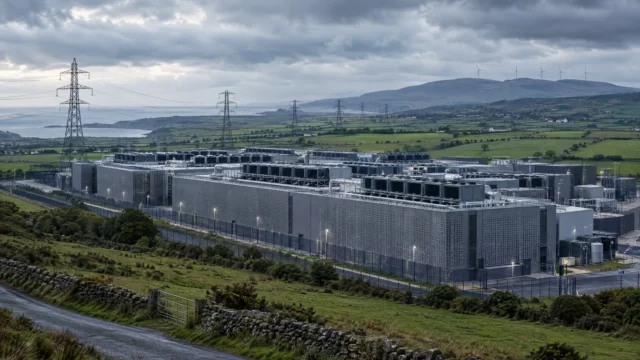
Ireland Data Centres Hit 25% of Power, Revolt Grows [2026]


Ireland now draws almost a quarter of its metered electricity into data centres, the highest share recorded anywhere in the world, and the political cost of that number finally landed on the front pages this month. The Irish Times set out the stakes in an editorial published on 8 September 2026 and updated on 17 October 2026, warning that “a storm is gathering” over the sector’s grip on the national grid. The piece argued that unless the government parties manage a radical rethink, they face a painful reckoning with voters who increasingly blame server farms for their electricity bills.
The timing could hardly be sharper. Waterford City and County Council was due to rule by 19 October 2026 on a 203-megawatt data centre proposed for the village of Kilmeaden, a scheme that drew more than 500 planning submissions, the largest volume of public objection any single Irish data centre project has attracted. Days earlier, the Supreme Court dismissed an attempt by opponents of a separate, 1.6 billion euro data centre near Ennis, County Clare, to appeal its approval. Between those two rulings sits the real story: a national argument about who pays for Ireland’s position as a server farm for American technology companies, and whether the current planning and energy system can hold.
Don't miss new tech stories on Google
Add TrendinTech Ireland once in the Google app and our stories appear in your news suggestions.
Why Ireland’s data centre numbers alarm policymakers
The headline figure driving the backlash is deceptively simple. Data centres consumed almost one-quarter of Ireland’s metered electricity in the past year, according to The Irish Times editorial, a share forecast to climb toward one-third by the end of the decade. No other country comes close to that concentration of computing load on a national grid. For a state with a population of roughly five million people, that means server halls now compete directly with homes and factories for a finite supply of power, at a moment when consumer energy prices are already elevated.
Jim Gannon, Commissioner at the Commission for Regulation of Utilities, put the trajectory in even starker terms in evidence to an Oireachtas committee, saying that data centres and other new technical loads could account for approximately 35 per cent of Ireland’s electricity requirement by 2035. Gannon also drew a distinction that explains why the politics have hardened so quickly: conventional data centres often require between 10 and 25 megawatts of power, he said, but large AI-focused facilities can exceed 100 megawatts in demand, with annual electricity consumption comparable to that of around 100,000 households. A single new-generation AI campus, in other words, can outstrip the entire draw of a mid-sized Irish town.
That scale shift is central to understanding why 2026 feels different from the quieter data centre growth of the previous decade. Ireland’s position as a European base for AWS, Azure and Google Cloud was built on a smaller, steadier load profile. The newer wave of facilities built to train and run large language models draws power in a different league, and the grid planning assumptions written a decade ago no longer match the demand now queuing for connection.
The Irish Times editorial and its warning to government
The Irish Times editorial board did not mince its framing. It said households blame data centres for rising electricity bills, and that communities resent the water use, the noise and the land taken up by new facilities. It pointed to tax breaks granted to some large corporations operating in the sector and noted that data centres provide relatively few permanent jobs once construction finishes, a point that undercuts the jobs-and-growth case that has underpinned Irish industrial policy for years.
The editorial also connected the backlash to a wider structural issue: Ireland’s economic dependence on American technology companies. That dependence, the paper argued, is itself a driver of data centre policy, since successive governments have been reluctant to constrain the infrastructure that underpins the corporate presence of firms whose tax contributions and employment figures feature heavily in national accounts. The piece cited high consumer energy prices, insufficient grid capacity, missed renewable energy targets and public distrust of the technology sector as the combined fuel behind the current backlash, rather than any single flashpoint.
Crucially, the editorial confirmed that the Department of Enterprise has commissioned a report examining the benefits and costs of data centres, an acknowledgement from government that the economic case for unconstrained growth needs re-testing. No publication date for that report has been confirmed, but its existence signals that officials in Dublin are no longer treating the sector’s expansion as a settled question.
Kilmeaden and the anatomy of a planning revolt
Nowhere illustrates the mechanics of the backlash better than Kilmeaden. The proposed development, associated with Echelon DC, sought approval for a 203-megawatt facility in a village of a few hundred residents. Local objectors, environmental groups and politicians combined to file more than 500 separate planning submissions, an extraordinary volume for a single application anywhere in the Irish planning system. Waterford City and County Council was scheduled to issue its decision by 19 October 2026, and subsequent coverage reported the application had been refused, with traffic congestion, wastewater capacity, flood risk, pressure on the local electricity network and concerns about village character all cited among the grounds.
Bono’s daughter, musician Jordan Joy Hewson, became one of the more visible voices in the Kilmeaden fight, framing the economics of the dispute in terms residents could immediately recognise. “You’re looking at data centres that are paying half the rate that we are for electricity as a population, which is a farce when all they’re doing is making big profits,” she said. That line, more than any technical planning objection, captures why the issue has moved from a niche planning dispute into mainstream political territory: it reframes data centres not as infrastructure investment but as a subsidy flowing from ordinary bill payers to some of the most profitable companies in the world.
People Before Profit TD Paul Murphy has pushed a similar argument in the Dail, describing data centres as “the toxic waste of the 21st century” and arguing that the sector consumes almost a quarter of the country’s electricity while paying just half the electricity rate that households must pay. Whether or not every element of that framing survives technical scrutiny, it reflects a political consensus forming across the left and among independent TDs that the current balance of costs and benefits needs to shift.
Ennis and the limits of legal resistance
While Kilmeaden shows planning objection working, the Ennis case shows its limits. The Supreme Court’s dismissal of the opponents’ application for leave to appeal effectively closed off a final legal route against the 1.6 billion euro facility planned for the outskirts of the County Clare town. The two outcomes sitting side by side within days of each other tell opposing stories: one community blocked a data centre through sheer weight of planning objections, while another saw its legal challenge exhausted at the highest court in the state. For developers, the lesson is that outcomes remain genuinely unpredictable from county to county, which itself is becoming a source of investor unease about Ireland as a location.
The Ennis and Kilmeaden disputes are not isolated. Kildare County Council separately rejected zoning motions aimed at reversing an existing data centre site designation, a vote that went against objectors despite warnings from residents and campaigners that the facility could raise energy costs and strain local water supplies. Taken together, these cases describe a planning system under sustained pressure from communities who have concluded that the economic upside of hosting a data centre no longer outweighs the local cost.
The grid capacity problem behind the politics
Behind the planning fights sits a harder engineering constraint. Ireland’s electricity grid was not designed for the concentration of load that large-scale computing now demands, and operators have warned for several years that data centres pose considerable challenges to the future planning and operation of the power system, a concern formally recorded in government assessments tied to national grid consultations. The practical effect has been a series of connection moratoriums, phased grid-access agreements and demand-side commitments that ask operators to reduce consumption at peak times or rely on backup generation during supply emergencies.
That dynamic explains why so much of the current debate centres on renewable energy targets, which the Irish Times editorial listed among the structural causes of the backlash, alongside insufficient grid capacity and high consumer prices. If new data centre demand is met largely by fossil-fuel generation or imported power rather than new wind and solar capacity, the sector’s carbon footprint becomes politically toxic on top of its cost footprint. Campaigners following the Kilmeaden refusal have already called for a moratorium on new fossil-fuel-backed data centres, arguing that any further large load additions should be conditional on matching renewable supply, not simply grid connection approval.
How the backlash compares with other major markets
Ireland is not alone in wrestling with data centre growth, but the intensity of its exposure is unusual. The table below sets out how the Irish data centre backlash compares with the pressures emerging in other major cloud markets, based on the publicly stated positions of regulators, editorial boards and campaigners in each jurisdiction during 2026.
| Market | Reported electricity share from data centres | Primary public concern | Dominant policy response |
|---|---|---|---|
| Ireland | Almost one-quarter nationally, forecast toward one-third by decade end | Household bills, grid strain, few permanent jobs | Department of Enterprise cost-benefit review commissioned |
| Netherlands | Single-digit percentage nationally, concentrated regionally | Land use and water consumption near Amsterdam | Regional moratoriums on new hyperscale permits |
| Virginia, United States | Reported as the largest data centre concentration in the US by capacity | Transmission line buildout and ratepayer cost allocation | State utility commission rate-case disputes |
| Singapore | Previously capped growth, since eased under efficiency conditions | Land scarcity and energy security | Efficiency-linked permitting conditions |
| Ireland (AI-specific load) | Individual AI campuses can exceed 100 megawatts, equivalent to about 100,000 households | Pace of AI-driven demand growth outstripping grid upgrades | Commission for Regulation of Utilities evidence to Oireachtas committee |
What distinguishes Ireland from the Netherlands, Virginia or Singapore is the combination of a small national grid, an outsized concentration of multinational cloud and AI infrastructure, and a tax and employment relationship with American technology companies that makes the sector politically difficult to constrain. Other jurisdictions can diversify their economic base more easily; Ireland’s dependence on the same corporate base that drives the data centre build-out is precisely what The Irish Times editorial identified as a structural driver of current policy.
Jobs, tax and the economic case under strain
The economic argument for data centres has traditionally rested on three pillars: construction employment, corporate tax receipts, and the broader case that Ireland needs digital infrastructure to remain attractive to foreign direct investment. Two of those three pillars are now under direct challenge. The Irish Times editorial noted that data centres provide relatively few permanent jobs once building work ends, since modern facilities are highly automated and require only small operational teams to run day to day. That leaves construction jobs, which are temporary by definition, as the main local employment benefit, a point campaigners in Kilmeaden and Kildare have repeatedly raised at council meetings.
The tax pillar is similarly contested. The editorial referenced tax breaks granted to some large corporations operating data centres in Ireland, without detailing specific rates or beneficiaries, but the framing matters politically: if the public perceives that profitable multinational operators receive preferential tax treatment while paying electricity rates lower than households, as both Jordan Joy Hewson and Paul Murphy argued, the jobs-and-tax rationale for the sector weakens considerably. That is the exact mechanism driving support for a moratorium among some campaigners and opposition politicians.
None of this is happening in a vacuum separate from Ireland’s wider technology sector. Companies such as OpenAI have continued expanding their Dublin headcount through 2026, and data centre services firms including Ethos Engineering have built substantial revenue around supporting the sector’s physical build-out. The jobs argument has not vanished; it has simply narrowed to a smaller set of specialist engineering, software and professional services roles clustered around Dublin, rather than the broad regional employment some communities were promised when individual facilities were first proposed.
What the Department of Enterprise review will have to answer
The commissioning of a formal cost-benefit review by the Department of Enterprise is the clearest sign yet that government is treating this as more than a planning nuisance. Any credible version of that review will need to grapple with several linked questions: how much of the reported almost-quarter share of national electricity demand is driven by cloud infrastructure for AWS, Azure and Google Cloud versus newer AI-specific training and inference facilities; how grid capacity additions can be sequenced against new data centre connections without triggering further missed renewable energy targets; and whether the current tax treatment of data centre operators reflects a fair return to the state relative to the jobs and services they generate.
The review will also have to confront the household fairness question directly. If, as critics including Paul Murphy allege, data centres pay roughly half the electricity rate charged to households, any report that fails to address that pricing gap head-on risks being dismissed by campaigners as an industry-friendly whitewash before it is even published. Conversely, a report that recommends sharp new restrictions risks reinforcing concerns among multinational technology firms that Ireland’s regulatory environment is becoming less predictable, a worry that could affect decisions on where the next generation of European cloud and AI capacity gets built.
Grid operators caught between demand and public trust
EirGrid and the Commission for Regulation of Utilities sit at the centre of this tension, tasked with keeping the lights on for households while also honouring existing connection agreements with data centre operators. Commissioner Jim Gannon’s evidence to the Oireachtas committee, projecting that data centres and other new technical loads could reach approximately 35 per cent of national electricity requirement by 2035, effectively confirms that the current moment of concern is not a temporary spike but the early stage of a decade-long trend. His distinction between conventional facilities drawing 10 to 25 megawatts and AI-focused campuses exceeding 100 megawatts also signals that the next phase of growth will be driven overwhelmingly by artificial intelligence infrastructure rather than traditional enterprise cloud storage and compute.
Public frustration has already spilled into set-piece events: campaigners protesting outside a Dublin AI industry summit in October 2026 objected to the gathering on energy-use grounds, the Irish Mirror reported, a sign that opposition is no longer confined to the specific villages where facilities are proposed. That AI-specific acceleration is the variable regulators find hardest to plan around, because unlike traditional enterprise data centre demand, which grows in relatively predictable increments tied to business expansion, AI training clusters can be commissioned and scaled within a single planning cycle. A grid operator planning transmission upgrades on a five-to-seven-year horizon is now being asked to absorb demand decisions that major technology companies can make in a matter of months, a mismatch that both EirGrid and CRU officials have flagged as a structural risk to system planning.
Historical context: how Ireland became a data centre magnet
Ireland’s emergence as one of the world’s densest data centre markets did not happen by accident. Low corporation tax, an English-speaking workforce, European Union market access and a reliable, historically cheap power supply combined over roughly two decades to make the country a default location for the European headquarters and infrastructure of major American technology firms. That same combination of factors that attracted companies such as AWS, Microsoft Azure and Google Cloud to build out regional cloud capacity in Ireland, as detailed in comparisons of their respective growth rates, is now the combination straining under its own success.
What changed in 2025 and 2026 was the scale of individual facilities. Generative AI training workloads shifted data centre design away from modest enterprise server halls toward campuses built to house the dense GPU clusters needed for large language model training and inference. Those facilities draw power at a different order of magnitude, and Ireland’s grid, planned around an earlier generation of demand, has had to catch up in real time.
Market impact: what investors and operators are watching
For the companies that run cloud and AI infrastructure in Ireland, the practical risk from this backlash is less about any single council decision and more about cumulative delay and policy uncertainty. A data centre operator weighing where to site the next European AI training facility now has to factor in planning timelines measured in years rather than months, the possibility of a national moratorium on fossil-fuel-backed projects, and a live cost-benefit review that could recommend tighter tax or grid-access conditions. None of that necessarily stops investment, but it changes the calculation, particularly for projects that compete directly with markets such as the Netherlands or the Nordic countries, which offer cooler climates and, in some cases, more predictable renewable energy supply.
Irish firms providing data centre construction, cooling and engineering services, including companies like Ethos Engineering, sit on the other side of that risk. Continued growth in facility count supports their order books, but a serious policy slowdown, especially one tied to a formal moratorium recommendation, would directly affect the pipeline of projects reaching construction. The period immediately following publication of the Department of Enterprise review is likely to be the clearest signal yet of which direction policy will move.
Scenario comparison: possible policy paths from here
With the Department of Enterprise review pending and no legislative changes yet confirmed, three broad policy paths are being discussed by politicians, campaigners and industry figures. The table below sets out the shape of each, based on positions already staked out publicly by the parties involved.
| Policy path | Who is advocating it | Core mechanism | Main risk if adopted |
|---|---|---|---|
| Status quo with stricter planning scrutiny | Current government approach, reflected in county-by-council decisions | Case-by-case refusals and approvals, as seen in Kilmeaden and Ennis | Continued investor uncertainty from inconsistent outcomes |
| Conditional growth tied to renewables | Campaigners calling for a moratorium on fossil-fuel-backed facilities | New connections approved only when matched with renewable supply | Slower buildout at a time of rising AI infrastructure demand |
| Pricing and tax reform | Paul Murphy and allied TDs, echoed by community campaigners | Align data centre electricity rates and tax treatment closer to household rates | Could reduce Ireland’s competitiveness versus other European hosting markets |
| Full cost-benefit-driven reset | Department of Enterprise, pending its commissioned report | Policy recalibrated based on findings not yet published | Outcome unknown until the report lands, prolonging uncertainty |
None of these paths is mutually exclusive, and the most likely outcome is a blend: continued case-by-case planning scrutiny in the near term, some form of renewable-matching condition introduced for new large-load connections, and a tax or pricing review that moves more slowly than campaigners want but faster than industry would prefer.
What this means for cloud and AI infrastructure decisions
For technology teams planning infrastructure in or through Ireland, including those weighing managed Kubernetes options such as the ones compared in EKS, GKE and AKS cost analyses, the data centre backlash is a reminder that regional capacity is not guaranteed to expand at the pace cloud providers have historically promised. Planning delays, grid-connection queues and the political likelihood of tighter renewable-matching conditions could all affect how quickly new capacity comes online in Irish regions over the next two to three years, even where demand for AI and cloud compute continues to climb.
That has a direct bearing on cost and availability planning for enterprises, since a slower-growing regional footprint typically means tighter capacity and higher prices passed through from providers absorbing their own grid-connection and compliance costs. Businesses with workloads tied to Irish or EU data residency rules are likely to feel this first.
Five predictions for the next twelve months
- The Department of Enterprise’s cost-benefit report will be published with recommendations that tighten tax or renewable-matching conditions rather than endorsing unconstrained growth, given the political pressure already visible in Kilmeaden and Kildare.
- More county councils will follow Waterford’s example and refuse large-scale data centre applications on grid, water and traffic grounds, even where legal routes for appeal remain open.
- Pressure will grow for a national electricity pricing review that addresses the gap campaigners describe between household and data centre rates, though full legislative change is unlikely within twelve months.
- AI-specific data centre proposals will increasingly be split out from traditional enterprise cloud applications in planning submissions, as developers try to separate the politically toxic AI framing from established cloud infrastructure requests.
- At least one major cloud or AI operator will publicly commit new Irish capacity to on-site renewable generation or long-term power purchase agreements, as a direct response to the public pricing-fairness argument.
Competitive comparison: cloud providers’ exposure to the backlash
Not every operator carries the same exposure to Ireland’s data centre politics. AWS, Microsoft and Google have each built substantial regional presence in Ireland over the past decade, and their growth rates show continued investment even as the political climate shifts. Their scale gives them more room to absorb new renewable-matching or tax conditions than smaller, standalone AI infrastructure developers such as Echelon DC, whose Kilmeaden proposal depended on a single large approval to proceed.
That asymmetry matters commercially. Large hyperscale cloud providers can diversify new capacity across other European regions if Ireland becomes harder to build in, while developers whose business model depends specifically on Irish sites have fewer alternatives if planning conditions tighten. Expect consolidation pressure on smaller standalone developers if the Department of Enterprise review results in stricter national conditions.
Frequently asked questions
What percentage of Ireland’s electricity do data centres use?
Data centres consumed almost one-quarter of Ireland’s metered electricity in the past year, according to The Irish Times, the highest share recorded in any country. Commissioner Jim Gannon of the Commission for Regulation of Utilities has projected that data centres and other new technical loads could reach approximately 35 per cent of national electricity requirement by 2035.
Why was the Kilmeaden data centre refused?
Waterford City and County Council’s decision followed more than 500 planning submissions against the 203-megawatt proposal, with traffic congestion, wastewater capacity, flood risk, electricity network pressure and village character all cited among the grounds for refusal.
Do data centres pay less for electricity than households in Ireland?
Campaigners including Jordan Joy Hewson and TD Paul Murphy have publicly argued that data centres pay roughly half the electricity rate charged to households. That claim has not been independently verified against specific operator contracts and is disputed by industry, but it has become central to the political case against unconstrained sector growth.
What is the Department of Enterprise reviewing?
The department has commissioned a report examining the overall benefits and costs of data centres to the Irish economy, covering employment, tax contribution and energy impact. No publication date has been confirmed.
How does the Ennis data centre case differ from Kilmeaden?
The Ennis facility, valued at 1.6 billion euro, had already secured planning approval, and the Supreme Court dismissed opponents’ final application for leave to appeal. Kilmeaden, by contrast, was refused at the initial planning stage by Waterford City and County Council.
Are AI data centres different from traditional cloud data centres?
Yes. Commissioner Jim Gannon told an Oireachtas committee that conventional data centres often require between 10 and 25 megawatts of power, while large AI-focused facilities can exceed 100 megawatts, with annual electricity consumption comparable to around 100,000 households.
Could Ireland introduce a moratorium on new data centres?
Some campaigners following the Kilmeaden refusal have called for a moratorium on fossil-fuel-backed data centres specifically, rather than a blanket ban. No government moratorium has been confirmed as of October 2026, but the Department of Enterprise review could recommend conditional restrictions.
How might this affect businesses using Irish cloud infrastructure?
Slower regional capacity growth, driven by planning delays and potential renewable-matching conditions, could tighten availability and raise costs for enterprises relying on Irish-hosted cloud and AI infrastructure, particularly those with EU data residency requirements that limit their ability to shift workloads elsewhere.
Related Coverage
- Data Breach Plan Ireland: 12 Steps, 72-Hour Deadline [2026]
- How to Set Up Xbox Cloud Gaming in Ireland: 14 Steps [2026]
- MARINEX's 4-Year Mission to Inspect Irish Wind Farms [2026]
- Veradigm Data Breach Exposes SSNs for Small Patient Group [2026]
- Bitwarden vs 1Password Ireland: €53 Cheaper Per Seat [2026]
Update log
Darragh Flynn
Darragh Flynn is the Cloud & Software Reporter at TrendinTech, where he covers cloud infrastructure, enterprise platforms, software development and the digital transformation of Irish businesses. His reporting focuses on the gap between vendor roadmaps and the systems businesses actually run, and on what Ireland's role as a European cloud hub means for jobs, energy and regulation.
All stories by Darragh Flynn (14)