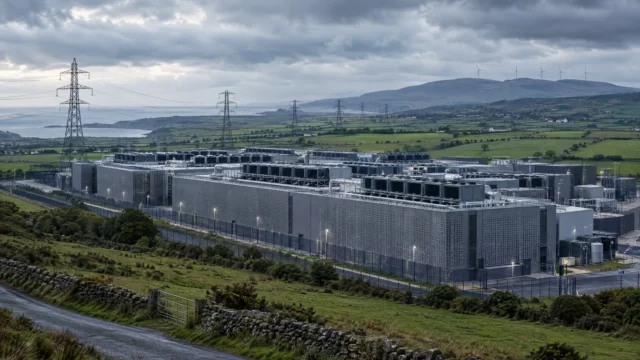
Kilmeaden Data Centre Refused: 500 Objections, 108 Hectares [2026]


Waterford City and County Council refused planning permission on Thursday, October 15, 2026, for a data centre and energy complex in Kilmeaden that would have covered 108 hectares on the site of a former cheese factory, a decision first detailed by The Irish Times. The decision caps months of organised resistance from a village of roughly 1,500 people who found themselves facing three industrial-scale ICT buildings, 16 gas-powered turbines, and over 43,000 solar panels on their doorstep.
The Kilmeaden case has become one of the clearest flashpoints yet in Ireland’s data centre boom, a story that pits grid capacity, housing-adjacent land and rural electricity bills against the state’s ambition to stay a hosting hub for global cloud and AI infrastructure. It also lands at a moment when the Supreme Court has already backed a separate 1.6 billion euro data centre near Ennis, showing how unevenly planning outcomes are landing across the country depending on location, local objection numbers and grid strain.
Don't miss new tech stories on Google
Add TrendinTech Ireland once in the Google app and our stories appear in your news suggestions.
What was actually proposed in Kilmeaden
The application came from a group of linked companies named in planning filings as Crag Rathnew DC Limited, Echelon Data Centres, and Kent Homes Limited. Together they sought permission for a mixed data centre and energy development spanning 108 hectares of land that includes the site of a former cheese processing plant and adjoining fields outside the village.
The scale of the plan is what galvanised Kilmeaden. Three separate ICT facility buildings were proposed, each roughly 24,000 square metres, which is comparable to several large retail warehouses stacked side by side. To power that load, the developers planned 16 gas-powered turbines and 43,056 photovoltaic solar panels, according to figures displayed on a protest sign erected in the village and reported by RTE. The combined electricity demand was estimated at around 203 megawatts on average, a figure that would make the Kilmeaden site one of the larger single demand connections sought in the south east of the country.
For context, 203 megawatts of average demand sits in the same broad range as a mid-sized town’s entire electricity draw. Residents argued that building that kind of load next to a village already living with ageing rural infrastructure was the wrong trade off, especially while household electricity prices remain under pressure.
Why Kilmeaden pushed back so hard
Opposition built steadily rather than exploding overnight. Waterford City and County Council received around 500 submissions on the application, with one local outlet describing the final count as more than 500 once late filings were included. That volume of objections is unusual for a single rural planning file and reflects how the campaign spread well beyond Kilmeaden itself into neighbouring townlands and Waterford city.
The campaign reached its most visible point on Sunday, October 11, when around 300 people took part in a slow-drive protest through the village, timing their convoy to make clear how many residents felt directly affected by the proposal. Protesters carried signs listing the project’s raw numbers, the hectares, the turbines, the panel count, turning planning jargon into something passersby could read in a few seconds.
Eileen O’Brien, a Kilmeaden resident who became one of the public faces of the campaign, framed the objection around cost and fairness rather than simple nimbyism. “Everybody is struggling right now across the country to pay their electricity bill, to live, to survive,” she said. She went further on the pricing gap between households and large energy users, telling reporters: “You’re looking at data centres that are paying half the rate that we are for electricity as a population, which is a farce when all they’re doing is making big profits.”
That argument, that ordinary bill payers subsidise industrial-scale electricity users through grid costs and wholesale pricing structures, has become a recurring theme in Irish data centre objections over the past two years, echoing concerns already raised around other contested sites covered in reporting on Ireland’s expanding data centre construction pipeline.
Labour and community groups joined the campaign
The Waterford Council of Trade Unions also weighed in publicly ahead of the council’s decision, broadening the opposition beyond residents directly bordering the site. A spokesperson for the group said: “The protest today showed the deep concern that people in Kilmeaden have against the current proposals to build a massive multi-billion euro data centre in Kilmeaden.” The same spokesperson added a line that captured the campaign’s core argument in one sentence: “Kilmeaden and Co Waterford should not be sacrificed just to feed data centres.”
Local committee member Amanda Power, who sits on the group Kilmeaden Against Industrialization, described what was at stake for residents in blunter terms. “If this is built, there’s no going back. We’re not getting the village back,” she said, according to the Waterford News and Star. Power also laid out the physical footprint residents were reacting to: “The thought of three big data centres going in, a massive solar farm, a gas power plant, essentially, and all the infrastructure that comes with that, not to mention the noise and the traffic.”
Elected representatives echoed those concerns once the scale of the project became public. Marc O Cathasaigh, the Green Party TD for Waterford, said: “Residents in Kilmeaden have raised serious and legitimate concerns about this development and what it would mean for their village, their homes and their quality of life,” a statement reported by RTE following the council’s decision.
The council’s decision and the political reaction
Waterford City and County Council refused planning permission for the development on Thursday, October 15, 2026, as confirmed by the Irish Examiner. The precise technical grounds cited in the refusal order were not immediately published in full, with at least one local report noting that the detailed reasons were not yet known at the time of the decision. What is clear is that the scale of public objection, around 500 submissions against a single rural application, was a significant factor in how the file was received by councillors and planning officials.
Reaction from local politicians was swift and largely celebratory for objectors. Waterford county councillor Declan Clune called the refusal “a victory for the people of Kilmeaden, pure and simple,” adding that “this was a community that refused to sit back and allow decisions affecting its future to go unchallenged.” Sinn Fein TD Conor McGuinness struck a similar note, telling Ireland Live: “I want to commend everyone who made submissions, attended protests and stood together to oppose this proposal.”
None of the reporting to date has confirmed which technology company, if any, intended to occupy or operate the proposed facilities. The application named only the development companies involved, Crag Rathnew DC Limited, Echelon Data Centres and Kent Homes Limited, rather than an eventual tenant or hyperscale operator. That absence of a named end user is itself notable: much of the recent wave of Irish data centre planning activity has involved speculative capacity built ahead of a signed tenant, a pattern that has drawn its own scrutiny from planners and grid operators.
How Kilmeaden fits Ireland’s wider data centre pattern
Ireland’s data centre sector has grown fast enough that it now accounts for a significant share of national electricity demand, a trend that has made every new planning application a potential flashpoint. Dublin’s grid constraints pushed developers toward regional sites years ago, and Waterford, with its port infrastructure, fibre routes and proximity to renewable generation, has increasingly featured in site searches. Kilmeaden’s location just outside Waterford city made it a logical candidate on paper, close enough to existing substations and transport links to look attractive to developers, but close enough to a settled community to guarantee organised resistance.
The Ennis case gives a useful point of comparison. There, the Supreme Court upheld planning approval for a 1.6 billion euro facility despite legal challenges, a result that suggests courts are generally reluctant to overturn planning authorities once a decision has been properly reasoned and procedurally sound. Kilmeaden differs because the refusal happened at first instance, before any court stage, driven by the scale of public submissions and the apparent weight given to local concerns. Whether the Kilmeaden applicants appeal to An Bord Pleanala, now rebranded in parts of its own correspondence but still the statutory appeals body, will determine whether this becomes another multi-year legal saga similar to Ennis or a closed chapter.
It is also worth setting Kilmeaden against the state’s own data centre employment and investment story. Firms such as OpenAI, which recently added 200 Dublin jobs to reach 450 roles in Ireland, and automation firm Tines, which added 100 Dublin jobs after a 272 million dollar raise, represent the software and services side of the same broader AI investment wave that data centres like Kilmeaden’s are meant to physically support. The tension is that software jobs land in cities while the physical infrastructure, the turbines, the substations, the solar arrays, lands in villages that see little of the direct employment benefit.
The electricity pricing argument at the centre of the protest
Eileen O’Brien’s comment about data centres paying roughly half the household electricity rate points to a structural feature of how Irish electricity tariffs are built. Large industrial users typically negotiate bespoke supply contracts and avoid many of the per-unit network charges that residential customers absorb through standing charges and levies. That gap, whether it is precisely half in Kilmeaden’s case or not, has become a politically potent shorthand nationwide for why communities feel data centres privatise the gains of AI and cloud growth while socialising the grid costs.
Energy regulators have faced growing pressure to publish clearer breakdowns of what large users actually pay compared with households, but detailed tariff disclosures remain limited, which leaves campaigners relying on estimates and anecdote rather than audited figures. That information gap is itself part of the friction: residents cannot easily verify claims about pricing fairness, and developers rarely volunteer the figures, which pushes disputes like Kilmeaden’s toward emotionally charged public meetings rather than data-led planning debates.
Market impact: what this means for data centre developers
For developers scouting sites in Ireland, Kilmeaden is a signal that public submission volume has become a real planning risk, not just background noise. A rural site with a few hundred residents generating 500 formal objections is a ratio that planning committees cannot easily wave through, regardless of the technical merits of grid connection studies or environmental impact statements. Developers chasing speed to power, the industry term for how quickly a site can be energised and brought online, may increasingly find that community engagement timelines now rival grid connection timelines as the critical path item.
The refusal also arrives as EirGrid and the Commission for Regulation of Utilities continue to tighten the conditions attached to new large energy user connections, including requirements around on-site generation and demand flexibility. A project proposing its own gas turbines and solar capacity, as Kilmeaden’s did, reflects developers trying to get ahead of those grid constraints by building power generation alongside compute capacity rather than relying purely on grid import. That self-generation model may become more common across the sector even as individual projects like Kilmeaden’s get turned down at the planning stage.
| Metric | Kilmeaden proposal |
|---|---|
| Location | Kilmeaden, County Waterford |
| Site area | 108 hectares |
| Data centre buildings proposed | Three ICT facilities, approx. 24,000 sq m each |
| Gas turbines proposed | 16 |
| Solar panels proposed | 43,056 |
| Estimated average electricity demand | Approx. 203 megawatts |
| Public submissions received | Around 500 (some reports: more than 500) |
| Protest turnout (October 11) | Around 300 people |
| Planning decision | Refused, October 15, 2026 |
Kilmeaden versus other recent Irish data centre disputes
Comparing Kilmeaden with other recent Irish data centre controversies shows how outcomes vary by stage, jurisdiction and the strength of organised local opposition. The Ennis case near County Clare made it all the way to the Supreme Court before the 1.6 billion euro facility was upheld, meaning years of legal cost and uncertainty for all sides before a final result. Kilmeaden, by contrast, was stopped at first instance by the local authority, a faster and cheaper outcome for objectors but one that leaves the door open to an appeal that could still drag the project through another planning cycle.
| Case | Location | Stage reached | Outcome |
|---|---|---|---|
| Kilmeaden data centre and energy complex | Waterford | Local authority decision | Refused, October 15, 2026 |
| Ennis data centre (1.6bn euro) | County Clare | Supreme Court appeal | Approval upheld |
| Ethos Engineering data centre pipeline | Nationwide, 45 sites | Construction and fit-out | Ongoing, revenue target 30 million euro |
That contrast matters because it shows planning authorities and courts are not applying a uniform standard nationally. Grid capacity in the immediate area, the number and tone of objections, and the specific environmental and traffic concerns raised in each file all shape outcomes differently, which means neither developers nor campaigners can assume a Kilmeaden-style refusal or an Ennis-style approval sets a binding precedent for the next contested site.
Historical context: how Ireland got here
Ireland’s position as a European data centre hub dates back more than a decade, built on low corporate tax rates, a temperate climate that reduces cooling costs, and strong subsea fibre connectivity through Dublin. That early advantage attracted major cloud and hosting operators long before rural communities like Kilmeaden had any direct exposure to the sector. As Dublin’s grid approached saturation, developers moved outward in search of available capacity, which is how a village built around a former cheese factory ended up at the centre of a 108-hectare planning fight.
The pattern of objections seen in Kilmeaden, hundreds of submissions, organised slow-drive protests, trade union involvement and cross-party political statements, mirrors a broader shift in Irish public opinion on data centres over the past three to four years. Where early data centre approvals in the 2010s drew comparatively little public comment, recent applications increasingly face coordinated local campaigns backed by social media organising and support from national politicians, a shift that planning consultants now treat as a standing risk factor when scoping new sites.
What happens next for the Kilmeaden site
The immediate question is whether Crag Rathnew DC Limited, Echelon Data Centres and Kent Homes Limited will appeal the council’s refusal to the national planning appeals body. An appeal would restart the clock on a decision that could still take many months, during which the 108-hectare site remains undeveloped and the former cheese factory lands sit in limbo. Given the scale of investment implied by a project of this size, a straightforward withdrawal seems less likely than a revised application or a formal appeal.
Residents, meanwhile, have shown they can mobilise quickly and sustain pressure over multiple months, from the initial submissions period through the October 11 protest to the council’s decision four days later. That organisational capacity, once built, tends to persist, which means any revised or appealed version of the Kilmeaden proposal will likely face the same scale of objection the second time around.
Five predictions for what comes next
- An appeal to the national planning appeals board is likely within the statutory window, given the scale of capital already committed to site assembly and design work.
- Developers pursuing similar rural data centre and co-located energy projects will increasingly pre-announce community benefit funds or local employment commitments earlier in the process, trying to avoid a Kilmeaden-style submission wave.
- Expect closer scrutiny of self-generation proposals, like the 16 gas turbines and solar array proposed here, as regulators weigh whether on-site generation should offset grid connection priority.
- Electricity pricing transparency between large users and households will keep surfacing in planning objections nationwide, pushing regulators toward clearer public reporting of large user tariffs.
- Waterford’s broader attractiveness as a data centre location will not disappear, but future applications in the county are likely to target sites with smaller footprints or stronger existing grid infrastructure to reduce objection volume.
Why this story matters beyond Waterford
Kilmeaden is a single planning refusal in a county of under 120,000 people, but its mechanics are repeatable anywhere in Ireland where a large site, a willing landowner and available grid capacity intersect with a settled community. The same questions residents raised here, about electricity pricing fairness, about noise and traffic from construction, about whether local people see any employment upside, apply equally to sites being scouted right now in other counties. Planning authorities watching how Waterford handled nearly 500 submissions will have a template, and developers watching the same outcome will adjust how early and how transparently they engage with communities before filing.
The broader cloud and AI infrastructure build-out that makes projects like Kilmeaden’s commercially attractive is not slowing down. Compute demand tied to generative AI training and inference keeps pushing operators toward new sites, and Ireland’s existing fibre and tax advantages keep the country near the top of the list for European expansion. What Kilmeaden demonstrates is that the easy sites, close to existing substations, close to Dublin’s fibre backbone, are increasingly gone, which pushes developers toward exactly the kind of rural, community-adjacent land that triggers the sharpest objections. For anyone tracking Ireland’s cloud infrastructure pipeline, including the kind of multi-cloud cost and deployment choices covered in comparisons of EKS, GKE and AKS costs for Irish workloads, Kilmeaden is a reminder that the physical build-out underneath those cloud platforms faces real local friction that cloud pricing tables never show.
There is also a renewable energy angle worth noting. Ireland’s offshore wind ambitions, including the inspection work covered in reporting on MARINEX’s underwater robot inspections of Irish wind farms, are partly framed as a long-term answer to exactly the kind of grid strain that projects like Kilmeaden’s create. If offshore wind capacity scales as planned over the coming years, some of the pressure pushing data centre developers toward gas turbines and sprawling solar arrays on rural land could ease, though that shift is measured in years, not months.
Frequently asked questions
What was refused in Kilmeaden?
Waterford City and County Council refused planning permission on October 15, 2026, for a data centre and energy development spanning 108 hectares on the site of a former cheese factory and adjoining lands in Kilmeaden, County Waterford.
Who applied for the Kilmeaden data centre?
The application was made by Crag Rathnew DC Limited, Echelon Data Centres and Kent Homes Limited, according to planning filings cited in local reporting.
How big was the proposed Kilmeaden project?
The plan covered 108 hectares and included three ICT facility buildings of roughly 24,000 square metres each, plus 16 gas-powered turbines and 43,056 solar panels, with an estimated average electricity demand of around 203 megawatts.
How many people objected to the Kilmeaden data centre?
Waterford City and County Council received around 500 public submissions on the application, with some reports describing the final figure as more than 500.
Did residents protest the Kilmeaden proposal?
Yes. Around 300 people took part in a slow-drive protest through Kilmeaden on Sunday, October 11, 2026, ahead of the council’s decision.
Will the developers appeal the refusal?
No appeal had been confirmed at the time of the council’s decision. Given the scale of the proposed investment, an appeal to the national planning appeals body is widely considered possible, though it has not been confirmed by the applicants.
Is this the same as the Ennis data centre case?
No. The Ennis case involved a separate 1.6 billion euro data centre in County Clare that reached the Supreme Court and had its approval upheld. Kilmeaden’s application was refused at the local authority stage and has not gone through any court process.
What company would have operated the Kilmeaden data centres?
No specific technology company or hyperscale operator has been confirmed as the intended tenant of the proposed facilities in reporting on the application so far.
Related Coverage
Darragh Flynn
Darragh Flynn is the Cloud & Software Reporter at TrendinTech, where he covers cloud infrastructure, enterprise platforms, software development and the digital transformation of Irish businesses. His reporting focuses on the gap between vendor roadmaps and the systems businesses actually run, and on what Ireland's role as a European cloud hub means for jobs, energy and regulation.
All stories by Darragh Flynn (14)