NTU’s AI Maps Phase Separation Across 1,106 Species [2026]

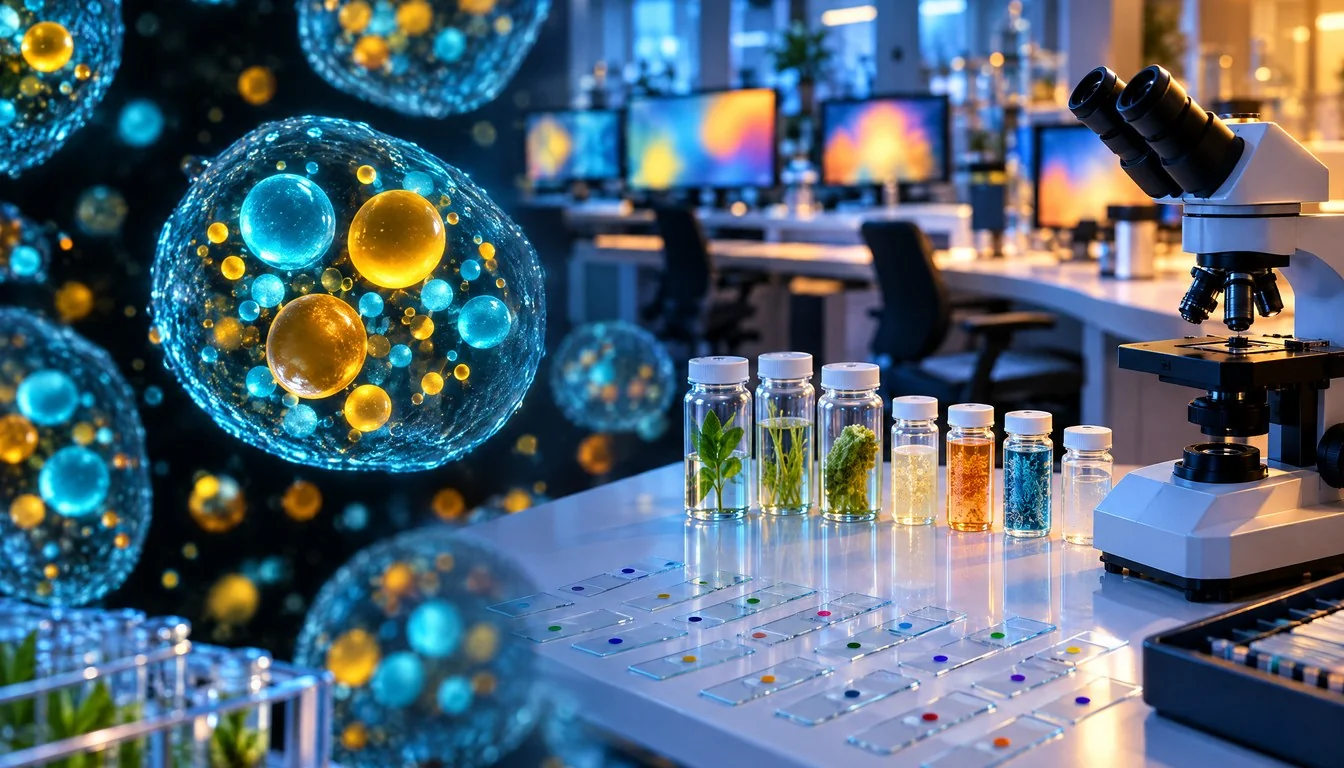
Researchers at Nanyang Technological University in Singapore have published a new AI-powered database and analysis platform that maps how proteins clump, separate and reorganize inside living cells, across more than a thousand species. The project, announced on October 12, 2026, pairs a benchmark database called PLATO with an analysis platform called PhaseHub, both built around a machine-learning algorithm named MolPhase that the NTU team developed earlier. Together they give researchers a way to search, test and visualize protein phase separation behavior across animals, plants, fungi, bacteria and other single-celled organisms, according to phys.org’s coverage of the announcement.
Protein phase separation is the process by which certain proteins inside a cell separate from the surrounding fluid, the way oil droplets separate from water. That separation forms dense, droplet-like compartments that cells use to organize chemical reactions, respond to stress and regulate gene activity. Scientists have linked disrupted phase separation to neurodegenerative conditions such as Alzheimer’s disease and to how plants respond to drought and heat, which is why a cross-species, AI-assisted map of the behavior is drawing attention well beyond NTU’s own labs.
Don't miss new tech stories on Google
Add TrendinTech once in the Google app and our stories appear in your news suggestions.
What NTU Singapore Announced on October 12
The NTU announcement, published on October 12, 2026 and updated on October 20, describes three connected pieces of research infrastructure. PLATO is the benchmark database. PhaseHub is the web platform researchers actually use to search and analyze proteins. MolPhase is the prediction algorithm that powers PhaseHub’s cross-species forecasts. None of the three carry a public price tag or a commercial tier. NTU presents all of them as research tools, hosted on university servers rather than sold through a company, according to the university’s own announcement.
The work is documented in a peer-reviewed paper, “From pan-life phase insights to PhaseHub: Analyzing protein condensate complexity,” credited to Qiyu Liang and co-authors. It appeared in the journal Molecular Plant with the DOI 10.1016/j.molp.2026.07.019. Professor Gao Weibo, from NTU’s School of Electrical and Electronic Engineering, is named as a collaborator on the project. The announcement does not spell out every researcher’s current title, but the paper’s authorship and the university’s own release both point to a biology-and-engineering collaboration rather than a single lab’s side project.
What makes the release notable is less the existence of a phase-separation predictor, since several already exist, and more the scale and the manual verification behind this particular dataset. NTU says its team used large-language AI models to mine PubMed literature for experimental evidence, then had researchers manually review every extracted result before it went into the database. That two-step process, AI-driven extraction followed by human review, is the same quality-control pattern showing up across other AI research assistant workflows built for scientific literature review this year.
Inside PLATO: The Numbers Behind the Benchmark
PLATO contains 5,118 unique protein sequences. Of those, more than 3,600 are experimentally supported phase-separating proteins, meaning laboratory experiments, not just computer predictions, confirmed they form condensates. The remaining roughly 1,300 sequences are non-phase-separating proteins, included specifically so that machine-learning models have negative examples to train against. Building a benchmark with that many confirmed negative cases is unusual in this field, where most earlier datasets leaned almost entirely on confirmed positives and left models guessing at what a non-phase-separating protein actually looks like.
That imbalance has been a known weak point in phase-separation prediction research for years. A model trained mostly on positive examples tends to overpredict, flagging ordinary proteins as condensate-formers simply because it has never seen enough confirmed negatives to learn the difference. By building in roughly one non-phase-separating protein for every three confirmed positives, NTU’s team appears to be directly addressing that bias, rather than just adding more positive examples to a dataset that already had plenty.
PLATO is hosted at NTU’s own domain, plato.sbs.ntu.edu.sg, through the School of Biological Sciences. There is no indication in the university’s material of a separate downloadable “PLATO model” distinct from the database itself. Researchers interact with it as a searchable, browsable resource rather than a model file they install locally, which is a meaningfully different access pattern than downloading open model weights the way developers might grab an open-source language model release.
PhaseHub: An Analysis Platform Built for Working Biologists
PhaseHub is the interface layer sitting on top of PLATO and MolPhase. NTU describes it as an “analyser” that lets a researcher search for a specific protein, or submit a new sequence entirely, and then inspect predicted phase-separation properties for it. The platform also visualizes potential protein-protein interactions and lets users examine sequence features such as homorepeats, which are repeated stretches of the same amino acid that often show up in proteins prone to forming condensates.
That combination of functions matters because phase separation research has historically required stitching together results from several separate tools: one for sequence prediction, another for interaction mapping, a third for structural features. PhaseHub folds those steps into a single workflow. It integrates MolPhase’s predictions with experimental protein-abundance and interaction data, which NTU says enables researchers to study multicomponent cellular compartments rather than single-protein behavior in isolation.
No confirmed renaming, retirement, or ownership change has been reported for PhaseHub since its public debut. It remains, as of October 20, 2026, an NTU-run academic platform rather than a spun-out commercial product, which puts it in a different category than venture-funded biotech AI startups currently raising capital around protein design and discovery tools.
MolPhase: The Algorithm Doing the Heavy Lifting
MolPhase is not new. NTU’s team first published the underlying algorithm in The EMBO Journal in 2024, in a paper describing it as an advanced prediction algorithm for protein phase separation. What is new in October 2026 is its role: MolPhase has moved from a standalone sequence-prediction tool used in individual research papers into the computational engine behind a much larger, cross-species mapping effort through PhaseHub and PLATO.
MolPhase remains available through its own NTU-hosted site at molphase.sbs.ntu.edu.sg, and researchers have continued citing it in separate 2026 studies, including work on PIEZO proteins and phage-associated proteins, independent of the PhaseHub release. A systematic evaluation covering results published between June and October 2026 reported that MolPhase and an existing method called DeePhase produced the most consistently accurate predictions among the methods tested, and that both were less affected by structural bias than competing approaches. That is a meaningful detail for anyone deciding which predictor to trust for a given experiment, since structural bias, where a model’s accuracy depends heavily on how much is already known about a protein’s 3D shape, has undercut confidence in several earlier phase-separation tools.
Why Protein Phase Separation Matters for Disease and Agriculture
Phase separation is not an obscure corner of cell biology. It governs how cells form stress granules, nucleoli, and other condensates that concentrate specific proteins and RNA molecules to speed up or slow down chemical reactions on demand. When phase separation goes wrong, proteins that should stay liquid and dynamic can instead clump into solid, persistent aggregates. That failure mode has been linked to neurodegenerative diseases, including Alzheimer’s disease, where misfolded and aggregated proteins build up in neurons over time.
NTU’s own announcement points to two concrete application areas: ageing-related diseases such as Alzheimer’s, and plant stress responses relevant to sustainable agriculture. On the plant side, phase separation helps crops respond to heat, drought and salinity by rapidly forming protective condensates under stress. A benchmark database covering plants alongside animals, fungi and bacteria gives agricultural researchers a comparative resource that was previously scattered across species-specific papers, rather than organized in one searchable place.
Separately, researchers at the University of Cambridge have pursued a related angle, combining a proprietary target-identification engine with a method called FuzDrop to identify disease-associated proteins prone to phase separation for drug discovery purposes, according to Cambridge’s own research announcement. That work predates the NTU release but illustrates that pharmaceutical-relevant phase-separation research has already moved from basic biology into applied drug-target screening elsewhere, which is the direction NTU’s own materials suggest PLATO and PhaseHub are aimed at as well.
The Tree of Life, by the Numbers: 1,106 Species
The scale of MolPhase’s cross-species predictions is the headline number in NTU’s release: 1,106 species, spanning animals, plants, fungi, bacteria and other single-celled organisms. That breadth is what distinguishes this project from most prior phase-separation research, which has tended to focus on a handful of well-studied model organisms, such as yeast, fruit flies, or human cell lines, rather than attempting anything close to a tree-of-life comparison.
According to the NTU team, eukaryotic organisms generally contain a higher proportion of proteins predicted to undergo phase separation than organisms such as bacteria, a pattern that lines up with the added cellular complexity eukaryotes carry: more organelles, more compartmentalized reactions, and more regulatory layers that condensates can help manage. That is a single research team’s reported finding rather than an independently replicated consensus at this point, but it gives biologists a testable hypothesis to check against their own organism of interest using PhaseHub’s search function.
How NTU Built the Database: AI Extraction, Then Human Review
The methodology behind PLATO is worth sitting with for a moment, because it is a template other scientific database projects are likely to copy. NTU’s researchers used large-language AI models to mine PubMed for experimental evidence of phase separation, then manually reviewed every extracted result for scientific accuracy before it was added to the benchmark. That is a deliberately hybrid approach: AI does the labor-intensive first pass across a literature base too large for any human team to read line by line, and trained scientists do the final accuracy check that AI extraction alone cannot be fully trusted to get right.
That hybrid pattern mirrors how other AI-assisted research tools are being deployed broadly this year, where language models handle retrieval and summarization at scale while a human reviewer signs off before anything is published or shipped. It is a more conservative approach than fully automated extraction pipelines, and it is also slower to scale, since every expansion of the database requires additional human review hours, not just more compute.
PLATO Database at a Glance
| Metric | Figure |
|---|---|
| Total unique protein sequences | 5,118 |
| Experimentally supported phase-separating proteins | More than 3,600 |
| Non-phase-separating proteins (negative controls) | About 1,300 |
| Species covered by MolPhase predictions | 1,106 |
| Organism groups included | Animals, plants, fungi, bacteria, other single-celled organisms |
| Database construction method | AI-assisted PubMed mining, then manual scientific review |
| Hosting institution | Nanyang Technological University, Singapore |
| Associated publication | Molecular Plant, DOI 10.1016/j.molp.2026.07.019 |
| Public pricing or commercial tier | None reported |
Historical Context: From Oil-Droplet Biology to AI Benchmarks
Liquid-liquid phase separation only became a mainstream research topic in cell biology within roughly the last decade and a half, after scientists realized that many of the membrane-less structures inside cells behave like liquid droplets rather than solid-walled compartments. Since then, the field has moved in three overlapping waves: first, basic biophysical characterization of which proteins form condensates and under what conditions; second, a wave of machine-learning predictors trained on whatever experimental data existed at the time; and third, the current push toward larger, better-curated, cross-species benchmarks that can actually test those predictors fairly.
PLATO sits squarely in that third wave. Earlier phase-separation prediction tools, including MolPhase’s own 2024 debut in The EMBO Journal, were generally validated against smaller, less systematically curated datasets. The jump to a 5,118-sequence benchmark with a deliberate, roughly 3-to-1 ratio of positive to negative examples, spanning more than a thousand species, is a step change in rigor compared to what the field had available even two years ago. It is the same kind of standardization effort that benchmarks like CASP provided for structure prediction in the years before AlphaFold, giving researchers a shared yardstick instead of a dozen incompatible, lab-specific test sets.
How This Compares to Google DeepMind’s AlphaFold 3
It is tempting to lump PLATO, PhaseHub and MolPhase in with Google DeepMind’s AlphaFold family, since both are AI tools working on proteins. The comparison only holds up loosely. AlphaFold 3, released by Google DeepMind and Isomorphic Labs in May 2024, predicts the 3D structure of complexes involving proteins, DNA, RNA, small molecules, ions and modified residues. It answers the question: what shape does this molecule, or this group of molecules, fold into? NTU’s tools answer a different question entirely: does this protein separate into a liquid-like condensate inside the cell, and which other proteins does it do that with? NTU’s own materials are explicit that the reported phase-separation mapping uses PLATO, PhaseHub and MolPhase, not AlphaFold 3, for that specific prediction task.
Google DeepMind has, in parallel, kept expanding its own biology-focused AI work. On October 14, 2026, the company announced that it would give up to 200 European researchers direct access to AlphaFold 3 and other science models, alongside $3 million in computing credits, as part of a European scientific-computing initiative. Days earlier, on September 30, 2026, Google DeepMind introduced SynthID Bio, which fine-tunes part of AlphaFold 3’s diffusion network to embed detectable watermarks into AI-predicted protein structures, aimed at biosecurity rather than at phase separation specifically. None of that overlaps directly with what NTU built, but it shows two different, well-resourced research efforts converging on protein-focused AI from separate angles in the same month, one from a university lab in Singapore and one from a corporate AI lab with access to frontier general-purpose models like Gemini 4 Argon running in the background of its broader research stack.
That broader AI infrastructure gap is worth noting. NTU’s project runs on a dedicated, narrowly scoped algorithm trained for one biological question. Google DeepMind’s phase-separation-adjacent work, by contrast, sits inside an organization that can route the same underlying compute and general-purpose reasoning models toward dozens of scientific domains at once. Both approaches have tradeoffs. A narrow, purpose-built algorithm like MolPhase can be tuned and validated tightly against a specific benchmark like PLATO. A general-purpose frontier model gains flexibility across domains but needs far more fine-tuning to match a specialist tool’s accuracy on any one narrow task.
AI Protein-Analysis Tools Compared
| Tool | Developer | Primary function | Key date | Access |
|---|---|---|---|---|
| PLATO, PhaseHub, MolPhase | Nanyang Technological University, Singapore | Benchmark database and platform predicting protein phase separation across species | Announced October 12, 2026 | Free, NTU-hosted research platform |
| AlphaFold 3 | Google DeepMind and Isomorphic Labs | Predicts 3D structure of protein, DNA, RNA and small-molecule complexes | Released May 8, 2024; European access expanded October 14, 2026 | Non-commercial model weights; Google Cloud for commercial use |
| SynthID Bio | Google DeepMind | Watermarks AI-designed protein sequences and structures | Announced September 30, 2026 | Research tool, biosecurity focus |
| DeePhase | Independently developed predictor cited in comparative evaluations | Predicts phase-separating proteins from sequence data | Cited in evaluations through October 2026 | Varies by publication |
What Industry Data Says About AI Adoption in Life Sciences
NTU’s release lands in the middle of a broader surge in AI adoption across life sciences research, and several industry surveys from 2024 help explain why a free, well-curated database like PLATO is likely to find an audience quickly. SAS reported in its 2024 “Your Journey to a GenAI Future” report that “ninety-seven percent of life sciences businesses were already using or planning to adopt generative AI, and 58% were already using it,” based on its survey work that year, according to SAS’s published report.
KPMG’s 2024 Global Tech Report found a more measured picture of actual deployment, noting that “thirty-four percent of life sciences technology leaders reported using AI at scale,” a gap between stated plans and operational use that is common across the sector, according to KPMG’s report. Arnold & Porter’s 2024 AI in Life Sciences Benchmark Report put a sharper point on where that AI effort is concentrated, reporting that “seventy-nine percent of life sciences executives were actively using or planning to use AI for faster and more efficient drug discovery and clinical trials.”
EY’s Health and Life Sciences Generative AI Report, also published in 2024, found that “twenty-eight percent of healthcare and life sciences firms had implemented their first generative AI solution, while 48% planned to implement one within the following year.” Read together, these 2024 figures describe an industry that was still in the early-adoption phase for generative AI tools generally, even as task-specific predictors like MolPhase were already running in individual research papers. A free, cross-species benchmark released in late 2026, with no licensing friction, fits neatly into that adoption gap: it lowers the barrier for the large share of labs that had planned to use AI tools but had not yet found a validated, ready-to-use resource for their specific biological question.
Market Impact: Drug Discovery, Crop Science and the Race for Biological AI
The immediate market impact of an academic release like this one is not measured in stock prices or funding rounds, since NTU has not spun PLATO, PhaseHub or MolPhase into a company and no prices have been attached to any of it. The impact instead shows up in how quickly pharmaceutical and agricultural biotech researchers start citing and building on the benchmark. Drug discovery teams working on neurodegenerative disease targets, where misfolded and improperly aggregated proteins are a known driver of pathology, now have a larger, better-balanced training set to validate their own phase-separation prediction models against, rather than relying on smaller datasets skewed toward confirmed positives.
Agricultural biotech is a less obvious but potentially larger beneficiary. Crop stress tolerance, particularly to heat and drought, increasingly looks tied to how efficiently plant cells form protective condensates under stress. A dataset that spans plants alongside animals and microbes gives crop science researchers a comparative resource they previously had to assemble themselves from scattered, species-specific papers. Given that commercial interest in AI-driven crop resilience has grown alongside broader climate pressure on agriculture, a free academic benchmark covering this exact biological mechanism is likely to get picked up by both university labs and the research arms of larger agricultural biotech firms.
There is also a quieter infrastructure angle. Database projects like PLATO, and the open-weight AI models increasingly used to mine scientific literature at scale, both depend on the kind of compute capacity that memory and chip suppliers have been racing to expand throughout 2026. Academic research compute budgets are smaller than corporate AI labs by orders of magnitude, which is part of why initiatives like Google DeepMind’s October 14 move to hand European researchers free access to frontier models and compute credits matter: it narrows a resourcing gap that otherwise favors large AI labs over university research groups doing exactly this kind of cross-species benchmark work.
The Analysis: Why Manual Review Still Matters in an AI Pipeline
The most instructive part of NTU’s methodology, for anyone following how AI gets deployed in serious scientific research rather than consumer products, is the insistence on manual review after AI extraction. It would have been faster, and almost certainly cheaper, to let large language models mine PubMed and populate the database without a human verification step. NTU chose not to do that. That decision reflects a broader pattern seen across scientific AI deployments this year: AI accelerates the mechanical, high-volume parts of research, like scanning tens of thousands of papers for a specific experimental claim, while the final judgment call about whether a given claim is trustworthy still runs through a trained human.
That is a different risk posture than what shows up in consumer and enterprise AI tools, where speed to market often wins out over verification, and where free, open AI tooling gets released and iterated on in public rather than reviewed line by line before release. Scientific databases that feed drug discovery or crop breeding decisions carry a different cost of error than a consumer chatbot giving a wrong answer, and NTU’s build process reflects that. It is also, practically speaking, the reason PLATO’s expansion is likely to be gradual rather than explosive: every new protein sequence added to the benchmark needs a human to sign off on it, which caps how fast the dataset can grow no matter how much AI extraction capacity is thrown at the problem.
What Comes Next: Five Predictions for Phase-Separation AI
First, expect other research groups to start benchmarking their own phase-separation predictors against PLATO specifically, the way structure-prediction researchers rallied around CASP before AlphaFold. A shared, well-balanced benchmark tends to become the default reference point once it exists, simply because comparing results against a common dataset is more useful to reviewers and readers than every lab using its own private test set.
Second, pharmaceutical research groups working on neurodegenerative disease targets are likely to begin incorporating PLATO and MolPhase predictions into early-stage target identification pipelines, alongside structure-prediction tools like AlphaFold 3, rather than treating phase-separation behavior and 3D structure as separate questions handled by separate teams.
Third, agricultural biotech researchers will likely be the fastest-growing user group outside NTU’s own institution, given how directly phase separation ties into plant stress tolerance and the commercial pressure to breed more climate-resilient crops.
Fourth, PLATO’s dataset will almost certainly expand over time as more experimentally confirmed proteins get added, but that growth will stay gradual rather than sudden, bound by the pace of NTU’s manual review process rather than by AI extraction speed.
Fifth, larger AI labs working on biology, including Google DeepMind, are likely to keep treating phase separation as a specialized problem handled by purpose-built academic tools rather than folding it directly into general-purpose frontier models, at least in the near term, given how narrow and data-dependent accurate phase-separation prediction currently is compared to broader structure prediction.
Frequently Asked Questions
What is PLATO in this context?
PLATO is a benchmark database built by researchers at Nanyang Technological University containing 5,118 unique protein sequences, including more than 3,600 experimentally supported phase-separating proteins and about 1,300 non-phase-separating proteins used as negative controls.
What is PhaseHub and what can researchers do with it?
PhaseHub is the web-based analysis platform built on top of PLATO. It lets researchers search for existing proteins or submit new sequences, inspect predicted phase-separation properties, visualize potential protein interactions, and examine sequence features such as homorepeats.
What is MolPhase and how is it different from PhaseHub?
MolPhase is the machine-learning algorithm, first published in The EMBO Journal in 2024, that predicts whether a protein undergoes phase separation. PhaseHub is the newer platform that uses MolPhase’s predictions, combined with experimental abundance and interaction data, to power its cross-species analysis.
How many species does this research cover?
MolPhase’s predictions, as deployed through PhaseHub, cover 1,106 species spanning animals, plants, fungi, bacteria and other single-celled organisms, according to NTU’s October 12, 2026 announcement.
Is this the same as Google DeepMind’s AlphaFold?
No. AlphaFold 3 predicts the 3D structure of proteins and other biomolecular complexes. NTU’s tools predict a different behavior entirely, whether a protein separates into a liquid-like condensate inside a cell. NTU’s materials state that the phase-separation mapping uses PLATO, PhaseHub and MolPhase, not AlphaFold 3.
Where can researchers access these tools?
PLATO is hosted at NTU’s plato.sbs.ntu.edu.sg domain, and MolPhase is hosted at molphase.sbs.ntu.edu.sg, both through NTU’s School of Biological Sciences. No commercial plans, subscription tiers, or prices have been reported for either tool as of October 20, 2026.
What is protein phase separation and why does it matter?
Protein phase separation is the process by which certain proteins separate from the surrounding cellular fluid into dense, liquid-like compartments, similar to oil separating from water. Disrupted phase separation has been linked to neurodegenerative diseases such as Alzheimer’s, and healthy phase separation helps plants respond to stresses like heat and drought.
What applications could this research lead to?
NTU’s announcement points to two application areas: research into ageing-related diseases such as Alzheimer’s, where protein aggregation plays a role, and research into plant stress responses relevant to sustainable agriculture and crop resilience.
Is PLATO a paid product?
No. Neither PLATO, PhaseHub, nor MolPhase has a reported commercial tier, subscription plan, or price. All three are presented by NTU as freely accessible academic research tools.
Related Coverage
- DHS Bans DeepSeek Across US Agencies as of Oct. 19 [2026]
- Kimi K2 vs DeepSeek vs Qwen3: Open LLM 4x Price Gap [2026]
- Women Face Greater AI Job Risk, 1940s Phone Jobs Show Why [2026]
- AECOM Tampa Lead Talks AI as Bids Hit 70% Automation [2026]
- Surface Laptop Ultra Review: RTX Spark Runs 120B AI Models [2026]
Daniel Okafor
Daniel Okafor is the Senior AI Reporter at TrendinTech, where he covers large language models, machine learning research and the practical use of artificial intelligence across business and government. He has a particular interest in evaluation: how models are benchmarked, where those benchmarks fail and what that means for the companies betting on them.
All stories by Daniel Okafor (389)