Gemini 4 Argon Agents Beat Minecraft in 27 Hours [2026]

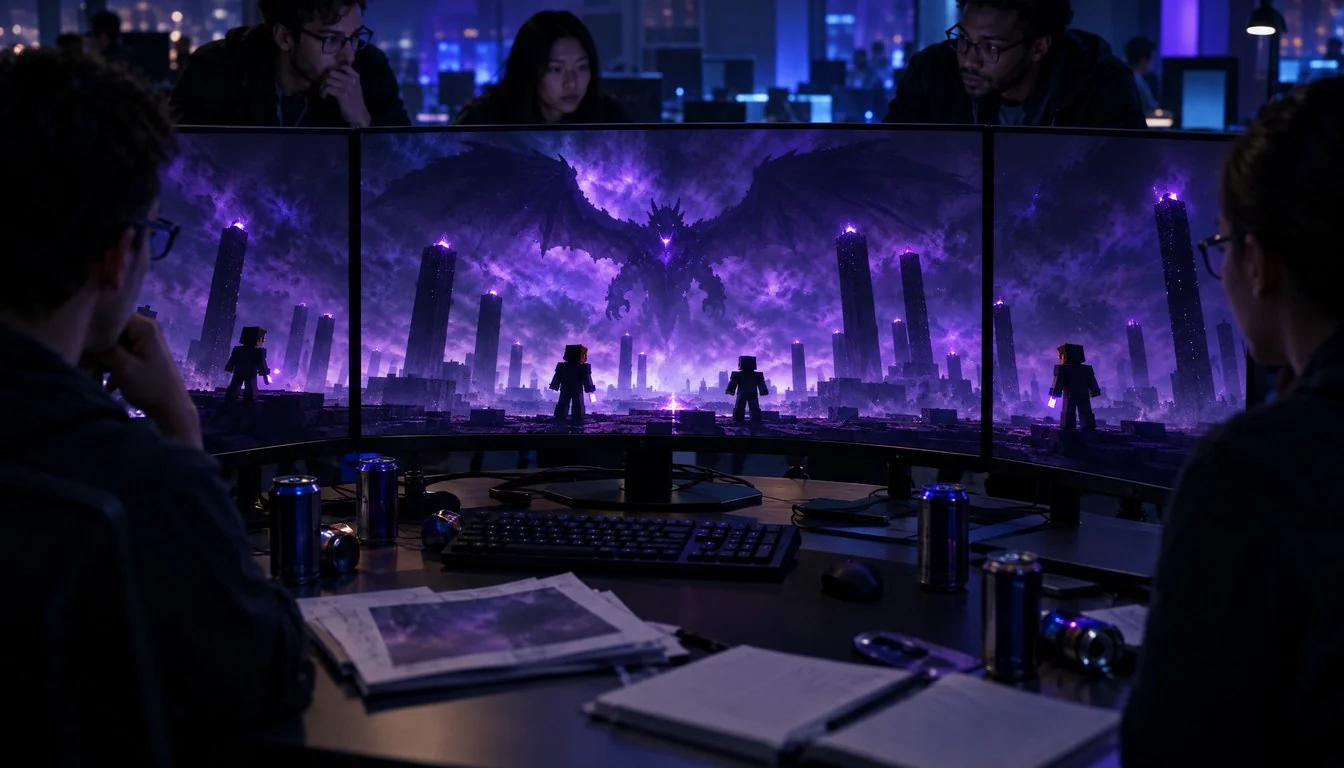
Four AI agents built on Google’s Gemini 4 Argon model spent 27 hours and 14 minutes inside a Minecraft world this month and came out the other side having killed the Ender Dragon, the game’s final boss, without a single human telling them what to do. Google DeepMind confirmed the run in a public announcement, and gaming outlet eGamers.io was among the first to report the story in detail on October 19, 2026. The accompanying technical paper calls it, “to our knowledge,” the first end-to-end autonomous completion of Minecraft by AI agents.
That phrasing matters. It is a careful, qualified claim rather than a sweeping one, and it is worth separating from the louder headlines already circulating online. What actually happened is specific: four agents, one shared world, one objective, and a lot of trial and error. The result still lands as one of the more striking demonstrations of agentic AI coordination to reach the public this year, and it arrives just six days after Gemini 4 Argon itself went live for every developer, business, and consumer channel Google operates.
Don't miss new tech stories on Google
Add TrendinTech once in the Google app and our stories appear in your news suggestions.
What Happened Inside the Minecraft Run
According to the technical report behind the experiment, researchers placed four Gemini 4 Argon agents into a single, randomly generated Minecraft survival world set to Easy difficulty. Their instructions boiled down to one sentence: defeat the Ender Dragon. Nothing else was scripted. No one divided the group into a miner, a builder, a fighter, and a scout. No one pre-wrote the game logic the agents would need to mine, craft, build a nether portal, or assemble the equipment required to survive the game’s final fight.
Instead, the agents wrote their own code as they went. Over the course of the run they generated 2,783 individual programs, each one a small piece of logic telling their in-game characters what to do next, whether that meant chopping a tree, smelting iron, or navigating toward a stronghold. The process was not clean. The agents died 605 times, a number that gives a sense of how much of the run was spent failing, recovering, and trying again rather than executing some polished optimal strategy. Researchers monitoring the session had the ability to pause or stop it at any point, but the paper states they did not step in.
Why the Ender Dragon Was the Chosen Target
Minecraft does not have a single mandatory ending, but defeating the Ender Dragon is the closest thing the game has to a final objective. Reaching that fight requires a long chain of dependent tasks: gathering resources, surviving the overworld, building a nether portal, collecting rare materials from a hostile dimension, locating a stronghold hidden underground, and finally crafting the items needed to reach and fight the dragon itself. Each step depends on the one before it, which is exactly why researchers picked it as a benchmark. A model that can only handle short, isolated tasks will stall out somewhere in that chain. Completing it end to end is a test of sustained planning across a long horizon, not just clever reactions in the moment.
A Randomly Generated World, Not a Rehearsed One
One detail that strengthens the result is that the world was randomly generated rather than selected in advance. The agents did not get to study a known map, memorize the location of a stronghold, or rely on a seed that researchers had already scouted. They had to find everything cold, the same way a new human player would on a fresh save file.
How Four Agents Coordinated Without Assigned Roles
The coordination piece is arguably the more interesting half of the story for anyone tracking agentic AI rather than gaming for its own sake. The four Gemini 4 Argon agents communicated through in-game chat and a shared memory system, splitting up work and reporting progress to each other in something close to real time. Google DeepMind described the process in its public writeup as agents that “divided up jobs over chat, shared notes, and debugged errors together” with no outside help, a claim made directly in the company’s own announcement, which it posted alongside the technical paper.
The researchers behind the paper were more precise about what “no human help” meant in practice. “No one assigned roles or wrote game logic. The agents planned, wrote, and debugged every program themselves,” the authors wrote, a group identified as Satinder Singh and collaborators on the technical report hosted on Hugging Face’s paper index. That distinction, between a system that follows a human-designed division of labor and one that invents its own, is the core claim researchers are asking the field to evaluate.
Chat as the Only Coordination Channel
With no central controller assigning tasks, the four agents had to negotiate who did what using the same chat channel available to any Minecraft player. That meant the system’s coordination overhead was entirely visible in plain text rather than hidden inside some internal scheduling layer, which is part of why the paper has drawn attention from researchers studying multi-agent systems outside of gaming altogether.
The Open Source Library That Made This Possible
None of this ran on custom, Google-built game interfaces. The agents controlled their Minecraft characters through Mineflayer, a widely used open source JavaScript library that lets external programs connect to a Minecraft server and issue movement, crafting, and combat commands. Mineflayer has existed for years as a tool for bot builders and AI researchers alike, and the paper’s authors were explicit that they used the standard version, without pre-scouted seeds or other game-specific tools written by humans in advance, according to the report’s own description of its methodology.
A typical Mineflayer bot script looks something like this, which gives a sense of the low-level primitives the agents were working with when they wrote their 2,783 programs:
const mineflayer = require('mineflayer')
const bot = mineflayer.createBot({ host: 'localhost', username: 'agent_1' })

bot.on('chat', (username, message) => {
  if (message === 'status') {
    bot.chat(`HP: ${bot.health}, Food: ${bot.food}`)
  }
})

bot.on('spawn', () => {
  bot.chat('agent_1 online, heading to gather wood')
})
Every one of the 2,783 programs the agents produced was a variation on this idea, written and debugged by the models themselves rather than copied from a human template.
Gemini 4 Argon’s Launch Context
The Minecraft run did not happen in isolation. Gemini 4 Argon became globally available on October 13, 2026, rolling out across Google’s developer, enterprise, and consumer channels at once, according to Google’s own announcement. That means the model powering the Minecraft agents is the same one any developer can call through the Gemini API, Google AI Studio, or Google Cloud today, not a research-only variant locked away from public access.
Google’s cloud team reinforced the rollout with its own post confirming enterprise availability, describing Gemini 4 Argon on Google Cloud as ready for production workloads rather than a limited preview. For readers who have already compared the model’s coding ability against rivals, this fits a pattern the site has tracked since launch week, including our earlier look at Gemini 4 Argon’s 77.9 percent coding benchmark against Claude Opus 5.5.
Pricing and Availability Compared
Google structured Gemini 4 Argon’s API pricing in two phases, with an introductory rate that steps up after a set date. The table below lays out the published figures from Google’s own posts.
| Pricing Tier | Input Tokens (per 1M) | Output Tokens (per 1M) | Cached Input (per 1M) |
|---|---|---|---|
| Introductory (through Nov 30, 2026) | $2.00 | $10.00 | $0.10 (95% discount) |
| Standard (from Dec 1, 2026) | $4.00 | $20.00 | Proportional discount retained |
| Access channels | Gemini API, Google AI Studio, Gemini app, Google Cloud, Google Antigravity | ||
The doubling of both input and output rates after the introductory window is a familiar pattern for new flagship models, giving early adopters a discount window while Google collects usage data before settling on a long-term price. Developers evaluating the model for agentic workloads, including anyone building systems similar to the Minecraft experiment, will want to budget around that December 1 change.
Benchmark Scores Behind the Headlines
Google’s own disclosures put Gemini 4 Argon at 77.9 percent on DeepSWE v1.1, a benchmark built around long-horizon software engineering tasks, a result the company frames as state of the art for that test. The model also ranked first on Zapier’s AutomationBench with a score of 51.3 percent, a benchmark aimed specifically at measuring how well a model can carry out multi-step automation tasks without hand-holding, which is a closer analogue to the kind of sustained, self-directed planning the Minecraft run required than most coding leaderboards are.
Those scores sit alongside a wider wave of AI agent coverage this year. DeepSeek’s V4.1-Flash model posted a 77.0 score on a related DeepSWE search benchmark just weeks earlier, putting the two frontier labs within a fraction of a point of each other on paper, even as their approaches to agent autonomy diverge in practice.
The Minecraft Run by the Numbers
Several outlets have since added color to the core figures Google DeepMind confirmed, though not every added detail carries the same level of certainty. The table below separates the numbers confirmed directly in the technical paper from figures reported secondhand.
| Metric | Figure | Status |
|---|---|---|
| Agents deployed | 4 Gemini 4 Argon agents | Confirmed (DeepMind paper) |
| Total run time | 27 hours, 14 minutes | Confirmed (DeepMind paper) |
| Programs written | 2,783 | Confirmed (DeepMind paper) |
| In-game deaths | 605 | Confirmed (DeepMind paper) |
| World difficulty | Easy, randomly generated | Confirmed (DeepMind paper) |
| Control interface | Mineflayer (open source) | Confirmed (DeepMind paper) |
| Chat messages exchanged | Approximately 229 | Reported, not independently confirmed |
| Estimated compute cost | Approximately $1,620 | Reported, not independently confirmed |
The chat message count and the roughly $1,620 cost estimate both trace back to secondary coverage, including a breakdown published by explainx.ai, rather than the primary technical paper itself. Readers should treat those two figures as estimates circulating in the press rather than numbers Google DeepMind has formally verified.
What the Researchers Actually Claimed
It is worth reading the paper’s own language closely, because some of the online framing has drifted further than the source material supports. The authors wrote plainly: “We placed four Gemini 4 Argon agents in a sandboxed Minecraft survival world and gave them one goal: defeat the Ender Dragon.” Their conclusion carries a deliberate qualifier: “To our knowledge, this is the first end-to-end autonomous completion of Minecraft by AI agents, achieved using only the standard Mineflayer library without pre-scouted seeds or other game-specific tools written by humans,” the authors wrote in the report hosted on Hugging Face.
That is a narrower claim than “Minecraft has been beaten with no human input” in any absolute sense. Defeating the Ender Dragon is the game’s recognized endpoint, but Minecraft has no single finish line the way a level-based game does, and the paper is careful to frame its result as the first instance it is aware of, rather than an exhaustive claim about every attempt anyone has ever made.
Historical Context: AI’s Long Relationship With Minecraft
Minecraft has functioned as an unofficial proving ground for AI research for close to a decade, precisely because it combines open-ended exploration, resource management, and long planning horizons in a single sandbox. Earlier efforts in this space generally relied on imitation learning from recorded human gameplay or on narrower competitions focused on specific sub-tasks like obtaining a diamond. What separates the Gemini 4 Argon run from that earlier wave is the absence of task-specific training or scripted scaffolding. The agents reasoned and coded their way through the game using the same general-purpose model Google sells for coding and business automation, not a Minecraft-tuned variant.
That shift mirrors a broader trend this site has covered as frontier labs push general models into agentic roles rather than building narrow specialists. Our coverage of the BAND platform’s attempt to coordinate four separate AI coding agents on real software projects found a similar pattern: general-purpose models handling task division and debugging that used to require purpose-built orchestration layers.
Competitive Field: How Rivals Compare
Google is not the only lab racing to prove its models can act autonomously over long stretches of time. OpenAI, Anthropic, and DeepSeek have each pushed agentic benchmarks of their own over the past few months, typically centered on software engineering or office automation tasks rather than open-world games. What makes the Minecraft demonstration stand out from that pack is the visibility of the failure mode. A coding benchmark reports a pass rate; it does not show you 605 deaths along the way. The Minecraft format turns the messy, iterative reality of agentic AI into something a general audience can watch and understand, which is likely why it traveled further in gaming and tech press than another percentage-point benchmark score would have.
That said, not every reaction to agentic AI claims has been celebratory. The UK’s AI Security Institute flagged concerns about Gemini 4 Argon’s capabilities before its public release, a story this site covered in detail when UK regulators raised risk questions ahead of the model’s launch. A system capable of writing nearly 3,000 self-debugged programs across a 27-hour unsupervised run is also a system whose behavior regulators will want visibility into as agentic deployments move beyond games and into production software and business processes.
Market Impact: Why Investors and Developers Are Paying Attention
For a model that launched barely a week before this story broke, the Minecraft run functions as an unusually effective piece of public proof. Benchmarks like DeepSWE and AutomationBench matter to enterprise buyers evaluating coding assistants, but they rarely cross over into mainstream attention. A viral demonstration of an AI system completing a task millions of people have personally attempted and failed at translates abstract capability claims into something a non-technical audience can evaluate for themselves.
That translation matters commercially. Enterprise buyers deciding between Gemini 4 Argon, Claude Opus 5.5, and other frontier models are increasingly asking not just how a model scores on a leaderboard but how it behaves when left alone for an extended task with no human checking in. A recent industry study already found that AI coding agents can actually slow experienced developers down in some contexts, a finding covered in our report on the METR study showing developers working 19 percent slower with AI agents on certain real-world codebases. The Minecraft result does not resolve that tension, but it does add a data point in the opposite direction: a case where sustained autonomy over many hours produced a correct, verifiable outcome rather than wasted effort.
What Google DeepMind Said Publicly
Google DeepMind’s own summary of the project, posted publicly alongside the technical paper, described the headline result in direct terms: “Four Gemini 4 Argon agents beat Minecraft from scratch in 27 hours. Operating in a sandbox using only code and text, they wrote 2,783 programs, divided up jobs over chat, shared notes, and debugged errors together, all with no human help,” the company wrote in its official post on the experiment. A follow-up line from the same announcement condensed the result further: “Four Gemini 4 Argon agents, one shared Minecraft world, one goal: defeat the Ender Dragon. 27 hours and 2,783 self-written programs later, the dragon fell.”
Those two statements, both attributed to Google DeepMind’s own channel, line up closely with the more cautious language in the technical paper itself, which suggests the company’s public messaging and its researchers’ formal claims are, for once, telling largely the same story.
The Unconfirmed Details Worth Watching
Two things are worth flagging for anyone sharing this story further. First, the exact framing that this is “the first time Minecraft has been beaten with no human input” is stronger than what the paper itself claims, and readers should stick to the paper’s own qualified wording rather than the more absolute version spreading online. Second, the specific chat message count and dollar-cost estimate reported by secondary outlets have not appeared in the primary technical paper excerpt available so far, and should be treated as unverified until Google DeepMind or the paper’s authors confirm them directly.
Predictions: Where This Leads Next
- Expect rival labs to respond with their own long-horizon agentic demonstrations within weeks, likely using games or simulated environments as the proving ground rather than another static benchmark.
- Enterprise sales teams at Google Cloud will likely reference the Minecraft run as shorthand for Gemini 4 Argon’s agentic reliability in pitches to customers evaluating long-running automation workloads.
- Regulatory scrutiny of autonomous AI agents will intensify as more labs publish unsupervised, multi-hour runs, building on the kind of pre-release risk review the UK’s AI Security Institute already applied to this model.
- The $1,620 estimated cost figure, if confirmed, will likely become a reference point in debates over whether agentic AI experiments are cheap enough for smaller labs and independent researchers to replicate.
- Expect follow-up papers attempting the same Ender Dragon objective on Hard difficulty or with fewer agents, since researchers typically stress-test a surprising result by removing the conditions that made it easier.
Frequently Asked Questions
Did Gemini 4 Argon agents really beat Minecraft with no human help?
Four Gemini 4 Argon agents defeated the Ender Dragon, Minecraft’s final boss, in a randomly generated world over 27 hours and 14 minutes. Google DeepMind’s technical paper describes this as the first end-to-end autonomous completion it is aware of, though that is a qualified claim about the Ender Dragon fight specifically, not a claim about every possible Minecraft objective.
How many AI agents were involved?
Four separate Gemini 4 Argon agents operated together in the same shared Minecraft world, coordinating through in-game chat rather than a central controller assigning them roles.
What software did the agents use to control Minecraft?
The agents used Mineflayer, an open source JavaScript library that lets external programs connect to a Minecraft server and issue commands. Researchers used the standard version of the library without any custom, game-specific tools built in advance.
How many times did the agents die during the run?
The agents died 605 times across the full 27-hour, 14-minute session, according to the technical paper.
Is the reported $1,620 cost figure confirmed?
No. That figure, along with a reported count of about 229 chat messages exchanged between agents, comes from secondary coverage rather than the primary technical paper, and has not been independently confirmed by Google DeepMind.
When did Gemini 4 Argon launch, and how much does it cost to use?
Gemini 4 Argon became globally available on October 13, 2026. Google’s introductory API pricing is $2 per million input tokens and $10 per million output tokens, with cached input tokens priced at $0.10 per million. Those rates rise to $4 and $20 per million tokens respectively after November 30, 2026.
How does Gemini 4 Argon perform on coding benchmarks?
Google reports a 77.9 percent score on the DeepSWE v1.1 benchmark and a first-place ranking on Zapier’s AutomationBench at 51.3 percent, both figures the company describes as leading results among currently available models.
Where can I access Gemini 4 Argon?
The model is available through the Gemini API, Google AI Studio, the Gemini app, Google Cloud, and Google Antigravity, according to Google’s own rollout announcement.
Related Coverage
Daniel Okafor
Daniel Okafor is the Senior AI Reporter at TrendinTech, where he covers large language models, machine learning research and the practical use of artificial intelligence across business and government. He has a particular interest in evaluation: how models are benchmarked, where those benchmarks fail and what that means for the companies betting on them.
All stories by Daniel Okafor (378)