
World’s Largest Stellarator Attracts PPPL Physicists to Campaign
As the first full campaign of the world’s largest and most powerful stellarator comes together, physicists from the U.S. Department of Energy’s (DOE) Princeton Plasma Physics Laboratory (PPPL) are brought in to make use of their expertise.

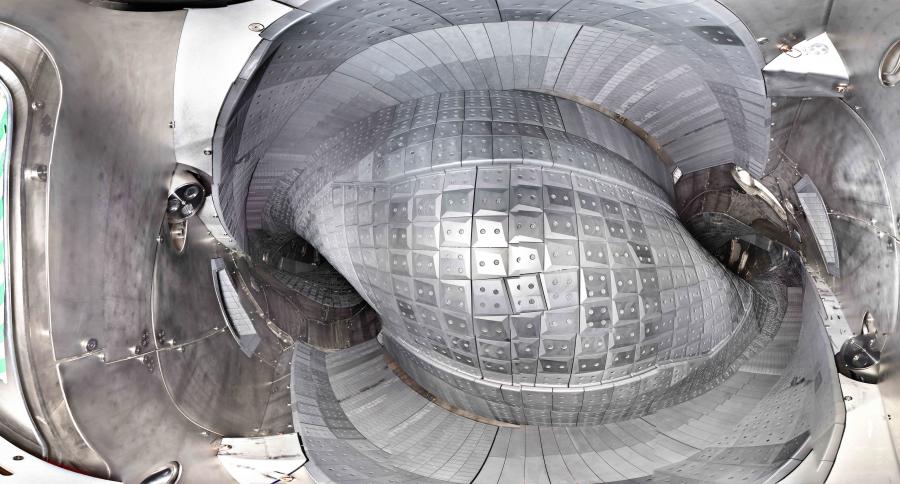
As the first full campaign of the world’s largest and most powerful stellarator comes together, physicists from the U.S. Department of Energy’s (DOE) Princeton Plasma Physics Laboratory (PPPL) are brought in to make use of their expertise. Wendelstein 7-X (W7-X) is the name of the magnetic confinement fusion experiment that took place in Germany. The facility is now investigating the suitability of its optimized magnetic fields to create steady state plasmas and to be used as a model plant for producing this “star in a jar”, clean energy source.
The W7-X ran from December 2015 to March 2016 and since then has been upgraded in preparation for this new, high-powered campaign. Those that will be heavily involved in the new project include PPPL physicists Sam Lazerson and Novimir Pablant, who will be spending two years studying over at the Max Planck Institute of Plasma Physics in Greifswald in Germany.
When the W7-X was in operation previously, Lazerson was responsible for mapping its magnetic fields. This time he will be heading a task force that will be responsible for carrying out some experiments on the stellarator. Pablant, on the other hand, has designed an x-ray crystal spectrometer that will record the behavior of W7-X plasma.
“This will be the first run of the machine in its designed configuration,” confirmed David Gates, head of the stellarator physics division at PPPL and overseer in the W7-X project. During the new run, a device called an “island diverter” will be tested for exhausting thermal energy and impurities.
The heating power of the stellarator will also be increased in the new run to a total of eight megawatts to allow for operation at a higher beta which is essential for plasma confinement. As confirmed by Gates, “The goal is to increase plasma confinement compared with traditional stellarators.”
Moving forward the team of Max Planck engineers will be looking to install a 2scraper element” to add to the W7-X after the initial 15-week campaign has ended. Then, the ability of the of the unit will be tested in the next phase, as well as the installation of the water-cooled diverter in 2019 which will increase the allowable pulse length of the stellarator.
More News to Read
- Do Physicists Need to Change the Way They Measure Quantum States?
- Researchers Discover Response in Liver Could Actually Help Treat Alcoholism
- Ancient Nova Explosion Recovered by 580-year-old Korean Recording
- Scientists Use VLA to Measure Galaxy’s Magnetic Field Billions of Light-Years Away
- Who Said Oil and Water Don’t Mix? New Study Suggests Otherwise
Related Coverage
- New Laser System Upgrade Allows Scientists to Explore Fusion Energy and Plasma Physics Like Never Before
- How to Make a Supercomputer?
- Two of the World’s Largest Internet Based Names Unite to Lay Gigantic Cable Across the Ocean
- Energy Firms U-Turning On Green Energy Agenda
- Next Generation Fuel Cells Could Soon Be Here Thanks to Graphene and Nanocrystals
Don't miss new tech stories on Google
Add TrendinTech once in the Google app and our stories appear in your news suggestions.
Helena Marsh
Helena Marsh is the Editor-in-Chief at TrendinTech, where she leads editorial strategy and oversees coverage across artificial intelligence, cybersecurity and enterprise technology. With more than a decade in technology journalism on both sides of the Atlantic, she previously served as a senior editor at Wired UK and covered the technology sector for The Guardian, following the rise of the big platforms, the Cambridge Analytica scandal and the regulatory push from Brussels and Washington. Helena holds an MA in Journalism from City, University of London and is a regular speaker at Web Summit in Lisbon and CES in Las Vegas. She believes technology reporting should be rigorous and plainly written, so readers understand what actually changes for them rather than what a company's announcement promises.
All stories by Helena Marsh (201)