
Scientists Uncover Giant Upwellings on the Surface of Mars
For many years scientists have been under the impression that Mars has a crust similar to that of the Earth’s. However, one Cornell scientist, Esteban Gazel, proposes a different theory.

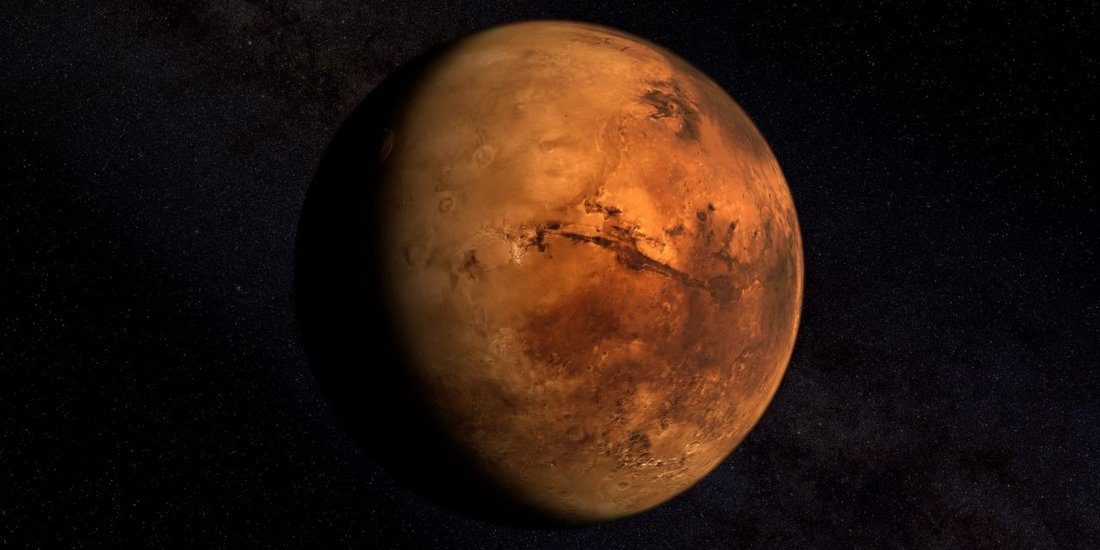
For many years scientists have been under the impression that Mars has a crust similar to that of the Earth’s. However, one Cornell scientist, Esteban Gazel, proposes a different theory. He suggests that the surface of Mars consists of crystallized magma that’s welled up from within the Red Planet.
In 2015 a group of scientists published a study that involved data that had been gathered by the NASA rover, Curiosity. Upon analyzing the data they found that the rover had discovered granite-like rock. This suggested that the Mars crust was similar to that of our own. However, nothing is ever that simple, as any expert will tell.
“To make continental crust you need to brew its ingredients for a very long time – millions and millions of year. The brewing process is complex, involving the process of plate tectonics,” said Gazel. But during their research, Gazel and colleagues saw nothing to indicate the Mars crust had been involved in plate tectonics.
So the researchers followed the continental crust theory instead. To best simulate how magma forms volcanic rocks, the scientists used a special kind of thermodynamical software called MELTS. They used five Mars surface rocks and a Martian meteorite which had fallen to the Earth previously.
Magma evolution is the process in which magma cools down enough to produce crystals, then changes as new crystals form. This same process happens in some places on Earth including Iceland, Hawaii, and the Canary Islands. “Volcanoes from these locations also produce magma that has high-silica content, but it does make a continental crust. Although this magma has high amounts of silica, the magma lacks the remaining ingredients,” explains Gazel.
“Nevertheless, our study confirms the formation of Mars’ early magmas by activity similar processes found in Hawaii today,” continues Gael. “There are gigantic upwellings of hot mantle material from deep regions in Mars.”
Related Coverage
- Scientists Created The Most Efficient Solar Cells Ever
- Scientist Has Solved The Mystery Behind Brain Disorders Such as Alzheimer’s And Schizophrenia
- Scientists Prove Traditional IQ Tests Useless
- Physicists Create Theory on Self-Interacting Dark Matter
- When Did the Universe Begin?
Don't miss new tech stories on Google
Add TrendinTech once in the Google app and our stories appear in your news suggestions.
Rachel Kowalski
Rachel Kowalski is the Cybersecurity Analyst at TrendinTech, where she covers vulnerabilities, ransomware, supply chain attacks, nation-state operations and the security rules shaping organizations in the United States and Europe. Before moving into journalism she worked as a threat intelligence analyst at a security vendor and later reported for CyberScoop and the security desk at Wired, covering the SolarWinds compromise and the ransomware wave that hit hospitals and pipelines. Rachel holds a Master of Science in Cybersecurity from the Georgia Institute of Technology and attends Black Hat and DEF CON in Las Vegas each year, where she follows research from the security community. She writes to make risks and countermeasures understandable to people who are not specialists.
All stories by Rachel Kowalski (214)