
Physicists Create Theory on Self-Interacting Dark Matter
Just like identical twins, at first glance, two galaxies can often appear to be very similar, identical even. However, upon closer scrutiny, we see that simply isn’t the case.

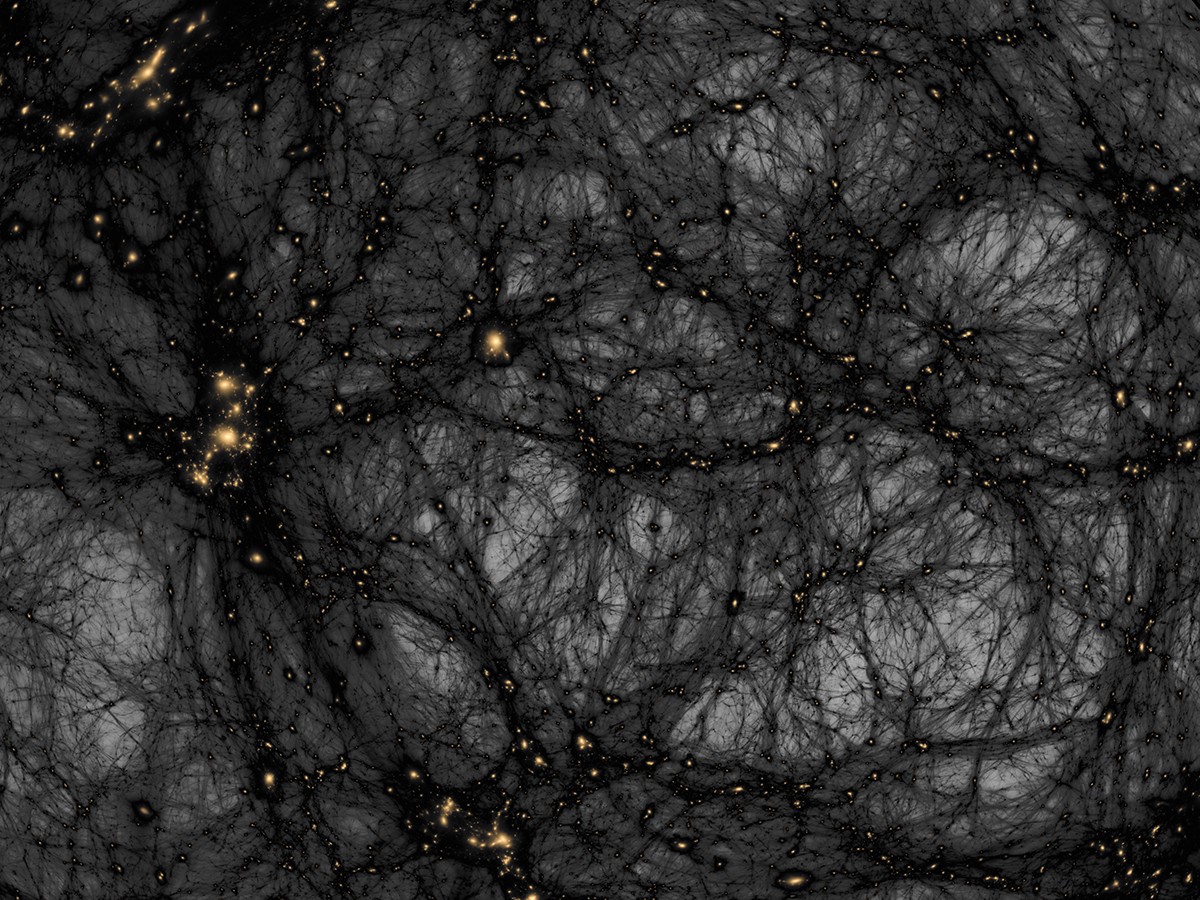
Just like identical twins, at first glance, two galaxies can often appear to be very similar, identical even. However, upon closer scrutiny, we see that simply isn’t the case. In terms of galaxies, these differences include inner regions that rotate at completely different speeds. So, although they may look the same on the outside, inside is a whole different story. One recent study, led by Hai-Bo Yu of the University of California, Riverside set out to provide us with an explanation for this diversity among galaxies.
Dark matter is the invisible casing that holds galaxies together. The distribution of it is inferred from the motion of gas particles and stars within the galaxy. In Yu’s research, the physicists report how the diverse curves and rotation speeds of these galaxies can be explained if dark matter particles do in fact collide with one another near the galaxy’s center, in a process called dark matter self-interaction. “In the prevailing dark matter theory, called Cold Dark Matter or CDM, dark matter particles are assumed to be collisionless, aside from gravity,” confirmed Yu. “We invoke a different theory, the self-interacting dark matter model or SIDM, to show that dark matter self-interactions thermalize the inner halo, which ties ordinary dark matter and dark matter distributions together so that they behave like a collective unit.” In doing this, the self-interacting dark matter halo then becomes much more flexible and easier to accommodate the diverse rotation curves.
These dark matter collisions occur in the inner halo and when the particles collide they thermalize. In galaxies of low-luminosity, the thermalization reduces the density by pushing out the inner dark matter particles. In high-luminous galaxies, such as our very own Milky Way, the thermalization process increases the dark matter density by pulling the particles into the luminous matter. “Our work demonstrates that dark matter may have strong self-interactions, a radical deviation from the prevailing theory,” says Yu.
Around 85 percent of the Universe is dark matter, yet there is still so much we don’t know about it. However, what we do know is that it has an unmistakable gravitational imprint on both cosmological and astronomical observations. A lot of Yu’s work over the last decade has been on pioneering a new kind of research that will finally conclude what happens when dark matter interacts with itself. He has hypothesized that it would almost certainly affect the dark matter distribution in each halo.
Flip Tanedo is an assistant professor if theoretical particle physics at UC Riverside who’s not involved in the study. Here’s what he had to say about it: “The compatibility of this hypothesis with observations is a major advance in the field. The SIDM paradigm is a bridge between fundamental particle physics and observational astronomy. The consistency with observations is a big hint that this proposal has a chance of being correct and lays the foundation for future observational, experimental, numerical, and theoretical work. In this way, it is paving the way to new interdisciplinary research.” He also added that “Hai-Bo is the architect of modern self-interacting dark matter and how it merges multiple fields: theoretical high-energy physics, experimental high-energy physics, observational, astronomy, numerical simulations of astrophysics, and early universe cosmology and galaxy formation.”
Research Via University of California / Research Paper
More News to Read
- Researchers Discover Ground Ice on the protoplanet Vesta
- Scientists Uncover Evidence That Suggests Mars’ Crust Isn’t As We Thought
- Researchers Have Developed a Prototype Smart Pill to Diagnose and Treat Diseases
- Move Across Even the Deepest of Snow With Ease With Drift Boards
- Keep Safe and Be Seen With the Next Generation Million Mile Light
Related Coverage
- Does General Relativity Need Dark Energy?
- Differences Between Bohmian Mechanics and Quantum Mechanics
- New Theory Emerges as to how the Universe Became Such a Light-Filled State
- Dark Energy Debate Takes Another Turn Thanks to New Supernova Analysis
- Quantum Entanglement is Just as Einstein Predicted
Don't miss new tech stories on Google
Add TrendinTech once in the Google app and our stories appear in your news suggestions.
Helena Marsh
Helena Marsh is the Editor-in-Chief at TrendinTech, where she leads editorial strategy and oversees coverage across artificial intelligence, cybersecurity and enterprise technology. With more than a decade in technology journalism on both sides of the Atlantic, she previously served as a senior editor at Wired UK and covered the technology sector for The Guardian, following the rise of the big platforms, the Cambridge Analytica scandal and the regulatory push from Brussels and Washington. Helena holds an MA in Journalism from City, University of London and is a regular speaker at Web Summit in Lisbon and CES in Las Vegas. She believes technology reporting should be rigorous and plainly written, so readers understand what actually changes for them rather than what a company's announcement promises.
All stories by Helena Marsh (201)