
Physicists Have Quantum Computing A Step Closer To Reality By Stopping Light
The world of quantum computing is a minefield. The more scientists think they know about it, the more they realize there’s so much more to learn. But, with thanks to physicists in a laboratory in Canberra, we are that one step closer to seeing…

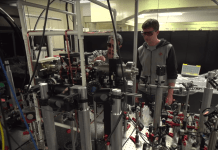
The world of quantum computing is a minefield. The more scientists think they know about it, the more they realize there’s so much more to learn. But, with thanks to physicists in a laboratory in Canberra, we are that one step closer to seeing a real life working quantum computer as they managed to freeze light in a cloud of atoms. This was achieved by using a vaporized cloud of ultracold rubidium atoms to create a light trap into which infrared lasers were shone. The light was then constantly emitted and re-captured by the newly formed light trap.
This is a fantastic example of how light can be stopped. Even if it’s not the first time light has been frozen, it is the first time the theory has been proven beyond doubt. Knowing this is a possibility gives scientists more to work with in terms of creating a functional quantum computer. This is because it allows the light and atom interactions that are needed to develop quantum logic gates.
Traditional computers work with 1’s and 0’s called bits, whereas quantum computers work with quantum bits (or qubits) and also deals with 1’s and 0’s, but in a cleverer manner. In quantum computing, a qubit can be assigned both a 1 and a 0 value at the same time, whereas in traditional computing, this would simply never work. What this means for quantum computing is the ability to perform several different tasks all at once at very fast speeds.
Researchers are aware that we still have some way to go before we have the answers we need to produce a reliable quantum computer, but that’s not about to deter anyone. But, as stated by Jesse Everett, lead researcher from the Australian National University, “Optical quantum computing is still a long way off, but our successful experiment to stop light gets us further along the road.”
The results from the experiment are published in Nature Physics.
More News To Read
- Now It Is Possible to Use Wireless Power To Keep a Drone Flying Without…
- Massive Slash on Food Waste Thanks to Blue Apron
- European Researchers Create Light System Brighter Than 21,700 Suns
- Choose Your Ideal Girl With This VR Dating Sim
- Google Cardboard Brings Dinosaurs to Life
Related Coverage
- Now Quantum Computers Can Send Information Using a Single Particle of Light
- Understanding the Speed of Light, How Much do We Know?
- Will Artificial Brains Soon Be More Effective Than Human Brains?
- Researchers Get One Step Closer to Building a Global Quantum Internet
- Quantum Computing: Set to Revolutionize Gaming?
Don't miss new tech stories on Google
Add TrendinTech once in the Google app and our stories appear in your news suggestions.
Rachel Kowalski
Rachel Kowalski is the Cybersecurity Analyst at TrendinTech, where she covers vulnerabilities, ransomware, supply chain attacks, nation-state operations and the security rules shaping organizations in the United States and Europe. Before moving into journalism she worked as a threat intelligence analyst at a security vendor and later reported for CyberScoop and the security desk at Wired, covering the SolarWinds compromise and the ransomware wave that hit hospitals and pipelines. Rachel holds a Master of Science in Cybersecurity from the Georgia Institute of Technology and attends Black Hat and DEF CON in Las Vegas each year, where she follows research from the security community. She writes to make risks and countermeasures understandable to people who are not specialists.
All stories by Rachel Kowalski (214)