
Engineers Develop Nanoscale Optical Quantum Memory Chip
A breakthrough has been made in the world of quantum computing this month as engineers at Caltech develop a computer chip equipped with nanoscale optical quantum memory. It’s the first time this has ever been done and is a massive leap forward in the development of quantum networks.


A breakthrough has been made in the world of quantum computing this month as engineers at Caltech develop a computer chip equipped with nanoscale optical quantum memory. It’s the first time this has ever been done and is a massive leap forward in the development of quantum networks.
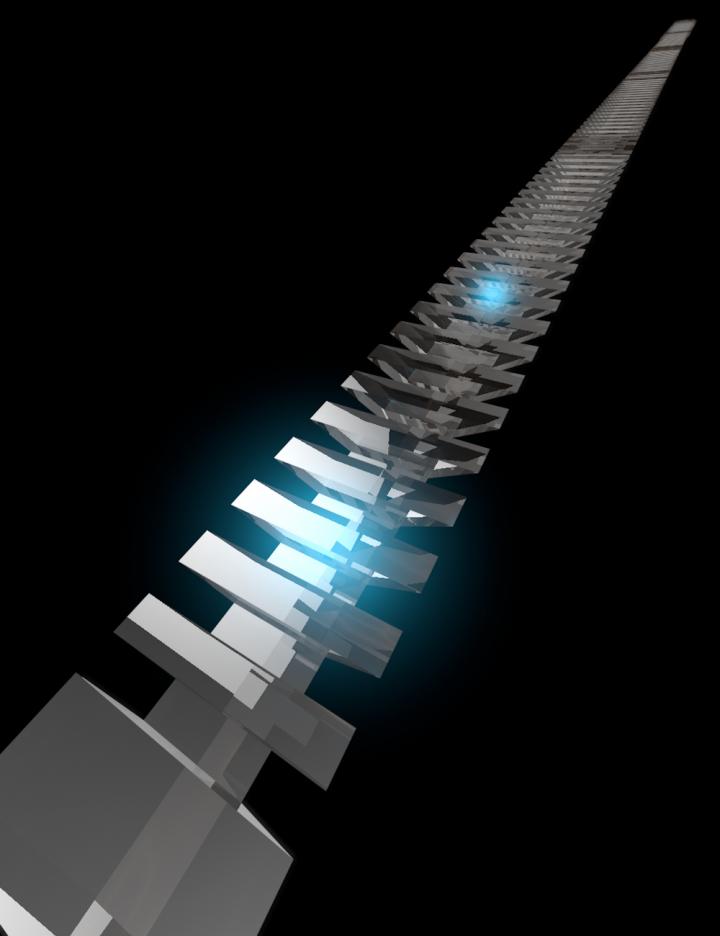
Credit: Ella Maru Studio
The way in which information is stored is similar on both traditional and quantum computers. But in quantum computers, memory is stored on individual quantum particles. Another feature of quantum mechanics that comes into play is superposition, which is where a quantum element can be in two separate states at the same time. “Such a device is an essential component for the future development of optical quantum networks that could be used to transmit quantum information,” says Andrei Faraon, assistant professor of applied physics and materials science in the Division of Engineering and Applied Science at Caltech. Faraon has recently published a study on the online version of Science magazine that describes the new chip.
Lead author of the study is Tian Zhong, a Caltech postdoctoral scholar. He advises, “This technology not only leads to extreme miniaturization of quantum memory devices, but it also enables better control of the interactions between individual photons and atoms.” In March 2018, Zhong will be setting up a laboratory to help develop quantum photonic technologies. Using individual photons in which to store and transit data is the ultimate goal mainly due to its ability to reliably and securely transfer information. They can easily be transmitted across fiber optic networks with minimal disruptions because they lack both charge and mass.
In order to be able to store the photons, Faraon and team used optical cavities that were made from crystals doped with earth ions. With these, they created tiny memory modules, which measured in around the same size as a red blood cell. The researchers then took these modules and cooled them to just above Absolute Zero (0 Kelvin, or -273.15 Celsius). Once they were cold enough, they pumped them full of single photons. Just 75 nanoseconds later, the photons were released and analyzed to see what information, if any, they had retained. According to Faraon 97% of the time, they had retained all the information.
Moving forward the team will be looking into ways they can extend how long the memory can store information. For the kind of quantum network, scientists are after; the memory will need to be able to store data accurately for at least one millisecond. At the same time, the team will also explore ways in which to successfully integrate the quantum memory into more complex circuits and thus making a massive leap towards achieving the ultimate quantum network.
More News to Read
- Researcher Discovered a New Way of Eco-Friendly Disposal for Data Security and Healthcare
- NASA’s Ocean Observation Reveals Sea-Level Fingerprints
- Chinese Scientists Create Device That Converts Blood Flow Energy into Electricity
- Researches Revealed a New Clinically Tested Drugs that Inhibits the Growth of Tumours
- What Do You Think About Clothes that Grow With Your Child?
Related Coverage
- Physicists Create Quantum Memory Capable of Storing Photons
- Synthetic Biology Takes Another Leap Forward with the Development of New Circuitry
- Quantum Technology Takes Another Leap Forward by Bending Photons
- IBM Will Use Quantum Computing In Cloud Service
- IBM Wil Use Quantum Computing In Cloud Service
Don't miss new tech stories on Google
Add TrendinTech once in the Google app and our stories appear in your news suggestions.
Owen Castellanos
Owen Castellanos is the Hardware & Gaming Reporter at TrendinTech, where he tests graphics cards, processors, consoles and peripherals and follows the games industry, from the major publishers to independent studios. He previously wrote reviews and benchmarks for Tom's Hardware and contributed features to PC Gamer, covering everything from laptop testing to the economics of game development. Owen holds a Bachelor of Science in Electrical Engineering from the University of Texas at Austin and attends CES in Las Vegas, Computex in Taipei and the Game Developers Conference in San Francisco each year to meet chipmakers and developers. He writes for readers who want to know whether a product is worth the money, and he is not shy about saying when it is not.
All stories by Owen Castellanos (252)