
New Galactic Secrets Revealed
The Fornax Cluster is one of the closest and richest galaxy clusters to our own Milky Way galaxy. A recent image captured by the VLT Survey Telescope (VST) at ESO’s Paranal Observatory in Chile reveals some of its hidden secrets.

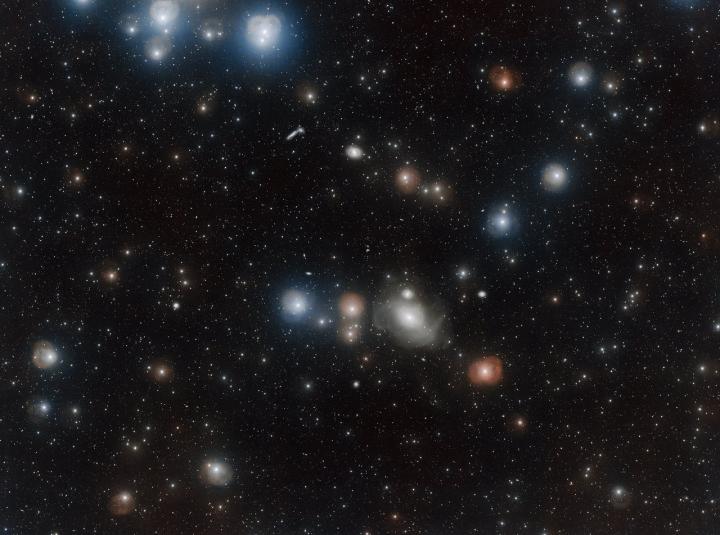
The Fornax Cluster is one of the closest and richest galaxy clusters to our own Milky Way galaxy. A recent image captured by the VLT Survey Telescope (VST) at ESO’s Paranal Observatory in Chile reveals some of its hidden secrets.
One of the fascinating galaxies of the cluster is NGC 1316. What makes it so special its dynamic history. Having been formed by the merger of several smaller galaxies, NGC 1316 has large ripples and loops embedded in its starry sky. These were first discovered in the 1970’s and still remain an active subject of observations today.
When NGC 1316 formed, there was a massive influx of gas as a result. This fuels the supermassive black hole that sits in its center. As the black hole accretes mass from its surroundings it emits powerful jets of high-energy particles that can be seen at radio wavelengths. These jets are also what make NGC 1316 the fourth-brightest radio source in the sky.

Four type Ia supernovae are also thought to be present in NGC 1316. This is especially exciting as type Ia supernovae are used to measure how far away the galaxy, which is only made possible because of their intense brightness. Using this method, researchers estimated NGC 1316 to be around 60 million light-years away.
These bright “candles of the night sky” are excellent markers to reliably measure the distance to such remote objects and are very sought after by astronomers. They also played a key part in discovering that our Universe is expanding at an accelerating rate.
More News to Read
- UCLA Researchers Create New Kind of Superlattice
- 5 Simple Tips for Maximizing Workplace Efficiency
- 5 Signs It Is Time to Invest in Video Marketing
- Tips for Maintaining Network Security
- Why Is CRUD So Important In Computer Programming?
Related Coverage
- Chile’s Very Large Telescope Interferometer Captures Best Image Ever of a Star’s Surface
- Cannabis and Cannabinoids Show Great Potential in Reducing Pain
- Hubble Telescope Reveals Unusual Object in the Asteroid Belt
- The Meme Culture of America is Taking Over
- Scientists May Have Just Revealed Evidence of the Multiverse
Don't miss new tech stories on Google
Add TrendinTech once in the Google app and our stories appear in your news suggestions.
Rachel Kowalski
Rachel Kowalski is the Cybersecurity Analyst at TrendinTech, where she covers vulnerabilities, ransomware, supply chain attacks, nation-state operations and the security rules shaping organizations in the United States and Europe. Before moving into journalism she worked as a threat intelligence analyst at a security vendor and later reported for CyberScoop and the security desk at Wired, covering the SolarWinds compromise and the ransomware wave that hit hospitals and pipelines. Rachel holds a Master of Science in Cybersecurity from the Georgia Institute of Technology and attends Black Hat and DEF CON in Las Vegas each year, where she follows research from the security community. She writes to make risks and countermeasures understandable to people who are not specialists.
All stories by Rachel Kowalski (214)