
Chile’s Very Large Telescope Interferometer Captures Best Image Ever of a Star’s Surface
It’s not easy to capture images of objects in the night sky, as they’re so very far away. So, when astronomers do get good ones, you can be sure that they’ll let everyone know.


It’s not easy to capture images of objects in the night sky, as they’re so very far away. So, when astronomers do get good ones, you can be sure that they’ll let everyone know. And, that’s what’s happened this month over at the Universidad Catolica del Norte in Chile. Using ESO‘s Very Large Telescope Interferometer (VLTI) at the Paranal Observatory in Chile, a team of astronomers led by Keiichi Ohnaka captured the best image that we’ve ever seen of the surface and atmosphere of a star, Antares, other than that of the sun.
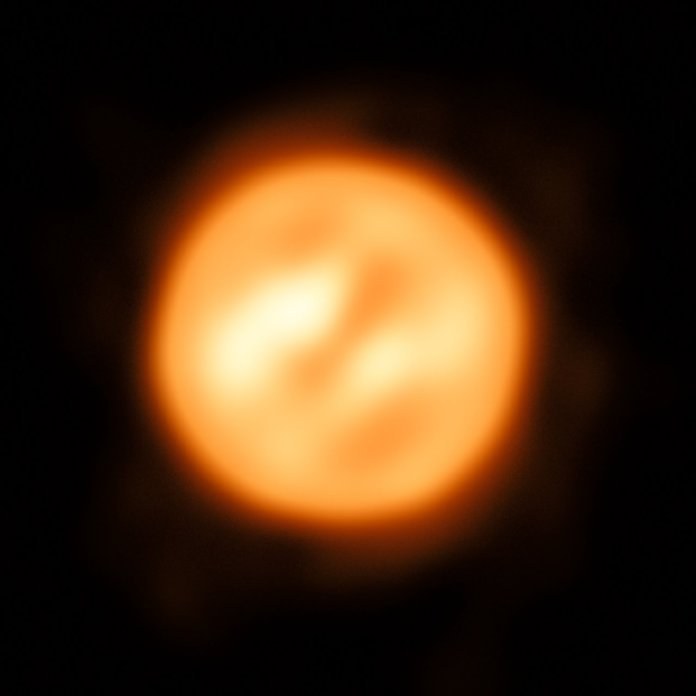
The VLTI is rather unique in what it can do as it has the ability to combine light from up to four telescopes in which to create a 200-meter virtual telescope. This allows it to see far more than any other single telescope could. As Ohnaka explains, “The VLTI is the only facility that can directly measure the gas motions in the extended atmosphere of Antares – a crucial step towards clarifying this problem. The next challenge is to identify what’s driving the turbulent motions.”
Antares is a red supergiant with a mass of about 12 times that of the Sun with a diameter about 700 times larger. According to experts, it has shed three solar-masses of material during its lifetime. Armed with the new results, the team created a 2D velocity map of a star’s atmosphere using the VLTI. The data they gathered was used to calculate the difference between the speed of the atmospheric gas various points on the star and the average speed across the whole star. The final result was the first ever map of the relative speed of atmospheric gas across the whole of Antares.
“In the future, this observing technique can be applied to different types of stars to study their surfaces and atmospheres in unprecedented detail,” says Ohnaka. “Our work brings stellar astrophysics to a new dimension and opens an entirely new window to observe stars.”
More News to Read
- New Hydrogel Material Could Help Tissue Repair After Stroke
- New Bacterium Discovered That Can Nucleate Ice
- Does the Answer to Better Patient Care Lie in Machine Learning?
- MAG-LEV Audio: Futuristic Technology Meets an old Format
- New Grant Allocated to Imperial College Professor to Research Incurable Lung Disease
Related Coverage
- Hubble Helps Astronomers Solve Cosmic Puzzle
- Researchers Get a Much Closer Look at Exoplanets Thanks to New Telescope Attachment
- NASA’s Solar Dynamics Observatory Captures Images of Two Fantastic Solar Flares
- Scientists Identify First Ever Supernova by Gravitational Lensing
- Quantum Computer Programming: What You Need to Learn to Get Started?
Don't miss new tech stories on Google
Add TrendinTech once in the Google app and our stories appear in your news suggestions.
Helena Marsh
Helena Marsh is the Editor-in-Chief at TrendinTech, where she leads editorial strategy and oversees coverage across artificial intelligence, cybersecurity and enterprise technology. With more than a decade in technology journalism on both sides of the Atlantic, she previously served as a senior editor at Wired UK and covered the technology sector for The Guardian, following the rise of the big platforms, the Cambridge Analytica scandal and the regulatory push from Brussels and Washington. Helena holds an MA in Journalism from City, University of London and is a regular speaker at Web Summit in Lisbon and CES in Las Vegas. She believes technology reporting should be rigorous and plainly written, so readers understand what actually changes for them rather than what a company's announcement promises.
All stories by Helena Marsh (201)