Motorola Razr Flex 27 Leak Eyes iPhone Duo Rival [2026]

Motorola appears to be building a compact foldable phone that leakers are calling the Razr Flex 27, and the timing puts it on a direct collision course with Apple’s iPhone Duo. A Geekbench listing spotted on October 19 and 20, 2026 reignited the story, with Indian outlet Digit and Germany’s NotebookCheck both reporting fresh hardware details on the same device. Neither Motorola nor its parent company Lenovo has confirmed the name, the specifications, or a release date.
That caveat matters, because the leak is circulating at the exact moment Apple’s own foldable, the iPhone Duo, is moving from announcement to shelf. Apple unveiled the device on September 9, 2026, opened preorders on October 16, and has scheduled retail availability for October 23, 2026, this week. Motorola’s alleged answer is reportedly aimed at undercutting it on price while chasing a similar compact, book-style form factor. Here is what the leaks actually say, what Motorola has officially shipped instead, and why the gap between rumor and confirmed product is wider than some headlines suggest.
Don't miss new tech stories on Google
Add TrendinTech once in the Google app and our stories appear in your news suggestions.
What the Motorola Razr Flex 27 Leak Actually Claims
The chain of leaks goes back further than this week’s Geekbench sighting. Reports traced an early version of the story to September 14, 2026, when leaked sketches reportedly showed Motorola developing a wider, passport-style foldable distinct from its existing Razr flip phones. By late September, a broader leak introduced an internal project name, “Razr Flex,” alongside a development codename, “Parker,” and pointed to a mid-December 2026 target window.
The naming shifted again on October 19 and 20, when a Geekbench benchmark entry reportedly attached the label “Motorola Razr Flex 27” to the project, a detail Digit and PhoneArena both picked up. Some coverage has floated “Razr Flex 2027” as an alternate reading, on the theory that the “27” refers to the 2027 product cycle rather than a confirmed retail name. None of this has been verified by Motorola, and the company’s own product pages make no mention of a Razr Flex of any kind.
Razr Flex 27 Is Not the Same Phone as the Razr Fold
One point of confusion worth clearing up early: Motorola already sells a large foldable called the Razr Fold, and it is a completely different device from the rumored Razr Flex 27. Motorola’s own marketing describes the Razr Fold as “An icon unfolds, now bigger, bolder, and AI-ready,” built around a 6.6-inch cover display that opens to an 8.1-inch inner screen. That phone is real, it is listed on Motorola’s regional sites, and it has nothing to do with the leaked Flex 27 project beyond sharing a parent brand.
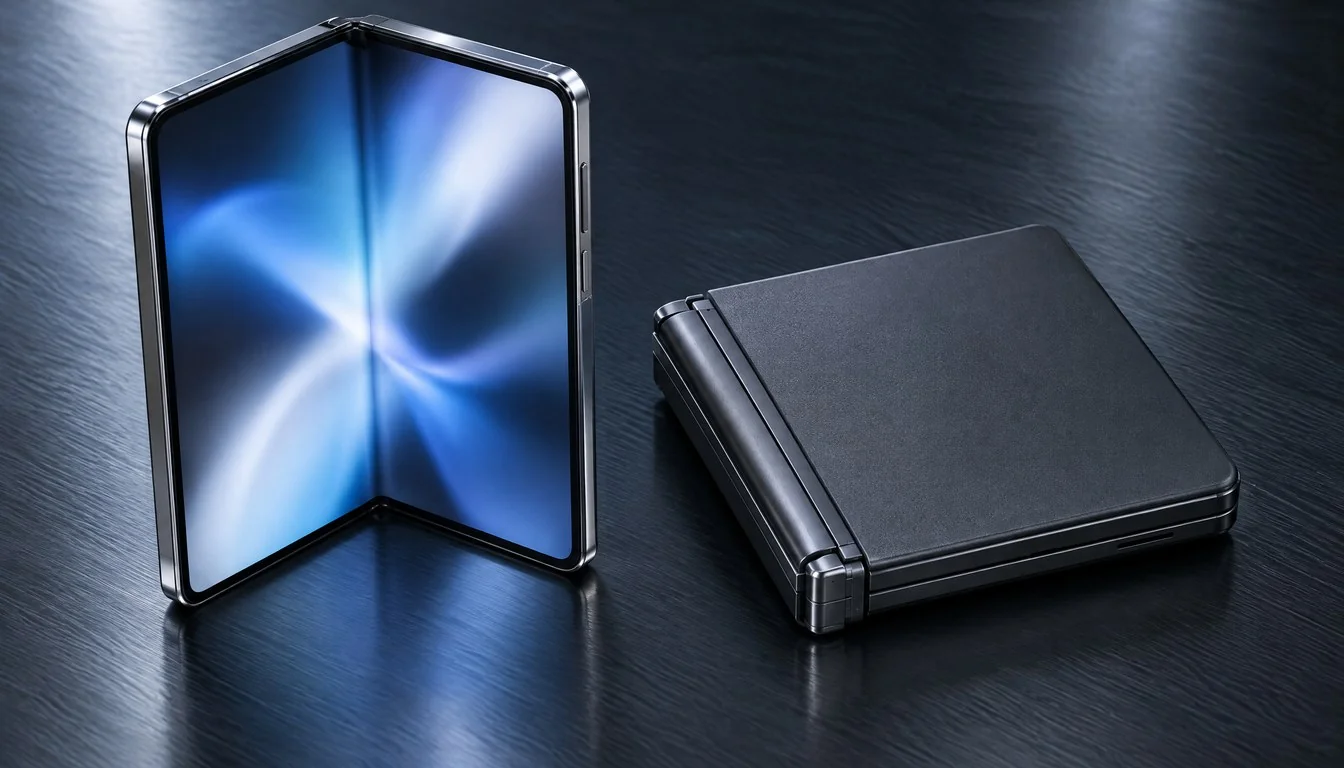
The Razr Flex 27, by contrast, is described in leak reports as a smaller, passport-style device, closer in concept to a compact book-style fold than to the wider Razr Fold. If the leaks hold up, Motorola would effectively be running two different foldable form factors side by side: the already-shipping Razr Fold at the larger end, and a smaller Flex model aimed more squarely at Apple’s compact foldable ambitions. Readers comparing Motorola’s existing foldable lineup against Samsung’s can find more detail in our earlier breakdown of the Galaxy Z Fold8 versus Razr Fold matchup.
Leaked Specs: What Reports Agree On, and Where They Clash
Across the Digit, PhoneArena and NotebookCheck reports, a rough specification sheet has emerged for the Razr Flex 27, though it should be read as a leak compilation rather than an official sheet. The most repeated claim is a 6.92-inch inner AMOLED display running at up to 165Hz, paired with a 4.97-inch external cover screen. Reports also converge on 12GB of RAM, a 5,000mAh battery, and Android 17 as the shipping software base.
Where the leaks disagree is the processor. NotebookCheck’s reporting on the Geekbench listing points to a Qualcomm Snapdragon 8 Gen 5, a notably less expensive chip than Qualcomm’s Snapdragon 8 Elite Gen 5 or the newer Snapdragon 8 Elite Gen 6. Other leak summaries had previously floated the costlier Elite Gen 5 as the chip of choice. NotebookCheck’s own framing treats the cheaper Snapdragon 8 Gen 5 as a signal that Motorola is deliberately building toward a lower price point rather than chasing flagship benchmark numbers, a strategy that would track with the “budget iPhone Duo rival” framing used across most of the coverage.
Additional details floating around the leak ecosystem, including 256GB of storage, 25W wireless charging, a 215g weight, 5.8mm folded thickness, an IP49 water and dust rating, and two PANTONE color options nicknamed Coriander and Dark Botanical Garden, remain single-sourced and unconfirmed by any Motorola or Lenovo material. Treat them as directional rather than final.
Spec Comparison: Rumor Versus Confirmed Hardware
| Spec | Razr Flex 27 (rumored) | Razr Fold (confirmed, shipping) | iPhone Duo (confirmed, Apple) |
|---|---|---|---|
| Status | Unconfirmed leak | Officially announced and listed | Announced, preorders open |
| Inner display | 6.92-inch, reportedly up to 165Hz | 8.1-inch | 7.6-inch |
| Cover/outer display | 4.97-inch | 6.6-inch | 5.4-inch |
| Processor | Snapdragon 8 Gen 5 (reported, disputed) | Not specified by Motorola in cited material | Apple A20 Pro |
| RAM | 12GB (reported) | Not confirmed | Not confirmed |
| Battery | 5,000mAh (reported) | 6,000mAh | Dual-battery architecture (capacity not disclosed) |
| Software | Android 17 (reported) | Not specified in cited material | iOS 27.1 |
| Reported launch window | December 2026 (unconfirmed) | Already available in multiple markets | October 23, 2026 |
The iPhone Duo Side of the Story
It helps to be precise about what Apple has actually confirmed, since several leak headlines treat the iPhone Duo as settled fact worth beating. Apple announced the iPhone Duo on September 9, 2026, describing it as a foldable iPhone with a 7.6-inch inner display and a 5.4-inch outer display, built around the A20 Pro chip and a dual-battery architecture. Preorders opened October 16, and Apple’s developer documentation confirms the device ships with iOS 27.1 on October 23, with Xcode 27.1 adding the development tools needed to support its folding poses and orientations.
That puts Apple roughly five weeks ahead of Motorola’s rumored December target, assuming the leak timeline holds. It also means Motorola is not chasing a moving target so much as a device that will already be in customers’ hands and under review by the time any Razr Flex 27 would ship. Our coverage of the iPhone Duo’s A20 Pro chip and Siri integration and the device’s head-to-head against Apple’s own flagship in the iPhone Duo versus iPhone 18 Pro Max comparison both go into more detail on what Apple has actually shipped.
Samsung’s Galaxy Z Fold8 Is the Other Target
Digit’s reporting frames the Razr Flex 27 as a rival not just to Apple but to Samsung’s Galaxy Z Fold8, positioning it as a smaller, cheaper alternative to both companies’ flagship foldables. That is a notable strategic choice if accurate: rather than trying to out-spec the Z Fold8 or match Apple’s A20 Pro silicon, Motorola would be betting on a mid-tier Snapdragon chip and a lower price to pull buyers who want foldable functionality without flagship pricing. It is the same playbook Motorola has run with its existing Razr lineup, where the standard Razr undercuts the Razr Ultra on price while keeping the flip form factor.
Why the Leak Timeline Keeps Shifting
Leak timelines for unannounced phones rarely stay fixed, and the Razr Flex 27 story illustrates why. What started in mid-September as a vague report about a “wider foldable” became, by late September, a named project with a codename and a mid-December target. By October 19 and 20, a Geekbench sighting added a chipset, a RAM figure, and an operating system version, while also attaching the more specific “Flex 27” label. Each stage added detail without any of it becoming official, which is a pattern familiar from how most unannounced flagship phones leak in stages ahead of launch.
If a mid-December 2026 window is accurate, Motorola would be launching a brand-new foldable form factor in the same quarter it typically refreshes its existing Razr line, a tight turnaround for a company that already ships several Razr variants a year.
Motorola and Lenovo’s Current Foldable Strategy
Motorola Mobility operates as a wholly owned subsidiary of Lenovo, which has used its own Tech World events to promote AI features across the Motorola lineup. Lenovo’s chairman and chief executive, Yuanqing Yang, is scheduled to present the company’s “Hybrid AI” direction at Tech World at CES 2027 in January, and Motorola’s current product pages already lean heavily on AI-branded features across the Razr, Edge and Moto G families.
That context matters for reading the Razr Flex 27 leak. Motorola’s currently shipping foldable, the Razr Fold, is explicitly marketed as “AI-ready,” and a second, smaller foldable aimed at undercutting Apple and Samsung on price would fit a broader pattern of Lenovo pushing Motorola into more foldable categories rather than consolidating around a single design. It would also give Motorola a compact-foldable answer at a moment when Apple’s debut foldable is drawing most of the attention away from Android foldables generally.
The Foldable Market Motorola Is Trying to Win
Foldables remain a small but growing slice of the smartphone market, and the numbers help explain why Motorola, Samsung and Apple are all crowding into the category at once. According to the International Data Corporation, “worldwide foldable smartphone shipments are forecast to reach 20.6 million units in 2025, representing 10% year-over-year growth,” a figure published in its Worldwide Foldable Smartphone Forecast, 2025 to 2029. IDC’s research also projects that “the foldable smartphone category” will grow “at a 17% compound annual growth rate through 2029,” a pace far ahead of the broader smartphone market.
Even with that growth, foldables remain a niche category in absolute terms. IDC’s separate Worldwide Smartphone Market Forecast notes that “the worldwide foldable smartphone market” is expected to “grow 6% year over year in 2025, following 4% growth in 2024,” and that IDC “forecasts foldable smartphones will represent less than 3% of total smartphone shipments by 2029.” In other words, every company piling into foldables right now, Motorola included, is fighting over a fast-growing but still small corner of the market, which is exactly why price positioning matters as much as specs.
Foldable Market Growth at a Glance
| Metric | Figure | Source |
|---|---|---|
| 2025 foldable shipment growth (YoY) | 6%, following 4% growth in 2024 | IDC Worldwide Smartphone Market Forecast |
| 2025 foldable unit shipments | 20.6 million units, +10% YoY | IDC Worldwide Foldable Smartphone Forecast, 2025-2029 |
| Foldable CAGR through 2029 | 17% | IDC Worldwide Foldable Smartphone Forecast, 2025-2029 |
| Foldable share of total smartphones by 2029 | Under 3% | IDC Worldwide Smartphone Market Forecast |
Historical Context: Motorola’s Long Road Back to Razr
Motorola’s Razr brand carries more nostalgia than almost any other phone name on the market, a legacy that dates back to the original flip-phone Razr of the mid-2000s before Motorola revived the name as a foldable in 2019. Since then, the company has iterated through multiple flip-foldable generations under Lenovo’s ownership, expanding the lineup to include standard Razr, Razr Plus and Razr Ultra tiers before adding the larger book-style Razr Fold this year. A Flex 27 project, if it ships, would represent Motorola’s first attempt at a smaller book-style foldable, a format it has not previously shipped at that screen size.
That expansion mirrors what Samsung did earlier in the decade, moving from a single Galaxy Fold model to a multi-tier lineup spanning flip and book-style foldables. Motorola, and by extension Lenovo, appears to be following a similar multi-form-factor strategy, just several years behind Samsung and now potentially racing Apple’s first attempt at the category too.
What Happens If the December Launch Slips
Because none of the Razr Flex 27 details come from Motorola directly, every element of the reported timeline carries real slip risk. Phones that show up on Geekbench months before launch sometimes ship on schedule, and sometimes get delayed by a full quarter or more while chipset allocation, display yields or carrier certification catch up. Given that Motorola has not even confirmed the project exists, a December 2026 date should be read as the leakers’ best guess rather than a locked release window.
There is also a naming risk worth flagging separately from the launch date. Multiple outlets are already using “Razr Flex 27” and “Razr Flex 2027” somewhat interchangeably, which suggests the final retail name has not solidified even among leakers, let alone inside Motorola. It would not be the first time a leaked codename or benchmark label ended up different from the name stamped on the retail box.
Competitive Pressure Across the Foldable Field
The Razr Flex 27 leak lands during a rough stretch for smartphone hardware generally. Broader supply constraints have already weighed on shipment volumes this year, a trend covered in our report on how global smartphone shipments fell 20% amid a memory shortage. Foldables are not immune to that pressure, since advanced displays and the specialized hinges they require draw on many of the same constrained component pools as flagship slab phones. A lower-cost foldable strategy, if Motorola is indeed pursuing one with Snapdragon 8 Gen 5 silicon instead of pricier Elite-tier chips, would be one way to manage those cost pressures while still competing on form factor.
Regional dynamics add another layer. Motorola and its rivals are fighting for share market by market, and our coverage of how Samsung holds just under half of South Africa’s smartphone market shows how entrenched incumbents can be even where foldables are a small slice of overall sales. Any Motorola foldable aimed at undercutting Apple and Samsung on price would need to clear that kind of entrenched brand loyalty in multiple regions at once, not just win on paper specs.
What a Cheaper Foldable Strategy Would Mean for Buyers
No official Razr Flex 27 price has surfaced in any of the reporting reviewed for this story, and readers should treat any number attached to the device elsewhere online as speculation. What the leaks do suggest, through the reported choice of a mid-tier Snapdragon 8 Gen 5 chip rather than a flagship Elite-series part, is a strategy built around undercutting rather than matching Apple and Samsung spec-for-spec. If that holds, the Razr Flex 27 would likely sit below both the iPhone Duo and the Galaxy Z Fold8 on price while trading away some processing headroom to get there.
Predictions: Where This Story Goes Next
- Motorola is unlikely to confirm the Razr Flex 27 by name before a formal teaser campaign, which, if the leaked December window holds, would likely begin in November 2026.
- Expect further Geekbench or regulatory filing leaks (FCC, BIS, or similar certification bodies) over the next few weeks that either confirm or contradict the Snapdragon 8 Gen 5 chipset claim.
- If Motorola does launch a compact book-style foldable, it will almost certainly be priced below both the iPhone Duo and the Galaxy Z Fold8, continuing Motorola’s budget-foldable positioning.
- The “27” naming convention is more likely to resolve into a simpler retail name by launch, following the pattern of past Motorola leaks where codenames did not survive to the final product.
- Even if the Razr Flex 27 ships on schedule, it will remain a niche product in a foldable category that IDC expects to stay under 3% of total smartphone shipments through 2029, meaning any real “rivalry” with the iPhone Duo will play out in reviews and tech press rather than in overall sales volume.
Frequently Asked Questions
Is the Motorola Razr Flex 27 an officially announced product?
No. As of October 20, 2026, the Razr Flex 27 exists only in leak reports and a reported Geekbench listing. Motorola has not confirmed the name, specifications, pricing, or a release date.
How is the Razr Flex 27 different from the Motorola Razr Fold?
The Razr Fold is a real, currently shipping Motorola foldable with a 6.6-inch cover display and an 8.1-inch inner display. The Razr Flex 27 is a separate, unconfirmed project described in leaks as a smaller, passport-style foldable with a reported 6.92-inch inner screen and a 4.97-inch cover screen.
What chipset will the Razr Flex 27 use?
Reports conflict. A Geekbench leak reported by NotebookCheck points to a Qualcomm Snapdragon 8 Gen 5, while earlier leak summaries had floated the costlier Snapdragon 8 Elite Gen 5. Neither is confirmed by Motorola.
When could the Razr Flex 27 launch?
Leak reports point to a possible mid-December 2026 window, but this is unconfirmed and could shift. No official Motorola launch date has been announced.
How does the Razr Flex 27 compare with the Apple iPhone Duo?
The iPhone Duo is an officially announced, confirmed product with a 7.6-inch inner display, a 5.4-inch outer display, Apple’s A20 Pro chip, and retail availability scheduled for October 23, 2026. The Razr Flex 27 remains an unconfirmed leak with a smaller reported 6.92-inch inner display and no confirmed chipset, price, or release date.
Will the Razr Flex 27 be cheaper than the iPhone Duo or Galaxy Z Fold8?
No official price exists for any of these comparisons, but leak reports consistently frame the Razr Flex 27 as a lower-cost alternative, partly based on its reported use of a mid-tier Snapdragon 8 Gen 5 chip instead of a flagship Elite-series processor.
Who owns Motorola, and does that affect this leak?
Motorola Mobility is wholly owned by Lenovo. Lenovo has not commented on the Razr Flex 27 specifically, though it continues to promote AI features across Motorola’s current Razr, Edge and Moto G lineups.
Where did the Razr Flex 27 name come from?
The name surfaced through a reported Geekbench benchmark listing spotted on October 19 and 20, 2026, following earlier leaks that used the internal project name “Razr Flex” and the codename “Parker.”
Related Coverage
Owen Castellanos
Owen Castellanos is the Hardware & Gaming Reporter at TrendinTech, where he tests graphics cards, processors, consoles and peripherals and follows the games industry, from the major publishers to independent studios. He writes for readers who want to know whether a product is worth the money, and he is not shy about saying when it is not.
All stories by Owen Castellanos (403)