
Latest ESA Research Leads to Better Cameras for Precision Agriculture
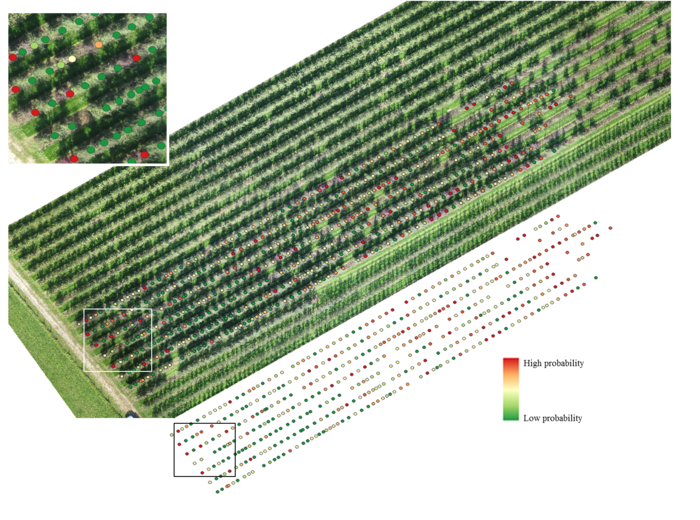
A new camera from Cubert, working in collaboration with VITO Remote Sensing and imec, based on research from the European Space Agency, is bringing high-resolution details to precision farming. Fireblight disease detection in pear orchards in St Truiden, Belgium, achieved by analysis based on RGB and hyperspectral data taken from a drone.

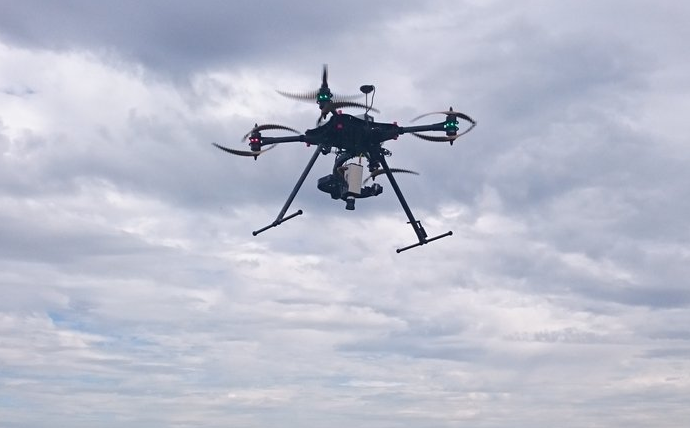
A new camera from Cubert, working in collaboration with VITO Remote Sensing and imec, based on research from the European Space Agency, is bringing high-resolution details to precision farming.
Precision farming relies on *hyperspectral imaging to gather additional information about crops for making the best decisions on resource and field management. The ButterflEYES LS from Cubert can now provide these images with in focus details as minute as five centimeters. Also, since it weighs only 400g, it is easily carried by a drone over large and varied land masses.
Hyperspectral imaging can capture visual information in a variety of wavelengths, including near-infrared. Because of this added feature, a hyperspectral camera allows its users to see processes or problems that might otherwise be invisible to in normal imaging.
One of the key differences between previous hyperspectral cameras and the ButterflEYES LS camera is the use of an incorporated filter in imec’s ultra-small sensor as opposed to the traditionally used prism that would make the camera too large for unmanned aircraft. Additionally, the image processor from VITO was developed after working on ESA remote sensing satellites.
Currently, the camera is being tested on three different projects: agricultural research in Australia, biological diversity studies in Denmark, and commercial data gathering for farmers in Italy. The resulting feedback of these programs will go on to inform development for a future commercially available model.
*Hyperspectral imaging, like other spectral imaging, collects and processes information from across the electromagnetic spectrum. The goal of hyperspectral imaging is to obtain the spectrum for each pixel in the image of a scene, with the purpose of finding objects, identifying materials, or detecting processes. Via Wikipedia
More News to Read
- 3D Printing’s Even More Affordable Now Thanks to SparkMaker
- Is it the End of the Road for Silicon Chips?
- Researches Made a Softer and Smarter Robotic Arm for Endoscopic Surgeries
- Breakthrough for Alzheimer’s Patients Comes in the Form of Enzyme Blockage
- Researchers Use AI Algorithm to Help Those Suffering From Sleep Disorders
Related Coverage
- The Race for Space Colonization Starts with NASA’s Lunar Station Plans
- Technology: The Future of Agriculture
- The European Commission Will Invest €1 Billion in Quantum Technology Research
- ONAGOfly: Drones That Follows You
- Thermal Imaging Specialists Buys This Little Drone’s Maker for $134 Million
Don't miss new tech stories on Google
Add TrendinTech once in the Google app and our stories appear in your news suggestions.
Yusuf Demir
Yusuf Demir is the Cloud & Software Reporter at TrendinTech, where he covers cloud infrastructure, enterprise platforms, developer tools and the digital transformation of businesses in the UK and the United States. He previously reported on enterprise technology for The Register in London and covered the cloud and SaaS beat for TechCrunch, following the competition between AWS, Microsoft Azure and Google Cloud, the open source licensing disputes and the rise of Kubernetes. Yusuf holds an MEng in Computing from Imperial College London and speaks regularly at KubeCon and AWS re:Invent, where he moderates conversations with engineers and chief technology officers. He is most interested in the gap between vendor roadmaps and the systems engineers actually run, and in what the cloud bill looks like once the free credits expire.
All stories by Yusuf Demir (294)