
Fast Radio Bursts Demystified With the Help of IceCube Neutrino Detector
First detected back in 2007, fast radio bursts (FRB’s) are a phenomenon that has had physicists mystified ever since they were first discovered. Since then nearly two dozen more FRB’s have been detected by Australia’s Parkes Telescope as well as other radio telescopes across the world.

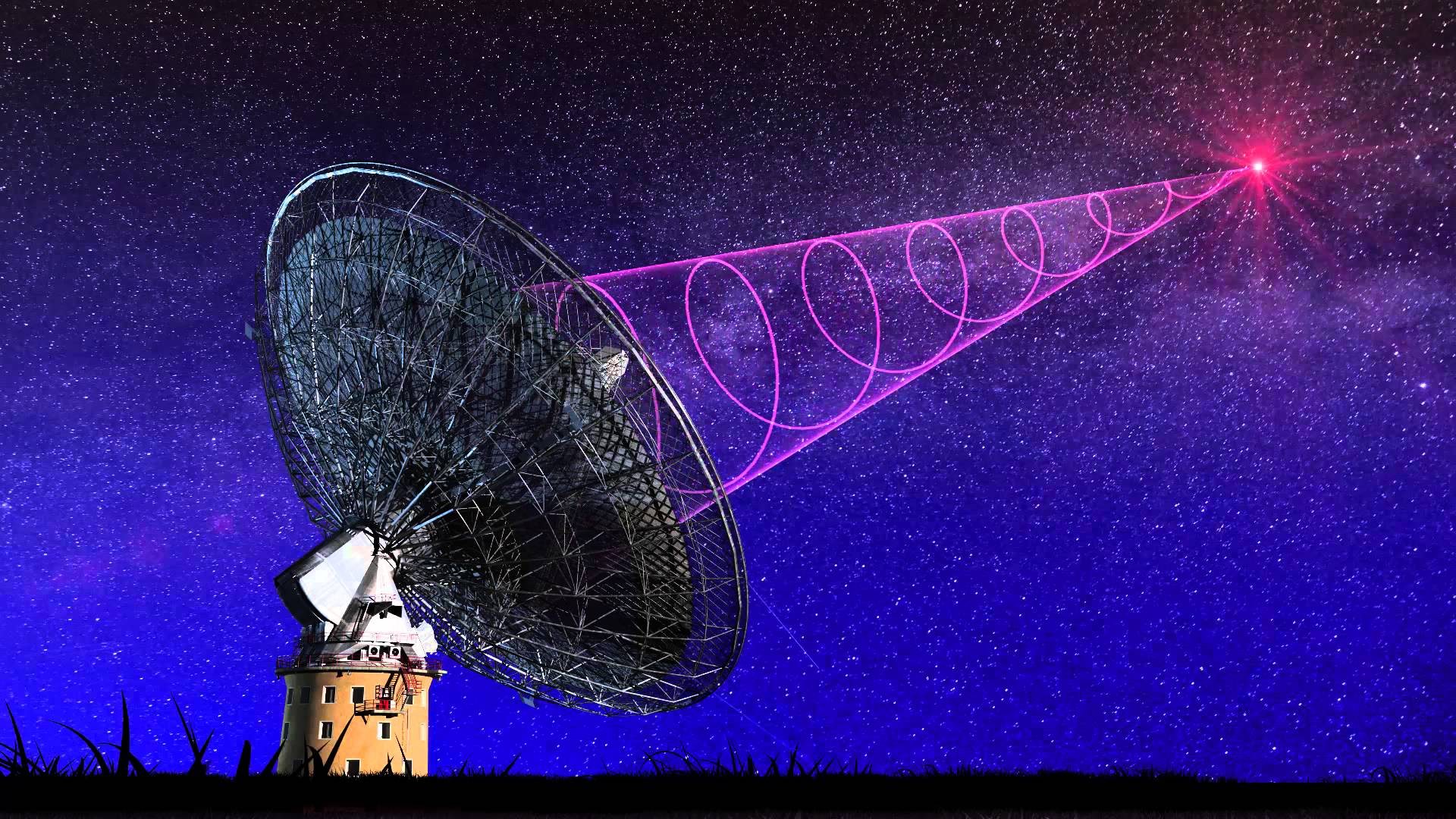
First detected back in 2007, fast radio bursts (FRB’s) are a phenomenon that has had physicists mystified ever since they were first discovered. Since then nearly two dozen more FRB’s have been detected by Australia’s Parkes Telescope as well as other radio telescopes across the world.
“It’s a new class of astronomical events. We know very little about FRB’s in general,” said Justin Vandenbroucke, a University of Wisconsin Madison physicist. To try and help demystify these intense pulses Vandenbroucke and colleagues turned to IceCube for assistance. IceCube is the world’s most sensitive neutrino telescope and is just what researchers needed to see if high-energy neutrinos are generated at the same time as the FRB’s. If they are, this will give scientists a heads up as to what may be behind the generation of these radio flares and the environment in which they come from.
The IceCube neutrino detector is made up of over 5,000 optical modules which are embedded in the ice a mile below the South Pole. This powerful machine is capable of capturing the signatures of high-energy neutrinos and is supported by the National Science Foundation. Catching fast radio bursts is difficult because they’re so random and only last for a matter of milliseconds. So far there’s only one FRB, called FRB 121102, that’s been found to repeat, and it’s located around 3 billion light-years away.
One of the reasons why IceCube is so right for the job of detecting fast radio bursts is that has an extremely wide field of view compared to radio and optical telescopes. As particles come hurtling in towards Earth, the telescope gathers data on neutrino events as it scans the whole southern and northern hemispheres.
To observe both fast radio bursts and neutrinos at the same time would be amazing and could help researchers gain valuable insight into both these phenomena. “Astrophysical neutrinos and fast radio bursts are two of the most exciting mysteries in physics today,” said Vandenbroucke. “There may be a link between them.”
More News to Read
- New Joint Initiative Between Imperial and Kings College London Boosts Artificial Cell Design
- Check Out New Features of Mars Rover 2020
- Astronomers Image Material That Obscures Black Holes
- A New Concept of Terrestrial Planet Formation Proposed
- Hydrogel Casts Could Become the New Way to Control Bleeding Disorders
Related Coverage
- Tabby’s “Alien-Megastructures” Star Had Begun to Dim Again
- Thanks to LIGO We Can Now Produce Our Very Own Gravitational Waves
- Astronomers Discover Strange ‘Glitch’ in Binary System
- Hubble Telescope Reveals Unusual Object in the Asteroid Belt
- Scientists Confirm First Nuclear Reactor Was Natural, Not Man-Made.
Don't miss new tech stories on Google
Add TrendinTech once in the Google app and our stories appear in your news suggestions.
Daniel Okafor
Daniel Okafor is the Senior AI Reporter at TrendinTech, where he covers large language models, machine learning research and the practical use of artificial intelligence across business and government. He previously reported on artificial intelligence for MIT Technology Review, covering the labs behind the current generation of frontier models and the policy debates in Washington and Brussels. Daniel holds a Master of Science in Machine Learning from Carnegie Mellon University and follows the research community closely, attending NeurIPS and ICML each year to speak with the people behind the papers. He has a particular interest in evaluation: how models are benchmarked, where those benchmarks fail and what that means for the companies betting on them.
All stories by Daniel Okafor (316)