
Could Using 3D Imaging Be Used to Detect Signs of Extraterrestrial Life in Space?
According to Caltech researchers, holographic microscopy is our best chance for identifying microbes living in space. In a paper published in a special edition of Astrobiology, Jay Nadeau and team make a case for using the technique to analyze water samples taken from Enceladus, one of Saturn’s moons.


According to Caltech researchers, holographic microscopy is our best chance for identifying microbes living in space. In a paper published in a special edition of Astrobiology, Jay Nadeau and team make a case for using the technique to analyze water samples taken from Enceladus, one of Saturn’s moons.
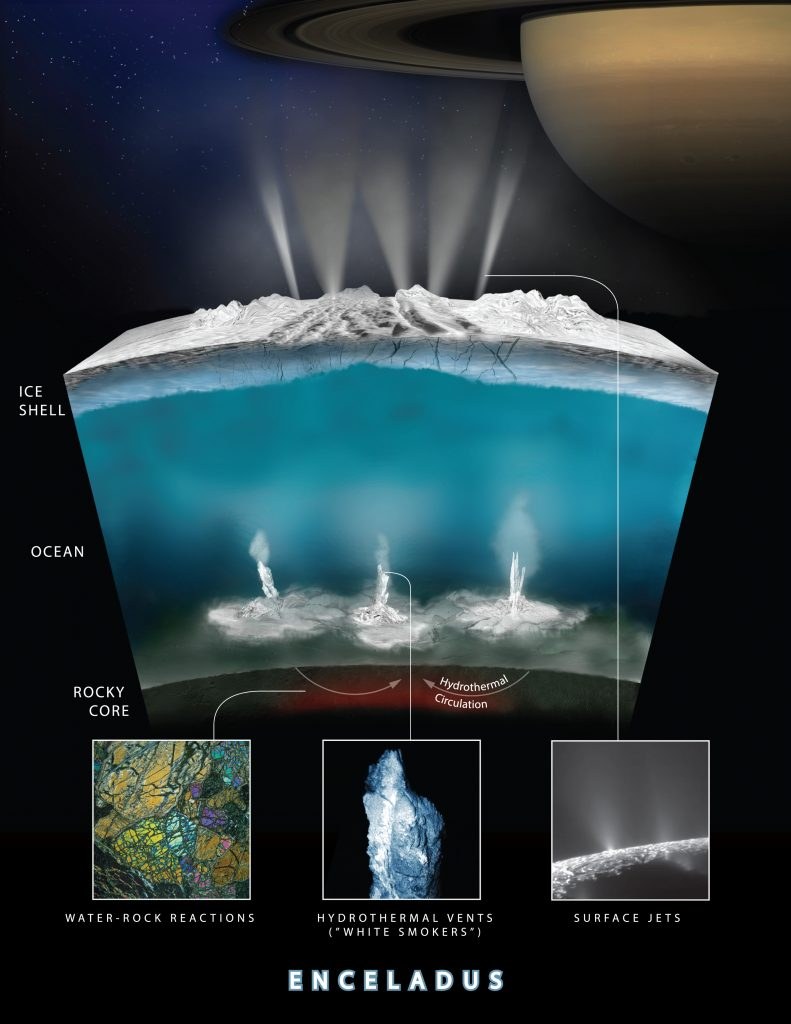
In general, Enceladus was the focus of the entire Astrobiology special edition because the amount of water on the moon has NASA naming it recently as an ‘ocean world’ and therefore capable of supporting life. The hope is that waters contain verifiable microbes, the challenge is verifying the minute signs of life from a distance of more than 750 million miles.
Due to its unique size and position about Saturn, Enceladus shoots jets of water from deep beneath its frozen surface out into space. In their paper, Nadeau’s team explains how an unmanned spacecraft sent to Enceladus could collect water from one of these jets and put the samples under a microscope.
However, the difficulties don’t end at obtaining a sample of an alien microbe. Once procured it can be troublesome to differentiate a microbe from other minute particles one might find under a microscope. For this task, Nadeau suggests the use of digital holographic microscopy, a special form of microscopic imaging.
Using lasers and detectors, holographic microscopy illuminates material in such a way that a computer can harness the information gathered to create 3-D images that can show details and motion that might be otherwise missed.
In addition to its ability to illuminate the tiniest details, the system of holographic microscopy has few parts and can go through samples at a quick pace, about one millimeter per hour. Both attributes make it ideal for a mission to Enceladus, according to Nadeau.
In order to test the sensitivity of such a device, Nadeau and her team used holographic microscopy on water samples from one of the most extreme environments on Earth, the Arctic. Using the special tech, her team was able to identify organisms in the frigid water whose population density was so low to only 1,000 cells present in a millimeter, as compared to the 1 to 10 million cells per millimeter found in a conventional pond.
In the next round of testing, researchers hope to use samples from other extreme locales around the world like Antarctica.
More News to Read
- New Machine Learning Software can Imitate Human Emotional Response
- NASA Discover Importance of Low-Frequency Wave to Increase Satellite Longevity and Performance
- How do Social Settings Affect Human’s Decision-Making?
- Possible Evidence of Majorana Particle Could be BIG News for Quantum Computers
- A Study on Marsupials Helps Scientist Better Understand Pregnancy in Humans
Related Coverage
- Is There Life on Saturn’s Moon Enceladus?
- Scientists Discover New Hair Growth Technique Using Stem Cells
- Students Study Confirms Instagram Photos Can Uncover Depression
- Researchers Have Developed a Prototype Smart Pill to Diagnose and Treat Diseases
- China’s New Type of Quantum Computing Device, Built Inside a Diamond
Don't miss new tech stories on Google
Add TrendinTech once in the Google app and our stories appear in your news suggestions.
Owen Castellanos
Owen Castellanos is the Hardware & Gaming Reporter at TrendinTech, where he tests graphics cards, processors, consoles and peripherals and follows the games industry, from the major publishers to independent studios. He previously wrote reviews and benchmarks for Tom's Hardware and contributed features to PC Gamer, covering everything from laptop testing to the economics of game development. Owen holds a Bachelor of Science in Electrical Engineering from the University of Texas at Austin and attends CES in Las Vegas, Computex in Taipei and the Game Developers Conference in San Francisco each year to meet chipmakers and developers. He writes for readers who want to know whether a product is worth the money, and he is not shy about saying when it is not.
All stories by Owen Castellanos (252)