
Cassini’s First Flight Through Saturn’s Rings Reveals Shocking Data
The Cassini spacecraft has just completed the first part of its grand finale as it flew through the narrow opening between Saturn and its many rings. The information transmitted back from the craft was somewhat unexpected.

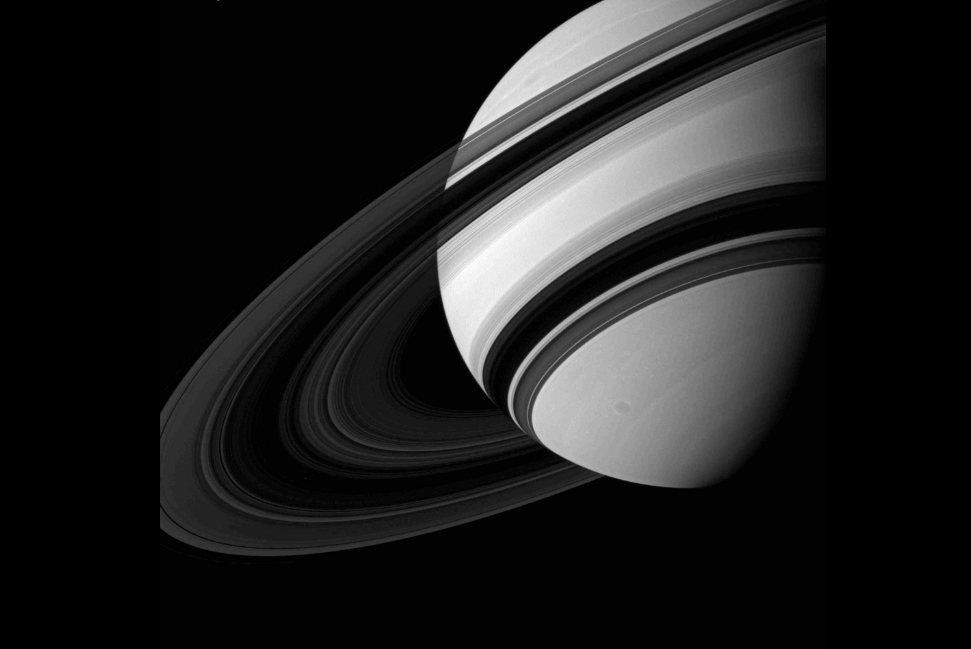
The Cassini spacecraft has just completed the first part of its grand finale as it flew through the narrow opening between Saturn and its many rings. The information transmitted back from the craft was somewhat unexpected. According to the data, this gap is free of almost anything. This is good news for Cassini’s engineers as will be far easier and safer for the craft to maneuver around. But it’s puzzling at the same time as NASA’s scientists were expecting more.
Earl Maize is a project manager at NASA’s Jet Propulsion Laboratory and he says, “The region between the rings and Saturn is ‘the big empty’, apparently.” Cassini will stay the course, while the scientists work on the mystery of why dust level is much lower than expected.” Scientists had already projected that there wouldn’t be any large particles in the gap by using images from Cassini and models of Saturn, but to find almost nothing was odd.
Because nothing had ever before flown through this gap, engineers ensured the antenna pointed in the direction of the oncoming particles in order to help shield the delicate instruments. However, as a consequence, the craft was disconnected from engineers back home. So engineers couldn’t monitor the craft through the dive. But, Cassini’s Radio and Plasma Wave Science (RPWS) instrument were just outside the shield to it picked up the hits of any particles as the dive was carried out. There were lots of pings detected as the craft moved outside the rings, but very few as it dived through the inside of the rings.
“It was a bit disorienting — we weren’t hearing what we expected to hear,” said William Kurth, RPWS team leader at the University of Iowa. “I’ve listened to our data from the first dive several times and I can probably count on my hands the number of dust particle impacts I hear.” The dive is part of Cassini’s Grand Finale that will end with the craft destroying itself by flying into the atmosphere of Saturn and burning to a crisp.
More News to Read
- Scientists May Have Just Revealed Evidence of the Multiverse
- In the Eyes of Science, Is Time Travel Possible?
- The World of Space Tourism is Almost Here
- We Have Gravitational Waves to Thank for Sound in Space
- Mapping Out Quantum Correlations
Related Coverage
- Is There Life on Saturn’s Moon Enceladus?
- Could Robots Replace Medical Workers?
- Antidepressant Use on the Rise – Do You Know What You Have Been Prescribed?
- BMW’s New ” Google Glass ” like technology for Motorcycles Riders.
- The Vinpok Bolt Brings back Magnetic Safety to Power Cords
Don't miss new tech stories on Google
Add TrendinTech once in the Google app and our stories appear in your news suggestions.
Rachel Kowalski
Rachel Kowalski is the Cybersecurity Analyst at TrendinTech, where she covers vulnerabilities, ransomware, supply chain attacks, nation-state operations and the security rules shaping organizations in the United States and Europe. Before moving into journalism she worked as a threat intelligence analyst at a security vendor and later reported for CyberScoop and the security desk at Wired, covering the SolarWinds compromise and the ransomware wave that hit hospitals and pipelines. Rachel holds a Master of Science in Cybersecurity from the Georgia Institute of Technology and attends Black Hat and DEF CON in Las Vegas each year, where she follows research from the security community. She writes to make risks and countermeasures understandable to people who are not specialists.
All stories by Rachel Kowalski (214)