

The Vinpok Bolt Brings back Magnetic Safety to Power Cords
Apple’s MagSafe power cords, launched alongside the newest MacBooks in 2006, was groundbreaking in as much as a power cord can be. It provided not only ease of use in correctly aligning pins between the laptop and cord but also a measure of safety in its detachability.

Apple’s MagSafe power cords, launched alongside the newest MacBooks in 2006, was groundbreaking in as much as a power cord can be. It provided not only ease of use in correctly aligning pins between the laptop and cord but also a measure of safety in its detachability. Previously if a cord was tripped over or tugged on, it could damage the power cord, the cord port on the device, or the entire laptop itself if it’s pulled off a table top or lap.
However, in 2015 Apple made the switch to USB-C style power cords and no longer offered the MagSafe feature. Now, the Vinpok Bolt, designed by a team of Apple devotees, is offering the public a chance to get back the safety of a magnetic power cord in their USB-C powered devices.
An IndieGoGo project, the Vinpok Bolt works with any USB-C device and is the first device of its type to offer the 87W charging capabilities for the 15-inch MacBook.
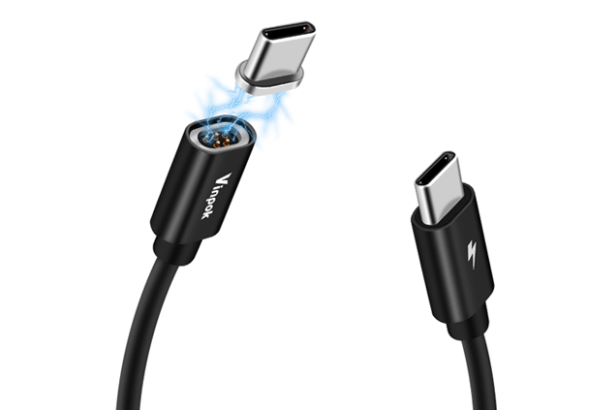
The Bolt measures 6.6 feet (2m) long and has two parts: the magnetic tip the plugs into the computer charging port and the cord that magnetically attaches to it. The magnetic tip is made with the smallest size of magnet available and matches the sleek design of Apple products, contrary to similar competitors which have bulky connectors. When the cord is pulled or tugged on it safely separates from the device, leaving the magnetic tip in the laptop or cell and keeping your expensive electronic device free of drops or damaged power ports.
Honestly, there appears to be no downside to this product. It’s already far exceeded its original goal, raising over $98,000 from over $2,000 backers and production beings in September The Bolt matches the power of the current Apple adapter charging cords, and it is usable with any USB-C to USB-C charged device, including the Samsung Galaxy S8, the Google Pixel, the Microsoft Surface Book, the Lenovo ThinkPad, and more. It’s available in silver and black to match the most common device colors.
Although the retail value of the Vinpok Bolt is $50, the crowdsourcing price is currently $24 for one power cord and tip, $47 for two, or $115 for 5. Prices for comparable prices range from $30 to $40 but none of them are compatible with the 15” Macbook and the 6.6-foot cord. For the safety of mind that comes with the magnetic detachability and the wide compatibility across devices, any of the introductory price points are a great deal for the Vinpok Bolt.
More News to Read
- MAG-LEV Audio: Futuristic Technology Meets an old Format
- New Grant Allocated to Imperial College Professor to Research Incurable Lung Disease
- Larger Artificial Cell Membrane Help Scientists Observe Proteins
- Meet Compectus – the World’s First Rollable Keyboard
- Is Graphene the Key to Making Low-Cost Disease Diagnostic Systems?
Related Coverage
- Microsoft ReCall For Surface Pro’s Power Cords, You Can Replace Yours
- MacBooks Are The Most Reliable Laptops
- New Joint Initiative Between Imperial and Kings College London Boosts Artificial Cell Design
- IBM Claims “New Linux Based Power System Server Kicks Butt”
- The Legend Is Back, But No Illegal Stuff This Time
Don't miss new tech stories on Google
Add TrendinTech once in the Google app and our stories appear in your news suggestions.
Helena Marsh
Helena Marsh is the Editor-in-Chief at TrendinTech, where she leads editorial strategy and oversees coverage across artificial intelligence, cybersecurity and enterprise technology. With more than a decade in technology journalism on both sides of the Atlantic, she previously served as a senior editor at Wired UK and covered the technology sector for The Guardian, following the rise of the big platforms, the Cambridge Analytica scandal and the regulatory push from Brussels and Washington. Helena holds an MA in Journalism from City, University of London and is a regular speaker at Web Summit in Lisbon and CES in Las Vegas. She believes technology reporting should be rigorous and plainly written, so readers understand what actually changes for them rather than what a company's announcement promises.
All stories by Helena Marsh (201)