Amkor Triples Gwangju Bet to $3B for AI Chips [2026]

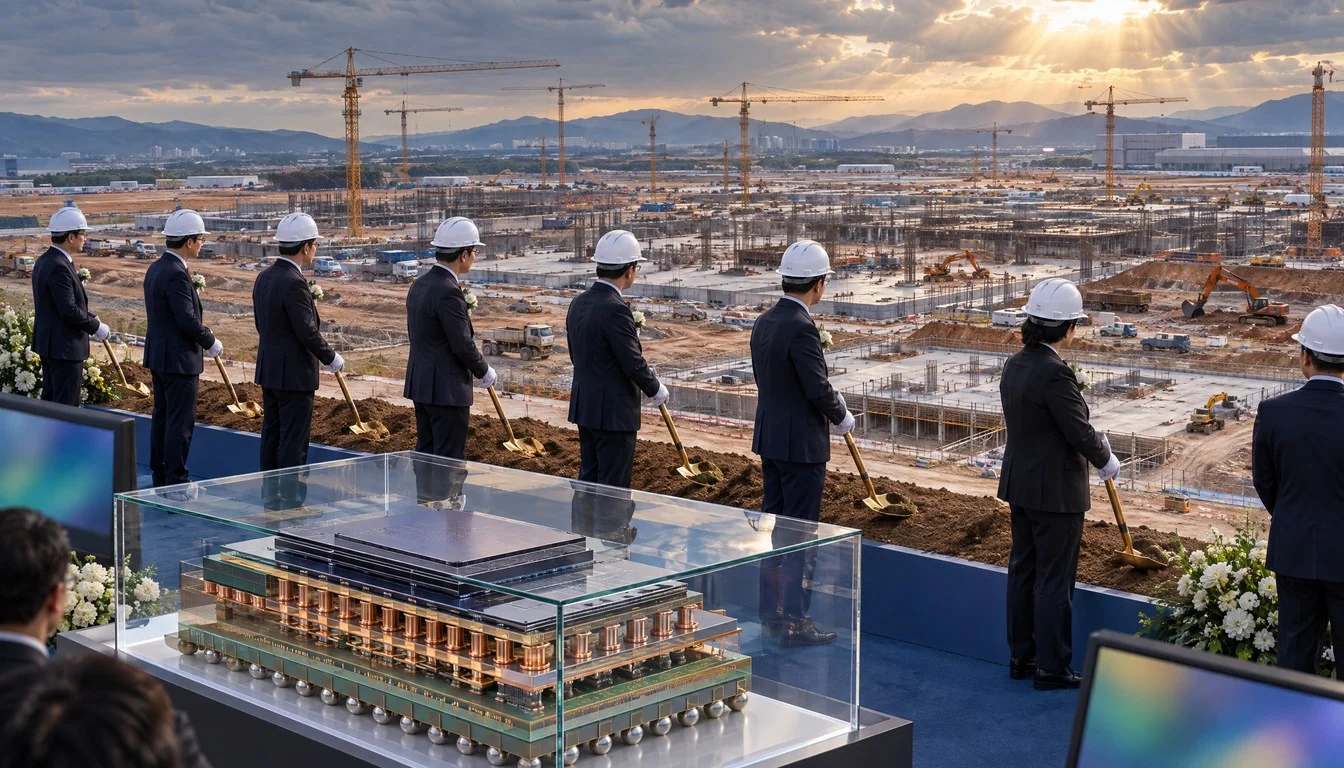
Amkor Technology broke ground on October 19, 2026 on a vastly larger version of its Gwangju packaging plant, tripling the project’s budget from roughly 1 trillion won to 3 trillion won (about $2.2 billion to $2.3 billion) and nearly doubling the planned headcount to about 2,000 workers by 2031. Two days later, on October 21, the company layered on a second announcement: a new $1.3 billion agreement with NVIDIA to expand South Korean packaging capacity, part of a combined Arizona and Korea commitment the two companies now put at $3 billion.
Together, the two moves mark the most concrete signal yet that the bottleneck in AI chip production has shifted away from raw transistor manufacturing and toward advanced packaging, the process of stitching processors, memory stacks and interconnects into a single working module. For Amkor (Nasdaq: AMKR), a company best known to most consumers as an anonymous back end supplier, the week put it squarely in the center of the AI infrastructure story alongside NVIDIA, TSMC and Samsung.
Don't miss new tech stories on Google
Add TrendinTech once in the Google app and our stories appear in your news suggestions.
Amkor Triples Its Gwangju Investment to 3 Trillion Won
According to TokenPost, Amkor Technology Korea lifted its planned Gwangju investment from approximately 1 trillion won to 3 trillion won, covering the period from 2026 through 2031. That is roughly $2.2 billion to $2.3 billion depending on the exchange rate used, and it represents a tripling of the figure the company had floated earlier in the year. The expanded plan also raises the expected hiring total to about 2,000 new employees by 2031, an increase of roughly 1,000 jobs over the original target.
Financial News reported that the project is tied to South Korea’s broader push to build a semiconductor cluster in the country’s southwest, a region that has not historically hosted large chip manufacturing operations. The outlet described the Gwangju groundbreaking as the first construction milestone of that regional plan, framing Amkor’s decision as a vote of confidence from a global company in the area’s industrial future.
The scale of the jump stands out even by the standards of a year packed with AI infrastructure announcements. Going from 1 trillion won to 3 trillion won in a matter of months suggests Amkor’s internal demand forecasts for AI and high performance computing packaging moved sharply upward sometime between the original plan and the October revision. The company has not detailed exactly which customer commitments drove the increase, and nothing in the public record ties the expanded Gwangju capacity to a single named buyer beyond the general description of serving AI and HPC applications.
Inside the October 19 Groundbreaking Ceremony
The ceremony took place at Amkor Technology Korea’s existing K4 site in the Cheomdan Industrial Complex in Gwangju’s Buk-gu district, according to The Herald Business. South Korean officials attended alongside Amkor executives, highlighting how closely the project is woven into the government’s industrial strategy for the Honam region, which covers Gwangju and the surrounding South Jeolla province.
Lee Min-woo, director general of the Industrial Growth Office at South Korea’s Ministry of Trade, Industry and Energy, told attendees that the groundbreaking was the first signal that the Southwest Region’s semiconductor investment was moving from plans to the field, calling it a decision made by a global company in trust of the future of South Korea and Gwangju. Read the full remarks via BigGo Finance.
Lee also framed the facility in explicitly competitive terms, saying that an advanced packaging plant that will determine semiconductor competitiveness in the AI era coming to Gwangju will help the semiconductor ecosystem take root in the Southwest Region. That language matters because it positions Gwangju, a city with little prior chipmaking infrastructure, as a deliberate counterweight to Korea’s existing semiconductor hubs around Icheon and Pyeongtaek, where Samsung and SK Hynix already dominate.
Amkor Technology Korea’s chief executive, identified in coverage of the ceremony as Jin An Lee, did not issue a separate public statement captured in available reporting, though the company’s US based leadership weighed in on the broader Gwangju strategy during its most recent earnings call, discussed below.
The NVIDIA Factor: A New $1.3 Billion South Korea Deal
Two days after the Gwangju groundbreaking, Amkor and NVIDIA announced an additional $1.3 billion agreement specifically earmarked for South Korean advanced packaging capacity. The deal builds on an earlier $1.5 billion multiyear agreement the two companies struck in July 2026 covering Amkor’s Arizona campus, and the companies now describe their combined Arizona and South Korea commitments as totaling $3 billion, according to Amkor’s own investor relations release.
The timing is notable. Rather than treating the Gwangju expansion and the NVIDIA agreement as a single announcement, Amkor separated them by 48 hours, letting the Korean government ceremony stand on its own before layering in the commercial backing from its largest AI customer. TokenPost, citing the October 21 release, reported that the collaboration between NVIDIA and Amkor is targeting more than a 300 percent increase in South Korean interposer wafer capacity by the end of 2028. That figure describes a planning target rather than capacity that is already under contract or operating, and it has not been independently confirmed beyond the initial report.
NVIDIA’s side of the announcement extended well beyond Amkor. The company said on October 21 that it expects total semiconductor testing capacity across its supply chain to double between 2026 and 2027, supported by buildouts in the United States, Taiwan and Singapore, and that it aims to grow substrate capacity to two and a half times current levels over three years through supplier agreements spanning Japan, South Korea and Taiwan. NVIDIA also used the same announcement window to confirm a joint AI research lab with KAIST in Korea, a reminder that the chip packaging news sits inside a much larger push by NVIDIA to lock down every link of its manufacturing chain, not just GPU wafers. That push comes even as NVIDIA manages its own consumer GPU roadmap carefully, with one widely discussed leak suggesting its next lower tier desktop card, the RTX 6060, could slip as far out as 2029 while the company prioritizes AI data center supply.
Why Advanced Packaging Became the New AI Chokepoint
For most of the last two decades, the semiconductor industry’s bottleneck sat at the front end: etching ever smaller transistors onto silicon wafers at fabs run by TSMC, Samsung and Intel. AI accelerators changed that calculus. Modern AI chips depend less on transistor density alone and more on how many high bandwidth memory stacks, interposers and interconnects can be packed around a processor die, because the real performance ceiling for training and inference workloads is often set by how fast data moves between compute and memory, not by compute alone.
That shift has turned outsourced semiconductor assembly and test providers like Amkor into strategic assets rather than commodity subcontractors. Packaging capacity, not wafer starts, increasingly determines how many finished AI accelerators a company like NVIDIA can actually ship in a given quarter. Advanced packaging techniques, generally grouped under labels like 2.5D and 3D integration, let manufacturers combine a logic die with multiple HBM stacks on a shared interposer, a process that is far more capacity constrained than conventional chip packaging because it requires specialized equipment, cleanroom space and skilled technicians that cannot be added overnight.
Amkor’s own description of its current offerings, drawn from its corporate site, lists 2.5D packaging, high density fan out, interposer based packaging, flip chip, system in package and wirebond services among its core capabilities. The Gwangju buildout is aimed squarely at expanding the first three of those categories, the ones most directly tied to AI and high performance computing demand. Memory suppliers are racing to keep pace with that same shift, as seen in Micron’s HBM4 roadmap, which projects AI accelerators will need roughly 2.6 times more memory bandwidth in coming generations, a demand curve that flows directly into how much interposer and packaging capacity companies like Amkor need to build.
Four Buildings, Two Timelines: Amkor’s Construction Schedule
The expanded Gwangju plan calls for four advanced packaging buildings rather than a single new facility. According to the companies’ own disclosures, two of the four buildings are targeted for completion in the second half of 2027, with the remaining two scheduled for the first half of 2028. Production at each building is expected to begin in phases after its individual completion, rather than all four coming online simultaneously.
| Plan detail | Original plan | Revised plan (Oct 19, 2026) |
|---|---|---|
| Total investment | Approximately 1 trillion won | Approximately 3 trillion won (about $2.2B to $2.3B) |
| Planned new jobs | Approximately 1,000 | Approximately 2,000 by 2031 |
| Investment window | Not specified at original scale | 2026 through 2031 |
| Number of buildings | Not specified at original scale | Four advanced packaging buildings |
| First completions | Not specified | Two buildings, second half of 2027 |
| Remaining completions | Not specified | Two buildings, first half of 2028 |
That staggered schedule matters for anyone trying to gauge when this investment will actually show up in AI chip supply. Even with construction already underway, none of the new Gwangju capacity is expected to be operational before the second half of 2027 at the earliest, meaning the project is best understood as a response to anticipated 2028 and beyond demand rather than a fix for today’s packaging constraints.
2,000 Jobs and the Southwest Korea Semiconductor Push
The employment figure is as politically significant as it is economically meaningful. South Korea’s chip industry has historically clustered around Gyeonggi province, home to Samsung’s Pyeongtaek complex and SK Hynix’s Icheon operations. Gwangju, by contrast, has had little direct role in the country’s semiconductor supply chain, and the government has been actively trying to change that through the Honam, or southwestern, semiconductor megaproject that officials referenced at the groundbreaking.
Roughly 2,000 new jobs by 2031 is a meaningful commitment for a regional economy. Advanced packaging facilities are capital intensive rather than labor intensive relative to their investment size, so the jobs figure reflects specialized technician and engineering roles rather than mass manufacturing employment. South Korea’s government has leaned on this kind of regional diversification argument before, and Amkor’s expansion gives Jeonnam-Gwangju officials a concrete, named anchor tenant to point to as the southwestern cluster strategy takes its first physical steps.
Amkor’s Financial Position Heading Into the Expansion
The Gwangju and NVIDIA announcements landed just days before Amkor’s scheduled third quarter 2026 results, due October 26, 2026, so the company’s most recent disclosed financial snapshot still comes from its second quarter. For the quarter ended June 30, 2026, Amkor reported net sales of $1.90 billion, up 26 percent year on year and described by the company as a record second quarter. Gross profit came in at $319 million, operating income at $200 million, and net income at $174 million, or $0.70 per diluted share.
| Metric | Q2 2026 actual | Q3 2026 guidance |
|---|---|---|
| Net sales | $1.90 billion | $1.95B to $2.05 billion |
| Gross margin | Not separately disclosed as a percentage | 18.5% to 19.5% |
| Net income | $174 million | $180M to $205 million |
| Diluted EPS | $0.70 | $0.72 to $0.82 |
| Full year 2026 capex | n/a | Approximately $2.5B to $3.0 billion |
Amkor closed the second quarter with $2.5 billion in cash and short term investments against $2.5 billion in total debt, and it paid a quarterly dividend of $0.08352 per share on June 23, 2026. The company’s own full year 2026 capital expenditure guidance of roughly $2.5 billion to $3.0 billion gives a rough sense of scale: the newly announced Gwangju commitment alone, spread across 2026 through 2031, runs close to a full year of the company’s current total capex budget, reinforcing how significant the bet on South Korea has become relative to Amkor’s existing balance sheet.
On the most recent earnings call, Amkor CEO Kevin Engel told investors that planned expansion is also underway on the company’s Gwangju campus, where incremental manufacturing space is expected to provide clean room capacity to support data center and advanced packaging growth opportunities in 2028 and beyond, a framing that lines up closely with the construction timeline the company later confirmed at the groundbreaking.
How Amkor Stacks Up Against TSMC, Samsung and SK Hynix
Amkor’s expansion does not happen in a vacuum. TSMC remains the dominant force in AI chip packaging through its CoWoS platform, which NVIDIA and other accelerator designers have relied on for years to bond logic dies to HBM stacks. Samsung Electronics, for its part, is building out its own advanced logic and packaging capabilities domestically in South Korea, while SK Hynix supplies much of the HBM memory that ends up inside AI accelerators regardless of which company handles the final packaging step.
None of the available reporting indicates that Samsung or SK Hynix is directly participating in Amkor’s Gwangju project, and nothing confirms that the new Gwangju lines will carry a CoWoS style brand or an equivalent named process. What the expansion does signal is that Amkor is positioning itself as an independent, outsourced alternative to TSMC’s in house packaging, something NVIDIA appears eager to encourage given its parallel push to diversify substrate and testing capacity across Japan, Taiwan and Singapore as well as Korea. Samsung, for its part, is already deepening its own foundry ties to NVIDIA’s roadmap, having agreed to supply 3nm foundry lines for NVIDIA’s next generation HBM base dies, a separate but related front in the same scramble for AI memory and packaging capacity.
| Company | Primary packaging role | 2026 South Korea or US AI capacity move |
|---|---|---|
| Amkor Technology | Outsourced advanced packaging and test (2.5D, fan out, interposer) | 3 trillion won Gwangju expansion plus $1.3B NVIDIA deal |
| TSMC | In house CoWoS advanced packaging tied to its own foundry | 10 year Arizona packaging partnership with Amkor announced June 2026 |
| Samsung Electronics | Logic foundry and in house advanced packaging development | Supplying 3nm foundry lines tied to Nvidia next generation HBM base dies |
| SK Hynix | HBM memory supplier to AI accelerator makers | Not confirmed as a direct Gwangju project participant |
The Interposer Capacity Race: What a 300 Percent Increase Would Mean
The reported target of more than a 300 percent increase in South Korean interposer wafer capacity by the end of 2028 is one of the most striking numbers to come out of the October 21 NVIDIA announcement, and it deserves careful framing. Interposers are the silicon or substrate layers that sit beneath a processor and its HBM stacks, routing thousands of electrical connections between them. They are notoriously difficult to scale because they require extremely fine lithography and testing precision, and a shortage of interposer capacity, rather than a shortage of logic chips or memory alone, has been cited repeatedly across the industry in 2026 as a constraint on how many finished AI accelerators can actually reach customers.
If accurate, a tripling plus of interposer output by 2028 would represent one of the largest single capacity expansions in this specific sub segment of the chip supply chain. But the figure remains a target tied to a two year old company’s forward plan rather than a confirmed, contracted capacity number, and it has only been reported through a single outlet’s account of the NVIDIA and Amkor announcement. Readers should treat it as a stated ambition rather than a locked in production schedule until Amkor or NVIDIA confirm it through their own investor communications.
Market Reaction and Analyst Views
Amkor shares moved higher following the back to back Gwangju and NVIDIA news, a reaction Yahoo Finance attributed directly to the advanced packaging expansion announcement. The stock’s response reflects how closely investors are now watching Amkor’s exposure to AI infrastructure spending, a shift from its historical reputation as a steadier, more cyclical play tied to smartphones and automotive electronics.
That AI exposure is becoming the dominant narrative in how Wall Street frames Amkor, echoing how analysts recently named NVIDIA, Intel, Micron and Monolithic Power as buy picks heading into third quarter earnings season on similar AI infrastructure exposure. The company’s own guidance pointed to computing revenue reaching a quarterly record in the second quarter, and its full year capital expenditure budget of up to $3 billion is itself a signal that management expects demand to keep outrunning existing capacity through the rest of the decade. The combination of the Arizona Phase 2 expansion, which Amkor said in September 2026 it was enlarging to $12 billion, and the new Gwangju commitment suggests a company deliberately building redundant advanced packaging capacity across two continents rather than betting on a single site. Demand for the circuit boards and components that feed into this kind of buildout is already visible elsewhere in the supply chain, with contract manufacturer Han’s CNC recently reporting a 214 percent profit jump on surging AI PCB demand.
Historical Context: From 1 Trillion Won to 3 Trillion Won in Months
The speed of the revision is itself a data point. South Korea’s Ministry of Trade, Industry and Energy had listed Amkor’s Gwangju investment at roughly 1 trillion won earlier in 2026, a figure that stood as the official planning number for months before the October 19 groundbreaking revealed it had tripled. That kind of rapid upward revision, rather than a slow, incremental scaling, mirrors a broader pattern across the AI supply chain in 2026, where companies from NVIDIA to its packaging and substrate partners have repeatedly revised capacity targets upward within the same calendar year as demand forecasts shifted.
Amkor’s own expansion history over the past twelve months tells a similar story in miniature. The company struck its first NVIDIA focused advanced packaging partnership in Arizona in July 2026, worth a reported $1.5 billion, then expanded that Arizona campus again in September with a Phase 2 announcement that lifted the total Arizona investment to $12 billion, before turning to South Korea in October with the Gwangju revision and the new $1.3 billion NVIDIA agreement. Each step came only two to three months after the last, a cadence that leaves little room to argue the Gwangju tripling was a one off reaction to a single customer request rather than part of a sustained, company wide capacity race.
What Industry Voices Are Saying
Beyond the government officials quoted at the groundbreaking, Amkor’s own leadership has been consistent in linking the Gwangju buildout to data center demand rather than any single product cycle. Kevin Engel, Amkor’s president and chief executive officer, told investors on the company’s Q2 2026 earnings call that the Gwangju campus expansion is expected to provide clean room capacity for data center and advanced packaging growth opportunities in 2028 and beyond, language that predates the October groundbreaking by nearly three months but accurately previewed the project’s eventual direction.
At the ceremony itself, Lee Min-woo of the Ministry of Trade, Industry and Energy offered the clearest public articulation of why the South Korean government cares about this specific facility beyond its job numbers, arguing that an advanced packaging plant that will determine semiconductor competitiveness in the AI era coming to Gwangju will help the semiconductor ecosystem take root in the Southwest Region, a statement that frames Amkor’s investment as a strategic anchor for a region the government hopes will eventually host a broader cluster of suppliers.
Competitive and Strategic Implications for the AI Supply Chain
For NVIDIA, spreading its advanced packaging bets across Amkor’s Arizona and Gwangju sites, alongside its own plans to grow testing capacity and substrate supply across the US, Taiwan, Japan, Singapore and Korea, reduces reliance on any single geography or vendor for a process that has repeatedly bottlenecked AI chip shipments in recent years. It also gives NVIDIA an independent path outside TSMC’s CoWoS lines, which remain the industry’s default for high end accelerator packaging but whose expansion pace NVIDIA cannot fully control on its own.
For Amkor, the strategic upside is clear: a company long seen as a lower margin, commoditized assembly and test business is being repositioned as critical infrastructure for the AI buildout, with a direct and growing financial relationship with NVIDIA that now spans two countries and $3 billion in disclosed commitments. The risk, as with any capital intensive bet tied to a single demand driver, is that the four new Gwangju buildings will not come online until 2027 and 2028, a long enough runway that a slowdown in AI accelerator demand between now and then could leave Amkor with packaging capacity built for a boom that has already cooled.
What’s Next: Predictions for Amkor and South Korea’s AI Chip Buildout
- Amkor’s October 26, 2026 third quarter results should offer the first chance to see whether management raises full year capital expenditure guidance beyond the current $2.5 billion to $3.0 billion range to account for the newly disclosed Gwangju and NVIDIA commitments.
- Expect South Korea’s Ministry of Trade, Industry and Energy to use the Gwangju groundbreaking as a template, pursuing additional anchor tenants for the broader Honam semiconductor cluster over the coming months.
- Watch for Samsung and SK Hynix to clarify their own advanced packaging and HBM capacity plans in response to Amkor and NVIDIA’s moves, even though neither company has been confirmed as a direct Gwangju participant. The stakes are high given how quickly chip market share can shift, as shown by NVIDIA’s own position in China, where its share of AI chip sales has fallen to 34 percent as Huawei climbed to 28 percent.
- The reported target of a more than 300 percent increase in interposer wafer capacity by the end of 2028 will likely draw scrutiny and requests for confirmation from analysts until Amkor or NVIDIA address it directly in an investor disclosure.
- With two of the four Gwangju buildings not due until the second half of 2027 at the earliest, near term AI packaging constraints are unlikely to ease before then, meaning current capacity bottlenecks persist through at least the next several quarters.
The broader picture is one where packaging, not wafer fabrication, has become the arena where the next phase of the AI buildout will actually be won or lost. Amkor’s tripled Gwangju bet and its expanding NVIDIA relationship are a direct response to that shift, and the next 18 to 24 months of construction progress will show whether South Korea’s southwestern semiconductor ambitions can scale as fast as the AI demand driving them.
Frequently Asked Questions
How much is Amkor investing in its Gwangju expansion?
Amkor Technology Korea plans to invest approximately 3 trillion won, or roughly $2.2 billion to $2.3 billion, in its Gwangju facility between 2026 and 2031, up from an original plan of about 1 trillion won.
When did Amkor break ground on the Gwangju project?
Amkor Technology Korea held its groundbreaking ceremony on October 19, 2026 at its existing K4 site in the Cheomdan Industrial Complex in Gwangju.
How many jobs will the Gwangju expansion create?
Amkor expects the expanded project to create approximately 2,000 new jobs by 2031, about 1,000 more than the company’s earlier employment target.
What is Amkor building in Gwangju?
The plan calls for four advanced semiconductor packaging buildings intended for AI and high performance computing applications, with two buildings targeted for completion in the second half of 2027 and two more in the first half of 2028.
What is Amkor’s new deal with NVIDIA?
On October 21, 2026, Amkor and NVIDIA announced an additional $1.3 billion agreement to expand advanced packaging capacity in South Korea, bringing their combined Arizona and South Korea commitments to a disclosed total of $3 billion.
Is the new Gwangju capacity already in production?
No. As of October 22, 2026, the Gwangju expansion is under construction, with production expected to begin in phases only after each building is completed starting in the second half of 2027.
Are Samsung or SK Hynix involved in Amkor’s Gwangju project?
No confirmation has been made public that Samsung Electronics or SK Hynix is directly participating in Amkor’s Gwangju expansion. Both companies remain separate, major players in Korea’s broader semiconductor and HBM memory supply chain.
When does Amkor report third quarter 2026 earnings?
Amkor’s third quarter 2026 financial results and conference call are scheduled for October 26, 2026, meaning that report was not yet available as of this article’s publication.
Related Coverage
Daniel Okafor
Daniel Okafor is the Senior AI Reporter at TrendinTech, where he covers large language models, machine learning research and the practical use of artificial intelligence across business and government. He has a particular interest in evaluation: how models are benchmarked, where those benchmarks fail and what that means for the companies betting on them.
All stories by Daniel Okafor (403)