The Hubble Captures More Amazing Sights
The Hubble Space Telescope has already captured some pretty amazing sights so far, but this one is a little different. This time researchers have spotted l

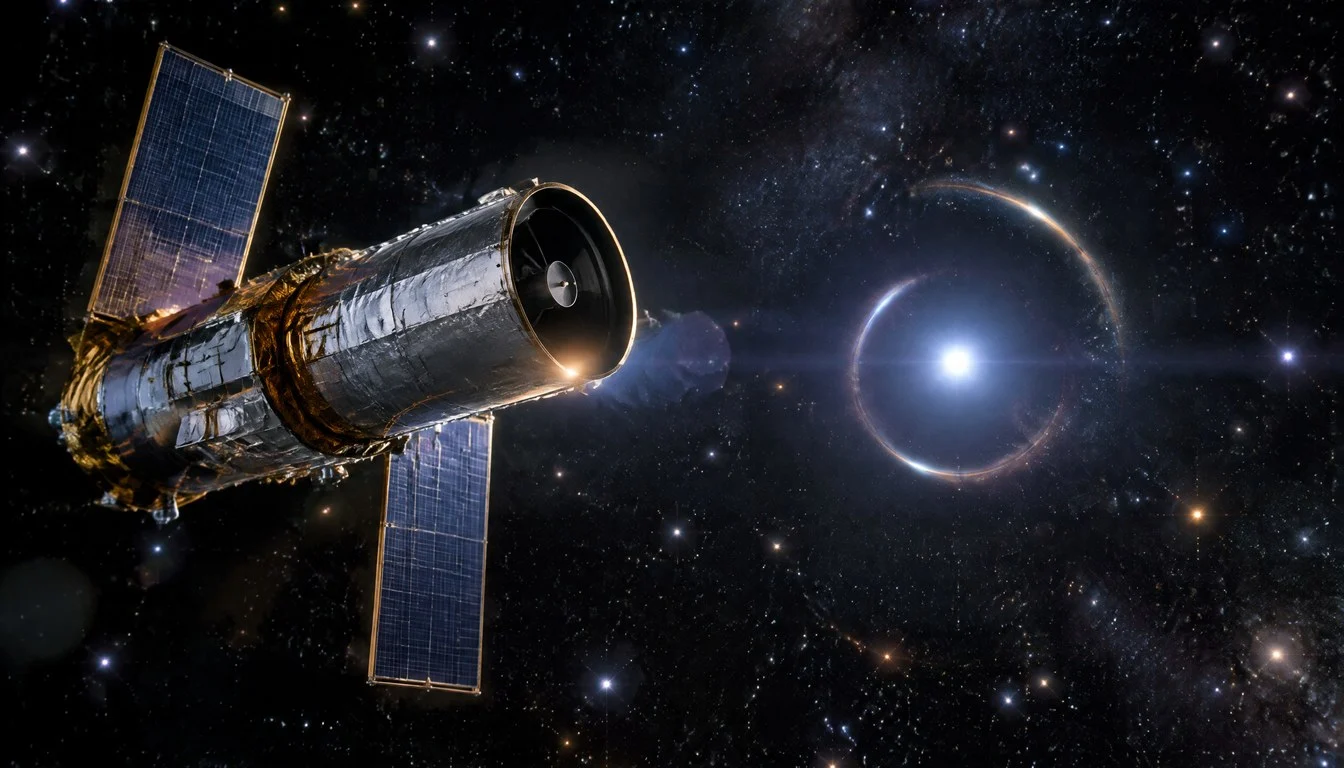
The Hubble Space Telescope has already captured some pretty amazing sights so far, but this one is a little different. This time researchers have spotted light bending due to the gravity of a close by a white dwarf star. It’s the first time this kind of observation has been made around a star opposed to the Sun and once again proves Einstein’s general theory of relativity.
Kalish Sahu is an astronomer at the Space Telescope Institute who led the observation. He and the team watched as the distant star jiggled as its light bent around a white dwarf for all to see. As it did, the researchers were able to calculate the mass of the white dwarf to be around 67% that if the Sun. “It’s a very difficult observation with a really nice result,” commented Pier-Emmanuel Tremblay, an astrophysicist at the University of Warwick in Coventry, UK.
White dwarfs are basically the remnants of stars that have burned up all their nuclear fuel. This particular white dwarf in question is called Stein 2051 B and is located 17 light years from Earth in the Camelopardalis constellation. For a white star, that’s quite close. Hence why it appears to move so fast in comparison to others that are more distant.
Between the time of October 2013 and October 2015, eight observations were made where the background star appeared to shift back and forth. It was just slightly, but enough to confirm that the gravity of Stein 2051 B was, in fact, bending the light of the background star. This light bending was observed back in 1919 by British astronomer Arthur Eddington, but back then it happened around the Sun rather than a star.
The scientific name for this bending of the light is called astrometric microlensing and if astronomer Martin Dominik’s predictions are right, there are many more examples to come. He has also confirmed that the European Space Agency’s Gaia space telescope alone could capture as many as 1,000 instances of microlensing in the near future.
More News to Read
- No Time For Visiting Art Galleries? Google Here to Help!!
- Imagining A Dying Milky Way, How Death Of The Milky Way Look Like?
- Another Breakthrough for Cancer Detection in the Form of Liquid Biopsies
- Breakthrough for Scientists Comes in the Form of Another Gravitational Wave
- Is it Possible to See the Edge of the Universe?
Comments
Don't miss new tech stories on Google
Add TrendinTech once in the Google app and our stories appear in your news suggestions.
Daniel Okafor
Daniel Okafor is the Senior AI Reporter at TrendinTech, where he covers large language models, machine learning research and the practical use of artificial intelligence across business and government. He has a particular interest in evaluation: how models are benchmarked, where those benchmarks fail and what that means for the companies betting on them.
All stories by Daniel Okafor (355)