

The AstroRad Radiation Shield: The New Protective Vest for Deep Space Travel
Exposure to radiation has always been a concern for those traveling in deep space. However, with thanks to a new type of vest called AstroRad, those concerns may soon be a thing of the past.

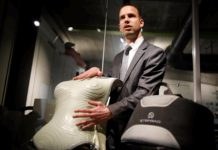
Exposure to radiation has always been a concern for those traveling in deep space. However, with thanks to a new type of vest called AstroRad, those concerns may soon be a thing of the past. It’s been designed by a team over in Israel and is now ready for use on any manned mission to Mars.
The company behind the AstroRad Radiation Shield is StemRad. Based in Tel Aviv, the company has already produced a belt that protects rescue workers from radiation during nuclear disasters like Fukushima and Chernobyl should one ever occur again. Add that to the newly designed vest, and everyone’s a winner. Mars offers no protection in its sparse atmosphere, so this kind of invention is vital if we’re really serious about putting people on Mars in the next few years.
The AstroRad consists of several layers of non-metallic materials to shield vital organs, and everyone will be tailor-made for each astronaut. StemRad’s CEO, Oren Milstein, said, “This product will enable human deep space exploration. Our breakthrough has come in creating the architecture of the multi-layered shield to cover the most important organs accurately.” Although the vest has already proven itself in simulations and the laboratory, StemRad will also be testing the product out onboard the Orion spacecraft in a joint venture between Lockheed Martin, NASA, and the European Space Agency.
Orion is due to launch late 2018 as an unmanned mission, but NASA is also considering sending two astronauts up on the same mission. During the flight, a dummy will be wearing one of the vests as well as a device to record the amount of radiation the dummy absorbs. Another dummy will travel alongside the one wearing a vest, but this one bare. The pair will be analyzed again upon returning to Earth. StemRad’s first example of the vest is to start being produced later thus year according to Milstein. He said, “Based on our simulations, we’re sure it works but to be 100 percent sure, we’re sending it up on EM-1.”
More News To Read
- Blue Origin Assemble Long-Awaited BE-4 Rocket Engine
- Could Marijuana Be A Future Treatment for Alzheimer’s?
- Could a Magnetic Shield Be the Answer to Creating a Suitable Atmosphere on Mars?
- Scientists Observe the Most Detailed Black Hole Wind to Date
- The Hubble Shows How Asteroids and Comets are More Alike than We Realized
Related Coverage
- Will Artificial Brains Soon Be More Effective Than Human Brains?
- Researchers Use AI Algorithm to Help Those Suffering From Sleep Disorders
- One Step Closer To Commercial Space Travel as NASA Team Up With Blue Origin
- Log In to Your SmartPhone with a Finger-Drawn Doodle Instead of a Password
- How deadly is the Exposure to Gamma Radiation?
Don't miss new tech stories on Google
Add TrendinTech once in the Google app and our stories appear in your news suggestions.
Yusuf Demir
Yusuf Demir is the Cloud & Software Reporter at TrendinTech, where he covers cloud infrastructure, enterprise platforms, developer tools and the digital transformation of businesses in the UK and the United States. He previously reported on enterprise technology for The Register in London and covered the cloud and SaaS beat for TechCrunch, following the competition between AWS, Microsoft Azure and Google Cloud, the open source licensing disputes and the rise of Kubernetes. Yusuf holds an MEng in Computing from Imperial College London and speaks regularly at KubeCon and AWS re:Invent, where he moderates conversations with engineers and chief technology officers. He is most interested in the gap between vendor roadmaps and the systems engineers actually run, and in what the cloud bill looks like once the free credits expire.
All stories by Yusuf Demir (294)