
Researchers Discover Way of Producing High Energy Photon Beams
Researchers have found a way of producing gamma rays in a more efficient way than ever before. The energy that’s obtained is around a billion times higher than the energy photons produced within the visible light.

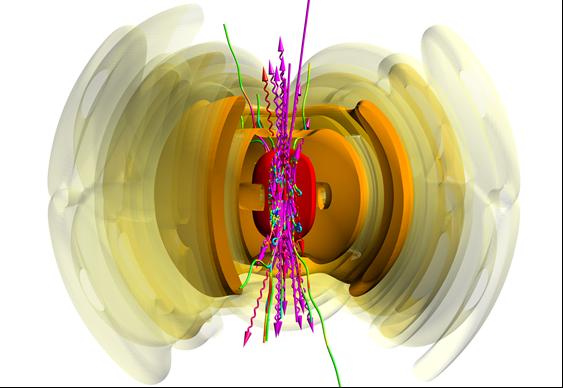
Researchers have found a way of producing gamma rays in a more efficient way than ever before. The energy that’s obtained is around a billion times higher than the energy photons produced within the visible light. This new discovery could pave the way towards a whole new branch of fundamental studies.
“When we exceed the limit of what is currently possible, we can see deeper into the basic elements of nature. We can dive into the deepest part of the atomic nuclei,” says researcher Arkady Gonoskov of The Department of Physics at the Chalmers University of Technology, Sweden.
Results from the study were published in the journal Physical Review X. The effort was a combined effort in collaboration with the Institute of Applied Physics, Lobachevsky University in Russia, and the University of Plymouth in the U.K. Numerical models and analytic estimates for simulating these ultra strong gamma rays were created by computer scientists to help.
Normally, When you shoot a laser pulse at an object, all the particles within it scatter. However, if the laser beam is so intense and all the other parameters are just right, then the particles become trapped and begin to behave in a very strange way. “The cloud of trapped particles efficiently converts the laser energy into cascades of high energy photons – a phenomenon that is very fortunate. It’s an amazing thing that the photons from this source can be of such high energy,” says Mattias Marklund, the professor at the Department of Physics at the Chalmers University of Technology.
This discovery comes at a very good time for future large-scale laser facilities that are being constructed right now. They will begin to house the world’s most intense light sources on the Earth. “Our concept is already part of the experimental program proposed for one such facility: Exawatt Center for Extreme Light Studies in Russia. We still don’t know where these studies will lead us, but we know that there are yet things to be discovered within nuclear physics, for example, new sources of energy. With fundamental studies, you can aim at something and end up discovering something completely different – which is more interesting and important,” said Gonoskov.
Related Coverage
- Brightest Light on Earth Changes the Way of Light and Matter React
- Turning Ordinary Windows into Solar Panels
- Now Quantum Computers Can Send Information Using a Single Particle of Light
- The New Laser Technique Promises Super-Fast and Secure Quantum Cryptography
- Quantum Technology Takes Another Leap Forward by Bending Photons
Don't miss new tech stories on Google
Add TrendinTech once in the Google app and our stories appear in your news suggestions.
Helena Marsh
Helena Marsh is the Editor-in-Chief at TrendinTech, where she leads editorial strategy and oversees coverage across artificial intelligence, cybersecurity and enterprise technology. With more than a decade in technology journalism on both sides of the Atlantic, she previously served as a senior editor at Wired UK and covered the technology sector for The Guardian, following the rise of the big platforms, the Cambridge Analytica scandal and the regulatory push from Brussels and Washington. Helena holds an MA in Journalism from City, University of London and is a regular speaker at Web Summit in Lisbon and CES in Las Vegas. She believes technology reporting should be rigorous and plainly written, so readers understand what actually changes for them rather than what a company's announcement promises.
All stories by Helena Marsh (201)