NEVI EV Chargers Finally Open, 96 Live Nationwide [2026]

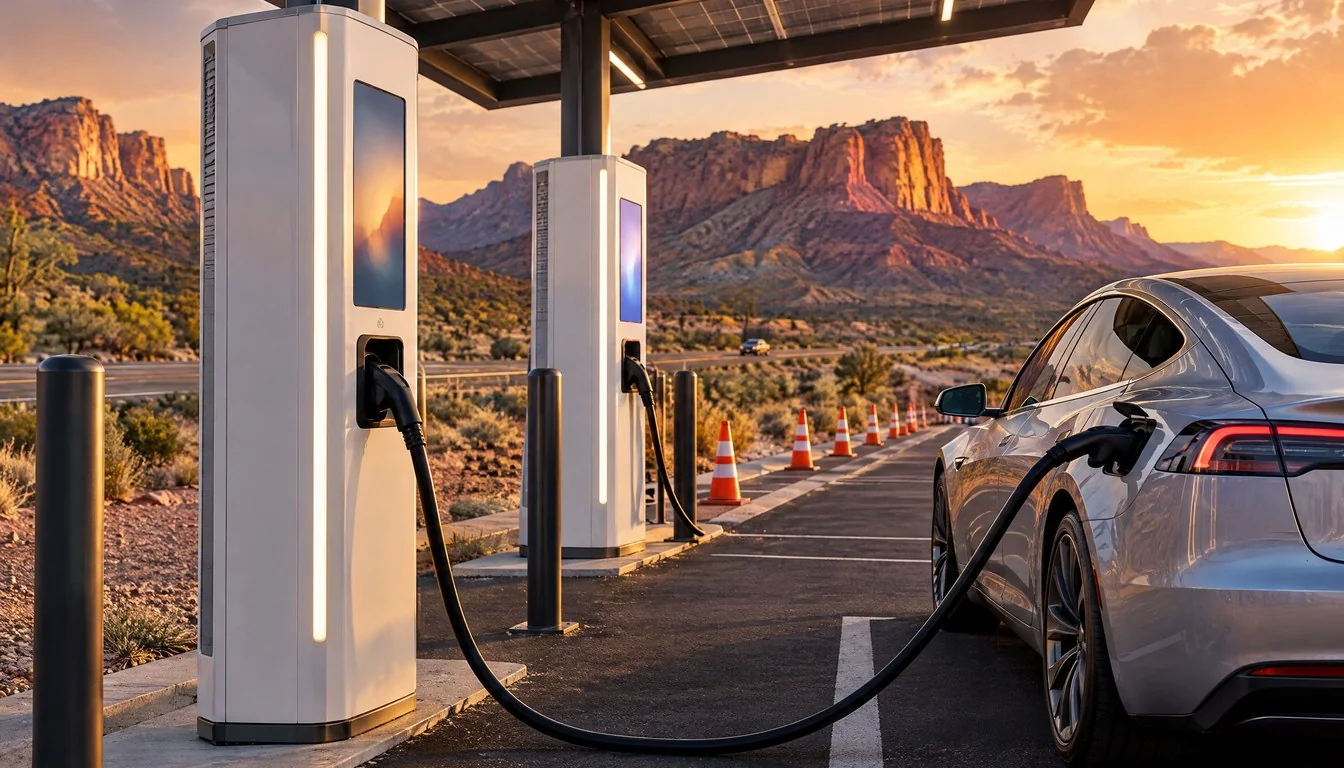
Four and a half years after Congress set aside billions of dollars to blanket American highways with fast chargers, the federal EV charger rollout is finally showing up where drivers can see it. Arizona switched on its first three NEVI-funded stations in mid-October 2026, Texas pushed its open count past 20 sites while committing $226 million to a second wave, and Pennsylvania quietly passed a 50-station milestone in the state’s eastern corridor. The news is real, it is happening state by state, and it caps one of the slowest infrastructure build-outs in recent federal history.
The National Electric Vehicle Infrastructure Formula Program, known as NEVI, was supposed to put fast chargers every 50 miles along designated highway corridors. Instead it became a case study in how federal funding, state procurement rules, utility hookups, and a change in presidential administration can stall a program for years before a single plug goes live. Electrek, GovTech, and public radio stations across the Mountain West have spent 2026 tracking the state-by-state crawl toward functioning stations, and this week’s Arizona and Texas announcements mark the most visible progress yet.
Don't miss new tech stories on Google
Add TrendinTech once in the Google app and our stories appear in your news suggestions.
What the NEVI Program Actually Funds
NEVI was created by the 2021 Infrastructure Investment and Jobs Act, which set aside $7.5 billion over five years for two related efforts: the NEVI Formula Program and the Charging and Fueling Infrastructure program. Of that total, $5 billion was earmarked specifically for NEVI’s highway-corridor fast chargers, the DC fast-charging stations meant to let EV drivers travel long distances without range anxiety. States apply for the money through their departments of transportation, and federal funds can cover up to 80% of eligible project costs, with the applicant covering the rest.
Every NEVI EV charger station has to clear a baseline federal standard before it counts toward a state’s build-out. According to Electric Era, a Seattle-based charging company active in the program, each NEVI-funded charging port must maintain an average annual uptime above 97%. That requirement sounds modest until you remember how many early public chargers nationwide have earned a reputation for broken screens and payment failures. The uptime rule is part of why the program moved cautiously: states and vendors had to prove reliability before stations could open to the public.
Arizona’s First Three NEVI Stations Finally Go Live
Arizona’s rollout is the clearest evidence of how long this has taken. The Wellton station opened on October 14, 2026, according to Arizona public radio, and by October 19 Electrek confirmed all three of Arizona’s first federally funded fast-charging sites were operating, in Tucson, Green Valley, and Wellton. Two of the three, Tucson and Wellton, run on Tesla’s Supercharger network, while Green Valley uses a separate charging provider.
The Tucson and Wellton sites were reported at 325 kilowatts, among the more powerful DC fast chargers deployed under the program so far. Arizona’s broader NEVI plan is built around $76.5 million in federal funding that could support as many as 79 stations statewide, with most sites planned to carry at least four 150-kilowatt DC fast chargers and both Tesla’s NACS connector and the CCS1 standard. Two more Arizona stations, in Seligman and Holbrook, were expected before the end of 2026 but had not been confirmed open as of October 21.
Why Arizona Took This Long
Arizona’s delay traces back to the same federal freeze that slowed NEVI nationwide. The Federal Highway Administration suspended NEVI funding after the Trump administration took office in early 2025, triggering a six-month gap in disbursements and a legal fight with several states. The U.S. Department of Transportation issued new program guidance in August 2025 that restarted the money, and Arizona’s construction on these three sites began in early 2026, roughly nine months before they opened to drivers.
Texas Moves From Delay to the Program’s Biggest Expansion
Texas offers the starkest before-and-after picture in the NEVI program. The Texas Department of Transportation reported 22 Phase I stations open as of mid-October 2026, with five more expected by the end of the year and roughly 30 planned for 2027. On October 15, 2026, TxDOT announced Phase II of its NEVI build-out, awarding $226 million in federal funding for 321 additional charging stations statewide, split between 264 sites in metropolitan planning organization areas and 57 in county seats, extending the network into smaller, more rural communities that Phase I largely skipped.
TxDOT’s own data management director, Michael Chamberlain, inspected open stations in Wichita Falls, Mount Pleasant, Van, Selma, Natalia, Encinal, Three Rivers, and Kerrville in mid-October, along with construction sites underway in Corsicana and Mission. In the San Antonio area alone, 24 Phase II stations are planned: 21 in San Antonio itself, two in Seguin, and one in Hondo, according to the Alamo Area Metropolitan Planning Organization.
Phase II Targets the Gaps Phase I Left Behind
The shift from Phase I to Phase II matters because it signals a maturing program rather than a one-time catch-up. Phase I concentrated on the interstate corridors required for federal certification. Phase II reaches into county seats that never had fast-charging options at all, which is the part of NEVI’s original mission, universal highway coverage, that has been hardest to deliver. Texas says some NEVI funding was lost along the way: the state missed a federal deadline for $84.6 million of its allocation in 2025, even though roughly $323.5 million had already been obligated and was unaffected.
Pennsylvania Quietly Crosses 50 Stations
While Arizona and Texas generated the bigger headlines, Pennsylvania reached a milestone of its own. The Shapiro administration announced its 50th NEVI-funded EV charging station at a Sheetz on Linglestown Road in Harrisburg in September 2026, alongside a separate announcement of $32 million in federal investment for EV chargers across eastern Pennsylvania as part of the program’s Community Charging phase. That phase, like Texas’s Phase II, is designed to extend fast charging beyond the interstate corridors and into the communities around them.
How the Nationwide Numbers Add Up
Zoom out from any single state and the pattern is the same everywhere: slow starts followed by a 2026 acceleration. GovTech reported that nearly five years after NEVI’s creation, fewer than 100 federally funded charging stations had opened nationwide by the end of 2025, a figure widely cited as evidence of the program’s sluggish rollout. The EV States Clearinghouse data project had tracked roughly 4,000 funded charging ports as of August 16, 2025, with only 382 of them actually open to drivers at that point, a gap that shows just how much lag exists between money awarded and chargers plugged in.
| State | Reported Status (October 2026) | Funding Committed | Notes |
|---|---|---|---|
| Arizona | First 3 NEVI stations open (Tucson, Green Valley, Wellton) | $76.5 million for up to 79 stations | 2 of 3 sites run on Tesla Superchargers |
| Texas | 22 Phase I stations open, 5 more due by year-end | $226 million Phase II award for 321 stations | Phase II reaches 57 county seats |
| Pennsylvania | 50th NEVI station opened (Harrisburg Sheetz) | $32 million for eastern PA Community Charging | Part of statewide Community Charging phase |
| Maryland | 7 NEVI sites open to the public | Third funding round open for up to 9 more projects | 70 funded ports public, 104 more coming |
| Wisconsin | 21 operational stations | Roughly $37 million awarded for 78 projects | Another application round under review |
| Oregon | Round 2 developers selected | 24 planned DC fast-charging stations, 126 ports | 7 companies selected in Round 2 |
| Wyoming | Still soliciting first NEVI proposals | Funds received in 2022, unused as of October 2026 | Applications due November 18, 2026 |
The Freeze That Stalled Everything
The single biggest reason NEVI took this long traces back to a change in federal leadership. After the Trump administration took office in early 2025, the Federal Highway Administration suspended NEVI funding and rescinded earlier program guidance, freezing money that states had already begun to plan around. NPR reported that the administration reopened the program in August 2025, releasing new guidance after a six-month freeze and a legal battle with states that had sued to unlock the funds. That guidance gave states more flexibility on where stations could be sited while keeping the program’s core reliability standards in place.
The freeze did lasting damage to the program’s funding pool even after it reopened. The Congressional Research Service reported that a February 2026 appropriations law transferred $503.756 million in unobligated NEVI formula funds to other highway programs, permanently shrinking the pot available for future stations. CRS also noted that fiscal year 2026 was announced as the final year of NEVI formula funding, meaning the program is now working through its last tranche of money rather than expecting a renewal.
Tesla’s Role Inside a Federal Program
One of the more notable details in Arizona’s rollout is how much of it runs through Tesla’s charging network rather than a dedicated NEVI-only brand. Tesla Superchargers now operate two of Arizona’s first three federally funded stations, using NACS, Tesla’s North American Charging Standard, alongside the CCS1 connector that non-Tesla vehicles rely on. That overlap reflects a broader trend: Tesla’s charging network has grown large enough, and open enough to non-Tesla vehicles through automaker agreements and compatible adapters, that state transportation departments increasingly treat it as one of several qualified vendors competing for NEVI contracts rather than a separate, closed system.
That dynamic puts Tesla in competition with purpose-built NEVI vendors for the same pool of state contracts, even as the company’s broader charging business keeps expanding on its own. Readers tracking Tesla’s EV momentum more broadly can see the scale difference: Tesla’s Model Y outsold the next 24 EV nameplates combined in Q3 2026, and the company’s energy-storage business set its own records with Tesla Powerwalls hitting a 601 MW virtual power plant milestone. NEVI contracts are a small slice of that footprint, but they put Tesla’s charging hardware directly inside a federal infrastructure program for the first time at meaningful scale.
The Private Vendors Filling in the Gaps
Tesla is far from the only company building NEVI-funded stations. Electric Era, the Seattle company founded in 2020, says it now operates more than 30 active deployments and has helped partners secure nearly $25 million in NEVI funding across eight states. In October 2026 alone, the company announced six new charging locations at United Dairy Farmers stores in Ohio, added its station network to Rivian’s native vehicle navigation system, and won a share of a $12.16 million Washington State award covering 14 highway sites and 96 fast-charging ports.
Electric Era’s pitch to states centers on battery-backed charging hardware paired with grid-power management software, a combination the company says lets it open stations on limited grid connections without waiting years for a utility upgrade. The software layer behind these deployments, the uptime monitoring systems, grid-management tools, and vehicle-navigation integrations that let a Rivian driver see a charger’s real-time status, has become as important to NEVI’s rollout as the physical hardware. It’s the kind of infrastructure work that increasingly overlaps with the broader software industry rather than sitting purely in utilities or construction.
NEVI by the Numbers
| Metric | Figure | Source / Date |
|---|---|---|
| Total IIJA funding for NEVI + CFI combined | $7.5 billion over 5 years | Infrastructure Investment and Jobs Act, 2021 |
| NEVI highway-corridor funding specifically | $5 billion | Congressional Research Service |
| Charging ports funded nationwide | ~4,000 | EV States Clearinghouse, Aug. 16, 2025 |
| Of those, actually open to drivers | 382 ports | EV States Clearinghouse, Aug. 16, 2025 |
| NEVI-funded stations open nationwide | 96 stations | GovTech, end of 2025 |
| Federal cost share per eligible project | Up to 80% | NEVI program rules |
| Minimum required port uptime | Above 97% annually | Electric Era / NEVI program standard |
| Unobligated NEVI funds shifted to other highway programs | $503.756 million | Congressional Research Service, Feb. 2026 appropriations law |
| Texas Phase II award, October 2026 | $226 million for 321 stations | TxDOT, Oct. 15, 2026 |
What the Research Shows About the Program’s Pace
Outside researchers have tracked NEVI’s crawl toward functioning stations for years, and their numbers help explain why this month’s openings feel like news even though the program is well into its fifth year. The Congressional Research Service found that by the end of 2024, just 12 states had installed a combined 44 public charging stations using NEVI funds, a figure that undercuts any sense that the program was moving at normal infrastructure speed. By February 10, 2025, CRS estimated that figure had grown to roughly 57 NEVI-funded stations open across 15 states, with states having awarded or obligated $527 million in NEVI funding by February 6, 2025, far more money committed than chargers actually built.
The Pew Research Center’s description of the program’s original design highlights the gap between intent and delivery: NEVI was built to provide $5 billion over five years to states specifically to deploy fast-charging stations roughly every 50 miles along designated highways, a density standard meant to eliminate range anxiety on long trips. CRS separately cited an estimate from the International Council on Clean Transportation that NEVI could ultimately fund at least 33,000 charging ports nationwide, a target that puts the current count of a few hundred open ports in sharp perspective.
Historical Context: How a Five-Year Program Became a Four-Year Wait
NEVI’s timeline is unusual even by the standards of federal infrastructure programs. The 2021 Infrastructure Investment and Jobs Act created the funding stream and gave states a formula allocation almost immediately, but each state still had to write and get federal approval for its own EV infrastructure deployment plan, run a competitive bidding process for vendors, secure utility interconnections, and build to federal reliability standards before a single charger could open. That multi-year sequence was already slow by design. The 2025 funding freeze added a six-month gap on top of it, and the shift to a new administration’s priorities, including the Department of Transportation’s September 2026 “Freedom Means Affordable Cars” initiative aimed at ending what the agency called the federal EV mandate, introduced political uncertainty that further discouraged some states from moving quickly.
Wyoming is the clearest illustration of how badly that uncertainty set some states back. The state received its NEVI funding allocation back in 2022 and, as of October 2026, is only now opening its first solicitation for proposals, with applications due November 18, 2026. That is a four-year gap between receiving federal money and asking vendors to bid on building anything with it.
Market Impact for Charging Companies and EV Buyers
For charging-hardware companies, NEVI’s 2026 acceleration is turning into real contract volume after years of planning work with no construction to show for it. Electric Era, Tesla, and other vendors are now competing for state awards that are actually translating into signed contracts and, increasingly, open stations. For EV owners, the practical impact remains limited so far: 96 stations nationwide by the end of 2025, growing to a larger but still modest total through 2026’s state-by-state openings, is a small fraction of the roughly 33,000 ports NEVI was originally projected to support. Most long-distance EV charging infrastructure built in the past few years has come from private investment, including Tesla’s own Supercharger expansion, rather than from NEVI directly.
The program’s slow pace has also shaped how EV route-planning tools treat federal infrastructure. Mapping and navigation features built into vehicles and apps, including the kind of long-distance EV route planning covered in Android Auto’s recent expansion to more than 350 EV models, still lean heavily on private charging networks for reliable long-trip routing, with NEVI stations folded in as they come online rather than treated as the backbone of the system.
Competitive Field: NEVI, Private Networks, and Automaker Charging
NEVI does not operate in isolation. It sits alongside a much larger private charging buildout that has outpaced it in raw station count, and alongside automaker-backed charging investments like Honda’s push into smart charging for its own EV lineup, discussed in coverage of the Honda Super-ONE EV’s $36,900 price point and charging strategy. The difference is that private and automaker-backed charging investments move at the pace of corporate decision-making, while NEVI moves at the pace of federal procurement, state bidding rules, and, as 2025 demonstrated, changes in presidential administration.
That makes NEVI’s 2026 momentum notable less for its total station count, which still trails private deployment by a wide margin, and more for what it signals about the program’s durability. Despite the freeze, the leadership change, and the loss of more than half a billion dollars in unobligated formula funds, NEVI continued to award money and open stations through October 2026 rather than quietly dying. Texas’s $226 million Phase II award is the clearest evidence that the program still has enough institutional momentum, and enough leftover money, to keep expanding through its final funded year.
Predictions: Where NEVI Goes From Here
- More states will report their first open NEVI stations before the end of 2026, following Arizona’s pattern of a single high-visibility opening after years of planning.
- Texas’s 321-station Phase II award will likely become the template other large states point to when asking for new funding rounds, since it demonstrates money can still move even in NEVI’s final formula-funding year.
- Tesla’s share of NEVI-branded sites will keep growing as more states lean on NACS-compatible Superchargers to hit uptime requirements quickly, rather than waiting on newer vendors to prove reliability.
- Laggard states like Wyoming will face continued scrutiny from local outlets over unused allocations, and some may see Congress or state legislatures attempt to claw back or reassign unspent funds.
- With fiscal year 2026 marked as NEVI’s final formula-funding year, expect a wave of use-it-or-lose-it station announcements in late 2026 and early 2027 as states rush to obligate remaining dollars before the funding window closes.
Frequently Asked Questions
What is the NEVI program?
The National Electric Vehicle Infrastructure Formula Program is a federal initiative created by the 2021 Infrastructure Investment and Jobs Act. It provides $5 billion over five years, out of a combined $7.5 billion with the related Charging and Fueling Infrastructure program, to help states build DC fast-charging stations along designated highway corridors.
Why did NEVI EV chargers take so long to open?
States had to write and get approval for deployment plans, run competitive vendor bidding, secure utility hookups, and meet federal reliability standards before any station could open. A federal funding freeze after the Trump administration took office in early 2025 added roughly six more months of delay before the Department of Transportation issued new guidance in August 2025.
How many NEVI-funded stations are open as of October 2026?
GovTech reported 96 NEVI-funded stations open nationwide by the end of 2025. Since then, states including Arizona, Texas, Pennsylvania, Maryland, and Wisconsin have added more stations through individual October 2026 announcements, though a single updated nationwide total has not been published.
Are Tesla Superchargers part of the NEVI program?
Yes, in some states. Two of Arizona’s first three NEVI-funded stations, in Tucson and Wellton, operate on Tesla’s Supercharger network using the NACS connector alongside CCS1 support for non-Tesla vehicles.
What happened to NEVI funding under the Trump administration?
The Federal Highway Administration suspended NEVI funding after the administration took office in early 2025, freezing money for about six months amid a legal dispute with states. New program guidance was issued in August 2025, restarting disbursements, though a February 2026 appropriations law later shifted $503.756 million in unobligated NEVI formula funds to other highway programs.
Which states have opened NEVI charging stations so far?
Arizona, Texas, Pennsylvania, Maryland, and Wisconsin have all reported open NEVI-funded stations as of October 2026. Oregon has selected vendors for its next funding round, while Wyoming has only recently opened its first solicitation for proposals after receiving funds in 2022.
What is Texas’s Phase II NEVI award?
On October 15, 2026, the Texas Department of Transportation announced $226 million in federal funding for 321 additional charging stations, with 264 planned in metropolitan planning organization areas and 57 in county seats.
Is the NEVI program ending?
The Congressional Research Service has identified fiscal year 2026 as the final year of NEVI formula funding being made available for obligation, which means states are now working through their last allocated tranche rather than expecting a program renewal, even as new stations continue opening.
Related Coverage
Helena Marsh
Helena Marsh is the Editor-in-Chief at TrendinTech, where she leads editorial strategy and oversees coverage across artificial intelligence, cybersecurity and enterprise technology. She believes technology reporting should be rigorous and plainly written, so readers understand what actually changes for them rather than what a company's announcement promises.
All stories by Helena Marsh (284)