
NASA is Developing Nuclear Reactors that Would Operate on the Planet Mars
The power for future human settlements on Mars could very well be nuclear. An operating source of power is required for providing air, fuel, and water for settlers. Currently, NASA is developing a $15 million project to make nuclear fission reactors that would operate on the planet Mars.

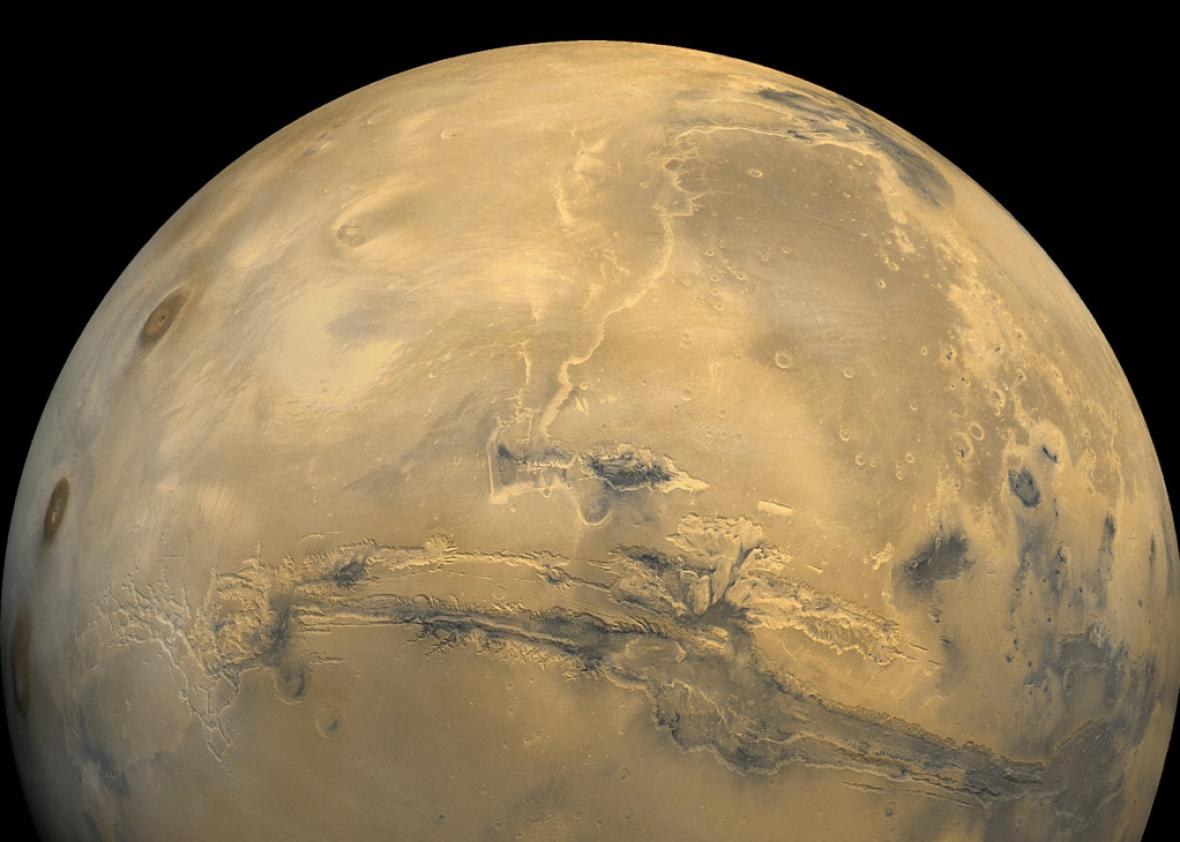
The power for future human settlements on Mars could very well be nuclear. An operating source of power is required for providing air, fuel, and water for settlers. Currently, NASA is developing a $15 million project to make nuclear fission reactors that would operate on the planet Mars. Already they’ve built a number of 6.5ft reactors that are scheduled to begin testing on Earth soon.
The reactors split atoms, specifically uranium atoms, in order to produce power. If the tests are successful, the generators will be sent to Mars for further testing. In addition to the air, fuel, and water a human settlement would need, it would also require power to create electricity for vehicles and scientific equipment as well as light and heat.
The reactors NASA is testing produce up to 10 kilowatts of electricity, which is enough to sustain a mission to Mars crew of two people, based on estimates made in 2008 by NASA for an 8 person crew requiring 40 kilowatts.
Other nuclear reactors have been tested in space previously.
In the 1960s, the NASA program SNAP, or Systems for Nuclear Auxiliary Power, developed the radioisotope thermoelectric generator, or RTG. The generator contains a chunk of plutonium-238 that radiates heat and power as it decays. RTGs are still in use today in both the Curiosity rover and the Cassini probe.
However, as Lee Mason, the oversees the development of power and energy storage tech at NASA’s Glenn Research Center, there hasn’t been much opportunity since then for these types of tests: “ It’s the first time we operate a fission reactor that could be used in space since the 1960s SNAP program.”
Creating a functional power source for the Mars missions will be an essential component if they are to be successful. Nuclear fission is the natural choice as solar panels would be ineffective given Mars’ well-known dust storms as well as the red planet’s distance from the Sun.
“We’ve landed some really cool things on Mars and they’ve had some pretty remarkable power systems … but they’re not going to cut it for human missions,” said Mason during Humans to Mars Summit held last month in Washington, D.C.
More News to Read
- AI Chatbots are Create New Jobs by Killing the Old Ones
- Top 5 Artificial Intelligence Chatbots to Help You Find Your Next Job
- AI Detects Abnormal Heart Rhythm Using the Apple Watch’s Heart Rate Sensor
- Google on the Edge of Quantum Breakthrough – ” Quantum Supremacy “
- Although the Apple 2017 iMac is brighter and more powerful, is it the right one For You?
Related Coverage
- Is 100% Renewable Energy Possible For Our World By 2050?
- Nuclear Power – is it to be the ‘Next Big Thing’?
- Toronto’s Electric grid Back up is at the bottom of Lake Ontario.
- We Could colonise The Moon With Using a Steam Powered Spacecraft
- Japan Turning Its Back On Nuclear Energy
Don't miss new tech stories on Google
Add TrendinTech once in the Google app and our stories appear in your news suggestions.
Owen Castellanos
Owen Castellanos is the Hardware & Gaming Reporter at TrendinTech, where he tests graphics cards, processors, consoles and peripherals and follows the games industry, from the major publishers to independent studios. He previously wrote reviews and benchmarks for Tom's Hardware and contributed features to PC Gamer, covering everything from laptop testing to the economics of game development. Owen holds a Bachelor of Science in Electrical Engineering from the University of Texas at Austin and attends CES in Las Vegas, Computex in Taipei and the Game Developers Conference in San Francisco each year to meet chipmakers and developers. He writes for readers who want to know whether a product is worth the money, and he is not shy about saying when it is not.
All stories by Owen Castellanos (252)