
Mars Base Camp Plans Underway for NASA
We could be seeing a whole new space station orbiting around Mars by as early as 2028 if NASA gets their way. Plans are underway by NASA that involves astronauts living on the space station for around a year to gather data in preparation for the first manned landing.

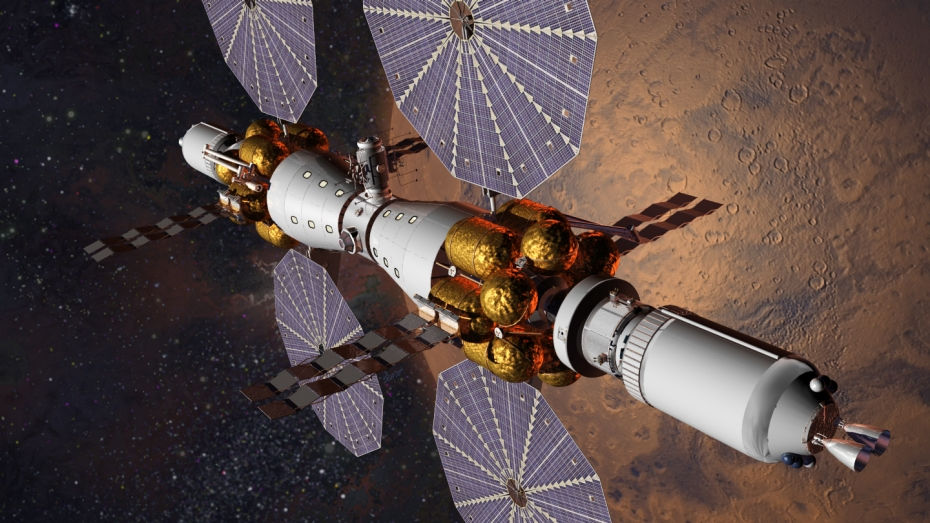
We could be seeing a whole new space station orbiting around Mars by as early as 2028 if NASA gets their way. Plans are underway by NASA that involves astronauts living on the space station for around a year to gather data in preparation for the first manned landing. This will allow scientists to study the planet in more detail before risking the risking the life of many people.
Lockheed Martin has created plans to construct a 132-ton space station that will orbit around Mars. It’s designed to carry six astronauts at a time that would be responsible for analyzing dirt and rock samples and possibly even traveling to Mars’ two moons. The first team of astronauts would occupy the space station for around a year, but is unclear whether a second team will then follow.
NASA’s rocket has just passed its final testing phase in June this year and is intended to transport astronauts to Mars in 2030, after first completing its crewless mission in 2018. According to a study carried out at NASA’s Johnson Space Center, America is much more equipped to visit Mars now than they were visiting the Moon in the 1960’s. The estimated costs involved in planning to send Americans to Mars will be around $35 billion by 2025.
Exploring space never comes cheap and even back in 1989, George H.W. Bush’s Space Exploration Initiative plans were estimated to cost around $400 billion over a period of 20 to 30 years. Unfortunately, the program never took off, but if it had, it would have been the single most expensive government undertaking since World War II. And, in 2004, George W. Bush’s Vision for Space Exploration would have cost $230 billion. In comparison, the Apollo program would have only cost around $170 billion if calculated on the same terms. But, Mars is not the Moon, and if it is all in the name of safety, then surely it can’t be a bad thing, can it?
More News To Read
- New Handwriting Algorithm Replicates Writing
- Air Ink – Turning Pollution into Ink
- Things Every Electric Vehicle’s Buyers Should Know
- How the Fourth Industrial Revolution is Affecting Fashion
Related Coverage
- First Stop: the Moon, Second Stop: Mars
- The Race for Space Colonization Starts with NASA’s Lunar Station Plans
- SpaceX Will be the Uber of the Space Travel
- Is it Really Possible to Create a Livable Atmosphere Up on the Moon?
- SpaceX ‘City on Mars’ Will Be Announced in Mexico
Don't miss new tech stories on Google
Add TrendinTech once in the Google app and our stories appear in your news suggestions.
Daniel Okafor
Daniel Okafor is the Senior AI Reporter at TrendinTech, where he covers large language models, machine learning research and the practical use of artificial intelligence across business and government. He previously reported on artificial intelligence for MIT Technology Review, covering the labs behind the current generation of frontier models and the policy debates in Washington and Brussels. Daniel holds a Master of Science in Machine Learning from Carnegie Mellon University and follows the research community closely, attending NeurIPS and ICML each year to speak with the people behind the papers. He has a particular interest in evaluation: how models are benchmarked, where those benchmarks fail and what that means for the companies betting on them.
All stories by Daniel Okafor (316)