

Fast Custom Made Robots Made in a Number of Minutes
It sounds too good to be true, doesn’t it? I mean is it really possible to make a fully functional robot in a number of minutes? Well, the answer is yes, it is.

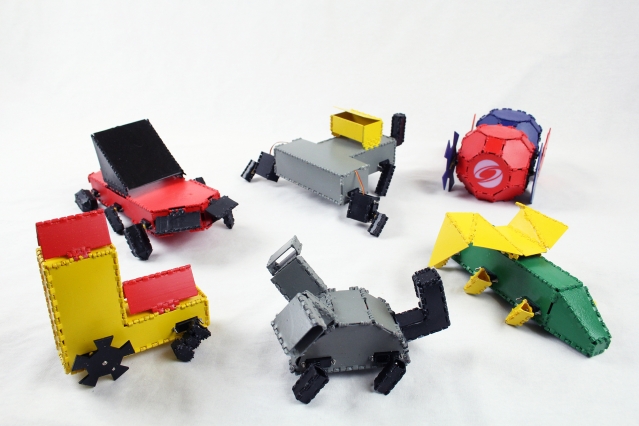
It sounds too good to be true, doesn’t it? I mean is it really possible to make a fully functional robot in a number of minutes? Well, the answer is yes, it is. There are many a robot out there that have taken a lot longer to design and build, but was it really necessary? Researchers from MIT’s Computer Science and Artificial Intelligence Laboratory (CSAIL) would probably say no as right now they’re perfecting a system called “Interactive Robogami” that enables the user to design, 3D print, and assemble their very own robot in less than four hours.
There are many fantastic features of this system, one of which is the fact that it allows designers to set both the robot‘s shape and movement, which is something that’s often separated in design systems. Adriana Schulz is the co-lead author of the study and a Ph.D. student. “Designing robots usually requires expertise that only mechanical engineers and roboticists have,” she says. “What’s exciting here is that we’ve created a tool that allows a casual user to design their own robot by giving them this expert knowledge.”
We’ve seen a massive boom in 3D printing since it was first introduced to the public. It has transformed the world as we know it in many ways, including giving people the freedom to move away from the idea that everything must be purchased, and start making things for themselves. Despite its popularity, current tools available now still have many limitations to them. Interactive Robogami however, is different. It aims to be more intuitive by using interactive feedback and simulations to allow the user to focus on high-level conceptual designs. There are over 50 different bodies, legs, wheels, and other parts available to choose from in the library and the system will actually guarantee if or not your robot’s design will even work. It will look at things like speed and stability and make suggestions if it thinks your design is flawed in any way.
When you’ve finished designing your robot it then sets to work fabricating it. The technique in which it uses to do this involves printing the design as flat faces connected at joints, then folding it into its final shape. This method combines the best of 2D printing and 3D printing. In testing the system, the team used eight subjects who were allowed 20 minutes of training before being asked to complete two tasks. The first task involved creating a mobile, stable car design in less than 10 minutes while the second involved creating a trajectory to navigate a robot design through an obstacle course as quickly as possible.
Together the team made six robots in total. Each robot took around 10 to 15 minutes to design, another three to seven hours to print depending on the complexity of the design, and then another 30 to 90 minutes to assemble. The team managed to cut printing time down by around 73 percent by using their 3D print-and-fold method. They used around 70 percent fewer materials too because of it. Co-leader on the paper was Ph.D. graduate Cynthia Sung and she says, “It’s lowering the barrier to have everyone design and create their own robots.”
While the current version of Interactive Robogami focuses on those robots that walk, the team are hoping to explore avenues that include robots taking flight too. “This tool enables rapid exploration of dynamic robots at an early stage in the design process,” says Moritz Bacher, a research scientist and head of computational design and manufacturing at Disney Research. “The expert defines the building blocks, with constraints and composition rules, and paves the way for non-experts to make complex robotic systems.”
More News to Read
- MAG-LEV Audio: Futuristic Technology Meets an old Format
- New Grant Allocated to Imperial College Professor to Research Incurable Lung Disease
- Larger Artificial Cell Membrane Help Scientists Observe Proteins
- Meet Compectus – the World’s First Rollable Keyboard
- Is Graphene the Key to Making Low-Cost Disease Diagnostic Systems?
Related Coverage
- Do Robots Make Good Teachers?
- Another Important Job For Drones; Blood Delivery
- Turning a Tesla Into a Brain-Controlled Vehicle
- This Mechanical Jellyfish Harvests Tons Of Energy From The Ocean
- 3D Pizza Printing Has Arrived Thanks to NASA
Don't miss new tech stories on Google
Add TrendinTech once in the Google app and our stories appear in your news suggestions.
Daniel Okafor
Daniel Okafor is the Senior AI Reporter at TrendinTech, where he covers large language models, machine learning research and the practical use of artificial intelligence across business and government. He previously reported on artificial intelligence for MIT Technology Review, covering the labs behind the current generation of frontier models and the policy debates in Washington and Brussels. Daniel holds a Master of Science in Machine Learning from Carnegie Mellon University and follows the research community closely, attending NeurIPS and ICML each year to speak with the people behind the papers. He has a particular interest in evaluation: how models are benchmarked, where those benchmarks fail and what that means for the companies betting on them.
All stories by Daniel Okafor (316)